
Trees
In this collection
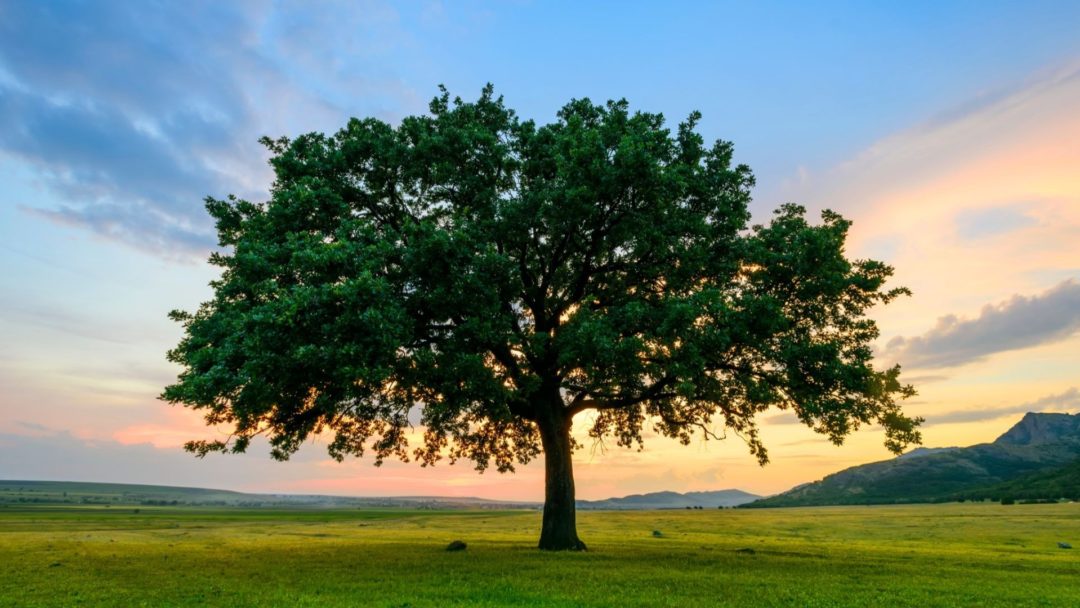
Trees are wonderful, life-giving, magical, legendary, spooky, and just plain interesting. Think of the Ents from The Lord of the Ring, the dryads of Narnia, Robin Hood’s Sherwood Forest, Harry Potter’s Whomping Willow, and Bilbo Baggins’s Party Tree.
See below for the science of trees, tree stories, tree poems, tree art projects, mathematical trees, tree houses, and more.
Celebrate Trees!

National Arbor Day usually falls on the last Friday in April - but some states base Arbor Day on their best tree-planting times. See Arbor Day Around the Globe at https://www.arborday.org/celebrate/globe to see when your state and countries around the world celebrate Arbor Day.
Visit the Arbor Day Foundation website for affordable trees, an informational tree guide, resources for connecting kids with nature, forest replanting programs, a history of the holiday, and more.

In Kathryn Galbraith’s Arbor Day Square (Peachtree Publishers, 2010), a small Nebraska prairie town has houses and barns, a store, a church, and a school with desks for seventeen children – but no trees. The townspeople, among them Katie and her father, raise money to order 15 saplings from back East and plant them in the town square. Time passes and the trees grow bigger and taller; Katie grows up, marries, and has a little daughter – who helps her grandfather plant new trees. An appendix explains the origin of Arbor Day, first celebrated in Nebraska in 1872. For ages 4-8.
As of 2013, the United Nations declared March 21 to be the International Day of Forests. From the Huffington Post, see background information and a photo-illustrated list of 21 Reasons to Celebrate the Value of Trees.
Tree Planters
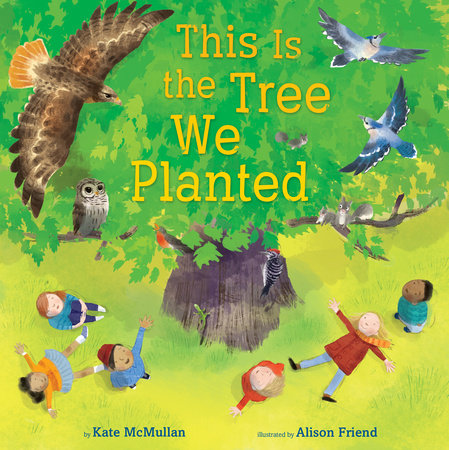
In Kate McMullan’s This Is the Tree We Planted (Knopf, 2022) a group of kids gather around the planting of a tree – and then watch as it acquires an entire ecosystem: a robin with a nest of eggs, a squirrel and her kits, a hovering hawk chased by jays, a lizard tracking a spider. A rhythmic repetitive text will appeal to ages 2-5.

Jerry Palotta’s Who Will Plant a Tree? (Sleeping Bear Press, 2010) is a picture-book account of a lot of surprising tree-planters, among them squirrels, bears, geese, ants, and dolphins. For ages 3-8.

In Mary Ann Rodman’s A Tree for Emmy (Peachtree Publishers, 2009), Emmy wants her own pink-flowered mimosa tree like the one that grows in her grandmother’s yard – and that Gramma claims is a lot like Emmy herself, “stubborn and strong and a little bit wild.” To her dismay, no garden store sells mimosa trees – but finally she finds the solution: a little sapling to transplant and nurture on her own. For ages 4-8.

By Jeanette Winter, Wangari’s Trees of Peace (Houghton Mifflin Harcourt, 2008) is a picture-book biography of Kenyan environmentalist Wangari Maathai, who won the Nobel Peace Prize for her tree-planting program. For ages 4-8.

By H. Joseph Hopkins, The Tree Lady (Beach Lane Books, 2013) is the picture-book story of tree-loving activist Kate Sessions, who grew up in California in the 1860s, went to college to study science, and finally moved to the desert town of San Diego, where she established a nursery and populated the town and surrounding area with trees. A great story about a little-known heroine for ages 5-8.

Jean Giono’s The Man Who Planted Trees (Chelsea Green, 2007) is the story of Elzeard Bouffier who spent his life planting one hundred acorns a day – through both World Wars I and II – in a desolate stretch of southern France, eventually transforming the region into a green woodland. A hopeful account of one person making a great difference for ages 12 and up.
Read The Man Who Planted Trees online.
Be a tree planter too! Neighborhood Forest at https://www.neighborhoodforest.org/ gives free trees and plants to kids.
All About Trees

Christie Matheson’s Tap the Magic Tree (Greenwillow, 2013) is a fun interactive read in which kids are first told to tap a picture of a bare brown tree and turn the page – and a green leaf appears. Readers tap, pat, rub, “blow a whooshing breeze,” shake, and close their eyes and count to ten and, as they do, the tree moves through the seasons, hosting a bird nest, sprouting flowers and ripening apples, until apples and leaves fall, and the bare tree is covered in snow. For ages 3-6.

Janice May Urdry’s Caldecott-winning A Tree is Nice (HarperCollins, 1987) is a gentle picture-book account of all the wonderful things about trees – they fill up the sky, provide shade from the sun, houses for birds, and escape routes for cats. Kids can rake their leaves, climb them, swing from their branches, picnic at their feet. A charmer for ages 3-8.

Joseph Anthony’s In a Nutshell (Dawn Publications, 1999) follows the life cycle of an oak tree, beginning with the fall of one plump little acorn, who lands on the forest floor and begins its struggle to get back to the sun. For ages 3-8.

By Clyde Robert Bulla, A Tree Is a Plant (HarperCollins, 2001) in the Let’s-Read-and-Find-Out Science series is a simple introduction to trees (“the biggest plant that grows”) for ages 4-7.

In Zoe Hall’s The Apple Pie Tree (Blue Sky Press, 1996) two little girls watch their backyard apple tree through the seasons of the year, from leafless winter to the buds and blossoms of spring when robins arrive to build a nest, to ripening fruit in summer – and finally, in fall, harvest and an apple pie. For ages 4-7.

In Gail Gibbons’s The Seasons of Arnold’s Apple Tree (Sandpiper, 1998), the apple tree is Arnold’s special secret place. He builds a snow fort around it and hangs strings of popcorn on its branches for the birds in winter; in spring, he builds a swing; in summer, a treehouse; and in the fall he rakes leaves and picks apples. Included is a recipe for apple pie and an explanation of cider-making. For ages 4-7.

Carol Reed-Jones’s The Tree in the Ancient Forest (Dawn Publications, 1995) is a cumulative environmental rhyme in the style of “This is the House That Jack Built,” that draws in all plants, animals, and features of the ancient forest. For ages 4-8.

Lois Ehlert’s Red Leaf, Yellow Leaf (Houghton Mifflin Harcourt, 1991) is the simple story of a sugar maple from seed to sapling to tree, illustrated with colorful collages that incorporate real maples leaves and seeds. Included are instructions for planting a tree and making bird treats. For ages 4-8.

Gail Gibbon’s Tell Me, Tree is a brightly illustrated introduction to trees covering the parts of trees, types of trees, tree shapes, seeds, bark, and fruit, and uses of trees. Included are attractive labeled diagrams, lots of tree facts, and helpful suggestions for making a personal tree identification book. For ages 4-8.

In Barbara Brenner’s One Small Place in a Tree (HarperCollins, 2004), the “small place” is a hole in a tree, first scratched out by a bear, then hollowed by timber beetles. As the hole grows larger, it hosts animal after animal – salamanders, white-footed mice, bluebirds, squirrels, and snakes. For ages 4-8, who will then want to go look for holes in trees.

Pam Marshall’s From Tree to Paper (Lerner Classroom, 2013), one of the extensive Start to Finish series, describes the process of papermaking in simple large print, illustrated with color photographs. For ages 4-8.
Paper Making Science Project has detailed instructions for making your own recycled paper. (You start with paper scraps, not a tree.)
Also see How to make and recycle paper from the Instructables website.
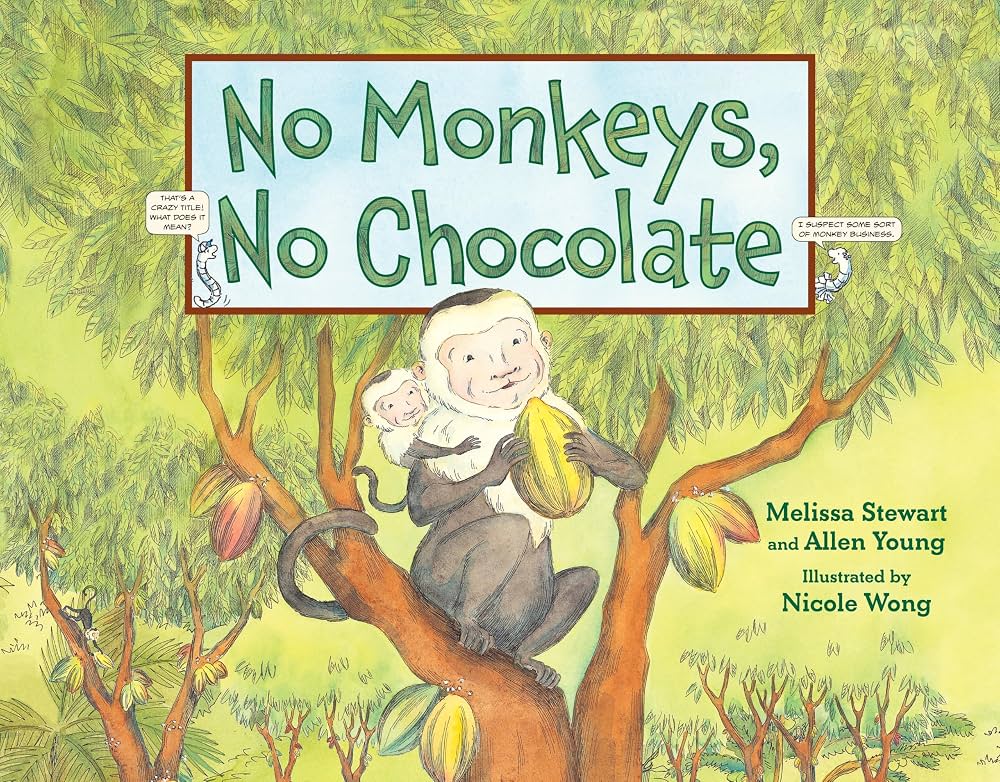
Melissa Stewart’s No Monkeys, No Chocolate (Charlesbridge, 2018) – with the help of a pair of bookworms - explains that chocolate comes from tropical rainforest cocoa trees that couldn’t survive without a host of creatures that make up the forest ecosystem. For ages 5-8.
For more on chocolate and the chocolate tree, see Robert Burleigh’s nonfiction Chocolate: Riches from the Rainforest (Harry N. Abrams, 2002). For ages 8-11.


Debbie Miller’s Are Trees Alive? (Walker Children’s Books, 2003) – inspired by a question asked by her young daughter – explains how trees are remarkably like people: they breathe, eat, and drink; the veins in their leaves are much like those in people’s hands; and their bark is the equivalent of skin. The book also takes readers on a tour of unusual trees around the world, among them the baobab, banyan, cocoa tree, weeping willow, paper birch, and sugar maple. For ages 5-8.
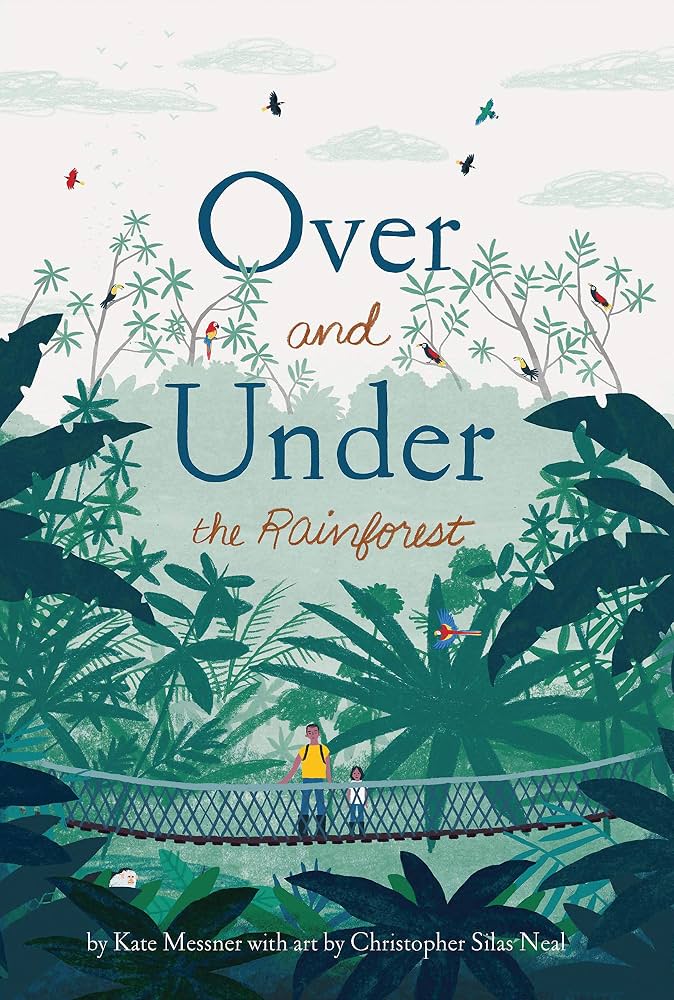
Kate Messner’s Over and Under the Rainforest (Chronicle Books, 2020) in the Over and Under series takes readers from the toucans in the rainforest canopy to the life that thrives beneath the ground. For ages 5-8.
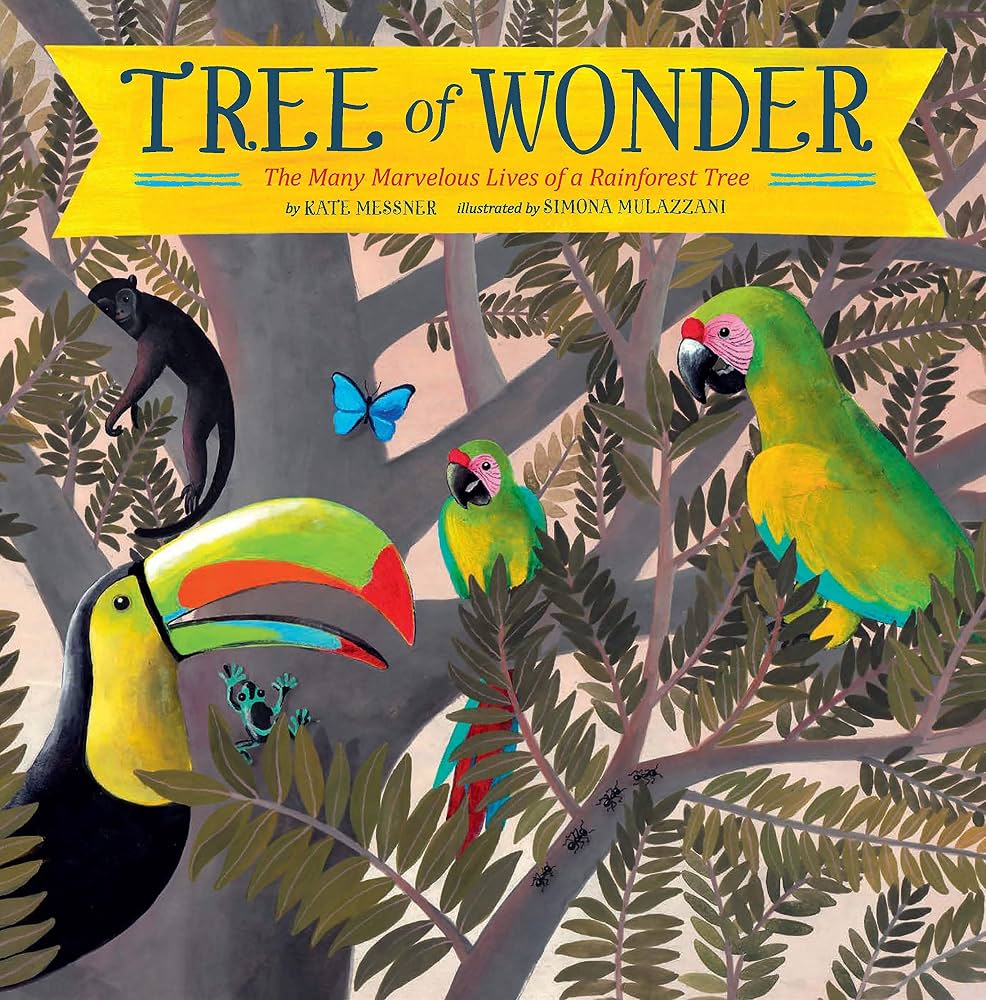
Tree of Wonder by Kate Messner (Chronicle Books, 2020) is an introduction to the biodiversity of the rainforest biome through a mix of science and math – via a marvelous tree that is home, among others, to two great green macaws, four toucans, eight howler monkeys, and 1,024 leafcutter ants. For ages 5-8.

Patricia Lauber’s Be a Friend to Trees (HarperCollins, 1994) in the Let’s-Read-and-Find-Out Science series explains why trees are important, providing food (fruit, nuts, chocolate), shelter, homes for animals, and – by way of photosynthesis – oxygen, which we all need to breathe. Associated activities include planting a tree and recycling paper. For ages 5-8.

In Betsy Maestro’s Why Do Leaves Change Color? (HarperCollins, 1994) in the Let’s-Read-and-Find-Out Science series, readers learn about the many different shapes of leaves (How many can you find?) and the process of fall color change, starting with chlorophyll and a cross-sectional diagram of a leaf. Included are instructions for making leaf rubbings and a pressed leaf collection. For ages 5-9.

Diane Burns’s Trees, Leaves, and Bark (Cooper Square Publishing, 1995) is one of the “Take Along Guides” for young naturalists. The book introduces kids to 16 different trees and suggests a handful of activities: make a pinecone “snackbar” for birds and a bark rubbing, for example. For ages 5-10.
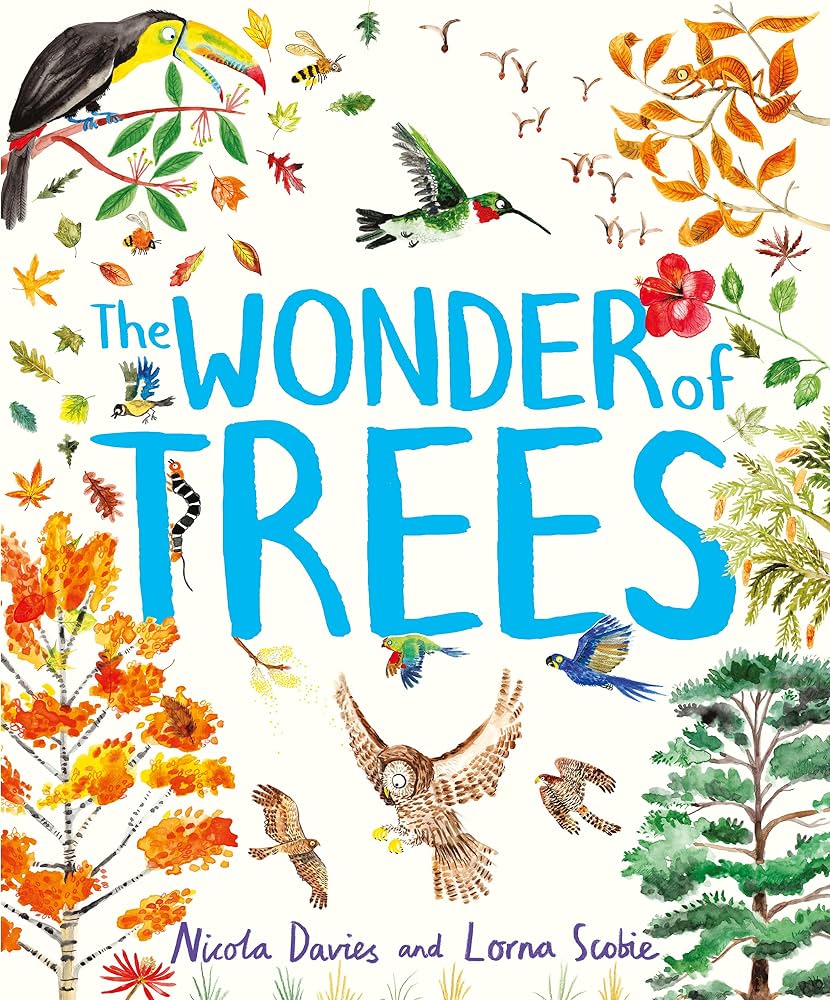
By Nicola Davies, the 64-page The Wonder of Trees (Hodder Books, 2024), stuffed with catchy facts and figures, explores the astonishing diversity of the forests. Sample chapters include “Wood, Trunks, and Branches,” “Birds and Trees, “Communities of Trees,” “Cloud Forest,” “Tropical Rainforests,” and – finally [ “How to Plant a Tree.” For ages 6-12.
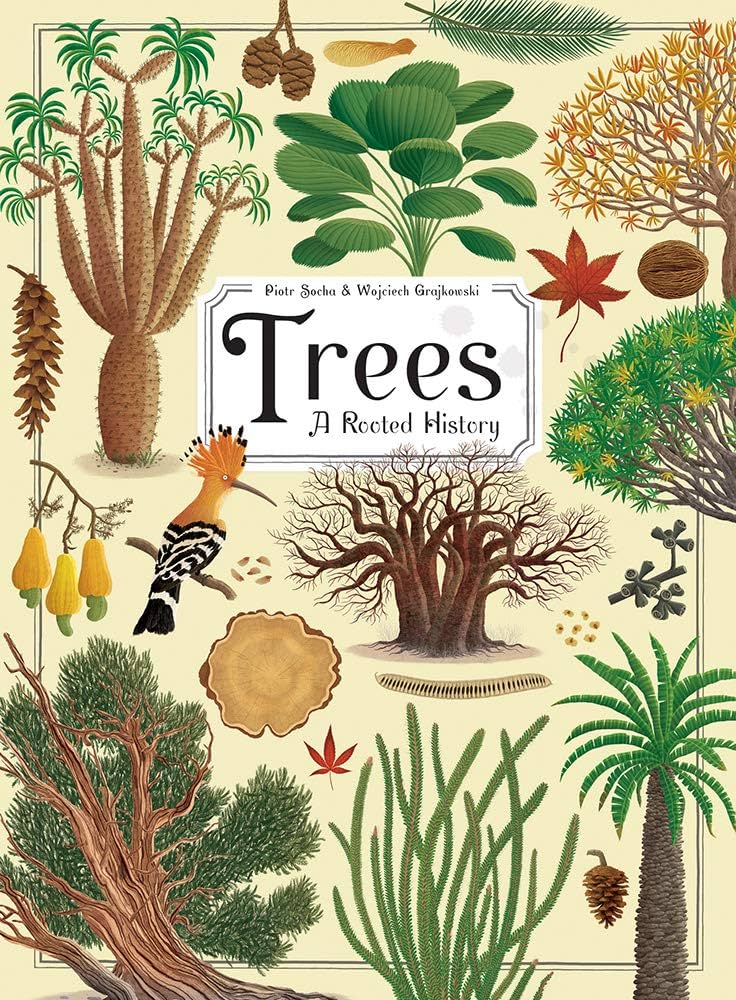
Trees: A Rooted History by Piotr Socha and Wojciech Grajkowski (Abrams, 2019) is a beautifully illustrated survey of the botany, history, ecosystems, and cultural anthropology of the world’s trees. For ages 9-12.
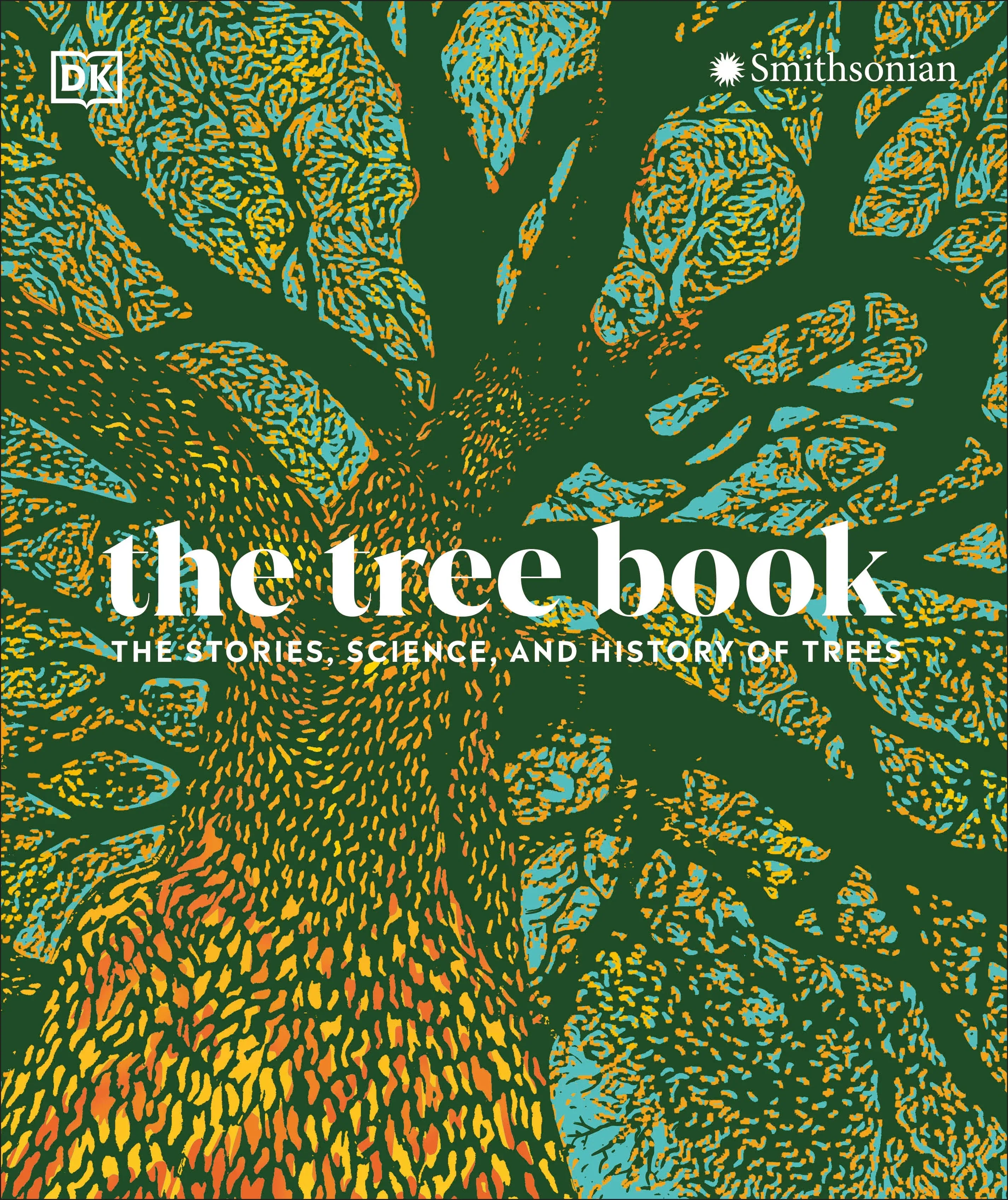
The Tree Book: The Stories, Science, and History of Trees (DK 2022) is a gorgeously designed guide to all aspects of trees, filled with color photos and fascinating facts. For all ages.
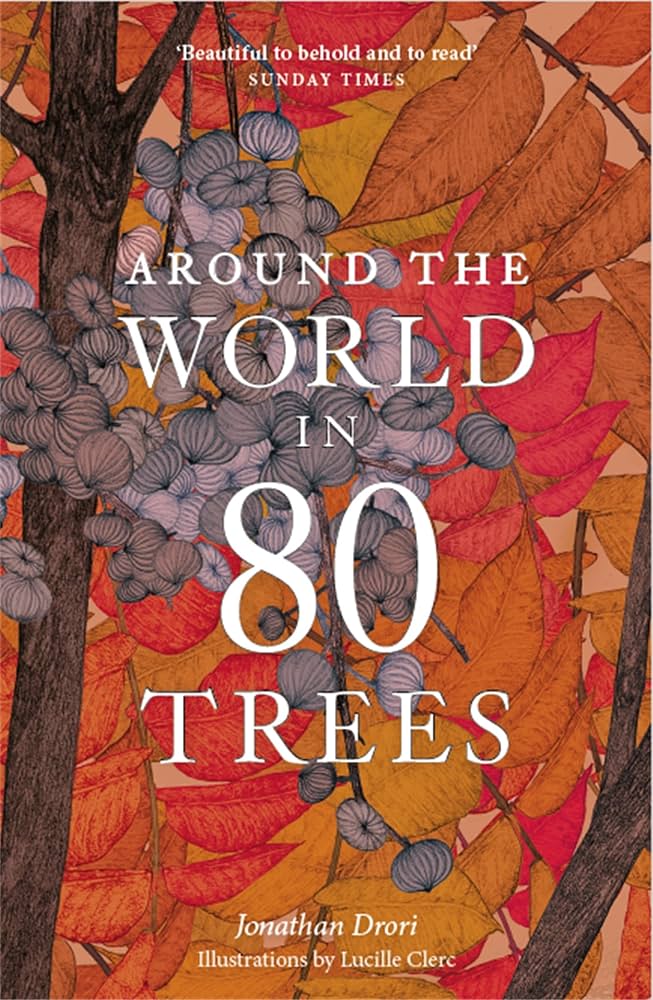
By Jonathan Drori, Around the World in 80 Trees (Laurence King, 2018) is a worldwide tour of trees, showing how each plays a role in human life and the life of the planet. A great tie-in to geography. For teens and adults.
From the New York Times, Olivia Judson’s Tree-mendous is a great essay on the meaning and importance of trees. See https://archive.nytimes.com/opinionator.blogs.nytimes.com/2010/04/06/tree-mendous/.
At Forestry Focus, learn about Sacred and Magical Trees.
Find out How Trees Affect the Weather with clear explanations, colorful diagrams, and a tree image gallery. Also included are lists of related links and sources.
Gold in Trees May Hint at Buried Treasure. Really! Read all about it.
How do trees respond to drought? They call for help. Literally. Read about it at https://www.nationalgeographic.com/science/article/130415-trees-drought-water-science-global-warming-sounds.
From Kidzone, Trees has basic information about trees, along with printable activities and worksheets.

What’s in the Amazon rain forest? Nearly 400 billion trees belonging to 16,000 different species, according to a new estimate. Read about it here.

The Oldest Trees on the Planet is an annotated photo gallery – among them the incredible 4765-year-old California Methuselah tree. See https://www.wired.com/gallery/old-tree-gallery/.
Join the TreeSnap citizen science project and help the trees! You'll need a love of trees and a smartphone.
Tree Lesson Plans
From Project Learning Tree, see Hands-On Activities to Explore the Many Uses of Trees. (Without cutting them down.) See https://www.plt.org/educator-tips/activities-explore-uses-trees/.
From Penn State, Forestry/Natural Resources Lesson Plans is an extensive collection, variously for grades K-5. Titles include Forest Stewardship, The History of Maple Syrup, Seasons of Trees, Trees and Their Parts, Tree Growth, Trees to Paper, Leaf Identification, and Build a Forest.
From Education World, Trees Sprout Classroom Lessons Throughout the Year is a collection of five detailed lessons about trees.
How Does Your Tree Measure Up?, for example, is a math-based lesson for grades 3-12 in which kids calculate the height of a tree, the area of its leaf cover, the number of leaves on the tree, the average size of a leaf, and more.

It's All in the Rings is a lesson plan for middle- and high-school-level students on tree growth.
Fictional Trees
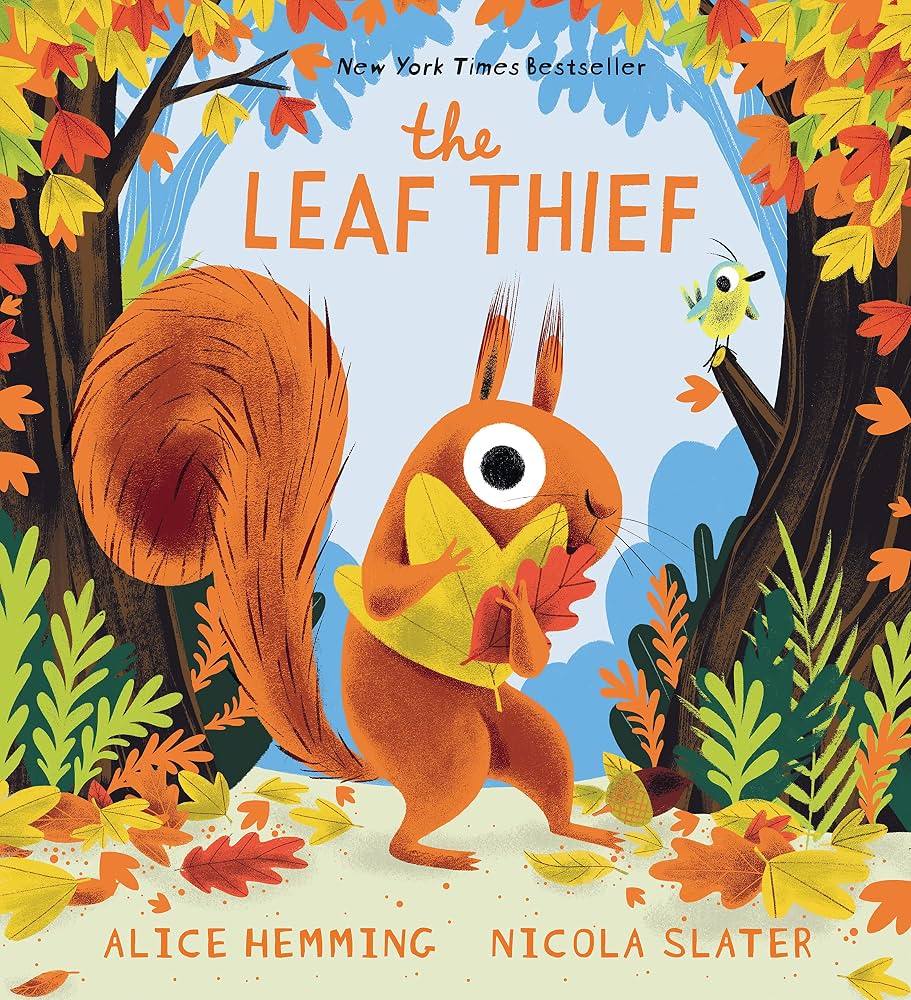
In Alice Hemming’s The Leaf Thief (Sourcebooks Jabberwocky, 2021), Squirrel – who has been counting the leaves on his tree – finds that one of them is missing! There must be a leaf thief! A fun introduction to fall for ages 2-5.
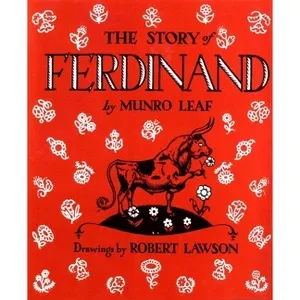
In Munro Leaf’s The Story of Ferdinand (Grosset & Dunlap, 2011), originally published in 1936, is the classic tale of the peaceful bull who only wanted to sit and smell the flowers – usually under a cork tree, from which (my kids loved this) corks dangle in bunches like grapes. For ages 2-6.
See “Why Cork is the World’s Best Material” to find out where cork really comes from at https://www.youtube.com/watch?v=XZvdHPMUgug.

By Dorothea Warren Fox, Miss Twiggley’s Tree (Purple House Press, 2002) – originally published in 1966 – is a perfect delight. Told in bouncy rhyme, it’s the story of the shy and unconventional Miss Twiggley who lives in a tree with her dog and some supportive bears. (“Funny Miss Twiggley/Lived in a tree/With a dog named Puss/And a color TV./She did what she liked and she liked what she did/But when company came/Miss Twiggley hid.”) When the town is flooded, however, Miss Twiggley (and bears) come to the rescue. For ages 3 and up (and up).

In Leo Lionni’s The Alphabet Tree (Alfred A. Knopf, 1990), each letter has a favorite leaf on the alphabet tree – until a gale-force wind swoops in and blows them all over the place. The solution is cooperation, as the letters band together to form words. For ages 3-7.
Try making your own alphabet tree!

In Oliver Jeffers’s Stuck (Philomel, 2011), when Floyd’s kite becomes stuck in a tree, he hurls things after it, which all become stuck in turn – shoes, the kitchen sink, a boat, a rhinoceros, a lighthouse, a whale. Hilarious for ages 3-7.
Listen to Stuck read by Oliver Jeffers on YouTube.

In Julia Rawlinson’s Fletcher and the Falling Leaves (Greenwillow, 2008), Fletcher – an adorable little fox – is convinced that his favorite tree is sick: its leaves are turning brown. His mother assures him that this is normal in autumn, but frantic Fletcher isn’t convinced, and as the leaves inevitably fall, he does his best to stick them back on the tree. Finally, despite his best efforts, the last leaf falls – but when Fletcher next visits his tree, he finds it covered with glittering (with real sparkle) icicles that laugh happily when Fletcher asks the tree if it is all right. For ages 4-7.

Dr. Seuss’s The Lorax (Random House, 1971) – which features the Lorax, who speaks for the trees – may be everyone’s all-time favorite environmental picture book. For ages 4-8.

The 2012 movie version of The Lorax is rated PG.

In Alan Zweibel’s Our Tree Named Steve (Puffin, 2007), Steve, the tree, is felled by lightning and the family recalls all that Steve has meant to them over the years, providing everything from a swing to a camp site to a hammock stand for fat Uncle Chester to a meeting place for young lovers. At the end, Steve’s wood becomes a playhouse. Love and loss, with gentle humor, for ages 4-8.

Lynne Cherry’s The Great Kapok Tree (Houghton Mifflin Harcourt, 2000) is the story of a man who has come to the rain forest to chop down the great kapok tree, but instead falls asleep at its foot. As he sleeps, animal after animal arrives to plead for the life of the tree – snakes, monkeys, birds, frogs, butterflies, and a jaguar all join in – and when the man awakes, now knowing the importance of the tree to so many creatures, he shoulders his ax and walks away. A beautiful and thought-provoking picture book for ages 4-8.
Find out about the kapok tree and more from the Rainforest Alliance.

In Patricia Polacco’s The Bee Tree (Puffin, 1998), Mary Ellen is tired of reading and wants to go outdoors – so her grandfather decides that it’s the perfect time to hunt for a bee tree. Soon they’ve gathered a crowd of people and animals following behind them, all out to find some honey. (There’s also a nice little moral at the end about the joys of reading.) For ages 4-8.

Lori Mortensen’s In the Trees, Honey Bees! (Dawn Publications, 2009) is a simple rhyming account of the life of a wild bee colony living in a bee tree; fact boxes provide more information for older children. For ages 4-7.

In Bill Peet’s Farewell to Shady Glade (Houghton Mifflin Harcourt, 1981), a host of forest animals, led by a raccoon, are about to lose their home to land developers with bulldozers. They set out by train to find a new home. For ages 4-8.

Leo Buscaglia’s The Fall of Freddie the Leaf (Slack, Inc., 1982) is a gentle explanation of the nature of death, through the tale of Freddie, a leaf whose time has come to fall. For ages 4 and up.

The star of Shel Silverstein’s The Giving Tree (Harper & Row, 2014) is a kind and generous tree who loves a little boy. At first, he plays with her leaves and climbs on her branches; then as he grows older, he demands more and more from the tree: her apples to bring him money; her branches to build a house; her trunk to build a boat. Finally, the man is old and the tree has nothing more to give him – except her stump, which provides a place to sit. There he sits, “and the tree was happy.” A discussion-promoter for ages 5 and up.
See The Giving Tree on YouTube narrated by Shel Silverstein.
From the Teaching Children Philosophy website, The Giving Tree page has a summary, background guidelines for philosophical discussion, and a list of questions for readers.
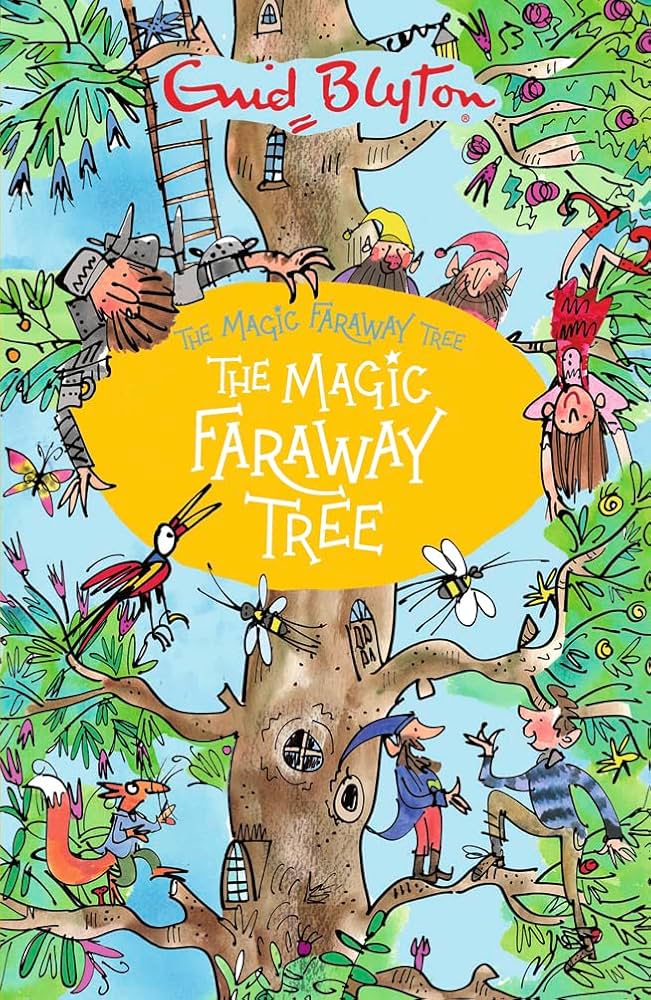
By Enid Blyton, in The Magic Faraway Tree series (several editions) three kids discover an enchanted wood and tree inhabited by magical people; the tree’s upper branches lead to magical lands which change each time the children visit. Book One of the series is The Enchanted Wood, originally published in 1939. For ages 5-8.
The movie version of The Magic Faraway Tree (2026) is rated PG. See https://www.imdb.com/title/tt7734244/.

In Roald Dahl’s The Minpins (Puffin, 2009), Little Billy – despite awful warnings from his mother – goes into the Forest of Sin where, living in the tops of the trees, he discovers the Minpins, an entire village of miniature people who scamper around in the branches wearing little green boots equipped with suction cups. They are terrified by a monster, the Red-Hot Smoke-Belching Gruncher, and when Billy manages to dispatch it, he ends up with a liberating reward (magical nightly rides on the back of a swan). For ages 5-9.
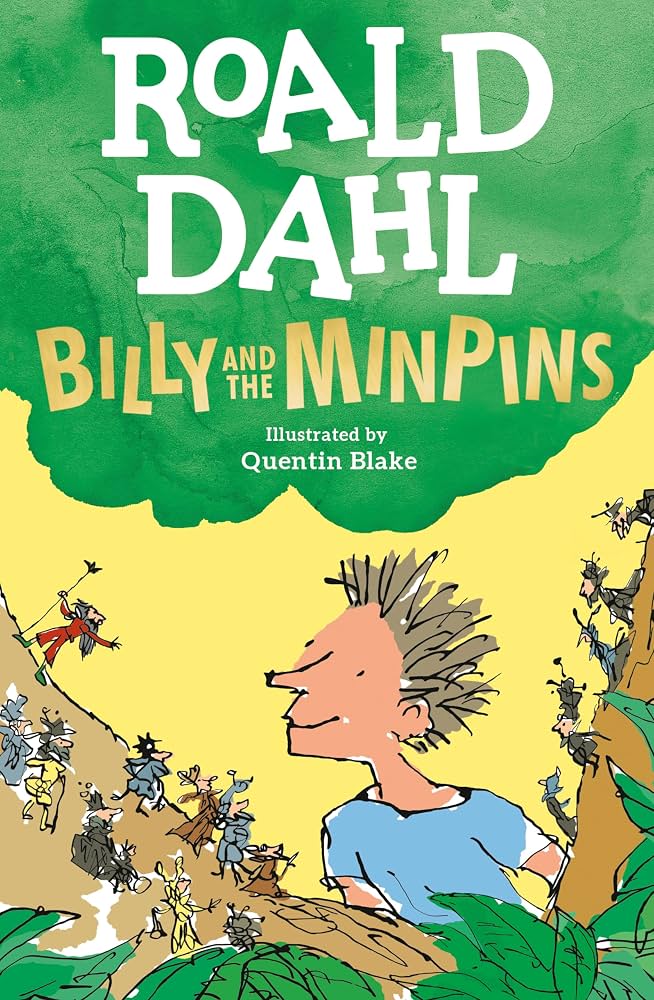
For a later version (“new interpretation”), see Billy and the Minpins (Viking, 2019), with wonderful illustrations by Quentin Blake. For ages 7-9.

By Ingri and Edgar Parin D’Aulaire, D’Aulaires’ Book of Norse Myths (New York Review Children’s Collection, 2005) is a marvelously illustrated collection of tales of Norse gods, goddesses, and giants, including the story of Yggdrasil, the World Tree. For ages 5 and up.

In Florence Parry Heide’s Treehorn’s Treasure (Pomegranate, 2011), Treehorn stashes his allowance in a hole in a tree and discovers that the tree is now sprouting dollar bills. His parents, however, refuse to believe him. Heide’s Treehorn stories are gems, starring the commonsensical Treehorn, who deals calmly with fantastic situations, and his oblivious parents. With great illustrations by Edward Gorey. For ages 7 and up.

The main character of Carolyn Sherwin Bailey’s Miss Hickory (Puffin, 1977), which won the Newbery Award in 1947, is a doll – a notably cross and cantankerous doll – whose body is made from an apple-wood twig and head from a hickory nut. Left behind when her owners move to Boston, Miss Hickory must fend for herself during the cold New Hampshire winter. She does so, with the help of assorted animals, and even eventually begins to amend her not-always-admirable ways.
At the end, however – SPOILER – a squirrel eats Miss Hickory’s head, at which point she has an epiphany about the meaning of her life; her headless twig body then wanders off and is grafted onto an apple tree, where it begins to grow. Many people love this book; I have mixed feelings about it, having been horrified when I was eight by Miss Hickory’s sudden end. A discussion-promoter for ages 7-12.

In Mildred D. Taylor’s Song of the Trees (Puffin, 2003), the Logan family of Mississippi – in a prequel to Roll of Thunder, Hear My Cry – struggles with poverty, racism, the Depression, and the absence of Papa, who has gone to Louisiana to make money working for the railroad. Cassie, however, finds comfort from the great trees that surround their house, that seem to her to sing a special song (though others say it’s just the wind). Then Mr. Andersen, a local white businessman, tries to force Cassie’s Big Ma to sell the beloved trees for lumber. For ages 8-12.

In T.A. Barron’s Tree Girl (Philomel, 2001), all nine-year-old Anna knows of her past is that crochety Master Mellwyn found her as a baby, lying in the roots of a willow tree. Now he warns her to stay away from the forest, which he claims is full of threatening tree ghouls – but Anna is drawn to the forest, believing it holds the secret of her mother. A short chapter fantasy for ages 8-12.

In Kate Klise’s Regarding the Trees (Houghton Mifflin Harcourt, 2007), the principal of Geyser Creek Middle School wants to trim trees on the school property, and so enlists the help of Ms. Florence Waters (first encountered in Klise’s Regarding the Fountain). Many misunderstandings ensue. The story is told through a creative mix of letters, announcements, newspaper clippings, and the like, with a lot of intercalated info about real trees, family trees, and Italian. For ages 8-12.

In S. Terrell French’s Operation Redwood (Amulet, 2011), 12-year-old Julian discovers by means of an intercepted email (calling his uncle a world-class jerk) that his uncle’s company plans to cut down a grove of old-growth California redwood trees. In company with new homeschooled friend Robin – who lives near the grove – Julian and friends embark on a campaign to save the trees. A great eco-adventure for ages 9-12.

The star of Rumer Godden’s The Doll’s House (Puffin, 1976) is Tottie Plantagenet, a little wooden doll, who in times of trouble remembers the tree from which she was made, standing tall against the storm. (“A little of that tree is in me,” thought Tottie.) Tottie needs all her tree’s bravery and determination when she and her family run up against the elegant, but evil, Marchpane. For ages 9 and up.

The narrator of Katherine Applegate's Wishtree (Feiwel and Friends, 2018) is a tree: a red oak known as Red. Red, large-hearted and witty, is home to a host of animals - and is loved by humans who, each year, hang wishes on his branches. Then a Muslim family moves to the neighborhood and someone takes a screwdriver and carves the word LEAVE on Red's trunk. A lovely story about tolerance, acceptance, and welcome, told by a wonderful tree. For ages 7-12. But really for everybody.

In Jean Craighead George’s My Side of the Mountain (Puffin, 2004), young Sam Gribley – miserable in the crowded city – runs away to the Catskill Mountains where he sets up house in a hollow tree. He copes with difficulties and dangers, makes unexpected friends – including a young falcon and a lost-in-the-woods English professor (who calls Sam “Thoreau”). A wonderful story of adventure and independence for ages 9-12. (The first of a trilogy.)

Toby Alone by Timothée de Fombelle (Candlewick Press, 2009) features a world of extremely small – no more than two millimeters tall - people who live in a vast oak known simply as the Tree. The tree is in political and social turmoil: thirteen-year-old Toby’s scientist parents have been captured and imprisoned, and he is alone and on the run. The root of the problem is politician/industrialist Joe Mitch, who is bent on exploiting the sap of the Tree for business purposes – a project that will inevitably kill it. Despite its minuscule characters, the book has more in common with 1984 than The Borrowers. This is a complex and sometimes violent story about the uses and abuses of power, and the consequences of environmental destruction. A thought-provoking read for ages 12 and up. The sequel – you’ll want it, since Toby Alone ends with a cliffhanger – is Toby and the Secrets of the Tree.

Betty Smith’s A Tree Grows in Brooklyn (HarperPerennial, 2006) – originally published in 1943 – is the wonderful coming-of-age story of young Francie Nolan, growing up in the slums of turn-of-the-century New York City. A recurring metaphor is that of the Tree of Heaven – the ailanthus – a tree so tough and determined that it manages to sprout and thrive in the unwelcoming cement of city streets. For ages 13 and up.

In Ursula K. LeGuin’s The Word for World is Forest (Tor Books, 2010), humans have taken over the tree-covered planet of Athshe, whose small furry green inhabitants pursue a peaceful lifestyle that involves a state of lucid dreaming – “dream-time” – and ritual singing. Enslaved by the invaders, the Athsheans finally revolt. There are analogies to the treatment of native Americans by the Europeans and to the U.S. involvement in Vietnam. A powerful book for teenagers and adults.

There are similar themes in James Cameron’s 2009 film Avatar, in which humans are exploiting the planet Pandora for a rare mineral (unobtanium) and in the process are destroying the native inhabitants, the Na’vi, tall blue-skinned humanoids who live in harmony with nature and worship the Hometree. Rated PG-13.
Spooky Trees

By Bill Martin, Jr., and John Archambault, The Ghost-Eye Tree (Square Fish, 1988) is a story-poem about a little boy and his older sister, sent out at night to fetch a bucket of milk, which involves passing the the truly creepy Ghost-Eye tree (“feared by all/the great and small”). The little boy wears his special hat, which makes him feel safer, even though his sister tells him it makes him look stupid. An owl panics them; he loses the hat; and his sister bravely goes back to retrieve it. A wonderfully illustrated account of being scared of the dark by a very spooky tree. For ages 4-8.

Ray Bradbury’s The Halloween Tree (Yearling, 1999) is the eerie tale of eight boys on Halloween night, headed for a haunted house – where they meet the skeletal Mr. Moundshroud and encounter the Halloween tree, hung with grinning jack-o-lanterns. The book traces the history of Halloween customs from the ancient Egyptians to the Mexican Day of the Dead. Eerie and wonderful for ages 9-12.
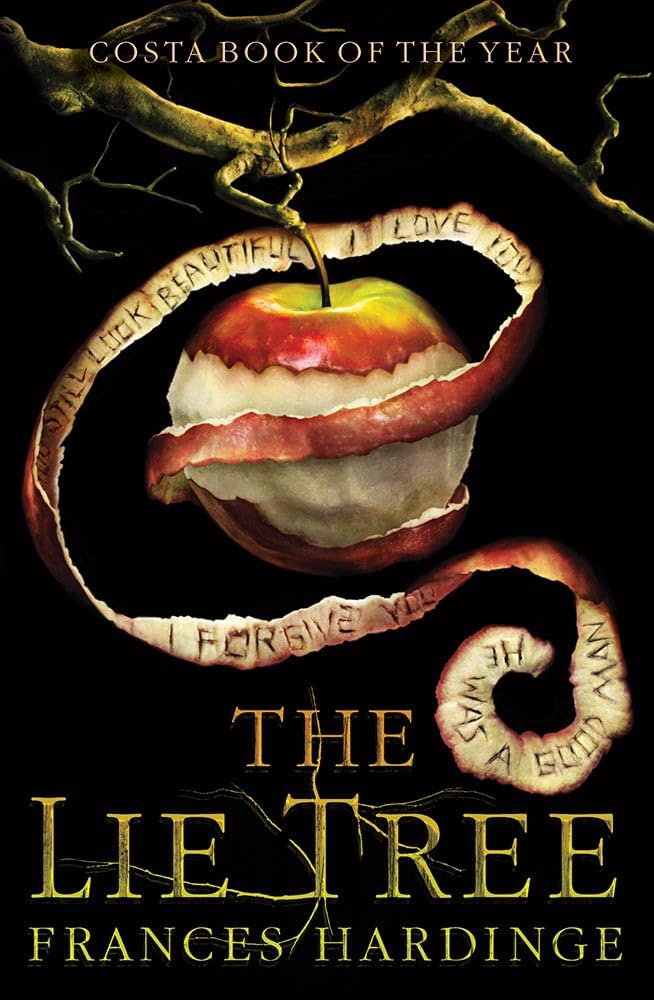
By Frances Hardinge, The Lie Tree (Harry N. Abrams, 2023) is a gripping historical fantasy in with teenage Faith Sunderly, searching for the truth about her father’s murder, finds the lie tree – which bears fruit only when she whispers a lie to it, and that fruit in turn delivers a hidden truth. For ages 13 and up.
Madagascar's legendary man-eating tree is a hoax, dating to 1881. But it’s still an interesting story. See https://www.weirdhistorian.com/the-myth-and-mayhem-of-the-man-eating-tree-of-madagascar/.
History with Trees
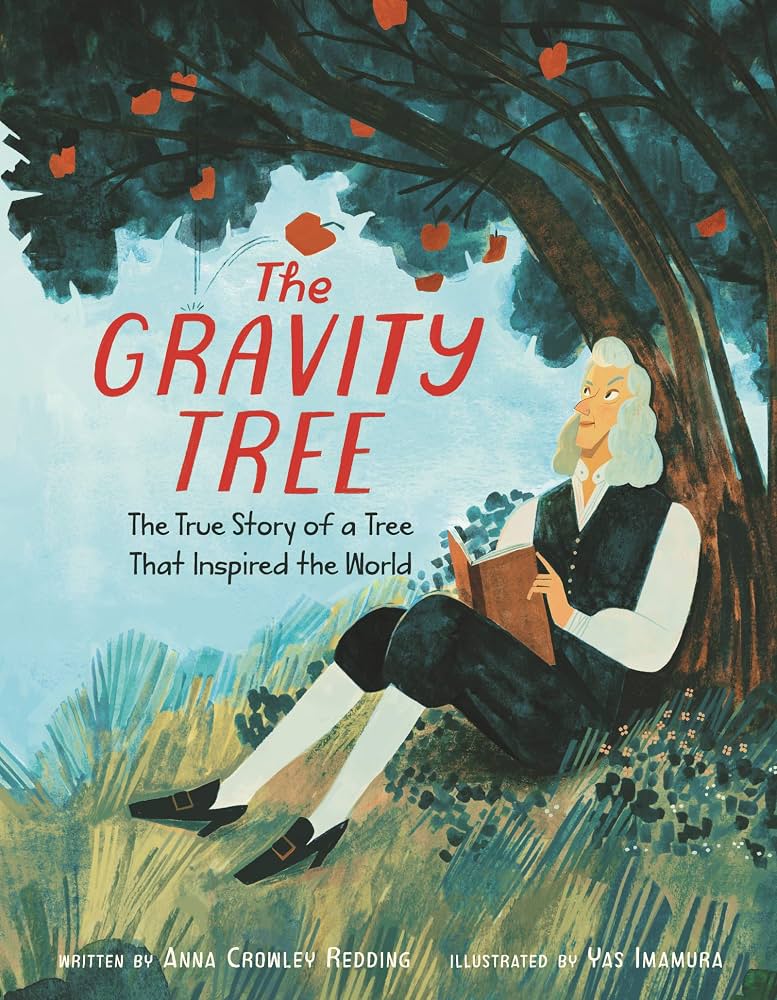
By Anna Crowley Redding, The Gravity Tree (HarperCollins, 2021) is the picture-book story of the apple tree that (well, maybe) inspired Isaac Newton to come up with the theory of gravity. (A bit of it even ended up for a ride on the International Space Station.) For ages 4-8.

By author/musician Dana Lyons, The Tree (Illumination Arts, 2002) is told in the voice of an ancient Douglas fir: “For eight hundred years I have lived here/Through the wind, the fire, and the snow.” An inspiration for young environmentalists, illustrated with wonderful pictures of awesome trees. For ages 5-8.
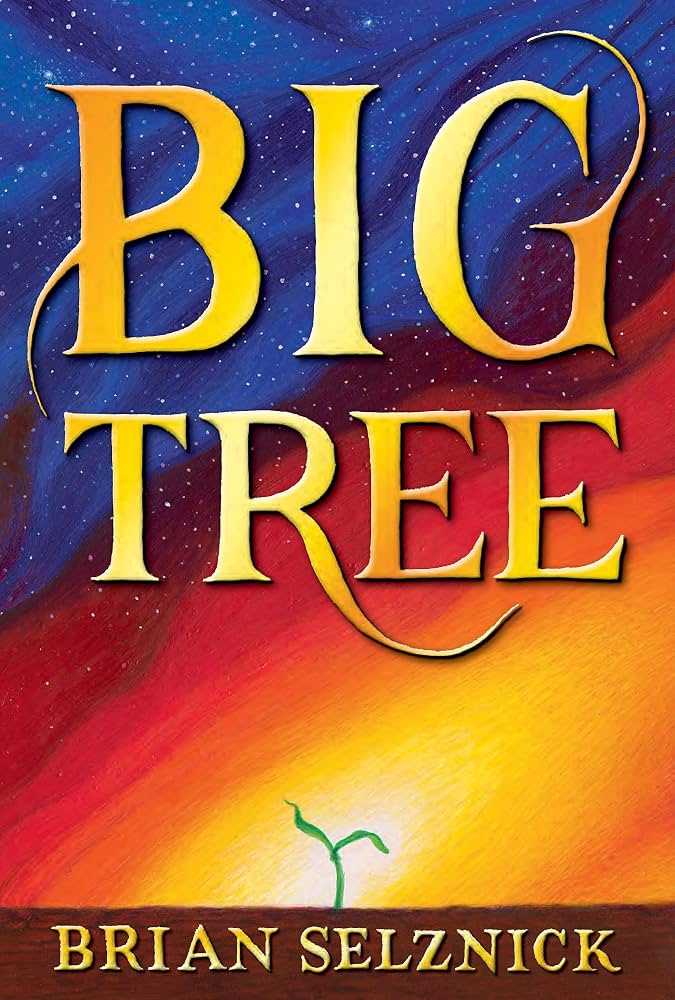
Brian Selznick’s Big Tree (Scholastic, 2023) is the story of Louise and Merwin, a pair of sycamore seeds, thrown prematurely from their parent tree in the wake of a fire and now facing a world filled with dinosaurs and volcanoes as they search for a place to put down roots. A history of our planet from the point of view of seeds. For ages 7-12.
There’s an excellent audio version narrated by Meryl Streep (Audible, 2023).

Holling C. Holling’s Tree in the Trail (Houghton Mifflin Harcourt, 1990) – originally published in 1942 - is a 200+-year history of the Santa Fe Trail as experienced by a cottonwood tree, from the buffalo and Kansa Indians to the Spanish conquistadors, French trappers, and Conestoga wagon trains. Heavily illustrated with colorful paintings, sketches, maps, and diagrams. For ages 9-12.

In Rudyard Kipling’s classic Puck of Pook’s Hill – available in many editions – Dan and Una are performing a version of A Midsummer Night’s Dream when Puck himself appears. Puck – who swears by the ancient English trees, oak and ash and thorn – magically conjures up people and stories from old English history for the children: Normans and Saxons, Roman soldiers and Picts, Vikings, explorers, and pirates, the signing of the Magna Carta. Included are wonderful poems, among them ”A Tree Song,” “A Smuggler’s Song,” and “The Bee-Boy’s Song.” For ages 9 and up.
Read Puck of Pook’s Hill online here at Project Gutenberg.
Tree Poems

Thom Wiley’s The Leaves on the Trees (Cartwheel Books, 2011) can be sung to the tune of “The Wheels on the Bus” – “The leaves on the tree are falling down/falling down/falling down/Autumn is here!” For ages 3-5.

By Kristine O’Connell George, Old Elm Speaks (Houghton Mifflin Harcourt, 2007) is an illustrated collection of short poems celebrating trees. “Oak’s Introduction,” for example, speaks directly to the reader: “I’ve been wondering/when you’d notice/me standing here. I’ve been waiting/watching you/grow taller. I have grown too/My branches/are strong. Step closer./Let’s see/how high/you can/climb.” For ages 4-9.

Amy Ludwig VanDerwater’s Forest Has a Song (Clarion Books, 2013) is a collection of 26 short poems about the forest and its inhabitants, from chickadees and frogs to moss and trees. Illustrated with lovely stylized watercolor paintings. For ages 5-9.

Selected by Mary Ann Hoberman and Linda Winston, The Tree That Time Built (Sourcebooks Jabberwocky, 2009) is an illustrated collection of over 100 poems about the natural world by such poets as Walt Whitman, Emily Dickinson, Langston Hughes, Eve Merriam, and Ogden Nash. See the “Think Like a Tree” section for many poems about trees. For ages 7-12.
See Joyce Kilmer’s Trees, which begins “I think that I shall never see/A poem lovely as a tree.”
Pair it with Ogden Nash’s Song of the Open Road. You’ll see why.
See Robert Frost's "Birches" at https://poets.org/poem/birches.
I've always loved Philip Larkin's The Trees. ("Last year is dead, they seem to say/Begin afresh, afresh, afresh.")
Mathematical Trees

At the Math Playground, experiment with Factor Trees.
From the American Mathematical Society, learn all about the many different kinds of mathematical trees at Trees: A Mathematical Tool for All Seasons. For older students.
Counting Trees is an excellent math lesson on estimation based on a tree farm. Included are printable worksheets, data sheets, and questionnaires.
Trees and Art

Barbara Reid’s Picture a Tree (Albert Whitman & Company, 2013) points out that “There is more than one way to picture a tree” – as a “sun umbrella” or a high-rise apartment for birds and animals; as a baby, a teenager, or a grandfather; as a “wild good-bye party” as its brilliantly colored leaves blow away in the wind in fall. Wonderful creative illustrations modeled in Plasticine. For ages 4-7.
Creating Picture a Tree is a YouTube video showing how Reid’s Plasticine illustrations are put together.

By Morteza E. Sohi, Look What I Did with a Leaf! (Walker Children’s Books, 1995) has great suggestions for making collage animals – butterflies, fish, peacocks, cows – with leaves. Included are instructions, a simple identification guide, and an account of the life cycle of a leaf. For ages 4-8.

Thomas Locker and Candace Christiansen’s Sky Tree: Seeing Science Through Art (HarperCollins, 2001) traces a single tree through the seasons of the year, pairing Locker’s gorgeous oil paintings with a brief descriptive text. For ages 5-8.

Make a newspaper tree! You’ll need newspaper, scissors, tape, and a cardboard tube. See https://stevespangler.com/experiments/how-to-make-a-newspaper-tree/.

See Kirigami: The Ancient Art of Paper Cutting for a lesson in how to make a stylized kirigami tree. Also from WikiHow, see how to make a cool
paper 3-D tree.

Learn about Canadian artist Emily Carr and her wonderful tree paintings at https://www.smithsonianmag.com/arts-culture/canadian-painter-found-muse-verdant-trees-british-columbia-180987829/.
For elementary-level kids, see this Emily Carr art lesson from Deep Space Sparkle at https://www.deepspacesparkle.com/emily-carr-art-lessons/.
From
Trees in Nature and Art is an interactive online lesson plan in which kids (in grades 5-8) explore the use of trees in the arts, learn about the science of forestry, collect leaves, create leaf-based art, and write tree poems.
On Pinterest, see this particularly gorgeous collection of Tree Art Lesson Ideas.
From Busy Bee, Tree Crafts for Kids include an Autumn Tree Collage, a flip-book-style seasonal Changing Tree, a Falling Leaves project (the leaves really fall), a Japanese Cherry Tree picture, Tie-Dyed Leaves, and more.
From First Palette, make these clever 3-D Christmas trees at https://www.firstpalette.com/craft/3d-paper-christmas-tree.html..
Tree Activities for Kids is a long list including science explorations, craft projects, paintings, and learning and book-related activities.
From DLTK’s Crafts, Famous Art Work: Tree Themes has images of works by famous artists such as Vincent Van Gogh, Georgia O’Keeffe, and Gustav Klimt, and coloring pages and art projects based on their trees.
Make Recycled Paper Trees.
These Fall Tree Crafts for Kids include a Fingerprint Fall Tree, Marshmallow Stamped Apple Trees, and Button Branches.
Tree Houses

Andrew Larsen’s In the Tree House (Kids Can Press, 2013) is a story of two brothers, a tree house, and growing up. Narrated by the younger boy, the book describes how the family moved to a new house with a very tall tree, made plans for a spectacular tree house, and finally built one – and there the kids had great times. Then the older brother stopped visiting the tree house, preferring to hang out with new friends – until one night there’s a power outage. Together again, the boys have one more happy night in the tree house. A sweet and nostalgic story for ages 5-8.

In Doris Burn’s Andrew Henry’s Meadow (Philomel, 2012), originally published in 1965, Andrew Henry’s inventions wreak so much havoc at home that, feeling unwanted and unloved, he sets off in search of a place of his own. He finds a sequestered meadow where he builds himself a wonderful little house. Soon other kids show up and he builds houses for them too, all peculiarly suited to their hobbies – Alice, a bird-lover, for example, gets a fabulous tree house surrounded by birdbaths and feeders, with a balcony just for bird-watching. Eventually the kids’ parents miss them and come to find them – and finally Andrew Henry, now appreciated, is given his own basement workshop at home. For ages 5-9.

In Gertrude Chandler Warner’s Tree House Mystery (Albert Whitman & Company, 1990), 14th in the Boxcar Children series, the four children acquire a tree house and a spyglass, and discover a mysterious secret room in the house next door. For ages 7-10.

In Andy Griffiths's The 13-Story Treehouse (Feiwel and Friends, 2013), Andy and Terry live in the world's most spectacular tree house - 13 stories of it, complete with bowling alley, shark tank, theatre, secret underground laboratory, and marshmallow machine. Zany adventures, lots of humor, and cartoon illustrations. Several sequels in which the treehouse gets ever bigger. For ages 7-10.

David Stiles’s How to Build Treehouses, Huts and Forts (Lyons Press, 2003) provides detailed instructions for building an exciting range of kid-friendly structures, among them treehouses, a lookout tower, and (got snow?) an igloo.
Tree Games
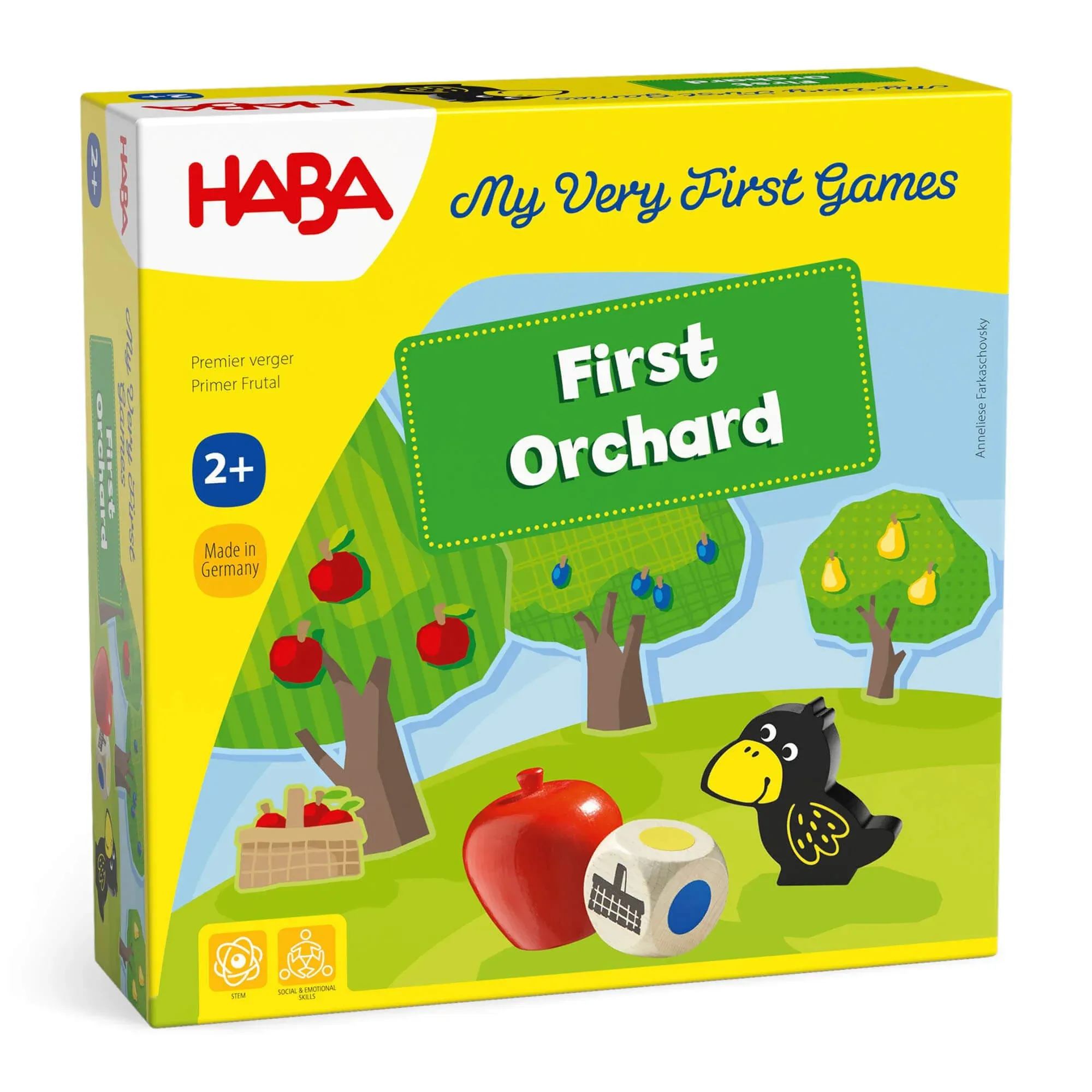
From HABA, First Orchard is a game for toddlers, in which kids try to collect fruit - colorful chunky wooden pieces - before a hungry raven makes it to the orchard. See https://www.habausa.com/products/my-very-first-games-first-orchard.
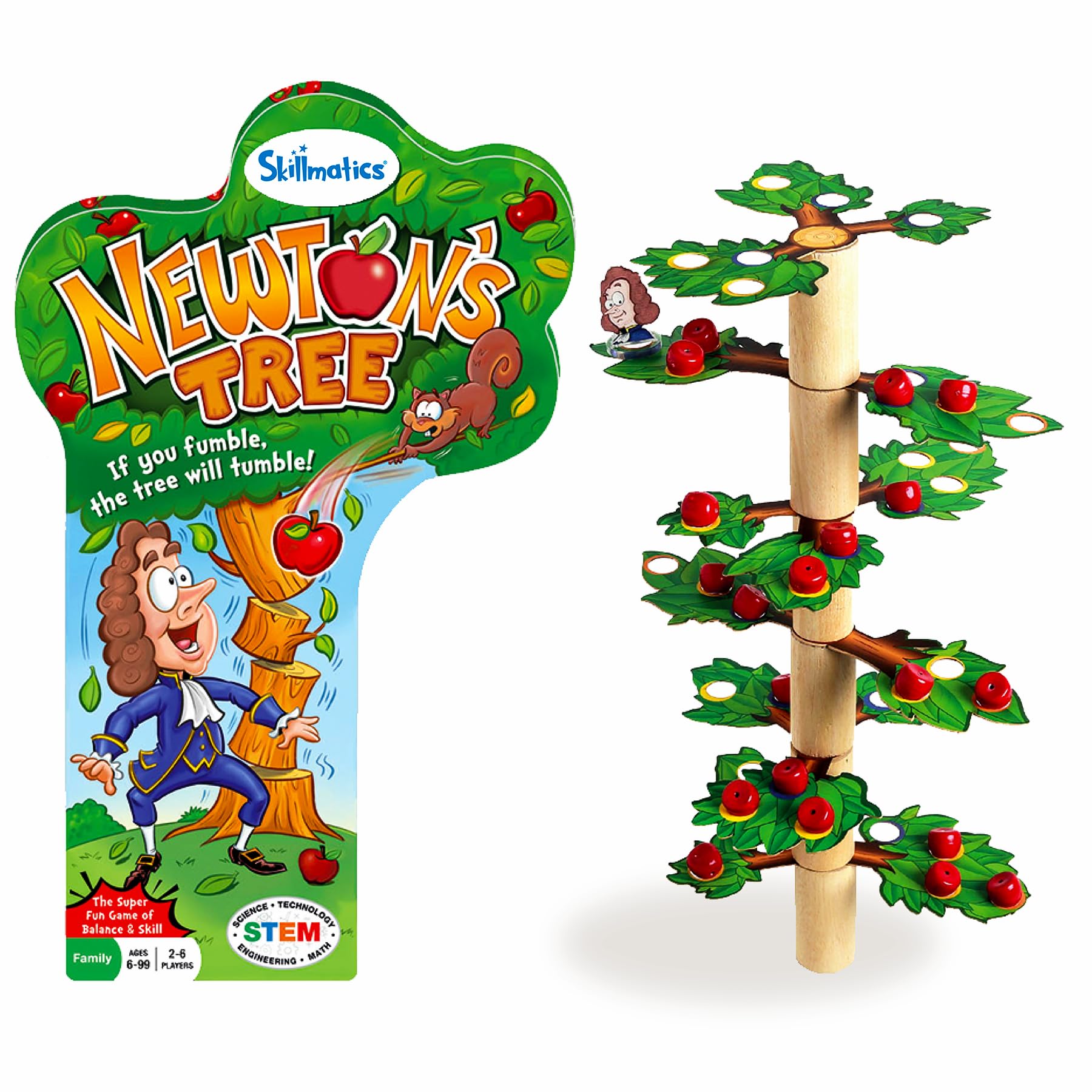
From Skillmatics, Newton's Tree is a game of stacking, balancing, and strategy in which players do their best to build the tallest apple tree without the whole thing tumbling down. For ages 6 and up. See 
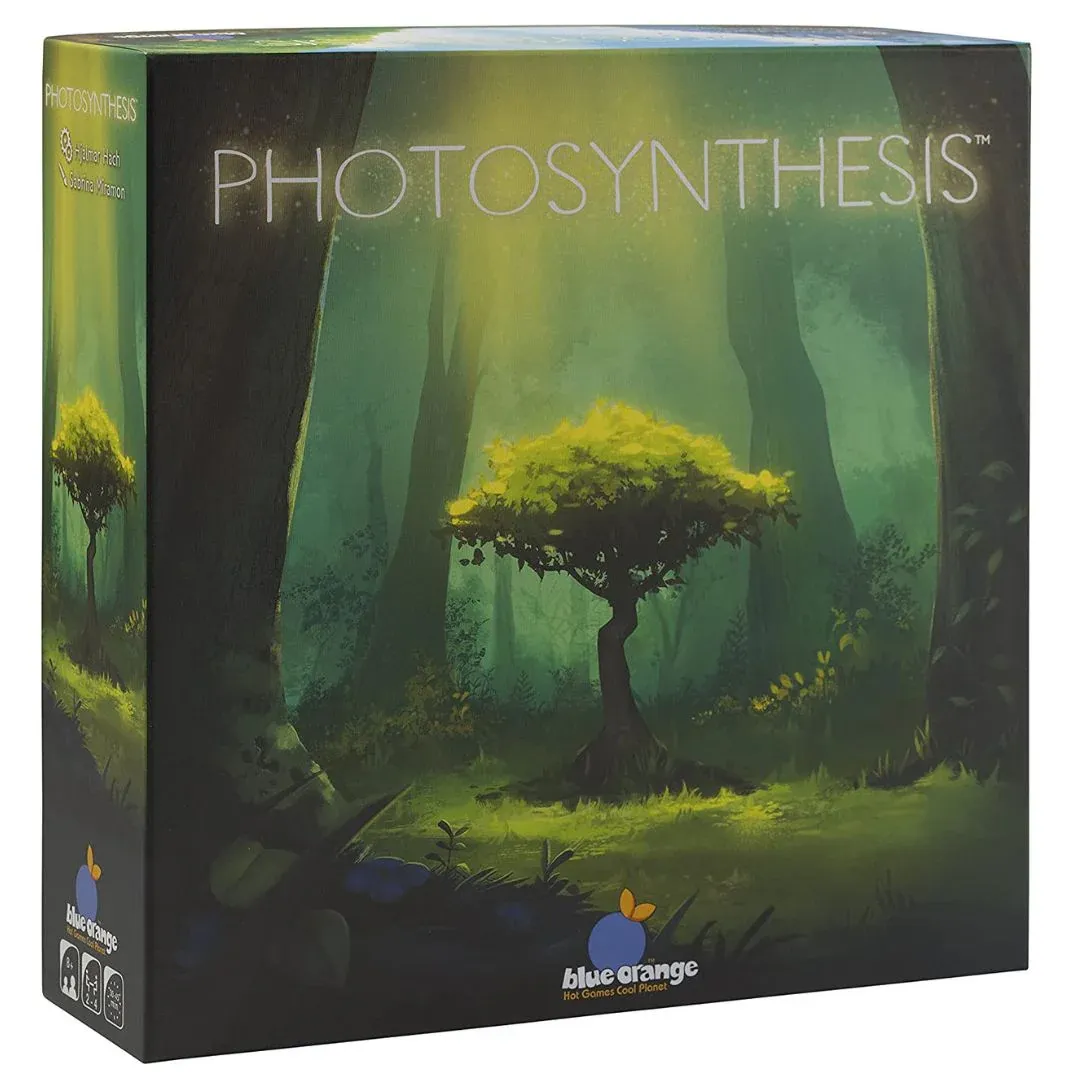
In Photosynthesis (Blue Orange Games), players grow trees from seed, place them strategically on the board, and collect light points from the rotating sun. Playing pieces are colorful 3-D cardboard trees of various shapes and sizes; the trick is to place them such that you'll be able to absorb the maximum amount of sunlight yourself while casting shadows on your opponents. For ages 10 and up.
See