
The Buzz on Bees
In this collection
Bees are incredible. They can count to three, tell a Picasso from a Monet, solve the Traveling Salesman Problem in the blink of an eye, and make honey – and they pollinate everything from apples, beets, and Brazil nuts to pumpkins, tangerines, and watermelons.
And they just might be disappearing, which is something we should all worry about.
See below for ways to help the bees – along with bee stories, bee poems, bees under the microscope, dancing bees, zombie bees, and robotic bees. And, of course, Winnie-the-Pooh.
Bee Tales

A.A. Milne’s Winnie-the-Pooh, originally published in 1926, with wonderful illustrations by Ernest H. Shepard, features a pudgy honey-loving bear who has an unfortunate adventure with bees. Also see the equally delightful sequel, The House at Pooh Corner, and the Latin version, translated by Alexander Lenard - Winnie Ille Pu (Penguin, 1991) – in which Pu loves mel. For all ages, always.

Steve Smallman’s The Very Greedy Bee (Tiger Tales, 2010) is a lesson in sharing. The greedy bee refuses to do his share of chores around the hive and spends all his time guzzling pollen and nectar – to the point where, stuffed full, he thumps to the ground, unable to fly. He’s helped home by some kindly fireflies and ants, and all ends happily with a party (featuring honey), some new friendships, and a lesson learned. For ages 3-7.

Munro Leaf’s The Story of Ferdinand (Viking Juvenile, 2011) recently celebrated its 75th anniversary. This is the now-classic story of the peaceful bull who loves to sit under the cork trees and smell the flowers – until a badly timed bee sting convinces visiting recruiters for the bullfight that Ferdinand would be a perfect candidate for the bullring in Madrid. For ages 3-8.

In Cece Bell’s Bee-Wigged (Candlewick, 2008), people simply did not like Jerry Bee – who was a perfectly enormous (though friendly) bee. In an attempt to make friends at school, Jerry acquires a wig that hides his antennae and makes him look (well, sort of) like a boy. He’s loved by all, until a wind snatches off the wig, revealing his true bee nature. Luckily the wig – actually a talkative guinea pig named Wiglet – averts panic by reminding people that the real Jerry is a sweetheart. For ages 4-8.

The panic-stricken protagonist of Melanie Watts’s Scaredy Squirrel (Kids Can Press, 2008) is terrified of everything – including bees – and so refuses to leave his tree. Anything could be out there in the fearsome unknown - Martians, sharks, tarantulas, germs – though he’s well-prepared for threats with an emergency kit containing everything from antibacterial soap to a parachute. Then one day, terrified by passing (killer?) bees, he leaps from his tree – and discovers, to his amazement, that he’s not just a squirrel: he’s a flying squirrel. There are many sequels, in which Scaredy Squirrel variously fears rabbits, piranhas, jellyfish, falling coconuts, dragons, ghosts, bats, confetti, ponies, and Bigfoot. For ages 4-8.

Frank R. Stockton’s The Bee-Man of Orn (Candlewick, 2004) is a reprint of the 1964 original. The elderly Bee-Man lives contentedly with his bees until a visiting Junior Sorcerer informs him that he’s been “transformed from something else” and encourages him to go on a quest to discover his original form. He does, with enlightening and surprising results. A classic for ages 6-11.
The text of The Bee-Man of Orn is online at Project Gutenberg.
From the Prindle Institute for Ethics, see background information and discussion questions for The Bee-Man of Orn. The main theme: the importance of self-exploration and examination.
Jay Hosler’s wonderful graphic novel The Way of the Hive (HarperAlley, 2021) traces the life of bees through the story of brand-new (and very chatty) honeybee Nyuki. For ages 8-12.
From the Brothers Grimm, The Queen Bee is the tale of three brothers, the youngest of whom triumphs because of his kindness to ants, ducks, and bees.
Country Bees, City Bees

In Laurie Krebs’s catchy rhyming picture book The Beeman (Barefoot Books, 2008), a little boy describes the work of his grandfather, the town beekeeper. (“Here is the queen bee/Who does her job well/and lays tiny eggs/in a six-sided cell.”) For ages 3-7.

Patricia Polacco’s The Bee Tree (Puffin, 1998) is a clever cumulative tale in which Mary Ellen and her Grampa search through the Michigan woods for a bee tree filled with honey. (There’s also a nice lesson at the end about the benefits of reading.) For ages 4-8.

Lela Nargi’s The Honeybee Man (Schwartz & Wade, 2011) is the picture-book story of Fred, who keeps beehives on the rooftop of his apartment building in Brooklyn. Readers learn about the busy life inside the hive, the process of foraging for nectar, honey-making and honey harvest, and end with a neighborhood honey feast. For ages 4-8.

The theme of Maggie de Vries’s Big City Bees (Greystone Books, 2013) is pollination. Sophie and Matthew have planted pumpkins in their city garden – but there’s no chance of pumpkins if the blossoms aren’t pollinated by bees. Are there bees in the city? And will the bees find their pumpkin patch in time? For ages 5-8.

Brian McCallum and Alison Benjamin, Bees in the City (Guardian Books, 2011) is an urban beekeeper’s handbook, with accounts of beekeeping projects by schools, businesses, and communities, and how-tos for city environments.
Mysteries with Bees

In Gertrude Chandler Warner’s The Honeybee Mystery (Albert Whitman & Company, 2000) – one of the Boxcar Children series – the four Alden children and their grandfather head to the Sherman farm for honey – only to find that there’s no honey to be had. Something is wrong with the bees. Henry, Jessie, Violet, and Benny learn about bees and beekeeping, while solving the mystery (and saving the farm). For ages 7-10.

The heroine of Laurie R. King’s The Beekeeper’s Apprentice (Picador, 2007), set in 1915, is orphaned teenage heiress Mary Russell, bright, gawky, and unhappily living with her guardian, a nasty aunt. Then, out for a walk, she meets the elderly Sherlock Holmes, now retired and devoting himself to the study of bees. Impressed by Mary’s sharp wits, he decides to tutor her in investigative techniques. In this, the first of a series, Mary and Holmes tackle a mystery that involves a kidnapping, a master criminal, and a threat to both their lives. For teenagers and adults.
Bee Movie

In the animated Bee Movie (Dreamworks, 2007), bee Barry B. Benson (voiced by Jerry Seinfeld) – recently graduated from college – is discouraged by his sole job option: making honey. Off he goes to New York, where he becomes friends with a florist named Vanessa – and discovers that humans eat honey. Outraged, he decides to sue the human race. Rated PG.
Non-fiction Bees

In Alison Formento’s These Bees Count! (Albert Whitman & Company, 2012), Mr. Tate’s class visits a farm and learns all about bees – counting-book-style, starting with one swarm, two dandelions, three strawberries. The paper-collage illustrations are terrific. For ages 4-7.

Lori Mortensen’s In the Trees, Honey Bees (Dawn Publications, 2009) is a rhyming introduction to honeybees with realistic illustrations and occasional prose paragraphs of scientific information. For ages 4-8.

April Pulley Sayre’s picture book The Bumblebee Queen (Charlesbridge Publishing, 2006) is a gentle poetic description of the life cycle of a bumblebee (“The bumblebee queen/begins the spring/below ground/and all alone”), punctuated with “fact circles” that provide additional information about bumblebees. For ages 4-8.

Judy Allen’s Are You a Bee? (Kingfisher, 2004) in the Backyard Books series addresses the reader directly, describing your life if you were a bee: “When you hatch, you are not a pretty sight. You are a larva.” For ages 3-5.
Charlotte Milner’s cleverly designed The Bee Book (DK, 2018) is filled with colorful information and catchy facts. Included are ways kids can help the bees. (Find out how to plant a bee-friendly garden.) For ages 4-8.
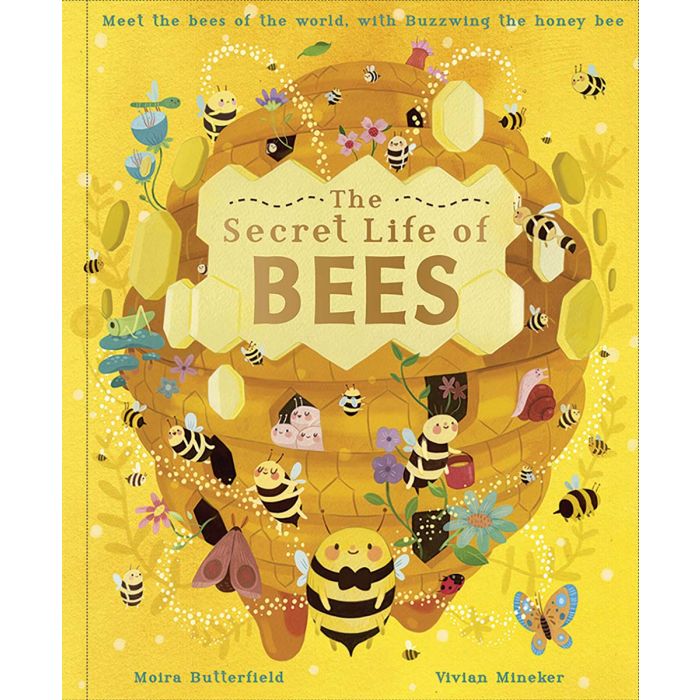
By Moira Butterfield, The Secret Life of Bees (Happy Yak, 2021) introduces kids to bee life along with Buzzwing, a worker bee. Readers learn about bee science and behavior along with bee folklore and fables, including bee stories from Greece, North America, India, Thailand, and Australia. For ages 4-8.

Anne Rockwell’s Honey in a Hive (HarperCollins, 2005) in the Let’s-Read-and-Find-Out Science series, covers the life cycle and behavior of bees and the process of making honey through a reader-friendly text illustrated with detailed paintings. For ages 5-8.

Gail Gibbons’s The Honey Makers (HarperCollins, 2000) covers life in the hive, the functions of queen, drones, and worker bees, and the process of bee-keeping and honey-harvesting, these last through sample pages from a bee keeper’s diary. For ages 6-9.

Joanna Cole’s The Magic School Bus Inside a Beehive (Scholastic, 1998) covers the same ground as Gibbons’s book (above) with a zany sense of humor: in this volume of the popular series, eccentric teacher Ms. Frizzle tricks her students out in bee costumes, sprays them with pheromones, and transports them (via magic bus) into a beehive. Information is delivered through after-action student-written reports. For ages 6-9.

Charles Micucci’s The Life and Times of the Honeybee (Sandpiper, 1997) is a creatively designed overview of bee/honey history and science. Double-page spreads cover such topics as “From Egg to Bee,” “How Honeybees Make Honey,” “A Honey Flower Menu,” “Buzzing Around the World,” and “Flying Through History.” For ages 7-11.

By Stephen Buchmann, beekeeper and entomology professor, Honey Bees: Letter from the Hive (Delacorte Books for Young Readers, 2010) is a history of bees and honey from prehistoric times to the present for ages 11 and up.

Stephen Buchmann’s Letters from the Hive (Bantam, 2006) is a more detailed history of bees, honey, and humans for teenagers and adults. Various chapters cover a typical beekeeper’s year; bees and honey in myth, legend, and ancient warfare; a history of cooking with honey; mead (“the honey that goes to your head”); and medicinal honey.

Hilda M. Ransome’s The Sacred Bee (Dover Publications, 2004) is a history of bee mythology, folklore, and superstitions from around the world, with many illustrations and photographs of artifacts - among these bees on ancient Greek coins, in Egyptian wall paintings and Mayan hieroglyphics, African bee carvings, and more. For teenagers and adults.
Andrew Gough’s The Bee is an excellent online three-part history of bees from prehistory on, illustrated with terrific color photographs of artifacts.
The American Beekeeping Federation has information on beekeeping and bee research, and a list of useful links for kids.

Tales From the Hive, the companion website to the NOVA program of the same title, has information about the anatomy of a hive, fascinating facts about bees, an interactive bee dance feature, and a resource list.
The Buzz About Bees website is crammed with information about types of bees, bee behavior and life cycles, beekeeping, bee gardening, and more – along with bee pictures, bee poems, bee video clips, puzzles and activities for kids, and an extensive book list.
Activities and Lesson Plans
Bee Memory Experiment has instructions for making a simple homemade bee feeder and using it to test bee memory. For ages 4 and up.
See Pollinator Activities at https://www.plt.org/educator-tips/pollinator-activities-world-bee-day/.
Bees Louise has a list of bee-based lesson plans for a range of ages. For example, kids learn bee anatomy by creating their own bee costumes; make a “Colorful Bees” mobile; make a Nectar Navigator and learn how bees find food; dissect a flower while learning about pollination; and dissect an adult bee.
Disappearing Bees

Suzanne Slade’s What If There Were No Bees? (Picture Window Books, 2010) emphasizes the importance of bees to ecosystems and food chains. Other titles in the series include What If There Were No Gray Wolves? and What If There Were No Sea Otters? Thought-provoking picture books for ages 5-8.
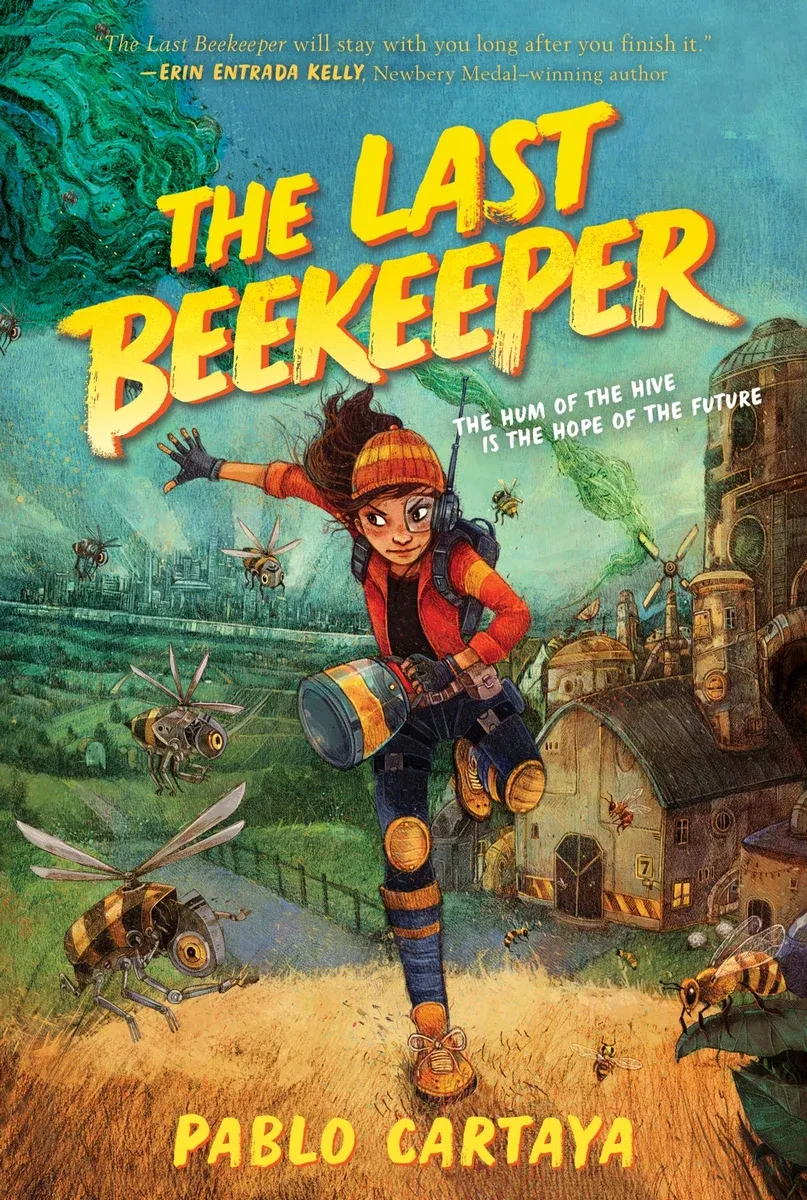
By Pablo Cartaya, The Last Beekeeper (HarperCollins, 2023) is set in a future world racked by climate disaster where young Yoly has to fight to save the last beehive from extinction. An exciting dystopian adventure for ages 8-12.

Odo Hirsch’s Darius Bell and the Crystal Bees (Allen & Unwin, 2012) does not, as I expected, feature magical crystal bees. Instead, the real bees are dying; the Bell estate – which raises fruits and vegetables – is threatened; and Darius sets out to solve the problem, despite opposition from a villainous mayor and difficult school principal. For ages 8-12.

The Hive Detectives: Chronicle of a Honey Bee Catastrophe by Loree Griffin Burns (Houghton Mifflin Books for Children, 2010) tracks four scientists as they try to solve the current mystery of disappearing honeybees, a deadly phenomenon known as “colony collapse disorder” or CCD. Illustrated with color photographs; included is an excellent supplementary resource list. For ages 11 and up.
From the New Yorker, Stung by Elizabeth Kolbert is an excellent article on bees and colony collapse disorder (CCD).
From Forbes, Colony Collapse Disorder – The Real Story Behind Neonics and Mass Bee Death argues that there may be more to CCD than a pesticide problem.

Queen of the Sun (2010) is a documentary on the global bee crisis, with appearances by beekeepers, entomologists, and historians, among them Michael Pollan and May Berenbaum.
The Foundation for the Preservation of Honey Bees sponsors an annual bee-based essay contest for students. They also have a list of resources for kids.

The Great Sunflower Project is an annual citizen-science project in which participants plant “bee-magnet” plants – such as sunflowers – and count the visiting bees. All ages welcome.
Bee Hunt, funded by the U.S. Department of the Interior and the National Science Foundation, is a citizen science project studying pollinators – including the all-important bee. Find out how to participate at the website.

For more bee-related citizen science projects, see PollinatorLive at https://pollinatorlive.fsnaturelive.org/. The site includes links and brief descriptions of citizen science projects surveying bees, butterflies, birds, and more. (Volunteer!)
Science and Bees

Joel Levy’s A Bee in a Cathedral and 99 Other Scientific Analogies (Firefly Books, 2011) presents basic scientific concepts in memory-jogging fashion, using creative analogies and infographics. Readers discover, for example, that a chunk of a neutron star the size of a sugar cube weighs more than the entire human race; that a single thunderstorm contains enough energy to power the U.S. for four days; and that every cell in the human body (except red blood cells) contains about two yards of DNA. The bee in the cathedral is a famous analogy comparing the size of the atomic nucleus (the bee) to the size of the atom (the cathedral). For ages 12 and up.

Rose-Lynn Fisher’s Bee (Princeton Architectural Press, 2012) is a spectacular collection of photomicrographs of bees – magnified hundreds to hundreds of thousands of times (using a scanning electron microscope). Fascinating for all ages.

To get a good look at bees, close up, try a Microslide Viewer (American Educational Products). This is a wonderful tool designed for the viewing of microslides – that is, collections of photomicrographs taken at various magnifications. Users get the effect of a high-powered microscope, but – unlike a microscope – the microslide viewer is inexpensive, essentially unbreakable, easily washable, and can be used by the very young. Available from Carolina Biological Supply at
https://www.carolina.com/microscope-slide-classroom-resources/microslide-viewer/489700.pr.
Microslide sets each consist of a strip of 8 related photomicrograph images and an explanatory booklet. The Honeybee Microslide set, for example, includes photomicrographs of bee mouth parts, antenna, compound eye, wing hooks, pollen basket, honeycomb cells, and sting and poison sac.
Flight of the Bumblebee explains how bumblebees fly. (Not very efficiently, it turns out.)
A jolt of java for the bees? From the NY Times, this article discusses research showing that plants lure in pollinating bees with caffeine-laced nectar.
From the Smithsonian magazine, The Secret Life of Bees by Carl Zimmer explores the complex behaviors of bee swarms. See https://www.smithsonianmag.com/science-nature/the-secret-life-of-bees-99559587/.
How Bees Work – illustrated with photos, labeled diagrams, and video clips – covers bee anatomy, types of bees, bee venom, pollination, the bee life cycle, navigation, honey production, colony collapse disorder, and more.
What does a honeybee see? Find out at B-Eye.

Tiny flying bee robots! Learn all about Robobees.

Numbering Bees is an account of how Karl von Frisch first discovered the honeybee dance language.
Mathematical Bees

Why do bees make hexagons? Find out here.
On You Tube from TED-ED, see a kid-friendly Why do bees love hexagons?
Bees do math. In fact, this article describes how they’re better than computers at solving the famous “traveling salesman” problem – that is, how to visit as many places as possible while expending the least amount of energy.
See the Trials and Tribulations of the Traveling Salesman for a mathematical explanation. (Warning: it's complicated.)

BEE Math Arithmetic Operations covers addition and subtraction with hexagons and buzzing cartoon bees.
Bumble Numbers in a math arcade game of arithmetic equations played with an animated bee. Players grab numbers out of the air with their bee and drop them into the flower with the corresponding equation.
Honey
The National Honey Board has general information about the history and uses of honey, and dozens of categorized honey recipes.

Holley Bishop’s Robbing the Bees (Atria Books, 2006) is a “biography of honey,” variously covering the science of bees and beekeeping, and the history of humans’ interactions with bees and honey. Included are honey recipes (“Old and New”). For teenagers and adults.

Jay Ingram’s The Velocity of Honey and More Science of Everyday Life (Basic Books, 2006) is a collection of reader-friendly essays in which the title honey essay explains just why honey doesn’t ooze every which way when poured on toast. It’s an adult book, but an interesting read for ages 13 and up. Great addition to any science program.
Viscosity is a measure of the “thickness” of liquids: honey and molasses (thick) are notably viscous; water and apple juice (thin) aren’t. Viscosity Races is a great experiment investigating viscosity for ages 5 and up. You’ll need a homemade ramp, an assortment of liquids, and a tape measure or stopwatch. (And, I would guess, lots of paper towels.)
Make a seven-layer density column - a spectacular multicolored seven-layer column of liquids of various densities, starting with very heavy honey. A very cool experiment. See https://www.youtube.com/watch?v=fE2KQzLUVA4.
Bee Poems

Betsy Franco’s Bees, Snails, and Peacock Tails (Margaret K. McElderry Books, 2008), with wonderful colorful illustrations by Steve Jenkins, is a celebration of pattern in nature through poetry, with subjects that include the puffer fish, diamond-backed rattlesnake, snail, peacock, spider, and bee. (“Study a beehive/and you will see/the mathematical genius of the bee.” ) Delightful for ages 3-8.

“Honeybees,” in Paul Fleischman’s prize-winning collection Joyful Noise: Poems for Two Voices (HarperCollins, 2004), is a clever dialogue between a worker bee and a queen. (Worker: “Being a bee…is a pain.”)

Douglas Florian’s UnBEElievables (Beech Lane Books, 2012) is a collection of honeybee poems and illustrations (using creative mixed media on paper bags). Sample titles: “Bee Anatomy,” “Drone,” and “Where Are the Bees?” For ages 5-10.
Emily Dickinson wrote several wonderful poems about bees – among them "Bee! I'm expecting you" written as a springtime letter to a Bee from an impatient Fly. See https://allpoetry.com/Bee!-I'm-expecting-you!.
Try writing some impatient springtime letters of your own.
Rudyard Kipling’s "The Bee-Boy's Song" describes the traditional belief that all family news must be told to be bees. See https://www.kiplingsociety.co.uk/poem/poems_beeboy.htm.

Sylvia Plath’s five bee poems - “The Bee Meeting,” “Sting,” “The Swarm,” “The Wintering,” and “On the Arrival of the Bee Box” – are found in her collection Ariel (Harper Perennial, 2005). For teenagers and adults.

British poet laureate Carol Ann Duffy’s The Bees (Faber & Faber, 2013) is a powerful poetry collection with an on-going theme of bees. For teenagers and adults.
Bee Arts and Crafts
First School’s Bee Craft page has a list of bee-themed activities for preschoolers, including online coloring pages, an introduction to the letter B, and a make-your-own-flying-bee pattern.
DLTK’s Bumblebee Craft Projects has instructions for several bee projects, among them a bee bookmark, fingerprint bees, and paper-plate bees.
Make a Bumblebee Mobile with fuzzy chenille stems and Styrofoam balls.

BZZZ Says the Bumble Bee has instructions for making particularly cute bees from cardboard tubes.
Music of and by Bees

From NPR, The Bee’s Knees: Music With a Definite Buzz is an assortment of bee-ish music, including three versions of “The Flight of the Bumblebee” (one on the tuba); Franz Schubert’s “The Bee,” and Emily Dickinson’s “Bee, I’m Expecting You” set to music.

Try an art-and-music project in which kids create abstract artworks while listening to "Flight of the Bumblebee."
This online rendition of Nikolai Rimsky-Korsakov’s “Flight of the Bumblebee” by Croatian pianist Maksim Mrvica will knock your socks off.
From Tonehammer, listen to Music Made With Bees. Just bees.
Diego Stocco’s Music From Nature, made to commemorate Earth Day 2012, incorporates bees, tree branches, rice, and coconuts. See https://vimeo.com/43198585.