
Chocolate
In this collection
Measure the speed of light - with chocolate!
Find out how below - and check out Chocolate Stories; Chocolate History and Science; A Chocolate Pilot and a Chocolate Entrepreneur; Chocolate Lesson Plans; Sundaes, Fudge, and Play Dough; Chocolate Poems; and What to Do With a Chocolate Box.
Chocolate Stories

Fred Gwynne’s A Chocolate Moose for Dinner (Aladdin, 1988) is a picture book of giggle-provoking homonyms: “Mommy says she had a chocolate moose for dinner last night. And after dinner she toasted Daddy.” (Accompanying illustrations: a giant chocolate moose with a napkin under his chin and a hapless father sitting in an enormous toaster.) Admittedly there’s not much chocolate in it, but it’s a great excuse for whipping up a family batch of chocolate mousse.

Try this mousse from Marin Mama Cooks- it’s a very simple recipe intended for kids (with a little bit of help). See https://marinmamacooks.com/2-ingredient-chocolate-mousse-with-coconut-sugar-whipped-cream/.

Gertrude Chandler Warner’s The Chocolate Sundae Mystery (Albert Whitman & Company, 1995) is one of the Boxcar Children series – which began with the four orphaned Alden children living in a boxcar, though by the end of book one, the four are living with their wealthy grandfather and the boxcar is in the backyard of his mansion. In this volume, the kids take a job working at the town ice cream parlor – where suddenly, mysteriously, ice cream and dishes begin to disappear. The owner, discouraged, thinks of closing the store, until the Aldens manage to solve his problem. For ages 7-10.

Patrick Skene Catling’s The Chocolate Touch (HarperCollins, 2006) is a twist on the King Midas tale for ages 7-11. Young John Midas, a selfish pig when it comes to candy, tastes a delicious chocolate from a mysterious candy shop, after which everything he touches turns to chocolate: his breakfast bacon and eggs, his shiny new trumpet, and even, eventually, his mother. It’s funny, but – without being preachy – it also teaches a useful lesson about the perils of greed and the benefits of healthy eating.

Henry Green, the hero of Robert Kimmel Smith’s Chocolate Fever (Puffin, 2006), eats nothing but chocolate – until suddenly he breaks out in chocolate-colored spots. His teacher sends him to the suspicious Dr. Fargo, who diagnoses the problem as chocolate fever. What follows: an exciting chase, an encounter with a kindly truck driver, a hijacking – and ultimately a lesson learned and a chocolate-fever cure. For ages 7-11.

In Roald Dahl’s Charlie and the Chocolate Factory (Puffin, 2011), poverty-stricken Charlie Bucket finds a golden ticket that entitles him to a trip to Willy Wonka’s fabulous candy factory. (Nobody does candy better than Roald Dahl.) The book is zany, imaginative, and satisfyingly moral – wicked children come to awful ends – but it’s all in good fun. For ages 8 and up. (Also available in French and Spanish.)

For movie-lovers, there’s Tim Burton’s version of Charlie and the Chocolate Factory (2005) with Johnny Depp as Willy Wonka (rated PG) and Mel Stuart’s
Willy Wonka and the Chocolate Factory (1971), with Gene Wilder as Willy (rated G).

In Charlotte Herman’s My Chocolate Year (Simon & Schuster, 2008), set in Chicago just at the end of World War II, Dorrie’s fifth-grade is about to embark on the annual “Sweet Semester,” in which the students compete to bake the best dessert (and write the best essay about it) – but Dorrie has no talent for cooking. At the same time, Dorrie’s Jewish-American family is fearfully awaiting news of the fate of relatives in Europe. Many have not survived the war, but sixteen-year-old cousin Victor is finally located in a displaced-persons camp. Victor, whose family had a bakery, is able to help Dorrie with her cooking problems (he provides a recipe for Peppermint Chocolate Sticks) – but Dorrie’s winning essay is about Victor’s experiences under the Nazis and the value of family. It’s a charming evocation of 1940s home life, and the dark historical background is gently presented for readers aged 8-11. Included are twelve recipes for chocolate desserts.

Pseudonymous Bosch’s This Book Is Not Good for You (Little, Brown Books for Young Readers, 2009) – third of the hilarious Secret Series – centers around a trance-inducing recipe for chocolate and an evil chef and chocolatier. (“Do not read this book standing up. You may fall down from shock.”) For ages 8-12.

Jane Austen and…magic? By Patricia Wrede and Caroline Stevermer, Sorcery and Cecelia, or The Enchanted Chocolate Pot (Harcourt Children’s Books, 2003) is written as an exchange of letters between two cousins, Kate and Cecelia, living in an alternative magical England in the early 19th century. Along with London seasons, tea parties, horse-drawn carriages, Lord Byron, and the Elgin marbles, Kate and Cecy also have to deal with the Royal College of Wizards, magic spells, and an extremely important ensorcelled chocolate pot. For ages 12 and up.

Robert Cormier’s The Chocolate War (Ember, 2004) is a challenging and discussion-heavy read for ages 12 and up. The protagonist, Jerry Renault, refuses to sell chocolates for the high-school fundraiser – which decision pits him against the school administration and the Vigils, the school gang, headed by the unscrupulous Archie Costello. Issues include peer intimidation, violence, individualism vs. groupthink, and the real dangers inherent in bucking the system.

In Tara Sullivan’s The Bitter Side of Sweet (Speak, 2017), 15-year-old Amadou and his little brother have been trapped into forced labor on a cacao plantation on the Ivory Coast. Together with Khadija, the only girl in the camp, they decide to escape. A gripping and sometimes painful story for ages 12 and up.

For mature teenagers (there’s sex in it) and adults, Laura Esquivel’s Like Water for Chocolate (Anchor Books, 1995) – subtitled “A Novel in Monthly Installments with Recipes, Romances, and Home Remedies” – is set in turn-of-the-century Mexico. Part fairy-tale, part soap opera, the story centers around Tita who – forbidden to marry the man she loves – pours her emotions into cooking.

Joanne Harris’s Chocolat (Penguin, 2000) is set in a tiny town in France, where Vianne Rocher and her young daughter Anouk (who has an imaginary pet kangaroo, Pantoufle) open a marvelous chocolate shop, infuriating the parish priest, but bringing hope to a wide range of unhappy outcasts. For teens and adults.
The movie version of Chocolat (2000), starring Juliette Binoche, Judi Dench, and Johnny Depp, is rated PG-13.
Chocolate History and Science

Inez Synder’s Beans to Chocolate (Children’s Press, 2003) traces the making of chocolate from cacao bean to candy kiss in 24 photo-illustrated pages with a simple large-print text, for ages 3-5. (The book is one of the “How Things Are Made” series; other titles include Wax to Crayons, Milk to Ice Cream, and Trees to Paper.)

C.J. Polin’s 48-page The Story of Chocolate (DK Publishing, 2005) is divided into six sections: “Chocolate trees,” “An ancient treat,” “To Europe and beyond,” “Chocolate factories,” “Making chocolate today,” and “All kinds of chocolate.” The book is illustrated with lush color photographs. For ages 5-10 (recommended as a read-alone book for grades 2-4).

Sandra Markle’s Smart About Chocolate: A Sweet History (Grosset & Dunlap, 2004) is a cleverly designed overview of chocolate written in the style of a creative kid’s school report and illustrated with photos and catchy bright-colored kid-labeled maps and drawings. In 32 pages, it manages to cover everything from the Mayas to Milton Hershey, plus a bit of chocolate science, chocolate recipes, and a reference list. For ages 5-10.

Sarah Moss’s Chocolate: A Global History (Reaktion Books, 2009) is one of an extensive short (128 pages) series on food history. Many titles, among them Bread, Cheese, Tea, and Milk. For teens and adults.
Visit the San Francisco Exploratorium’s Sweet Science and History of Chocolate for an excellent interactive chocolate experience, including video clips of an Amazon cacao plantation and an American chocolate factory, interviews with scientists, and a hands-on chocolate experiment. See https://annex.exploratorium.edu/chocolate/.
Chocolate contains about 380 different chemicals. Learn all about it at Neuroscience for Kids: Discovering the Sweet Mysteries of Chocolate.
The dark side of chocolate: find out why not to feed it to the dog at The Curious (Toxic) Chemistry of Chocolate.
From Chicago’s Field Museum, visit All About Chocolate for chocolate word puzzles, a Fun-Facts-based illustrated history of chocolate, an online activity in which kids can make a chocolate bar from scratch, and an assortment of kid-friendly chocolate recipes, including Mexican hot chocolate and chocolate modeling clay.
Also from the Field Museum, see the Educators’ Resources page for a terrific downloadable resource kit, Cocoa Connections: From Beans to Bars, with multiple lessons grouped under “Chocolate and the Environment” and “Chocolate and Culture.”

Learn all about the chemistry of chocolate. Also see
Toxicity and Aphrodisia: The Chemistry of Chocolate.

Measure the speed of light with chocolate! You'll need a microwave and a chocolate bar. Check it out at the Smithsonian's Quantum Chocolate.
A Chocolate Pilot and a Chocolate Entrepreneur

In the Childhood of Famous Americans series, Milton Hershey: Young Chocolatier by M.M. Eboch (Aladdin, 2008) is the rags-to-riches story of the famous Pennsylvania chocolate entrepreneur for ages 7-11.

For older teenagers and adults, see Michael D’Antonio’s Hershey: Milton S. Hershey’s Extraordinary Life of Wealth, Empire, and Utopian Dreams (Simon & Schuster, 2007), a comprehensive reader-friendly biography with cover photo of a gigantic Hershey’s chocolate bar.

Margot Theis Raven’s Mercedes and the Chocolate Pilot (Sleeping Bear Press, 2011) is based on the true story of a young German girl during the days of the Berlin Airlift, when American cargo pilot Gail Halvorsen began dropping chocolate bars (attached to little parachutes) to the blockaded children of West Berlin. Mercedes writes a letter to Halvorsen, asking him to look for her house, which has white chickens in the yard. An epilogue describes how the two met when Halvorsen visited Germany in 1972. For ages 6-10.

Michael O. Tunnell’s Candy Bomber: The Story of the Berlin Airlift’s Chocolate Pilot (Charlesbridge Publishing, 2010) is a more detailed account of the Airlift and Gail Halvorsen, the “candy bomber.” Illustrated with black-and-white photos, for ages 9-14.
Chocolate Lesson Plans

Where does chocolate come from? Learn all about Cacao Tree Geography while coloring and labeling a map.
For free printable maps, see here.
From the Guardian, The Dark Side of Chocolate is a multidisciplinary hyperlinked lesson plan in which kids view a video about chocolate making, identify chocolate-growing regions on a map, listen to some prize-winning chocolate rap, and invent a fair-trade chocolate bar.

Chocolate Chip Cookie Mining is a hands-on exercise on environmental destruction as kids “mine” chocolate chips from cookies using toothpicks as mining tools. The lesson plan includes background info on coal mining and suggestions for extension activities.
See Chocolate Recipes for Kids for a quick-and-easy chocolate chip cookie recipe.
From the American Chemical Society’s ChemMatters magazine, Chocolate: The New Health Food – Or Is It? is a terrific illustrated article on the science of chocolate for middle- and high-school-level students, illustrated with photos and great color diagrams.
From Young Minds Inspired, The Story of Chocolate is a downloadable color-illustrated lesson unit on the history, cultivation, and consumption of chocolate. Included is a chef’s guide to the different types of chocolate and a recipe challenge. For high-school-level students.
Sundaes, Fudge, and Play Dough
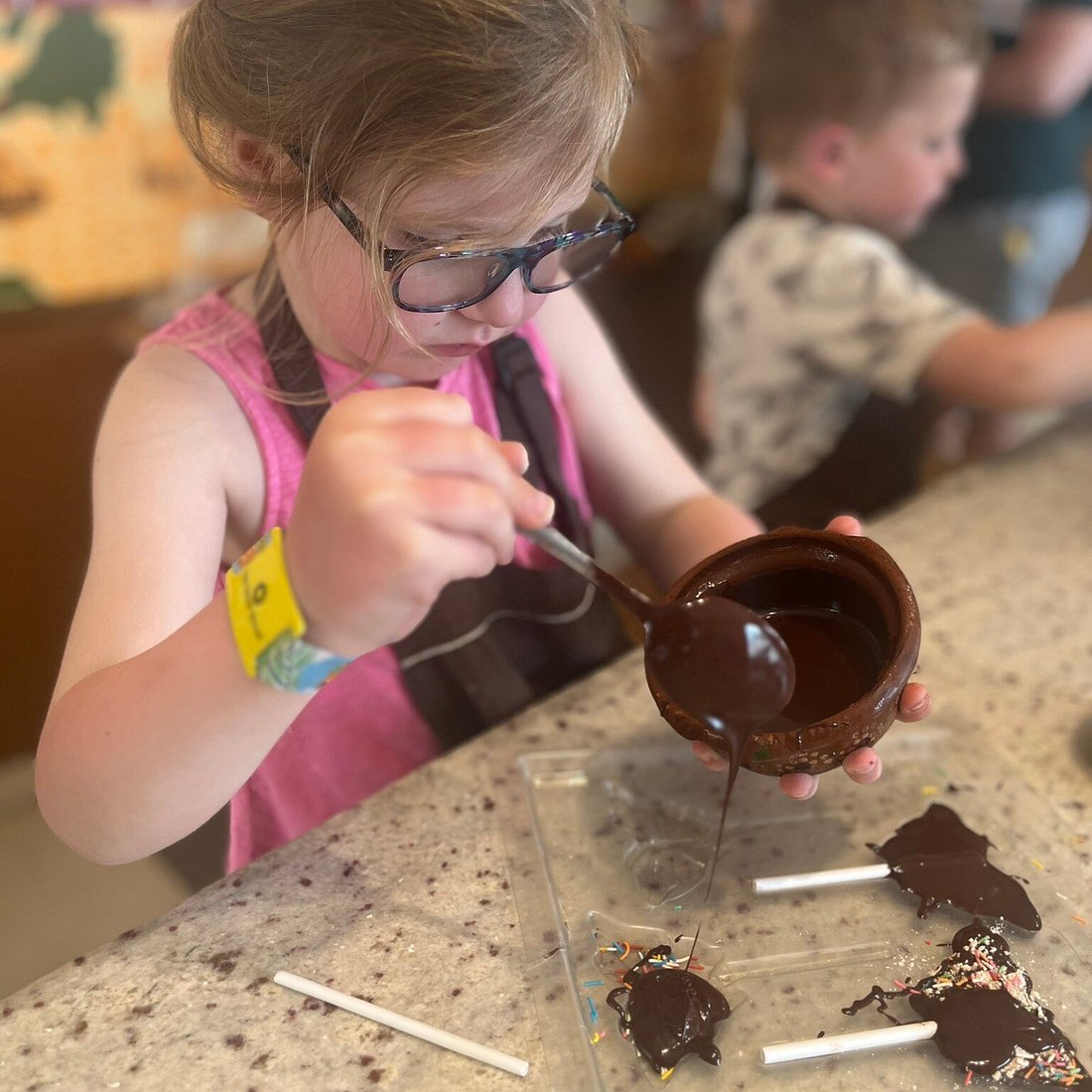
Mix up a batch of your own chocolate at home with the Craftly's Chocolate Making Kit. The kit includes everything you need for whipping up yummy dark chocolate: organic cocoa butter, cocoa powder, agave syrup, silicone molds, and a thermometer – plus instructions. See 

See these instructions for making Fudge in a Ziploc Bag – just combine ingredients, seal bag, and squish.
Make chocolate play dough! See https://theimaginationtree.com/easy-chocolate-play-dough-recipe/.
Chocolate Poems
Read Rita Dove’s poem Chocolate.

Arnold Adoff’s Chocolate Dreams (Lothrop, Lee & Shepard, 1989) is an illustrated collection of all-chocolate poems for ages 7-11. It’s out of print, but available from used-book suppliers and public libraries.