
Thanksgiving
In this collection
Not all Americans celebrate Thanksgiving. Like Columbus Day, it's a holiday with troubled and tragic historical roots. From the Smithsonian, see The Myths of the Thanksgiving Story and the Lasting Damage They Imbue.
On the other hand, for all its past, in the here and now the holiday has come to be a time to celebrate family, togetherness, and appreciation of what we're lucky enough to have - all indisputably good things and traditions we'd be poorer without.
But that doesn't mean that we shouldn't know both sides of the Thanksgiving story. From Learning for Justice, see Teaching Thanksgiving in a Socially Responsible Way for resources and recommendations for Native American historical perspectives.

How Carrots Won the Trojan War (Storey Publishing, 2011), a catchy science and history of garden vegetables, is packed with stories and information adaptable for a wide range of educational and just plain interesting purposes. For Thanksgiving, check out the corn and pumpkin chapters. Find out what corn has to do with vampires and why pumpkins occasionally explode.
Historical Thanksgiving

Katharine Ross’s The Story of the Pilgrims (Random House, 1995) is a simple and attractively illustrated account of the Thanksgiving story for ages 3-7. (It begins “Once upon a time…”)
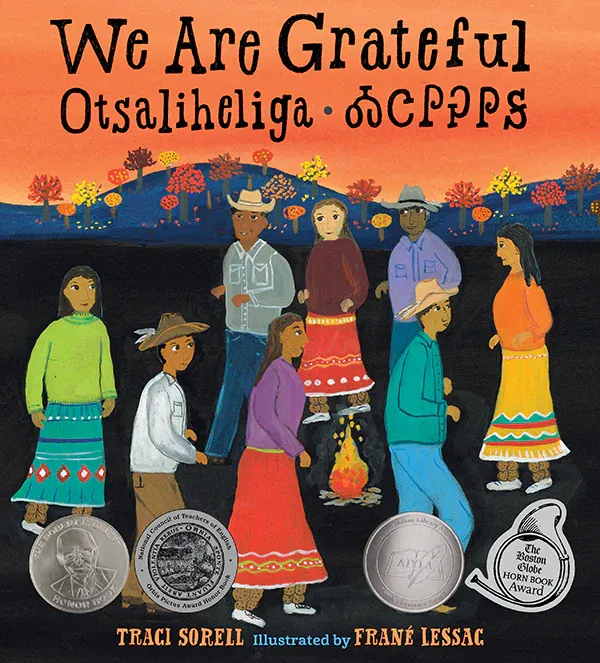
Traci Sorell’s award-winning We Are Grateful: Otsaliheliga (Charlesbridge, 2018) is a picture-book celebration of how the Cherokee people express gratitude throughout the seasons with a mix of modern and traditional practices. A lovely account of family and thankfulness for ages 3-7.
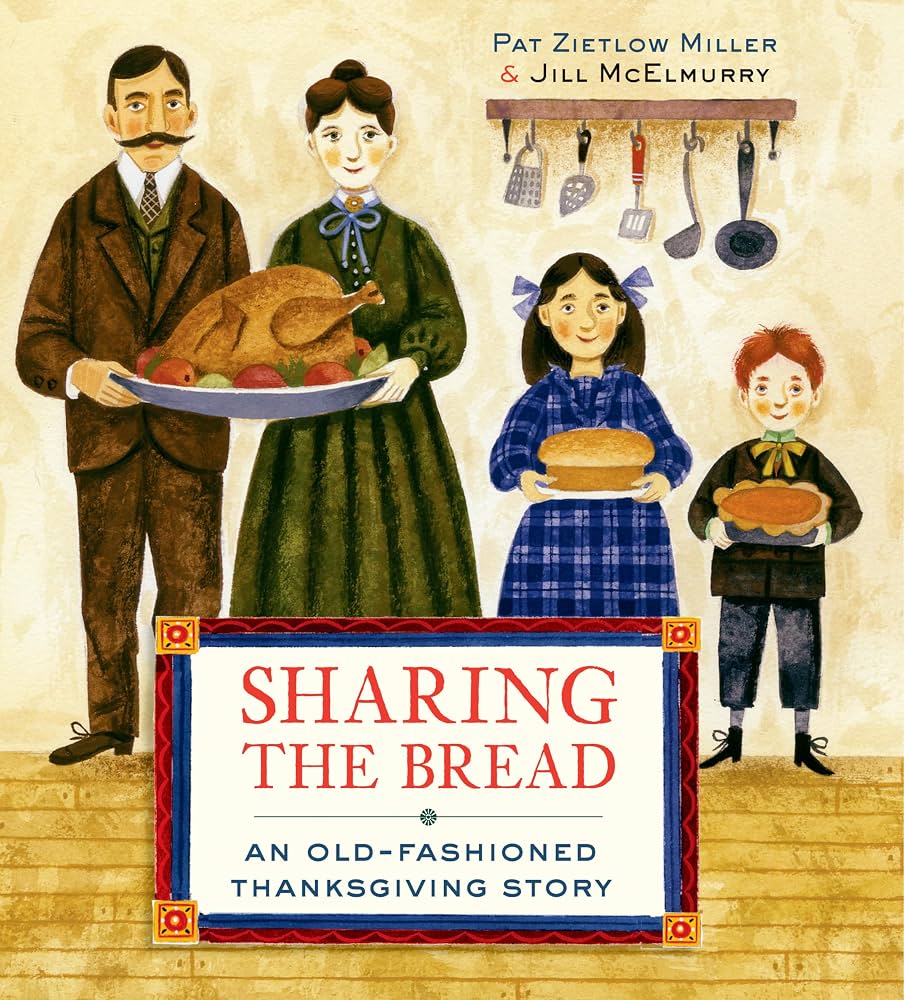
By Pat Zietlow Miller, in Sharing the Bread: An Old-Fashioned Thanksgiving Story (Dragonfly, 2024), set at the turn of the 20th century, every member of an extended family shares in the preparation of Thanksgiving dinner. Told in rhyming verse with lovely period illustrations. For ages 3-7.

Ann McGovern’s The Pilgrims’ First Thanksgiving (Scholastic, 1993) is a short picture-book history filled with interesting details. Readers learn that two dogs and a cat sailed on the Mayflower, that the ship was the size of two trucks, and that the first Thanksgiving feast lasted for three whole days. For ages 4-8.

By Kate Waters, Sarah Morton’s Day (Scholastic, 2008) – illustrated with wonderful photos from the Plimouth Plantation living museum – is an account of a day in the life of a nine-year-old Pilgrim girl in 1627. For ages 4-8.
In the same format, see Waters's Samuel Eaton's Day (Scholastic, 1996), a photo-illustrated day in the life of a seven-year-old Pilgrim boy.

Also by Kate Waters, Tapenum’s Day (Scholastic, 1995), a typical day in the life of a young Wampanoag boy in the early 1600s - which begins with young Tapenum disappointed that he has not yet been chosen for initiation as a pniesog, a warrior. For ages 4-8.

Susan E. Goodman’s Pilgrims of Plymouth (National Geographic Children’s Books, 2001) is the story of the everyday lives of Pilgrim children, illustrated with great color photographs from the Plimouth Plantation living history museum. For ages 4-8.

Jean Craighead George’s The First Thanksgiving (Puffin, 2001) puts the holiday in a long perspective, starting with the shaping of Cape Cod and deposit of Plymouth Rock by glaciers, then the warming of the climate, the arrival of the Pawtuxets, the kidnapping and return of Squanto, and the coming of the Pilgrims. Illustrated with beautiful paintings by Thomas Locker. For ages 4-8.

In Diane Stanley’s Thanksgiving on Plymouth Plantation (HarperCollins, 2004), Liz and Lenny (the Time-Traveling Twins), along with their grandma and dog, Moose, travel back in time to 1621 and the first Thanksgiving feast. A cleverly presented approach to the real story of Thanksgiving. Illustrated endpapers compare what foods were eaten at the first feast (boiled eels, pottage, beer) to what is traditionally eaten today. For ages 4-8.

In Carol Peacock’s Pilgrim Cat (Albert Whitman & Company, 2004), young Faith adopts a stray cat on board the Mayflower and names it Pounce. The cat remains her friend through all the hardships ahead (and ultimately produces a litter of Pilgrim kittens). For ages 4-8.

By Alice Dalgleish, The Thanksgiving Story (Aladdin, 1985) – with stylized folkart-ish illustrations by Helen Sewell – is the story of the Mayflower voyage, the Plymouth colony, and the first Thanksgiving as seen through the eyes of young Pilgrims Giles, Constance, and Damaris Hopkins. For ages 5-8.
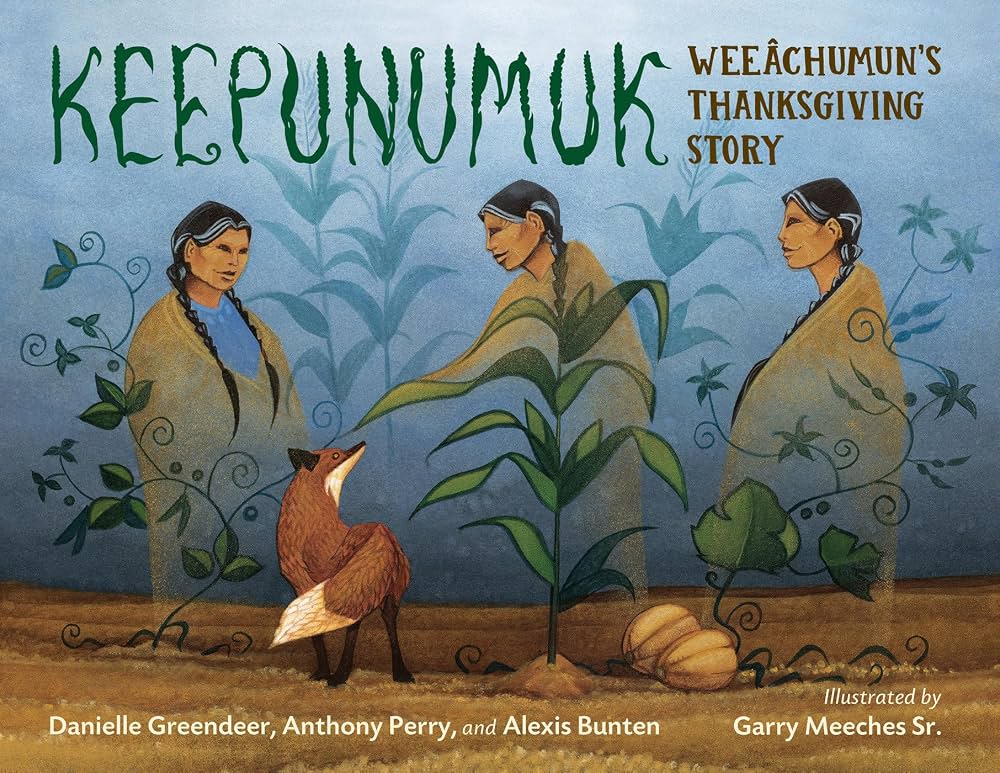
By Danielle Greendeer and co-authors, Keepunumunk (Charlesbridge, 2022) is a story of Thanksgiving through Wampanoag eyes. Learn how to make a Spirit Plate in honor of plants, animals, and ancestors. Appendices include a glossary and additional historical information. For ages 5-8 – and a good pick for a Thanksgiving family read for all.

Kathryn Lasky’s Two Bad Pilgrims (Viking Juvenile Books, 2009) is the story of obstreperous real-life Pilgrim boys Francis and John Billington, who nearly blew up the Mayflower. For ages 5-8.
For more on the badly behaved Billingtons, see Clyde Bulla’s 88-page John Billington: Friend of Squanto (Ty Crowell Company, 1956). It’s out of print, but is available in inexpensive used editions. For ages 7-10.

By Laurie Halse Anderson, Thank You, Sarah: The Woman Who Saved Thanksgiving (Simon & Schuster, 2005) is a delightful account of Sarah Hale’s 38-year campaign to have Thanksgiving declared a national holiday – which Abraham Lincoln finally signed into law in 1863. The appendix – “A Feast of Facts” – ends by challenging readers to “Pick up a pen. Change the world.” For ages 5-9.

In Thanksgiving on Thursday (Random House, 2002), one of Mary Pope Osborne’s Magic Tree House series, the Tree House sends Jack and Annie back in time to 1621, where they meet the Pilgrims and Squanto and almost disrupt the first Thanksgiving. For ages 6-9.

Kenneth C. Davis’s appealingly designed Don’t Know Much About the Pilgrims (HarperCollins, 2006) is written is question-and-answer format: “You know they wore tall black hates and ate turkey and cranberries. But who were the Pilgrims, really?” “Did the Pilgrims call themselves Pilgrims?” “What was life like on the Mayflower?” The reader-friendly text is interspersed with cartoonish illustrations, fact boxes, and timelines. For ages 6-9.

Marcia Sewall’s The Pilgrims of Plimoth begins “Aye, Governor Bradford calls us pilgrims. We are English and England was our home.” Illustrated with primitive-style paintings. For ages 6-9.

Anne Kamma’s If You Were At the First Thanksgiving (Scholastic, 2001) is written in an appealing question-and-answer format that makes for a great interactive reading experience. Questions range from the broadly historical to the everyday: Why did the Pilgrims come to America? Were Pilgrim parents strict? Who was Squanto? Had the Pilgrims seen turkey before they came to America? Did the Pilgrims make cranberry sauce? Did any Indian children come to the first Thanksgiving? For ages 6-10.

Ann McGovern’s If You Sailed on the Mayflower in 1620 (Scholastic, 1991), written in question-and-answer format, features such questions as: How many people sailed on the Mayflower? What could the Pilgrims take with them? Did they land on Plymouth Rock? What did the Pilgrims learn from Squanto? For ages 6-10.

Cheryl Harness’s Three Young Pilgrims (Simon & Schuster, 1995) covers a year in the lives of three real children who traveled to America on the Mayflower – Mary, Remember, and Bartholomew Allerton – from the landing of the ship and the establishment of the new Plymouth colony to the first Thanksgiving feast. Well-done history illustrated with terrific paintings and diagrams. For example, there’s a great double-page cutaway spread of the (very crowded) Mayflower, with all the parts of the ship labeled. For ages 6-10.

By Joseph Bruchac, Squanto’s Journey (Houghton Mifflin Harcourt, 2007), narrated in the first person, is the story of a remarkable life. Squanto was kidnapped by John Smith, sold into slavery in Spain, and eventually made it home again, only to find his family and tribe dead of disease. Nonetheless, he befriended and supported the early settlers at Plymouth. A well-researched story for ages 6-10.

Jean Fritz’s Who’s That Stepping on Plymouth Rock? (Puffin, 1998) is a witty and original history of the iconic Plymouth Rock – the one and only big rock on the beach at the time when the Pilgrims (a.k.a. the First Comers) arrived. There’s no evidence that any Pilgrim landed on it, but their descendants built a wharf on top of it, moved it twice, and broke it in half once. A thoroughly interesting read for ages 7-11. (And so is everything else by Jean Fritz.)

Mary Englar’s The Pilgrims and the First Thanksgiving (Capstone Press, 2007) – one of the Graphic History series – is a 32-page comic-book-style account of the Pilgrims’ story. For ages 8 and up.

Catherine O’Neill Grace’s 1621: A New Look at Thanksgiving (National Geographic Children’s Books, 2004), a Wampanoag-centric look at the famous first feast, has well-researched and fascinating information on the local Pawtuxet tribe and debunks the common mythology of Thanksgiving. An excellent view of history from a Native American viewpoint, illustrated with photos from the Plimouth Plantation living history museum. For ages 8-12.

By Plimouth Plantation (with Peter Arenstam, John Kemp, and Catherine O’Neill Grace), Mayflower 1620: A New Look at a Pilgrim Voyage (National Geographic Children’s Books, 2007) is a well-researched account of the landmark voyage using primary sources and peppered with first-person accounts. Illustrated with photos from a re-enactment using the Mayflower II. For ages 8-12.

Penny Coleman’s 160-page Thanksgiving: The True Story (Henry Holt and Company, 2008) is divided into two main parts – Thanksgiving Origins and Thanksgiving Traditions – both crammed with period illustrations, maps, and fascinating information. (A table lists 12 competing claims for America’s “first Thanksgiving,” variously from Texas, Florida, Maine, and Virginia, as well as Massachusetts.) For ages 10 and up.

Nathaniel Philbrick’s 350-page The Mayflower and the Pilgrims’ New World (Puffin, 2009), adapted and abridged from Philbrick’s best-selling adult book Mayflower (Penguin, 2007), is a detailed and fascinating account spanning the period from the Mayflower voyage to the outbreak of King Philip’s War. Readers learn the true story of the relationship between the Plymouth colonists and the Native Americans, which isn't that of the traditional Thanksgiving myth. The book is illustrated with maps, photos, and period prints. Included are a timeline, the Mayflower passenger list, additional reading suggestions, and discussion questions. For ages 11 and up.
Mark Twain’s Plymouth Rock and the Pilgrims – originally a speech given in 1881 – is a less-than-reverent take on the Pilgrims. (“I have kept still for years; but really I think there is no justification for this sort of thing. What do you want to celebrate those people for?”)

The Plimouth Plantation website has a great assortment of educational resources for kids, including an interactive investigation of the first Thanksgiving, a Thanksgiving virtual field trip, and a list of illustrated historical essays for kids, among them “Who Were the Pilgrims?.” “Who Were the Wampanoag?,” “Thanksgiving,” and “What’s For Dinner?”
ALL ABOUT THANKSGIVING FOOD

Aliki’s Corn Is Maize: The Gift of the Indians (HarperCollins, 1986) is a picture-book overview of the science and history of corn, with information on native American customs and festivals and a brief account of the Pilgrims and Thanksgiving. For ages 4-8.

Also see Charles Micucci’s The Life and Times of Corn (Houghton Mifflin Harcourt, 2009); Tomie de Paola’s The Popcorn Book (Holiday House, 1984); and Gail Gibbons’s Corn (Holiday House, 2009).

By Lucille Recht Penner, Eating the Plates: A Pilgrim Book of Food and Manners (Aladdin, 1997) is a 128-page survey of Pilgrim daily life with an emphasis on food (recipes included; recreate a genuine first Thanksgiving dinner). For ages 7-10.

American as Pumpkin Pie from Backstory Radio features historian James McWilliams discussing real Thanksgiving foods, religion scholar Anne Blue Wills on the Victorian origins of the modern holiday, and an archaeologist from Colonial Williamsburg on early American diets.
From the Food Timeline, American Thanksgiving is a history of traditional Thanksgiving foods with period recipes and quotations.
From Smithsonian magazine, find out What Was on the Menu at the First Thanksgiving?
Lincoln and Pumpkin Pudding at https://toriavey.com/thanksgiving-abraham-lincoln-and-pumpkin-pudding/ covers Sarah Josepha Hale’s Thanksgiving campaign, Lincoln’s Thanksgiving Proclamation, the origin of the presidential turkey pardon, and a period recipe for pumpkin pudding.

From the New Yorker, Adam Gopnik’s The First Served is an interesting essay on the all-American turkey.
Why are turkeys called turkeys? See Fowl Play: The Twisted Linguistics of Turkey at https://www.nationalgeographic.com/culture/article/fowl-play-the-twisted-linguistics-of-turkey.
All Kinds of Pilgrims

Eve Bunting’s How Many Days to America? (Houghton Mifflin Harcourt, 1990) is a modern-day Pilgrim story, as a Caribbean family escapes from political persecution in a fishing boat, and after a dangerous journey, reaches America on Thanksgiving Day. For ages 4-8.

Set in the early 20th century, Molly’s Pilgrim by Barbara Cohen (HarperCollins, 2005) is the story of a young Russian Jewish girl, recently arrived in America and struggling for acceptance by her new third-grade classmates. When the class is given an assignment to make a doll based on a Thanksgiving character, Molly does her best – but gets last-minute help from her mother, who makes the doll look like a traditional Russian. Molly’s class makes fun of her at first – but then comes to realize that there are many different kinds of Pilgrims. For ages 6-10.
Molly’s Pilgrim is a collection of discussion questions and activities to accompany the book.
Molly’s Pilgrim (1985) is a short (24 minutes) film based on the book, directed by Jeffrey Brown.
Thanksgiving Stories

Alison Jackson’s I Know an Old Lady Who Swallowed a Pie (Puffin, 2002) is a Thanksgiving take on the cumulative nursery rhyme “I Know an Old Lady Who Swallowed a Fly.” Here the astonishing old lady gulps down a pie, a gallon of cider, a whole roll, a squash, a salad, and the entire turkey, to the awe and alarm of all about her. (Perhaps she’ll die.) For ages 3-8.
MakingLearningFun has multidisciplinary activities to accompany I Know an Old Lady Who Swallowed a Pie, among them a cereal-box food game, instructions for making a toilet-paper-tube Old Lady (with pie), and a recipe for tiny bite-sized pumpkin pies.

Eileen Spinelli’s The Perfect Thanksgiving (Square Fish, 2007) is a gift for all families whose Thanksgivings routinely feature underdone potatoes and difficult uncles. There’s a perfect (lace tablecloth, golden turkey) family and a not-so-perfect (smoke alarm) family – but they’re alike in that they love each other. For harried cooks and for ages 4-7.

In Wendi Silvano’s Turkey Trouble (Two Lions, 2009), Turkey – who doesn’t want to end up as the main dish at Farmer Jake’s Thanksgiving dinner – disguises himself (hilariously) as a horse, cow, pig, sheep, rooster, until he comes up with the brilliant idea of pretending to be a pizza delivery boy. For ages 4-8.

In Lisa Wheeler’s Turk and Runt (Atheneum Books, 2005), Turk’s parents are thrilled that their son is the biggest, strongest, and most graceful bird on Wishbone Farm. “He’s a dancer,” says Turk’s mother. “He’s an athlete,” says Turk’s father. “He’s a goner,” says little brother Runt. While their parents remain clueless, Runt does his best to protect Turk, and Turk eventually returns the favor. For ages 4-8.

In Teresa Bateman’s A Plump and Perky Turkey (Two Lions, 2013), Thanksgiving is approaching and the people of Squawk Valley are in dismay because there isn’t a turkey in sight. (“They couldn’t find a turkey/for the feast they planned to eat./It looked like they’d be making do/with bowls of shredded wheat.”) So they come up with a clever plan: they’ll lure a turkey into town by throwing a turkey fair and advertising for a particularly handsome turkey to serve as an artist’s model. For ages 5-8.

In Eve Bunting’s A Turkey for Thanksgiving (Houghton Mifflin Harcourt, 1995), Mr. and Mrs. Moose have invited all their friends to dinner – but Mrs. Moose, for once, would like to have a real turkey, rather than just a paper turkey decoration. Off Mr. Moose goes to find one – though the upset turkey doesn’t understand that they want him as a guest, not a main course. For ages 5-8.

In Wende and Harry Devlin’s recently re-issued Cranberry Thanksgiving (Purple House Press, 2012), Maggie and her grandmother live beside a cranberry bog on the New England seacoast. When Maggie invites Uriah Peabody – known as Mr. Whiskers for his enormous beard – to Thanksgiving dinner, her grandmother worries that he’s out to steal the recipe for her famous cranberry bread. The secret recipe is included in the book. For ages 5-8.

In Barbara Park’s Junie B., First Grader: Turkeys We Have Loved and Eaten (and Other Thankful Stuff) (Random House, 2012) – one of the large and funny Junie B. Jones series – feisty Junie B.’s first-grade class is caught up in the school-wide Thanksgiving Thankful Contest. (Junie B. is not grateful for squash, but she likes biscuits in a tube. Especially when they explode.) I love Junie B. For ages 6-9.

I love – yes, LOVE – Daniel Pinkwater. In Pinkwater’s Hoboken Chicken Emergency (Aladdin, 2007), Arthur Bobwicz is dispatched to collect his family’s Thanksgiving turkey, and ends up instead with Henrietta, a GIGANTIC and disaster-creating chicken. For ages 6-9.

In Ron Roy’s Mayflower Treasure Hunt (Random House, 2007) – one of the extensive A to Z Mystery series – Dink, Josh, and Ruth Rose are spending Thanksgiving in Plymouth, Massachusetts, where they explore the Mayflower II, learn a great deal about the ship and the Pilgrims, and tackle a mystery involving a stolen sapphire necklace. A chapter book for ages 6-9.

Truman Capote’s wonderful “The Thanksgiving Visitor” is included in A Christmas Memory (Modern Library, 1996). The story is narrated by eight-year-old Buddy – butt of the neighborhood bully, red-headed Odd Henderson, who, to his horror, his cousin and best friend, Miss Sook, has invited to Thanksgiving dinner. All ages.
Listen to Capote reading "The Thanksgiving Visitor" at https://www.youtube.com/watch?v=CbbJ4iClrWI.

Laura Ingalls Wilder’s On the Banks of Plum Creek (HarperCollins, 2008) – third in the Little House series – includes an account of Thanksgiving in a sod house in Minnesota. For ages 8-12.

O. Henry’s Two Thanksgiving Day Gentlemen – in which the broke Stuffy Pete is treated to a Thanksgiving dinner each year by a mysterious old gentleman - is a short story with a typical Henry twist.
Thanksgiving Science

Science and parades? Melissa Sweet’s wonderful Balloons Over Broadway (Houghton Mifflin Harcourt, 2011) is the story of how puppeteer Tony Sarg invented the giant balloon characters featured each year in Macy’s Thanksgiving Day Parade. The illustrations are fantastic. For ages 4-8, but so appealing that it will be loved by all.
Invent your own parade float? See November STEM Ideas for activities to accompany Balloons Over Broadway.

From National Geographic, learn all about wild turkeys.
Why are turkeys called turkeys? See Fowl Play? The Twisted Linguistics of Turkey.
From Wired magazine, Science Supersized Your Turkey Dinner at https://www.wired.com/2008/11/turkeytech/ explains how just about every crop and animal consumed at the first Thanksgiving has changed over the past four hundred years. Turkeys have nearly tripled in size. (Check out the graph.)
From Kidzone, The American Turkey has basic turkey-themed information and activities for kids.
Why Are Turkeys Genetically Modified? discusses genetic modification and selective breeding, and has a turkey photo gallery and a video on muscle genes.
From Scientific American, The Science of Thanksgiving at https://www.scientificamerican.com/report/thanksgiving/ addresses such questions as “Why does turkey make you sleepy?”
Extra cranberries? Make Spy Juice. A.k.a. invisible ink.
From the American Society of Chemistry Teachers, see https://teachchemistry.org/chemclub/themes/thanksgiving for chemistry-based Thanksgiving activities.

Steve Spangler’s Amazing Egg Drop is a Thanksgiving tradition at our house. It’s a thrill. Try it!
See https://stevespangler.com/experiments/egg-drop-inertia-trick/.

What to do with the leftovers?From National Geographic’s The Plate, find out How Leftover Turkey Launched the TV Dinner.
Thanksgiving Math

In Tony Johnston’s zany 10 Fat Turkeys (Scholastic, 2004), readers count down from ten to zero as ten turkeys, balanced on a fence, topple one by one as they variously swing from a vine, roller skate, swan dive, and balance bricks – all to the refrain of GOBBLE GOBBLE WIBBLE WOBBLE. For ages 2-5.

Laurie Krauss Melmed’s The First Thanksgiving Day (HarperCollins, 2003) is a counting story, starting with one little Pilgrim boy: “1 dressed in linen/sitting in a tree/dreaming of the tall, strong ship/on which he crossed the sea.” For ages 3-6.
Thanksgiving and Turkey Math, Science, and Social Studies Activities is a creative list, including a printable Roll a Turkey game and a favorite Thanksgiving foods graph.
Thanksgiving by the Numbers at https://www.columnfivemedia.com/work/infographic-thanksgiving-by-the-numbers/ is a cool infographic of Thanksgiving statistics. (The U.S. produces five billion pumpkins a year.)
Thanksgiving Poems

Illustrated by Matt Tavares, Over the River and Through the Wood (Candlewick, 2011) is a picture-book version of 19th-century writer Lydia Maria Childs’s classic Thanksgiving poem. (“Over the river and through the wood/to grandfather’s house we go;/The horse knows the way/to carry the sleigh/through the white and drifted snow.”) For ages 3-7.

Jack Prelutsky’s It’s Thanksgiving! (HarperCollins, 2008) is an illustrated collection of twelve Thanksgiving-themed poems, among them “It’s Happy Thanksgiving,” “When Daddy Carves the Turkey,” and “The Wishbone.” For ages 4-8.

Edited by Katharine Paterson, Giving Thanks: Poems, Prayers, and Praise Songs of Thanksgiving (Chronicle Books, 2013) is a 56-page collection from a wide range of cultures, religions, and voices, with gorgeous illustrations by cut-paper artist Pamela Dalton. Included are verses from the King James Bible, poems by Walt Whitman, Emily Dickinson, and Basho, native American blessings, and Chinese proverbs. For ages 5 and up.
From the Academy of American Poets, Poems for Thanksgiving is a list of grateful poems from a wide range of poets.
For another Thanksgiving poetry list, see Thanksgiving Poems: The Cranberry Cantos which includes works by Robert Herrick, Maxine Kumin, John Greenleaf Whittier, Robert Frost, and more.

Henry Wadsworth Longellow’s The Courtship of Miles Standish, written in 1858, is a narrative poem about the early days of the Plymouth colony, in which Miles Standish persuades John Alden to court the lovely Priscilla Mullins for him – to which Priscilla famously responds, “Why don’t you speak for yourself, John?”
Thanksgiving Arts and Crafts

By Fran Newton-D’Amico, The Story of the Pilgrims (Dover Publications, 2005) is a coloring book with thirty black-line captioned drawings that follow the Pilgrims in their journey to America and through their first year at Plymouth Plantation.
Simple Origami Turkey for Children is a You Tube video that shows how to make a great paper turkey with a spectacular tail. A fun while-dinner-is-cooking project.

From Activity Village, see these instructions for making a Paper Cup Indian and a
Paper Cup Pilgrim Boy or
Girl.

Make a spectacular turkey hat! (Make one for everybody!)

Thanksgiving in the Movies/on TV

In the animated movie Free Birds (2013), Reggie the Turkey (the annual Pardoned Turkey) and his fanatic pal Jake use a time machine to transport themselves to the Plymouth Colony to change the course of turkey history by ensuring that turkeys are NOT on the menu at the first Thanksgiving. Rated PG.

A Charlie Brown Thanksgiving is a 30-minute made-for-TV short, in which there’s dinner confusion and Charlie Brown once again fails to kick the football.

From PBS’s American Experience, We Shall Remain is a five-part series on native American history after the arrival of the European settlers. For Thanksgiving, see episode one, “After the Mayflower.”

From PBS’s American Experience, God in America is a six-part series on the “400-year history of the intersection of religion and public life in America.” Features at the site include a timeline, transcripts, episode-by-episode study guides, and a selection of classic American religious documents. Episode 1 (“The New Adam”) covers early New England settlers.