
ZAP! Electricity!
In this collection
Learn about Ben Franklin's kite, Thomas Edison's light bulb, and petrified lightning - and try the Bloody Current experiment, build an electric pinwheel, and explode a balloon with electricity!
All About Electricity

Melvin Berger’s Switch On, Switch Off (HarperCollins, 1990) in the Let’s-Read-and-Find-Out science series is a simple picture-book explanation of how electricity is produced, transmitted, and used, with helpful diagrams and a simple experiment involving a magnet, a compass, and a length of wire. For ages 4-8.

Geoff Waring’s Oscar and the Bird (Candlewick, 2011) in the Start with Science series begins when Oscar – a curious gray-and-white kitten – wonders what makes a tractor’s windshield wipers move. Luckily a competent brown bird arrives to tell him all about electricity, batteries, and circuits. For ages 4-7.

In Joanna Cole’s The Magic School Bus and the Electric Field Trip (Scholastic, 1999), one-of-a-kind teacher Ms. Frizzle explains electricity and takes her class on a trip through the power grid, via the (lightning-bolt-patterned) magic school bus. Much of the information is delivered via hand-printed kids’ school reports on lined notebook paper. For ages 5-9.

Liam O’Donnell’s graphic novel, The Shocking World of Electricity with Max Axiom, Super Scientist (Capstone Press, 2007), illustrated by Richard Dominguez and Charles Barnett, is one of a series starring superhero scientist Max Axiom, whose multitudinous superpowers include being able to shrink to the size of an ant or an atom, travel through time and space (with the help of a magic lab coat), or surf on a sound wave. There’s not much in the books by way of plot, but the text and cool comic-book graphics provide easily accessible information on the featured science topic, with help from supplementary fact boxes. For ages 8 and up.

Kazuhiro Fujitaki’s 224-page Manga Guide to Electricity (No Starch Press, 2009) is a black-and-white graphic-novel-style introduction to electricity. The frame story is that of failed high-school student Rereko from the electrically advanced world of Electopia, sent to Earth to learn the fundamentals of electricity from a knowledgeable tutor. Topics covered include the physical nature of electricity, voltage and potential, electrical circuits, Ohm’s Law, resistivity and conductivity, current and magnetic fields, batteries and power plants, and semiconductors, diodes, and transistors. A reader-friendly and readily understandable approach to a complex topic for ages 12 and up.
One of a series: other titles include The Manga Guide to Physics, The Manga Guide to Molecular Biology, and The Manga Guide to the Universe.

Kenn Amdahl’s 200+-page There Are No Electrons: Electronics for Earthlings (Clearwater Publishing, 1991) is a quirky, irreverent, entertaining, and scientifically thorough explanation of electrical concepts. Chapter titles include “Static Electricity: A Cat’s Nightmare,” “Circuits, Switches, Ants, Lizards and Pigs,” “The Intergalactic Steam Circus,” and “Vacuum Tube Diode: A Pickle Jar With a Purpose.” Amdahl’s inspiration for the book occurred when he realized that his sons, fans of Star Wars, had learned everything about Wookies, light sabers, and the Force - effortlessly. (“Yoda could have taught them Chemistry,” he wrote.) So why not write a book that made physical science as easy and absorbable as a movie? Here it is. For teenagers and adults.

Henry Schlesinger’s The Battery (HarperPerennial, 2011) is a history of that small but all-important device from ancient Baghdad batteries, Galvani’s twitching frog legs, and Volta’s stack of zinc and copper discs to the present day. For older teenagers and adults.
Articles About Electricity is a collection of helpful reader-friendly explanations by an electrical engineer at the University of Washington. Topics include “What’s the relation between watts, ohms, amps, and volts?” “What is voltage?” and “How transistors really work.” Also at the site is a list of great “Build-It Projects,” among them an ultra-simple electric generator, an electrostatic motor made from plastic soda bottles, and instructions for generating ball lightning in the microwave.
Voltage, Current, Resistance, and Ohm's Law has background information, explanations, video demonstrations, and experiments.
The History of Electricity: A Timeline is an annotated chronology of electrical discoveries, from Ben Franklin’s kite-and-key experiment to the first electricity-generating nuclear power plant.
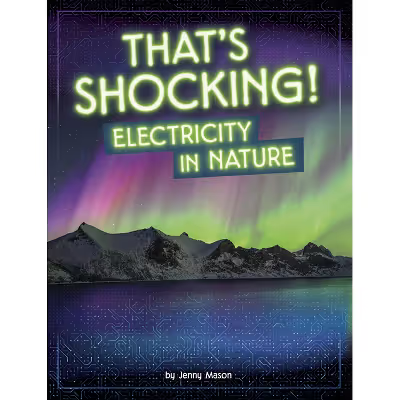
By Jenny Mason, That’s Shocking!: Electricity in Nature (Capstone, 2025) covers everything from lightning bolts to electric eels to nerve impulses for ages. Clear explanations, fact boxes, and hand-son experiments. For ages 8-11.
One of the Electricity in Action series: other titles include Amped Up!: Electricity and Technology; Watt’s Up?: Electricity at Work; and Power Trip: The Future of Electricity.
Hands-on Electricity
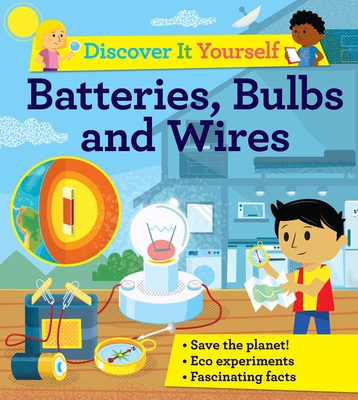
By David Glover, Batteries, Bulbs, and Wires (Kingfisher, 2021) in the Discover It Yourself series, illustrated with colorful drawings and photographs, is a short overview of magnetism and electricity with simple hands-on projects, among them lighting up a light bulb with a simple circuit. For ages 7-9.

TOPScience has two terrific informational activity books on electricity, respectively targeted at grades 3-8 and 8-12. Illustrated instructions are presented in the form of panel cartoons; detailed lesson notes are included. The TOPS program is noted for doing substantive science experiments with very simple equipment – here, for example, think aluminum foil, paper clips, and clothespins. Sample activities from the Electricity modules include experimenting with series and parallel circuits, making electrical puzzles, building a fuse, and exploding a balloon with electricity. The modules are available as softcover books or downloadable e-books.

From the San Francisco Exploratorium, Science Snacks at https://www.exploratorium.edu/snacks are low-cost experiments in a wide range of field. Many involving electricity and magnetism, among them making a Leyden jar, an electrical (static, that is) flea circus, a hand battery, a magnetic pendulum, and an electric motor.


From TeachEngineering, Put a Spark in It! is a multi-part electricity unit targeted at grades 3-5. Included are activities and printable worksheets.
Build Your Own Flashlight! See https://littlebinsforlittlehands.com/diy-flashlight-for-kids/.
Electric Switches is a lesson plan for ages 8-11 in which kids learn how switches work, build electric circuits with switches, and draw basic wiring diagrams. Included at the website are downloadable worksheets with background info, diagrams, and instructions.

Make a Circuit Board has step-by-step instructions for making a circuit board – a great way to demonstrate simple electrical circuits for kids.
All Science Fair Projects: Electricity has a list of projects based on electricity and magnetism, among them building a magnetic linear accelerator (which looks fun), testing different combinations of metals in galvanic cells, and experimenting with number of wire coils in electromagnets.
At Electricity and Electronics Science Fair Project Ideas, the projects are categorized by level of difficulty (Beginner, Intermediate, and Advanced).


Find out how to light a light bulb with (red-dyed) salt water – a.k.a. The Bloody Current experiment.

Learn how to make a cool electric pinwheel.
NeoK12: Electricity has interactive quizzes, games and puzzles, and many short videos on electricity. Titles of the latter include “Electricity and Circuits,” “Voltage and Current,” and “Introduction to Generating Electricity.”
Circuit Breaker is an interactive game in which players try to make a light bulb light up.
From Science Games for Kids, see Electricity Circuits at https://www.sciencekids.co.nz/gamesactivities/electricitycircuits.html.
The Fun of Taking Things Apart
Find out for yourself what makes things go. Disassembling stuff - formally known as "reverse engineering" - is a terrific hands-on learning experience; and almost any yard sale is an inexpensive source of raw material.

From TeachEngineering, Engineering in Reverse is a hands-on activity targeted at grades 5-8 in which kids disassemble a push-toy, draw diagrams showing how it works, and suggest improvements. See https://www.teachengineering.org/activities/cub_engineering_in_reverse.
For helpful safety tips and instructions on taking old appliances apart, see the Instructables’ How to Take Things Apart Without Killing Yourself.

Thomas Thwaites’s The Toaster Project (Princeton Architectural Press, 2011) is the story of Thwaites’s struggle to build a toaster from scratch. First step was to deconstruct a toaster – a process any curious kid can relate to – and then to reproduce it, a process which took nine months and a lot of research and ingenuity. A fascinating read for teenagers and adults, after which you’ll never take an appliance for granted again.
Electrified Ben

Rosalyn Schanzer’s How Ben Franklin Stole the Lightning (HarperCollins, 2002) is a folksy picture-book account of Franklin’s inventions and scientific experiments, with special attention to his studies of electricity, including the famous kite-in-the-storm experiment and Franklin’s promotion of the lightning rod. For ages 6-11.

Jean Fritz’s What’s the Big Idea, Ben Franklin? (Perfection Learning, 2001) is a witty and interesting biography of Franklin, filled with human interest, and emphasizing his many ideas and innovations, among them his electrical experiments. Don't be deceived by the ugly cover. For ages 7-10.
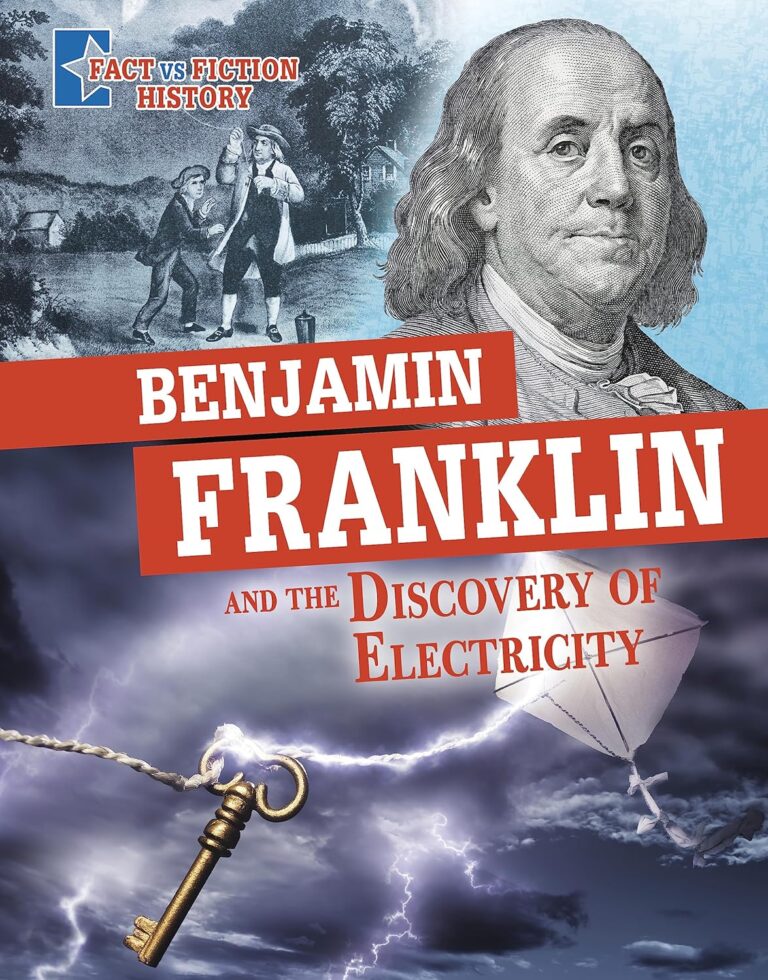
In Megan Cooley Peterson’s Benjamin Franklin and the Discovery of Electricity (Capstone, 2023) in the Fact vs. Fiction in U.S. History series, find out about Franklin’s electrical experiments (and what really happened with that kite in a thunderstorm). Illustrated with photos and period prints. For ages 8-11.

Carmela Van Vleet’s Amazing Ben Franklin Inventions You Can Build Yourself (Nomad Press, 2007) has both biographical background information and instructions for 30 different hands-on activities based on Franklin’s many varied interests. In the “Electricity and the Lightning Rod” chapter, for example, kids make a potato battery and a kite. For ages 9-12.

Learn all about lightning from NASA's Lightning Primer.
From the Franklin Institute, see Ben Franklin and the Kite Experiment. (Don't ever try this at home!)

Edison and Tesla

David A. Adler’s A Picture Book of Thomas Alva Edison (Holiday House, 1999) is a short simple biography of the inventor for ages 4-8.

Mike Venezia’s Thomas Edison: An Inventor With a Lot of Bright Ideas (Children’s Press, 2009) is an entertaining biography in the “Getting to Know the World’s Greatest Inventors and Scientists” series, illustrated with photos and clever cartoons. For ages 5-9.

In the Childhood of Famous Americans series, Sue Guthridge’s fictionalized Thomas Edison: Young Inventor (Aladdin, 1986) concentrates on Edison’s childhood, including his deafness (which led his mother to homeschool him), his home experiments, and the “laboratory on wheels” that he set up in an empty box car while working on a train. (It exploded.) For ages 7-11.

Scott Welvaert’s Thomas Edison and the Lightbulb (Capstone Press, 2007) is a catchy graphic-novel-style biography of Edison’s race to develop an effective incandescent lightbulb, with appended book and resource lists. This is one of a series; other titles include The Wright Brothers and the Airplane, Philo Farnsworth and the Television, Marie Curie and Radioactivity, and Isaac Newton and the Laws of Motion. (For a complete list, see Capstone Press.) For ages 8 and up.

Laurie Carlson’s Thomas Edison for Kids (Chicago Review Press, 2006) is a comprehensive biography of Edison, illustrated with photographs, period prints, and diagrams, and including 21 hands-on activities, among them making an electrical switch, a telegraph, and a zoetrope. For ages 9-12.

Dan Gutman’s Back in Time with Thomas Edison (Simon & Schuster Books for Young Readers, 2002) stars thirteen-year-old Qwerty Stevens (his nickname comes from a third-grade typing goof) who digs up a mysterious device in his backyard that sends him and his sister back to Thomas Edison’s laboratory in the late 19th century. Along with the exciting time-travel story, the book provides information about Edison’s life and work. Included are period photos and patent drawings, and an Edison timeline. For ages 9-12. Also see Back in Time with Benjamin Franklin (2005).

Randall E. Stross’s The Wizard of Menlo Park(Broadway, 2008) is a fascinating biography of Thomas Edison (“the patron saint of electric light”), his many inventions, and his overwhelming public persona. For teens and adults.
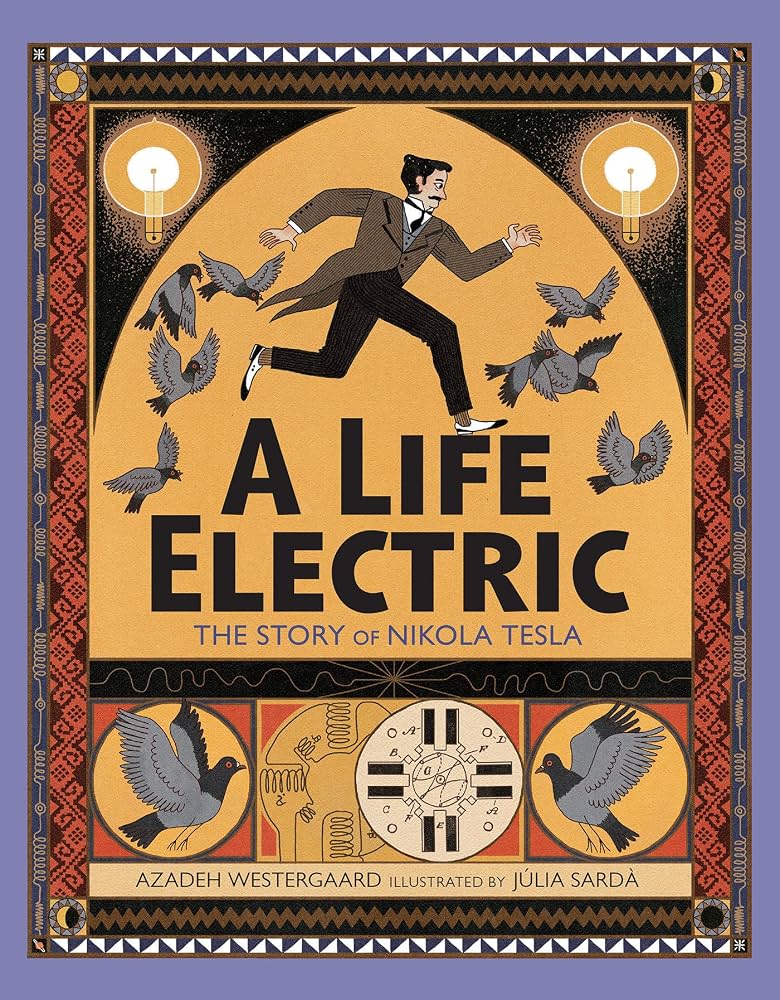
By Azadeh Westergaard, A Life Electric: The Story of Nikola Tesla (Viking, 2021) is a charmingly illustrated picture-book biography of Tesla – born in a thunderstorm and who grew up to be one of the most important electrical inventors in the world. For ages 6-9.
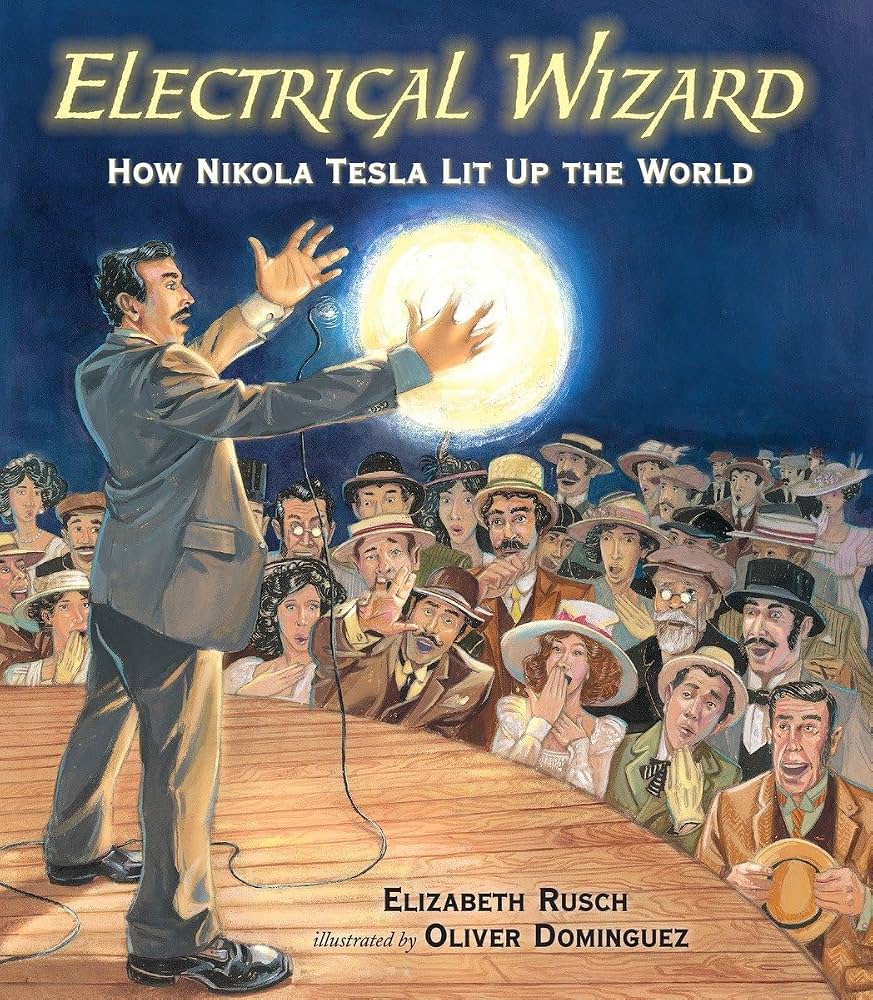
By Elizabeth Rusch, Electrical Wizard: How Nikola Tesla Lit Up the World (Candlewick, 2015) is an engaging short illustrated biography for ages 8-12.
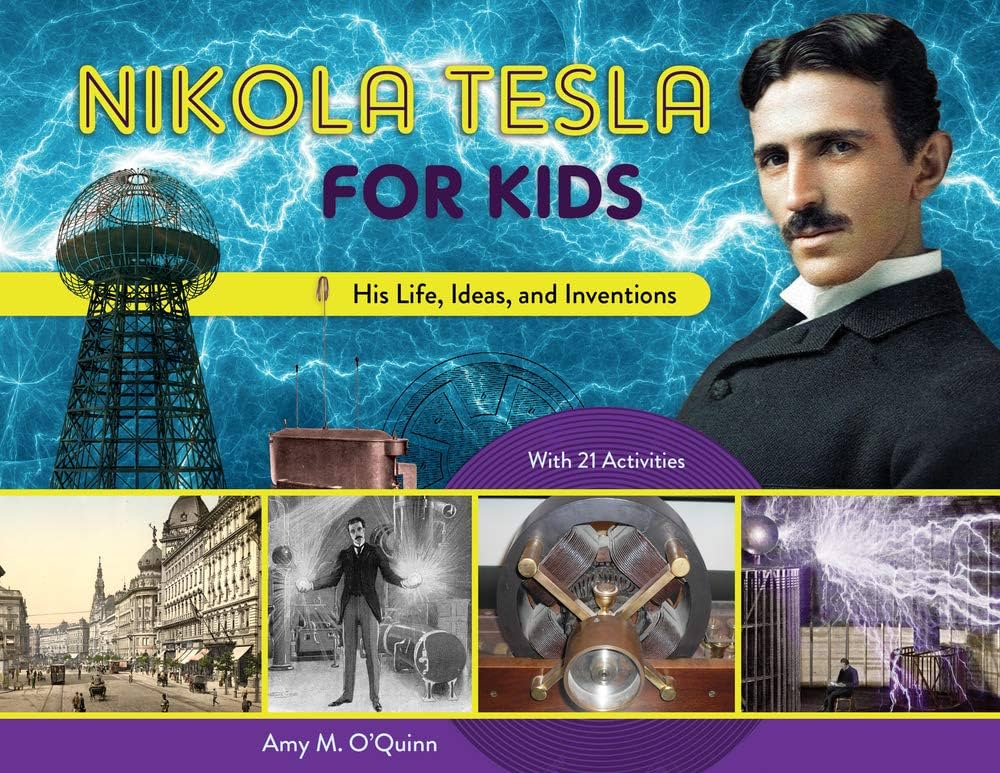
By Amy M. O’Quinn, Nikola Tesla for Kids (Chicago Review Press, 2019) covers the life and work of Tesla with 21 hands-on activities for ages 9 and up.

Jill Jonnes’s Empires of Light (Random House, 2004) details the 19th-century battle among Thomas Edison, Nikola Tesla, and George Westinghouse to forge an electrical empire, including the “War of the Electric Currents” between the supporters of AC current (Westinghouse and Tesla) and DC current (Edison and followers). For teens and adults.

Jane Brox’s Brilliant (Mariner Books, 2011) is a history of artificial light, from the torches of the Stone Age to the light bulb to the sometimes overwhelming illumination of the modern day. For teens and adults.
Build your own light bulb! With adult supervision.
Build a cool Lego light bulb! See https://invention.si.edu/invention-stories/build-lego-light-bulb.

See Edison’s Miracle of Light, a film in the PBS American Experience series, and accompanying resources.
Thomas Edison for Kids from the National Park Service has period photos, an Edison biography and timeline, info on Edison’s inventions, and more.
See here to listen to early Edison sound recordings - including a really creepy talking doll - and try and Edison employment test.
Listen to early Edison sound recordings at https://www.nps.gov/edis/learn/photosmultimedia/the-recording-archives.htm.
At the Franklin Institute, see (and learn all about) Edison's Lightbulb.
AC/DC: What’s the Difference? is a nicely designed animation on direct and alternating currents.

Amy M. O'Quinn's Nikola Tesla for Kids (Chicago Review Press, 2019) covers the Tesla's life and inventions, with 21 hands-on projects and activities, among them building an electric circuit and a soda-bottle submarine, making a batch of fluorescent slime, and taking a virtual tour of the 1893 Chicago World's Fair. Includes maps, period photos, diagrams, and a timeline. For ages 9 and up.

From PBS, Tesla: Master of Lightning has information on Nikola Tesla’s life and work, interactive explorations of Tesla’s inventions, a tutorial on electricity, timelines, and lesson plans on energy and electricity.
Take a virtual tour of the Nikola Tesla Museum in Belgrade.
Blackouts

In John Rocco’s Blackout (Hyperion Books, 2011), it’s a normal city summer night – hot, loud, and busy – until, suddenly, the lights go out. Deprived of computer, television, and cookstove, a family is left to its own devices: making flashlight pictures, stargazing, eating ice cream with the neighbors. The experience is so rewarding that when the lights come back on, they decide to turn them off again and play a board game together. The illustrations, for which Blackout won a Caldecott Honor award, include panels and full-page drawings and segue from full color to a lights-off blue, black, and white; the stars are Van-Gogh-esque pinwheels. For ages 4-8.

In Suzanne Collins’s cartoon-illustrated When Charlie McButton Lost Power (G.P. Putnam’s Sons, 2005), Charlie is a total techie kid (“The things that he liked involved handsets and bots”), whose world disintegrates when a lightning bolt knocks out the electrical tower. Desperate, he steals batteries from his sister’s talking doll, which only gets him in trouble; and eventually he comes to terms with his electricity-less situation and finds that imaginative play with his sister is fun. For ages 4-8.

Cynthia Rylant’s When I Was Young in the Mountains (Puffin, 1993), with enchanting illustrations by Diane Goode, is a gentle story of what life was like in the rural hills of West Virginia – without plumbing or electricity, when there were kerosene lamps in the kitchen, water pumped from the well (and boiled for baths in the kitchen), and candlelit trips to the outdoor “johnny-house.” For ages 4-8.

In Martha Freeman’s Zap (Simon and Schuster/Paula Wiseman, 2018), when a disastrous blackout hits Hampton, New Jersey, two sixth-graders tackle the mystery of who turned out the lights. An exciting mystery, plus science, for ages 9-12.

By Stephen Scott and Kenneth Pellman, Living Without Electricity (Good Books, 1990), illustrated with black-and-white photographs, explains how the Amish make do without electricity or modern appliances. Chapters cover various aspects of Amish life: “How Do You Light a Room Without Electricity?” “How Do You Keep Warm Without Centralized Heating?” “What Do You Do for Entertainment If You Don’t Have TV?” “How Do You Get Around Without a Car?” 128 pages long; for ages 12 and up.

In Susan Maushart’s The Winter of Our Disconnect (Jeremy P. Tarcher/Penguin, 2010), the author and her three teenaged kids pull the plug on technology for six screen-free months – no computer, no cell phone, no iPod, no TV. A funny and fascinating exploration of the pros and cons of our now-electronic world. For older teenagers and adults.

Journalist Nick Rosen’s Off the Grid (Penguin, 2010) is a journey in search of the growing movement of people seeking to live “off the grid,” free from dependence on electricity, telecommunications networks, government services, and mainstream culture. This is a human-interest book, rather than a how-to manual; it concentrates on many reasons for and ways in which different people attempt to live free. For older teenagers and adults.

The classic off-the-grid story is certainly that told in Helen and Scott Nearing’s The Good Life (Schocken Books, 1990), an account of how the Nearings left New York City in the 1930s to life a self-sufficient life on a small farm, first in Vermont, then later in Maine. For older teenagers and adults.

Colin Beavan’s No Impact Man (Farrar, Straus & Giroux, 2009) is an account of Beavan’s heroic year-long attempt to live with as little environmental impact as possible, smack in the middle of New York City. This involved giving up plastic, toilet paper, electricity, and motorized vehicles; eating local food; conserving water; and cutting down on trash. The book is peppered with observations, insights, and a lot of (sometimes appalling) statistics. Included is a helpful resource list. For families.
No Impact Man: The Documentary (2009) is a 93-minute film based on the book.

Maggie Koerth-Baker’s Before the Lights Go Out (John Wiley & Sons, 2012) is a thoroughly interesting and wholly reader-friendly overview of the energy crisis that faces us and its possible solutions. There’s no easy fix, Koerth-Baker explains, and the solution will inevitably involve multiple approaches rather than a single miraculous one-size-fits-all. Readers also learn where our current electrical grid came from in the first place and meet a lot of innovative and optimistic energy pioneers. For older teenagers and adults.

Jeanne DuPrau’s aging City of Ember (Yearling, 2008) would exist in perpetual darkness if not for the (increasingly feeble) floodlights that struggle to provide twelve hours of gloomy “daylight.” The inhabitants of Ember have long since forgotten their origins, and it’s left to two twelve-year-olds - Lina Mayfleet, put to work as a messenger, and Doon Harrow, assigned to the Pipeworks, site of the city’s failing electrical generator – to solve the mystery of the city’s past and save its inhabitants. Three sequels. For ages 8-12.
Also see the film version of City of Ember (2008), directed by Gil Denan. It’s rated PG (for peril).

Jessie, the protagonist of Margaret Peterson Haddix’s Running Out of Time (Simon & Schuster Books for Young Readers, 1997) believes that she lives in the village of Clifton, Indiana, in 1840. When diphtheria strikes the town, however, Jessie’s mother reveals that Clifton is really a reconstructed museum village, project of an eccentric millionaire – and Jessie must escape to the outer world of 1996 to find help. Not only is this an exciting adventure, but a clever twist on time-travel as Jessie suddenly has to cope with a world of electric lights, telephones, and automobiles. For ages 9-13.

In Peter Dickinson’s Changes trilogy, originally published between 1968 and 1970, England is suffering from a time known as “The Changes” in which suddenly, inexplicably, the populace has turned against machines and reverted to a state of medieval peasantry. The few hold-outs who hoard modern machinery are accused of witchcraft. The three books in the series are The Devil’s Children, Heartsease, and The Weathermonger. All, though out of print, are readily obtainable through libraries and used-book suppliers. For ages 12 and up.

Pat Frank’s now-classic Alas, Babylon (Harper Perennial, 2005), originally published in 1959, was one of the first post-apocalyptic novels of the nuclear age, based in a small town in central Florida. The protagonist, Randy Bragg, has some warning of the impending strike from his brother, a military officer, who sends his wife and young children to stay with Randy, hoping this will keep them out of harm’s way. The little town does survive “the Day,” as the global holocaust comes to be called, but their way of life is gone forever, as electricity fails; food, water, gasoline, and medical supplies are exhausted; and “highwaymen” take to preying on the townspeople. For ages 12 and up.

In Leigh Brackett’s The Long Tomorrow (Phoenix Pick, 2011), now a sci-fi classic, America has been destroyed in a nuclear holocaust and the survivors blame technology for the disaster. The protagonists, young cousins Len and Esau, live in a New Mennonite farming community called Piper’s Run, but long for a different way of life, having been fascinated by their grandmother’s stories of a time when there were electrified cities, airplanes, televisions, and automobiles. After discovering a radio set said to come from Bartorstown – a mysterious town attempting to bring back the old technologies – the boys run away to find it. For ages 12 and up.

In S.M. Stirling’s Dies the Fire (Roc, 2005), “the Change” has inactivated all modern technology, including electricity and explosives. Survivors group themselves into bands and communities, struggling to forge new lives and to protect themselves from warlords and marauders. Among the survivors: a Marine pilot, now leader of the Bearkillers; folksinger Juniper Mackenzie, now leader of Clan Mackenzie; and Norman Arminger, ex-medieval professor, now leader of the threatening Portland Protective Agency. The first of a series. For ages 14 and up.

Jean Hegland’s Into the Forest (Dial, 1998) is the story of Nell and Eva, two teenage sisters who live in the redwoods of northern California at an unspecified time in the not-so-distant future when the world as we know it is coming to an end. Their parents die; electricity and phones go out; fuel and food supplies dwindle; and in the outer world, violence prevails. Eventually the girls must come to terms with their new primitive life in the forest. For ages 14 and up.

In J.J. Abrams and Eric Kripke’s NBC series Revolution, the lights have suddenly gone out, cars have stopped, planes have fallen out of the sky. For fifteen years now, the world has been in a black-out; survivors live in small farming communities, under the thumb of an ominous leather-armored militia. The Matheson family possess an artifact that may hold the key to the power collapse and the means of reversing its effects, which puts them at risk from various malefactors. Young Charlie Matheson (a girl and a whiz with the crossbow) sets off with a band of companions to distant Chicago to rescue her brother, kidnapped by the militia, and solve the mystery. See https://www.imdb.com/title/tt2070791/. (Rated TV-14.)
Alternative Energy

Allan Drummond’s Energy Island (Farrar, Straus & Giroux, 2011) is the picture-book story of the Danish island of Samso, which has come to rely almost entirely on renewable energy, using wind turbines, solar panels, and biomass converters, riding bicycles, and driving electric cars. For ages 6-10.

By William Kamkwamba and Bryan Mealer, The Boy Who Harnessed the Wind (William Morrow, 2010) is the story of 14-year-old William who, determined to bring electricity to his poverty-stricken Malawi village, finds an old physics book with diagrams of windmills and manages to fabricate a working windmill from scraps, junk, and old bicycle parts. The book – an inspirational story of hope and ingenuity – is targeted at teens and adults. A Young Readers version of The Boy Who Harnessed the Wind (Dial, 2012) is available for ages 6-11.
Listen to William Kamkwamba’s TED talk on his windmill project.
From PBS’s SciGirls, Blowin’ in the Wind is a project for building a model windmill capable of hoisting a weight.

Michael J. Caduto’s Catch the Wind, Harness the Sun (Storey Publishing, 2011) is an informative activity book on energy and global climate change, illustrated with cartoons, diagrams, and color photographs. For example, kids build mini-windmills, power a battery with a bicycle, and make a solar heater. For ages 8-12.

Kathleen Reilly’s Energy (Nomad Press, 2009), subtitled “Investigate Why We Need Power and How We Get It,” is an informational activity book with chapters devoted to electricity, hydrogen, petroleum, coal, nuclear power, wind, hydropower, solar power, geothermal energy, and biomass. Included are fact boxes, word lists, and 25 hands-on projects, among them building a steam-powered boat, a solar-powered water heater, and an electric burglar alarm. For ages 9-12.

Mike Rigsby’s Doable Renewables (Chicago Review Press, 2010) is a collection of “16 Alternative Energy Projects for Young Scientists.” Among these are a “Simple Heat Engine” made from corrugated cardboard, rubber bands, and a sewing needle that runs off an incandescent desk lamp; and a fascinating solar-powered seesaw, operated by sunlight focused through a magnifying glass. (You’ll need a bimetallic strip for this one, that you obtain by tearing apart a large-dial thermometer, but it’s worth the effort.) Other projects involve fooling around with devices that you buy outright, such as a solar drinking bird, a thermobile – dunk it in a cup of hot water and the wheels go around, and a radiometer. (Sources provided.) Each project includes brief background information and a list of “More to Think About” questions. For ages 9 and up.
Incredible Electrical Art

Captured Lightning has information about sculptor Bert Hickman, whose works are fractal-like Lichtenberg structures, made by blasting a block of acrylic with electricity.
From Popular Science, Trap Lightning in a Block shows just how to do it, with explanations and a cool video.

Find out about fulgurites - a.k.a. "petrified lightning" - here.