
Ben Franklin
In this collection
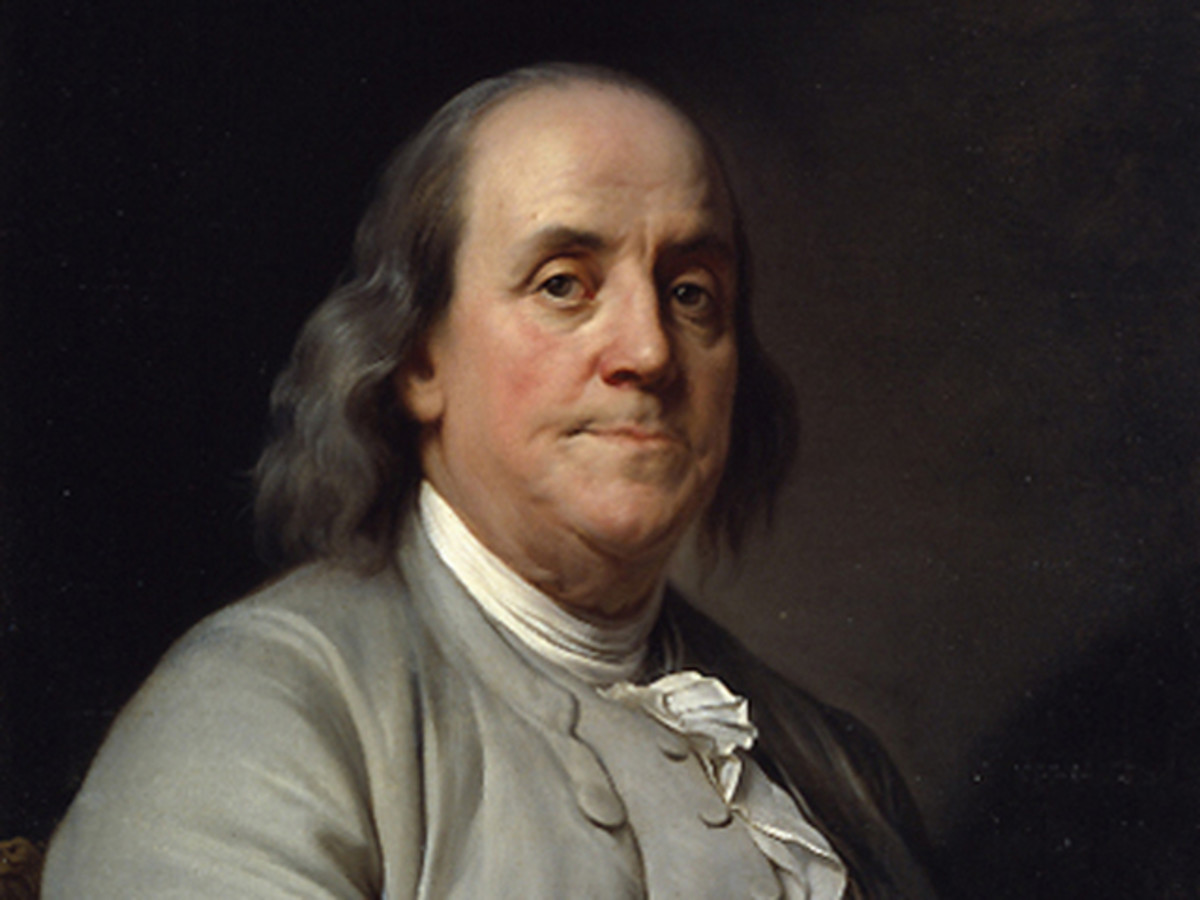
January 17 is Ben Franklin's birthday - devote the day to Ben! (Though Ben Franklin is interesting at just about any time.)
All About Ben

Gene Barretta’s Now & Ben: The Modern Inventions of Benjamin Franklin (Square Fish, 2008) is a picture-book account of the many Franklin inventions and innovations that are still with us today, a surprising collection that includes everything from bifocals to odometers and political cartoons. For ages 4-8.

By the irresistible Lane Smith, John, Paul, George, and Ben (Disney-Hyperion, 2006) is the tongue-in-cheek picture-book story of four lads: John (Hancock), Paul (Revere), George (Washington), and Ben (Franklin). Just to keep the story straight, there’s a helpful True/False section at the back of the book. For ages 5-8.

Not sure what you want to be when you grow up? You're in good company. Michael Rosen's A Ben of All Trades (Candlewick, 2020), with wonderful illustrations by Matt Tavares, is a picture-book biography of the inventive young Ben Franklin, who experimented with many trades - while all the time preferring to read, swim, and fly his kite. For ages 5-9.

Alan Schroeder’s Ben Franklin: His Wit and Wisdom from A to Z (Holiday House, 2011) is an unusual alphabet book of Franklin’s life and accomplishments. A, for example, is for Almanac, Abiah (Franklin’s mother), Apprentice, and Armonica (a Franklin-invented musical instrument); N is for Newspaper, Navigation, and Nude (Franklin liked to take “air baths”). Absorbing for ages 7-9.

At the Franklin Institute at https://fi.edu/en, search Ben Franklin for a wealth of articles, videos, and FAQs.

Jean Fritz’s What’s the Big Idea, Ben Franklin? (Puffin, 1996) is a delightfully written and well-researched biography, packed with unusual details and human interest. For example: “In 1706 Boston was so new that its streets were still being named. For 5 years the town officials had been thinking up names and they hadn’t finished yet. So far they had Cow Lane, Flownder Lane, Turn Again Alley, Half-Square Court, Pond Street, Sliding Alley, Milk Street, and many others. Luckily Milk Street had been named early, because that’s where Benjamin Franklin was born. So right away he had an address.” For ages 7-10.
There are several more equally excellent American history books by Fritz in this same format, among them And Then What Happened, Paul Revere?, Can’t You Make Them Behave, King George?, and Will You Sign Here, John Hancock?

Robert Byrd’s cleverly designed Electric Ben (Dial, 2012) – filled with quote boxes, captions, and colorful, detailed illustrations - is a comprehensive 40-page biography for ages 7-10.

By Ingri and Edgar Parin D’Aulaire, Benjamin Franklin (Beautiful Feet Books, 1998) is a gorgeously illustrated picture-book biography for ages 7-10.

Robert Lawson’s Ben and Me (Little, Brown Books for Young Readers, 1988), subtitled “An Astonishing Life of Benjamin Franklin by His Good Mouse Amos,” is a clever and hilarious biography of Ben through the eyes of his pet mouse – who, as it turns out, was the brains behind many of Franklin’s landmark inventions.
If you like this one, also see Lawson’s Mr. Revere and I (“Being an Account of certain Episodes in the Career of Paul Revere, Esq., as Revealed by his Horse”). For ages 7-12.

See the Disney cartoon version of Ben and Me on YouTube.

Dennis Brindell Fradin’s Who Was Ben Franklin? (Grosset & Dunlap, 2002) is a atraightforward 112-page chapter biography of Franklin, illustrated with black-and-white drawings and diagrams. (Among these, for example: a Leyden jar, with the parts labeled, and an illustrated account of the candle-making process.) For ages 8-11.

The Landmark Books series is an extensive collection of excellent histories, written in the 1950s and 60s by award-winning authors. Among these is Margaret Cousins’s Ben Franklin of Old Philadelphia (Random House, 2004). A good pick for ages 9 and up.

Augusta Stevenson’s Benjamin Franklin: Young Printer (Aladdin, 1986) in the (large) Childhood of Famous Americans series is a chapter biography covering Franklin’s early years. (“A long time ago, away up in New England in the little city of Boston there was a certain blue ball. It was about the size of a cocoanut, and it hung above the front door of a certain little house. On this blue ball was a name – Josiah Franklin.”) For ages 8-11.

James Cross Giblin’s The Amazing Life of Benjamin Franklin (Scholastic, 2006) is an appealing 48-page biography of Franklin illustrated with wonderful realistic paintings by Michael Dooling. For ages 8-12.

Candace Fleming’s creative Ben Franklin’s Almanac (Atheneum Books, 2003) is a catchy compendium of Frankliniana beginning with “A Year-by-Year Look at Ben’s Life.” Subsequent chapters – filled with anecdotes, quotations, capsule biographies, background information, and period illustrations – include “Boyhood Memories,” “The Writer’s Journal,” “The Scientist’s Scrapbook,” and “Revolutionary Memorabilia.” For ages 10 and up.
See a varied lesson plan based on Poor Richard's Almanack for grades 3-8. Kids discuss Franklin's proverbs and invent some of their own.

Brandon Marie Miller’s Benjamin Franklin, American Genius (Chicago Review Press, 2009) is a chronological account of Franklin’s life, creatively illustrated with period prints and interesting fact boxes. Included are 21 hands-on activities, among them dipping candles, making rock-crystal candy and hasty pudding, making a leather apron and a pair of shoe buckles, making a barometer and a walking stick, and designing a turkey seal for the United States. For ages 9-12.

By Newbery-winning author Russell Freedman, Becoming Benjamin Franklin: How a Candle-Maker’s Son Helped Light the Flame of Liberty (Holiday House, 2013) is a chronological biography illustrated with paintings, period prints, and documents. For ages 11 and up.

The Autobiography of Benjamin Franklin, written by Franklin in four parts between 1771 and 1790, was originally intended for his son William. Now considered the greatest autobiography produced in colonial America, it is available in many editions, including (for free) from Kindle and online at Project Gutenberg.
Poor Richard's Almanac

Wit and Wisdom from Poor Richard’s Almanack (Dover Publications, 1999) is a collection of aphorisms from Ben Franklin’s famous Almanac, categorized by topic from “Aging and Youth” and “Anger, Revenge, and Forgiveness” to “Happiness,” “Money and Frugality,” and “Social Relations.”

At the Internet Archive, see the full text of Poor Richard’s Almanack online.
Scientific Ben

In Stephen Krensky’s Ben Franklin and His First Kite (Simon Spotlight, 2002), ten-year-old Ben uses a kite to propel himself across a pond. For ages 4-7.
See Ken Burns's documentary Ben Franklin on PBS at https://www.pbs.org/kenburns/benjamin-franklin/. Included are teacher's resources and lesson plans.

Rosalyn Schanzer’s How Ben Franklin Stole the Lightning (HarperCollins, 2002) is a charming picture-book account of Franklin’s many inventions and accomplishments, concentrating on his discovery of the electrical nature of lightning and his invention of the lightning rod to prevent fires. (“It’s true! The great Benjamin Franklin really did steal lightning right out of the sky! And then he set out to tame the beast.”) For ages 5-9.
See instructions for building a Ben Franklin kite replica at https://www.my-best-kite.com/ben-franklin-kite.html. (Just don't try to repeat his famous experiment!)


Mara Rockliff’s Mesmerized: How Ben Franklin Solved a Mystery that Baffled All of France (Candlewick, 2015) is a gorgeously illustrated account of how Franklin, armed with the scientific method, unmasked the dramatic Dr. Mesmer, who claimed to control a mysterious and powerful magical force. For ages 6-10.

From the Franklin Institute, The Ben Franklin Book of Easy and Incredible Experiments (Wiley, 1995) is a great collection of hands-on projects and activities, variously categorized under “Using Your Head,” “Exploring the Weather,” “Exciting Electricity,” “Making Music,” “Paper and Printing,” and “Exploring Light and Sight.” For each project, there are instructions, explanations, and historical background from the life of Franklin. For ages 8 and up.

Carmella Van Vleet’s Amazing Ben Franklin Inventions You Can Build Yourself (Nomad Press, 2007) combines background information on the life and times of Ben Franklin with 30 Franklin-related hands-on projects. Among these: kids can make a hornbook, a paper mold, invisible ink, a kite, a personal mailbox, a quill pen, and a fur hat. For ages 8-12.
Mathematical Ben

Frank Murphy’s Ben Franklin and the Magic Squares (Random House, 2001) is a Step Into Reading book about Franklin and his inventions, among them the mathematical “Magic Square” – a box of nine numbers arranged such that each row, column, and diagonal adds up to the same total. For ages 7-9.
See The Fascination of Magic Squares at https://www.rigb.org/explore-science/explore/blog/fascination-magic-squares.
Try some magic square puzzles! Printable magic squares (categorized by grade) can be found at https://www.math-salamanders.com/magic-square-worksheets.html.
LESSON PLANS AND RESOURCES

From PBS, Benjamin Franklin: An Extraordinary Life, An Electric Mind includes biographical and historical information, a tour of “Ben’s Town,” a Virtue Quiz, “Ben A to Z,” a timeline, and an eight-lesson Teacher’s Guide.
At Ben’s Guide to the U.S. Government, a cartoon Ben Franklin tells kids all about himself and introduces visitors to the workings of government. Included are games, activities, and puzzles. Categorized by grade level.

Our national symbol: eagle or turkey? Visit Great Seal to find out what Ben Franklin thought and why.
Ben Across the Curriculum is a collection of themed lesson plans, variously appropriate for grades K-5, 6-8, or 9-12. Lessons are categorized under Character Matters, Franklin, Printer, Civic Visions, Useful Knowledge, and World Stage. Also included at the website are a Franklin timeline, a list of Franklin trivia, Franklin-related essays and articles, and a bibliography.

Celebrate Benjamin Franklin’s Birthday by setting up a homestyle or classroom postal service. Sounds fun.

The Electric Ben Franklin is a wide-ranging site including the multi-episode “Temple’s Diary” (the story of the Revolution through the eyes of Franklin’s teenage grandson), images and descriptions of Franklin’s inventions, an account of the famous kite experiment, issues of the New-England Courant (including letters from Franklin’s alter-ego, Silence Dogood), experiments (make a thermometer, for example), and games. (Play checkers with Benjamin Franklin.) An excellent resource.