
Baseball!

In this collection
There’s a lot out there about baseball. There are baseball books, baseball poems, baseball songs, baseball movies, baseball science experiments, baseball math challenges, baseball arts and crafts, and baseball philosophy. Yes, really. Baseball philosophy. Check it all out:
Baseball Stories

In Curious George at the Baseball Game by H.A. Rey and Margret Rey (Houghton Mifflin, 2006), George and the Man in the Yellow Hat go to watch the Mudville Miners play ball and the well-meaning but inquisitive little monkey – as always – manages to get in trouble. For ages 3-7.

To Bats at the Beach and Bats at the Library, Brian Lies now adds the equally adorable Bats at the Ballgame (Houghton Mifflin, 2010), a delightfully illustrated account of bat-style baseball, complete with mothdogs, Cricket Jack, and fans hanging upside-down in the stands. For ages 4-8.

The baseball-playing title character of Rachel Isadora’s Max (Aladdin, 1984), en route to baseball practice, walks his sister Lisa to her ballet lesson, is invited to join the class, and discovers that he loves to dance. Soon he finds that he can happily participate in both worlds – baseball and ballet. A nice anti-stereotype picture book for ages 4-8.

Randy Riley, the title character of Chris Van Dusen’s Randy Riley’s Really Big Hit (Candlewick, 2012), isn’t much good at baseball, but he’s a whizz at science and math. When he spots an Earth-heading meteor through his telescope, he saves the day by cleverly calculating trajectories and building an enormous robot who smacks the fireball back into space with a smokestack baseball bat. For additional oomph, the story is told in the rhyme and rhythm of “Casey at the Bat” (see below). For ages 5-9.

Matt Tavares has written and illustrated several superb baseball picture books, among them Zachary’s Ball (Candlewick, 2012), in which Zachary’s father catches a foul ball at Fenway Park, which magically causes Zachary’s baseball fantasies to come true. The story is enchanting and the illustrations are marvelous. Other titles include Mudball, Oliver’s Game, There Goes Ted Williams, Growing Up Pedro, Becoming Babe Ruth, and Henry Aaron's Dream. For ages 6-9.

In David A. Kelly’s Ballpark Mysteries series – beginning with The Fenway Foul-Up (Random House Books for Young Readers, 2011), Mike and Kate – nine-year-old cousins with a knack for detective work – solve baseball-related mysteries. Each book manages to work in a bit of baseball history along with the action. For ages 6-9.

In David A. Adler’s The Babe and I (Sandpiper, 2004), set in 1932 in the Bronx at the height of the Great Depression, the young narrator and his best friend Jacob struggle to earn money by selling newspapers near Yankee Stadium, and shouting out the latest about the famous Babe Ruth. The business takes off, with a boost from the Babe himself – but the real message of the book is that working together as a team is the best way to get through hard times. For ages 5-9.

Freddy and the Baseball Team from Mars (Overlook Juvenile, 2011) is one of Walter R. Brooks’s hilarious Freddy the Pig series, starring the ever-inventive Freddy and all his animal friends on the Bean farm. For ages 5 and up.
Become a Friend of Freddy and learn more about his books and escapades at Freddy the Pig's Home Page.

In Mary Pope Osborne’s A Big Day for Baseball (Random House, 2017), one of the Magic Tree House series, Jack and Annie travel back in time to Brooklyn, New York, in 1947, where they end up as batboys in a game with Jackie Robinson. For ages 6-9. Also see Baseball, a Magic Tree House Fact Tracker and nonfiction companion to the book.

In Matt Christopher’s The Lucky Baseball Bat (Little, Brown, 2004), originally published in 1954, Martin, new in town, is anxious to do well on the baseball field – and he does, until his lucky baseball bat breaks. Predictably, he eventually discovers that ability really comes from within himself. Christopher is the author of over 100 books with sports themes, many about baseball, for ages 7-10.

In Bette Bao Lord’s In the Year of the Boar and Jackie Robinson (HarperCollins, 1986), ten-year-old Bandit leaves China with her mother to join her father in New York City. Excited, she adopts the new American name of Shirley Temple Wong – but America isn’t quite what she had expected, and Shirley struggles with a new language, new customs, and the difficulty of fitting in. Then she discovers baseball – and what’s more, the year is 1947 and Jackie Robinson has just become the first black player to join a white major-league team. Inspired by his example, Shirley discovers that for her, too, America can truly be a land of opportunity. For ages 8-12.

Sharon Robinson’s The Hero Two Doors Down (Scholastic, 2016), set in 1948, is based on a true story about the friendship between a young white boy in Brooklyn and baseball hero Jackie Robinson. For ages 8-12.

By Wendy Wan-Long Shang, The Way Home Looks Now (Scholastic, 2015) is the story of a Chinese-American family whose love for baseball ultimately help them heal after Peter’s older brother is killed in a car accident. For ages 8-12.

In Joan Bauer’s Soar (Viking, 2016), Jeremiah, who has a heart condition, and his father have moved to a town where the death of a school baseball player and a scandal have crushed the entire community. When Jeremiah decides to become a baseball coach, however, his wit and courage help the town heal. A coming-of-age story for ages 9-12.

In Ellen Klages’s Out of Left Field (Viking, 2018), set in 1967, every boy in the neighborhood knows Katy is the best pitcher going – but she’s a girl and is not allowed to join the Little League. Determined Katy protests and sets out to learn the forgotten history of female baseball players. For ages 9-12.

Lupe, of Donna Barba Higuera's Lupe Wong Won't Dance (Levine Querido, 2020) is a middle-grade star athlete who dreams of meeting her hero, Fu Li Hernandez, a pro baseball player of mixed Chinese and Mexican heritage, just like hers. All she needs is a straight-A school record, which looks like a shoe-in - until the final gym unit turns out to be square dancing. Lupe, horrified, does everything she can to eliminate square dancing, from researching the racist history of the music to protesting enforced gender roles. Nothing seems to work. For ages 9-12.

In John H. Ritter’s The Boy Who Saved Baseball (Puffin, 2005), there’s a lot riding on a baseball game. Set in rural California, Doc Altenheimer, an elderly apple rancher, is preparing to sell his land – which makes up most of the little town of Dillontown – to developers. Unless, that is, the scruffy town baseball team can manage to defeat the team of the well-equipped suburbanites who live down the road. Twelve-year-old Tom helps recruit the reclusive Dante Del Gato, an old baseball legend, to coach the home team, and the contest is on. For ages 10-13.

In Stumptown Kid by Carol Gorman and Ron Findlay (Peachtree Publishers, 2007), it’s 1952 and 11-year-old Charlie is mourning his father, killed in the Korean War, resenting his mother’s thuggish boyfriend, and loving baseball – though he’s not good enough to play on the Wildcats, the prime local team. Then he meets Luther Peale, an ex-Negro League pitcher, on the run after pitching a ball that killed a drunken white batter. With the help of Luther, Charlie and friends forge a team capable of beating the Wildcats – though meanwhile around town, racial tensions rise, and the vengeful brother of the dead batter is on Luther’s trail. For ages 10-13.
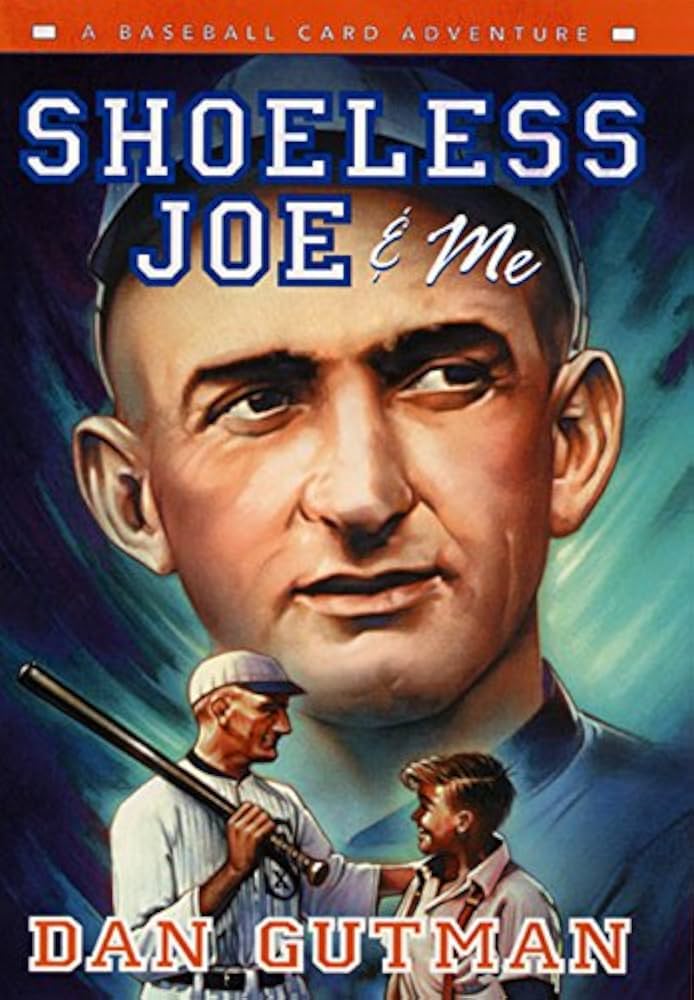
Joe Shostack, the 12-year-old hero of Dan Gutman’s Baseball Card Adventure series, is able to travel through time with the help of vintage baseball cards. In the first book of the series, Honus and Me (HarperCollins, 1998), Joe finds a rare Honus Wagner baseball card (see Baseball Biographies, below) while cleaning out a neighbor’s attic which enables him to travel back to the 1909 World Series. In other volumes, Joe meets such baseball greats as Babe Ruth, Jackie Robinson, Mickey Mantle, Roberto Clemente, Shoeless Joe Jackson, and – this time by means of a photograph – Civil War General Abner Doubleday, who may or may not have invented the game of baseball. A nice combination of real history, adventure, human relationships, and – of course – baseball. For ages 10 and up.
Make your own custom baseball cards! See https://www.youtube.com/watch?v=RnbmBNEl17c.

Michael Chabon’s Summerland (Hyperion Books, 2011) is fantasy baseball, and I mean fantasy baseball. Eleven-year-old Ethan – a lousy ballplayer - and his father have moved to an island off the coast of Washington, whose westernmost tip, called the Summerland, is known for its perfect sunny weather. The Summerland is also a portal to other worlds, and there a mysterious and ancient baseball scout recruits Ethan and friends to save both our world and the world of the fairy-like ferishers from the evil trickster Coyote and his warriors. Giants, legendary liars, a depressed Sasquatch, a werefox – and some truly high-stakes baseball. For ages 11 and up.

Alan Gratz’s The Brooklyn Nine (Puffin, 2010) traces the generations of a Brooklyn family and its ties to baseball through nine sequential historical “innings.” The book begins with ten-year-old Felix Schneider who arrives in America from Germany and encounters Alexander Cartwright, possibly the founder of modern baseball, during the Manhattan fire of 1845. Subsequent chapters deal with the Civil War, the years of the Negro Leagues and struggles with racial prejudice, the All-American Girls League, and the Cold War era. Wonderful characters (both male and female), discussion-worthy themes, and compelling stories. For ages 10 and up.

Steve Kluger’s Last Days of Summer (William Morrow, 2008) is funny, sad, uplifting, and a gem. The protagonist is twelve-year-old Joey Margolis, a brilliant loudmouth Jewish kid from Brooklyn in the 1940s. Joey, who lives with his divorced mother, is a victim of neighborhood bullies – in part because he has (a lie) boasted that he is a friend of Charlie Banks, a player for the New York Giants. Eventually, by dint of sheer persistence, he does become friends with Charlie, and it’s a wonderful, funny, and ultimately bittersweet relationship, when Charlie goes to war. The book is told entirely in letters, interviews, memos, newspaper clippings, and Top Secret messages between Joey and his best friend Craig Nakamura (a.k.a. The Green Hornet) who lives in the apartment downstairs. Highly recommended for teenagers and adults.

American journalist and short-story writer Ring Lardner’s You Know Me Al (Touchstone, 1991), originally published in 1914, is a baseball classic, written in the form of letters from Jack Keefe, a pitcher with the Chicago White Sox, to Al, his buddy back home in Indiana. Jack is vain, clueless, poignant, and inadvertently hilarious. For high-school-level students and up.
You Know Me Al is a free audio version from Books Should Be Free.

The book behind the popular movie Field of Dreams, W.P. Kinsella’s Shoeless Joe (Mariner Books, 1999) uses baseball as a means of fulfilling dreams, healing wounds, and celebrating love, family, and the miracles of the everyday. Spurred by a mysterious voice saying “If you build it, he will come,” Ray Kinsella builds a baseball diamond in the middle of his Iowa cornfield. Wonderful and evocative. For teenagers and adults.

The 1989 movie Field of Dreams, stars Kevin Costner, Amy Madigan, James Earl Jones, and Burt Lancaster. Rated PG.

Bernard Malamud’s The Natural (Farrar, Straus & Giroux, 2003), originally published in 1952, overlays baseball with Arthurian legend in the tale of a tragic hero, the supremely talented, but ultimately flawed, Roy Hobbs. Deservedly on many high-school reading lists.

The 1984 movie The Natural, starring Robert Redford as Roy Hobbs, takes liberties with Malamud’s plot and is a far sunnier and more sentimental story than the author intended. Rated PG.

Baseball: A Literary Anthology (Library of America, 2002), edited by Nicholas Dawidoff, is a wonderful (and enormous, over 700 pages long) collection of short stories, essays, profile pieces, and poems – all on baseball or baseball players – by such writers as Ring Lardner, Roger Angell, John Updike, Damon Runyon, James Thurber, William Carlos Williams, and Marianne Moore. First selection in the book – naturally – is Ernest Thayer’s classic poem “Casey at the Bat.” For teenagers and adults.
Poems and Songs

By Douglas Florian, famed for his picture-book poetry collections, Poem Runs (Harcourt Children’s Books, 2012) is a wonderful illustrated collection of baseball poems for ages 4 and up.

“Take Me Out to the Ball Game,” it turns out, is the third most frequently sung song in America, topped only by “Happy Birthday to You” and “The Star-Spangled Banner.” See Ben Nussbaum’s Take Me Out to the Ball Game (Soundprints Audio, 2006) in the Smithsonian American Favorites series for illustrated lyrics to the song, background information, a sing-along music sheet, and an audio CD. For ages 3-7.
For a rendition of the song, along with lyrics and some background info, see https://www.youtube.com/watch?v=daLjXXJ3huw

Baseball’s Greatest Hit by Andy Strasberg, Robert Thompson, and Tim Wiles (Hal Leonard Corporation, 2008), illustrated with period prints, photos, and newspaper clippings, is a 200+-page history of “Take Me Out to the Ball Game,” with accompanying CD. For teenagers and adults.

Who doesn’t know these lines?: But there is no joy in Mudville/Mighty Casey has struck out. Ernest L. Thayer’s immortal Casey at the Bat is available in many editions – of which one of the best is the version “copiously and faithfully illustrated” by Christopher Bing and published by Chronicle Books (2000). Bing’s version of Thayer’s famous poem is designed to look like a vintage scrapbook, stuffed with newspaper clippings and pasted-in memorabilia. For all ages.
Hear James Earl Jones recite Casey at the Bat.

Dan Gutman – in Thayer-esque rhyme - continues the saga of Casey in his picture-book Casey Back at Bat (HarperCollins, 2009). Casey, given a second chance, slams the ball out of the park, sending it off around the Earth, when it knocks the Leaning Tower of Pisa askew, takes the nose off the Sphinx, and does in the dinosaurs. For ages 5-9.
A long list of baseball poems and songs can be found at the Baseball Almanac. Included is an entire “Casey Collection” (among the contributors is Garrison Keillor) and lyrics to dozens of baseball songs by such performers as Bruce Springsteen, Kenny Rogers, and Bob Dylan.
What About the Girls?

In David A. Adler’s Mama Played Baseball (Harcourt Children’s Books, 2003), set in the days of World War II, Amy’s father has gone to war and her mother, who needs a job, decides to become a professional baseball player. (But “baseball is just a game,” Amy thought.) She changes her mind, however, when her mother joins the All-American Girls’ Professional Baseball League. For ages 4-8.

Shana Corey’s Players in Pigtails (Scholastic Press, 2003) is the story of feisty Katie Casey who, though a disaster at dancing and baking, could “catch any ball with any mitt with her eyes closed” and “hit any ball with any bat with one hand behind her back.” She comes into her own in 1942, when she tries out for the newly formed all-girls team, the Kenosha Comets. For ages 5-9.

Marissa Moss’s Mighty Jackie: The Strike-Out Queen (Simon & Schuster, 2004) is the picture-book story of Jackie Mitchell, 17-year-old pitcher for the Chattanooga Lookouts, who – in an exhibition game in 1931 – struck out both Babe Ruth and Lou Gehrig. (She won the day, but women were still banned from professional baseball.) For ages 5-9.

Deborah Hopkinson’s Girl Wonder (Aladdin, 2006) is the picture-book story of Alta Weiss who – despite many objections - wangled a place as pitcher for the all-male Vermilion Independents in 1907. Soon she was the star of the team and people flocked to see the “Girl Wonder.” Told in the first person, this is a delightful read. An appendix includes a biography of Weiss and a timeline of women in baseball. For ages 5-9.

Dirt on Their Skirts: The Story of the Young Women Who Won the World Championship by Doreen Rappaport and Lyndall Callan (Dial, 2000) is the story of the famous 1946 game between the Racine Belles and the Rockford Peaches, as seen through the eyes of Margaret, a young baseball fan. Included are period photos of the players and the original scorecard of the game. For ages 6-10.

The All-American Girls’ Professional Baseball League is also the subject of the 1992 movie A League of Their Own, in which washed-up ex-player Jimmy Dugan (Tom Hanks) takes a job coaching the Rockford Peaches and takes them all the way to the World Series. Rated PG.

Audrey Vernick’s She Loved Baseball (Collins, 2010) is the picture-book story of African-American civil-rights activist (and baseball lover) Effa Manley, who founded the Negro League team the Newark Eagles and became the first woman inducted into the Baseball Hall of Fame. For ages 5-9.
From Smithsonian magazine, see The Feminist History of "Take Me Out to the Ball Game."
See also
The Negro Leagues and Jackie Robinson

Kadir Nelson’s We Are the Ship: The Story of Negro League Baseball (Hyperion, 2008) takes its title from a quote by the League’s founder: “We are the ship; all else is the sea.” The book, gorgeously illustrated with paintings, is divided into nine “innings,” beginning with the formation of the League in 1920 and ending with Jackie Robinson’s historic entry into white major league baseball. For ages 8 and up.

Patricia and Fredrick McKissack’s Black Diamond: The Story of the Negro Baseball Leagues (Scholastic, 1998) is an excellent history emphasizing the role of baseball in the quest for racial equality, illustrated with period photographs. For ages 10-14.

Marybeth Lorbiecki’s Jackie’s Bat (Simon & Schuster Books for Young Readers, 2006) is a fictionalized account of Jackie Robinson’s first season with the Brooklyn Dodgers, as told by the young batboy, Joey, whose father insists that a white boy has no business serving a black man. Increasingly impressed by Robinson’s behavior, talent, and fortitude, however, Joey eventually learns the error of his ways. For ages 5-9.

Margaret Davidson’s The Story of Jackie Robinson: Bravest Man in Baseball (Yearling, 1987) is a chatty and interesting 96-page biography for ages 8-11.

Barry Denenberg’s Stealing Home: The Story of Jackie Robinson (Scholastic, 1990) is a 128-page biography, illustrated with black-and-white photographs, for ages 9-12.
Baseball, Race Relations, and Jackie Robinson is a lesson plan based on primary sources from the Library of Congress American Memory collection, targeted at grades 9-12.
More Baseball History
Whoever wants to know the heart and mind of America had better learn baseball. Jacques Barzun

Frank Murphy’s Babe Ruth Saves Baseball! (Random House Books for Young Readers, 2005) is the charmingly presented story of how Babe Ruth – with his prodigious talent for hitting home runs – managed to redeem baseball following the Black Sox scandal during the World Series of 1919. For ages 5-8.
See The Black Sox Scandal for more information on the 1919 debacle.

Audrey Vernick’s Brothers at Bat (Clarion Books, 2012) is the (true) picture-book story of the Acerra family who lived in Long Branch, New Jersey, in the 1930s – and who had sixteen children, twelve of them boys who loved to play baseball. With the help of their father, the boys formed an all-brother baseball team that went on to be inducted into the Baseball Hall of Fame. For ages 5-8.

In Ken Mochizuki’s Baseball Saved Us (Lee & Low Books, 1995), a Japanese-American boy in an internment camp during World War II finds that his skill at baseball helps him cope with captivity and prejudice. For ages 6-10.

Hey Batta Batta Swing! by Sally Cook and James Charlton (Margaret K. McElderry Books, 2007) is a fascinating history of early baseball and baseball players, illustrated with vintage-cartoon-style drawings by Ross MacDonald, and peppered with intriguing trivia and a terrific array of early baseball slang. (Discover the meaning of crank, Uncle Charlie, can of corn, gapper, and frozen rope.) For ages 7-12.

Richard Panchyk’s Baseball History for Kids (Chicago Review Press, 2016) traces the history of baseball from 1900 to the present, with a timeline, period photos, and 19 hands-on activities, among them designing a team logo, learning to calculate a batting average, and making a batch of Cracker Jacks. For ages 9-13.

From the National Baseball Hall of Fame and National Geographic, Baseball As America (National Geographic, 2005) is a photo-packed survey of baseball in American history and culture. See pictures of the famous Honus Wagner T206 baseball card, Shoeless Joe Jackson’s shoes, a Barnum & Bailey circus poster of baseball-playing elephants, and much much more. For all ages.

Zack Hample’s The Baseball (Anchor Books, 2011) is a collection of ball-related history, lore, trivia, and disasters. Did you know, for example, that Babe Ruth once tried to catch a ball dropped from an airplane? That there’s a thousand feet of yarn inside every ball? There’s even (for the morbid) a chapter on “Death by Baseball.” Hample – who is a master of the art of ball-snagging – also includes helpful hints for snagging baseballs of your own to take home from the game. For teenagers and adults.

For everything you could possibly want to know about the baseball bat, see Stuart Miller’s Good Wood: The Story of the Baseball Bat (ACTA Publications, 2011). For teenagers and adults.

Sports writer Roger Kahn’s The Boys of Summer (Harper Perennial Modern Classics, 1996) is a memoir of Kahn’s life with the Brooklyn Dodgers in the historic years of Jackie Robinson. Often cited as the best baseball book ever. For teenagers and adults.

For baseball- and history-lovers – either or both – Ken Burns’s acclaimed PBS series Baseball, originally presented in nine (now updated to ten) innings/episodes, traces baseball from its origins in the 1840s to the present day. The website has episode descriptions, biographies of famous ballplayers, a baseball timeline, a multiple-choice quiz, a resource list, and a terrific list of associated lesson plans, most targeted at middle-grade-level students.
The Library of Congress American Memory collection includes over 2000 vintage baseball cards. See https://www.loc.gov/collections/baseball-cards/about-this-collection/.
National Baseball Museum in Cooperstown, NY, has a "This Day in Baseball History” feature, a list of the members of the Baseball Hall of Fame, and more.
The
More Baseball Biographies

Richard Michelson’s Lipman Pike: America’s First Home Run King (Sleeping Bear Press, 2011), a National Jewish Book Award finalist, is a beautifully illustrated (by Zachary Pullen) slice of little-known baseball history. Lip, the son of an immigrant shopkeeper in Brooklyn in the mid-1800s, is known as the first “professional” baseball player. The book combines an account of Lip’s life and career with stories of the early days of baseball and the often difficult Jewish immigrant experience. For ages 5-8.

Jonah Winter’s You Never Heard of Sandy Koufax? (Schwartz & Wade, 2009) is the picture-book story of the extraordinary pitcher for the Brooklyn Dodgers who struggled with discrimination because he was a Jew. For ages 5-9. Also by Winter, see You Never Heard of Willie Mays? (2016).

David A. Adler’s Lou Gehrig: The Luckiest Man (Sandpiper, 2001), with wonderful illustrations by Terry Widener, is a simple biography of the indomitable baseball player who came to be nicknamed the “Iron Horse.” For ages 5-9.

Phil Bildner’s Shoeless Joe & Black Betsy (Simon & Schuster Books for Young Readers, 2006) is the picture-book story of how baseball player Joe Jackson – stuck in a hitting slump – goes to the “finest bat smith in South Carolina” for the wonderful bat he names Betsy, made of hickory and rubbed down with tobacco juice. An afterword has a more detailed biography of Jackson, including a brief account of the 1919 Black Sox Scandal. For ages 5-9.

Jane Yolen’s All Star! Honus Wagner and the Most Famous Baseball Card Ever (Philomel, 2010) is a picture-book biography in verse of the famous Pittsburgh Pirates player who began his career shoveling coal in the Pennsylvania mines. His rare baseball card sold for three million dollars at an auction in 2007. For ages 6-11.

By Matt Tavares, There Goes Ted Williams (Candlewick, 2012) is a terrific picture-book biography of “The Greatest Hitter Who Ever Lived” with beautiful illustrations. For ages 6-11.

Also by Tavares, Henry Aaron’s Dream (Candlewick, 2012) traces Aaron’s days from his boyhood in Alabama, playing in the yard with a broomstick bat – the baseball field was for whites only – through his years with the Negro Leagues and his debut with the Milwaukee Braves. For ages 6-11.

Robert Burleigh’s Home Run: The Story of Babe Ruth (Sandpiper, 2003) is a lovely free-verse-style biography of Babe Ruth – a.k.a. the Sultan of Swat – illustrated with impressive oil paintings by Mike Wimmer. For ages 6-10.

The Childhood of Famous American series (Aladdin), a collection of short chapter biographies for ages 8-11, includes several biographies of famous baseball players. Titles include Babe Ruth: One of Baseball’s Greatest (Guernsey Van Riper, 1986), Joe DiMaggio: Young Sports Hero (Herb Dunn, 1999), Lou Gehrig: One of Baseball’s Greatest (Guernsey Van Riper, 1986), Jackie Robinson: Young Sports Trailblazer (Herb Dunn, 1999), and Roberto Clemente: Young Ball Player (Montrew Dunham, 1997).

Nelson Yomtov’s The Bambino (Capstone, 2011) in the American Graphic Novel series is a comic-book-style account of Babe Ruth and the fabulous baseball season of 1927. For ages 8-12.
Playing the Game

Margaret Blackstone’s This Is Baseball (Henry Holt and Company, 1997) is a simple and charmingly illustrated introduction to baseball for beginners. (“This is a stadium…and this is a baseball diamond.”) For ages 3-6.

Gail Gibbons’s My Baseball Book (HarperCollins, 2000) is a straightforward introduction to baseball with a simple text and big bright illustrations (among them a nice diagram of a baseball diamond). For ages 4-7.

Brad Herzog’s H is for Home Run (Sleeping Bear Press, 2004) has a (somewhat labored) rhyming scrap of baseball information for each letter of the alphabet, beginning with “A is for all stars/baseball’s acrobatic aces/who throw and catch and hit/and run around the bases.” One of a series of sports-themed alphabet books for ages 4-8. Other titles include T is for Touchdown, J is for Jumpshot, and K is for Kick.

Michael P. Spradlin’s Baseball from A to Z (HarperCollins, 2010) is a wittier approach to the baseball alphabet, largely due to Macky Pamintuan’s exaggerated and comical illustrations. Each letter is accompanied by a baseball factoid. For ages 4-8.

Greg Jacobs’s The Everything Kids’ Baseball Book (Adams Media, 2010) is a nicely designed, 176-page compendium of all things baseball, from the rules of the game through baseball history, team-by-team tours of the National and American Leagues, biographies of famous players, statistics and records, and instructions for keeping score. Included are “Words to Know” and “Fun Facts” in sidebars and boxes. For ages 9 and up.
How Baseball Works covers the rules of the game, baseball equipment, the layout of the baseball diamond, the roles of the players, and more. Illustrated with photographs and diagrams.
The Science of Baseball
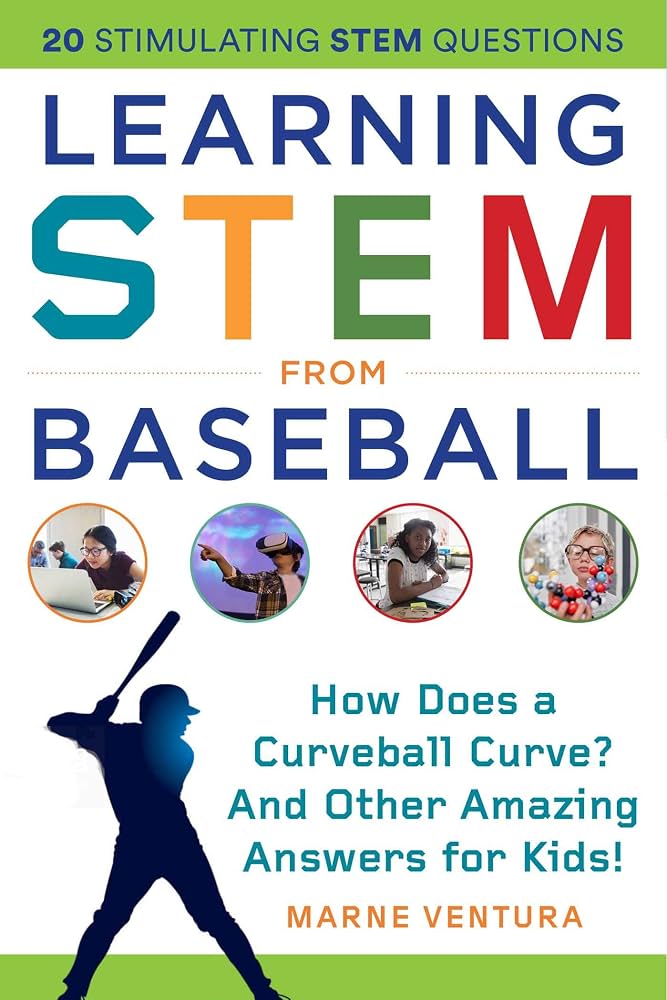
By Marne Ventura, Learning STEM from Baseball (Sky Pony Press, 2020) ties science, engineering, math (and some history) to baseball. Kids learn why pitchers wind up, what makes a curveball curve, how baseballs are made, and more. For ages 9-12.

Home Run! The Science of Baseball and Softball by Robert Bonnet and Dan Keen (Enslow Publishers, 2010) has 100+ pages of information and experiments, variously dealing with environmental factors, energy transfer, friction and pressure, and statistics, as well as a list of supplementary reading suggestions and Internet addresses. Challenges include “Does rain affect a ball’s bounce?” and “How does the weight of a bat affect a hit?” For ages 10 and up.

David Dreier’s Baseball: How It Works (Capstone Press, 2010) in the Science of Sports series, illustrated with color photos, diagrams, and sidebars, is an overview of the physics of baseball for ages 11-14, covering such concepts as velocity, inertia, gravity, acceleration, and torque.

Robert Kemp Adair’s The Physics of Baseball (Harper Perennial, 2002) is an absorbing overview of the science behind balls, bats, pitching, catching, and throwing, illustrated with charts, diagrams, and graphs. It’s reader-friendly and studded with analogies and anecdotes, but it’s physics. Best for high-school-level physics students and up.
From the Smithsonian, check out the science (and math) of the stolen base.
Younger brothers try to steal more bases than older brothers. Find out why here.
Baseball and Math
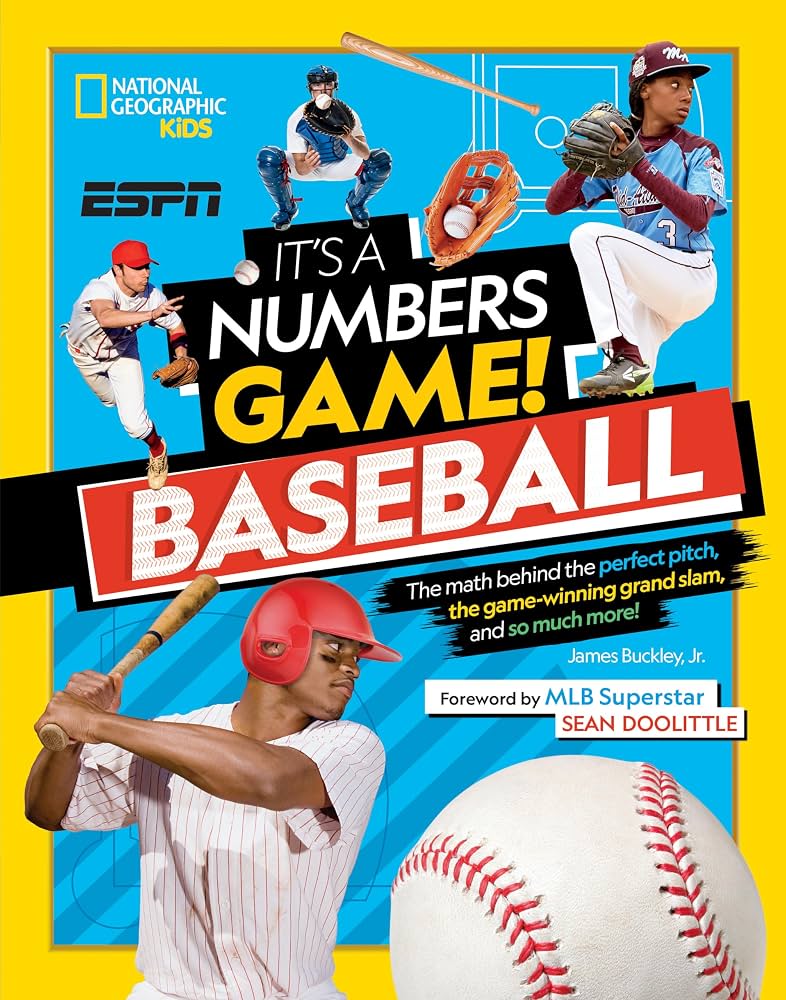
By James Buckley, Jr., It’s a Numbers Game! Baseball (National Geographic Kids, 2021) is a clever, graphic-packed overview of numbers and math in all aspects of baseball. Included are Pencil Power challenges and History by the Numbers boxes. For ages 7-11.
In the same format, other books in the series cover football, basketball, soccer, and hockey.

By Eric Braun, Super Baseball Infographics (Lerner Classroom, 2015) is a creatively illustrated collection of cool sports facts and figures. For starts, find out what inside a baseball. For ages 8-12.

Christopher Jennison’s Baseball Math (Good Year Books, 2005) is an arithmetic workbook for grades 4-8 in which all the problems have baseball themes. Topics include basic arithmetical operations, decimals, percents, and ratios, and reading charts and graphs.

Math professor and baseball fan Ken Ross’s A Mathematician at the Ballpark (Plume, 2007) first shows readers how to calculate a batting average (though he prefers the more informative “slugging percentage”), and then spins off into a discussion of the strategy, tactics, and probabilities of the game. (Appendices include both “Binomial Theorem” and “Fantasy Baseball.” Go figure.) For teenagers and adults.
From Prongo, Batter’s Up Baseball is a Flash game in which players score hits and runs by solving addition or multiplication problems. (Get a right answer and the crowd cheers.)
From the NCTM, What's round, hard, and sold for $3 million? is a challenge involving compound interest, based on collector's baseballs.
Art, Crafts, Puzzles, and Projects

E. Lisle Reedstrom’s The Story of Baseball Coloring Book (Dover Publications, 1991) features 45 black-line ready-to-color pictures of famous baseball players, with brief biographies.

Brad Herzog’s I Spy With My Little Eye: Baseball (Sleeping Bear Press, 2011) is visual puzzle book in which readers are challenged to find differences in nearly identical, crammed-full color photographs of balls, bats, mitts, and players. For ages 6-8.
From the Kennedy Center, see The Art of Baseball, a multifaceted hands-on lesson in which kids build a model baseball diamond using tiles or pattern blocks, then explore the game of baseball through art, movement, and sound, creating skits, dances, audiotapes, and collages. For ages 5-10.
Decorate your own baseball cap! Inexpensive plain white ready-to-decorate caps are available from the Oriental Trading Company.
Baseball in the Movies

Among the recommendations for kids is Everyone’s Hero (2006), the first computer-animated movie devoted to baseball. Young Yankee Irving’s father, a janitor at Yankee Stadium, has been accused of stealing Babe Ruth’s bat, so Yankee, after retrieving the bat from the real thief, sets off on a cross-country trek to return it to Babe Ruth at the World Series and redeem his father’s reputation. He’s accompanied by a talking baseball who bickers continually with the (also talking) Babe Ruth bat.
The 25 Best Baseball Movies. At least in one person's opinion.
Baseball and Philosophy

In the Popular Culture and Philosophy series – which also features such volumes as Harry Potter and Philosophy, The Lord of the Rings and Philosophy, and Buffy the Vampire Slayer and Philosophy – see Baseball and Philosophy, edited by Erin Bronson (Open Court, 2004) which includes essays on a wide range of topics by 18 different philosophers. Sample titles include “Socrates at the Ballpark,” “Democracy and Dissent: Why America Needs Reggie Jackson,” “Baseball, Cheating, and Tradition: Would Kant Cork His Bat?,” “The Zen of Hitting,” and “Should Cubs Fans Be Committed? What Bleacher Bums Have to Teach Us About the Nature of Faith.” For teenagers and adults.
In the same series, see The Red Sox and Philosophy (Open Court, 2010), edited by Michael Macomber. Thirty different philosophers discuss the Red Sox as they relate to everything from Aristotle to Sartre.