
Squirrels
In this collection
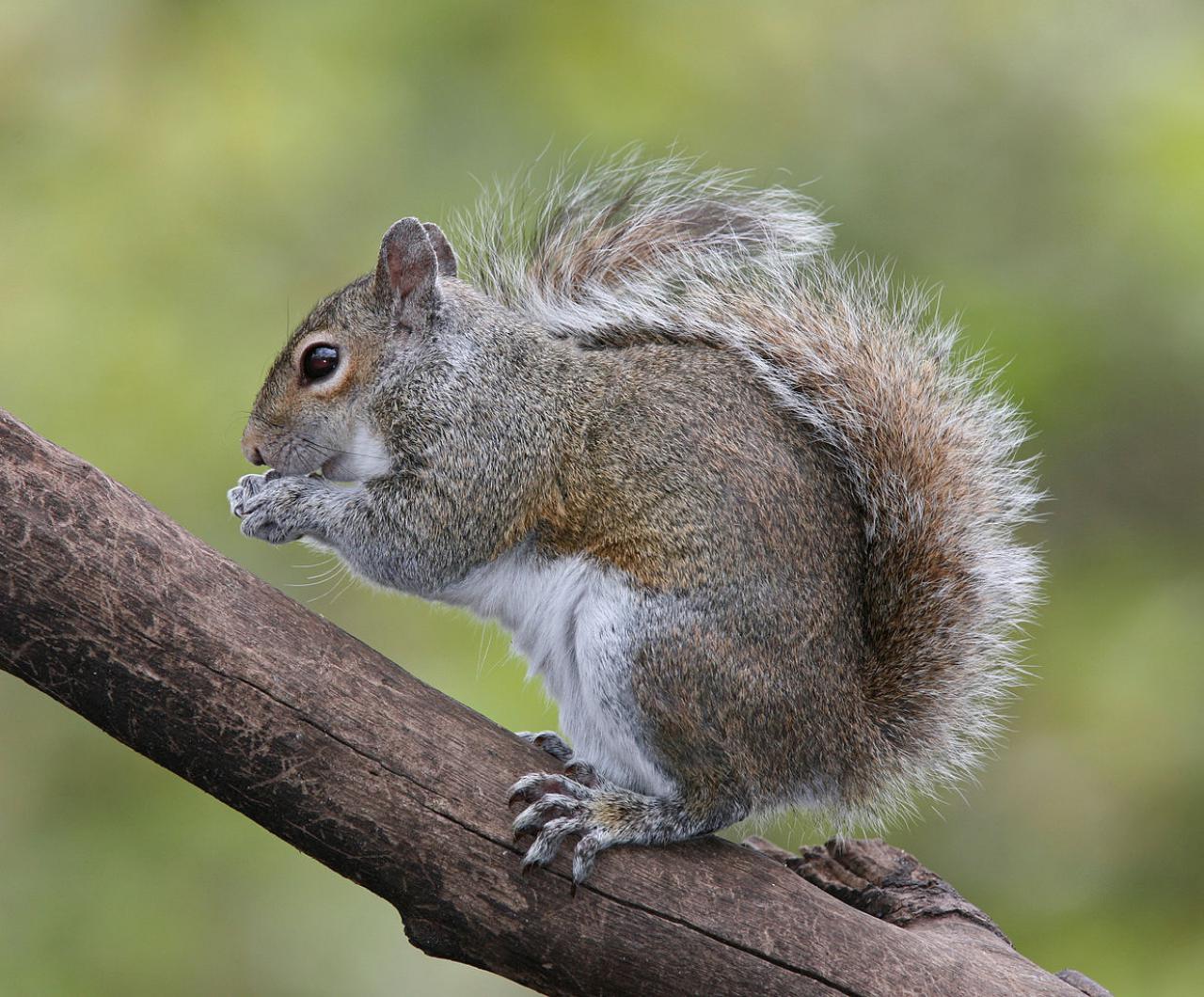
The world is full of wonderful squirrels: think Pattertwig in C.S. Lewis’s Prince Caspian, Silent Sam and Jess Squirrel in Brian Jacques’s Redwall, and Scrat, the acorn-chasing squirrel in the Ice Age movies. Check out the resources below for all things squirrel, including squirrel poems, squirrel paintings, squirrel robots, and a peculiar purple squirrel from Pennsylvania.
Squirrel Stories: Good Squirrels

In Nancy Tafuri’s The Busy Little Squirrel (Simon & Schuster Books for Young Readers, 2007), fall has arrived and a frenetic squirrel busily gathers nuts, berries, and apples, and prepares his nest for winter. He’s too busy to nibble pumpkin with the mice, hop rocks with the frogs, or run in the fields with the dogs – and finally, when asked to watch the moon with the owls, tired (but well-stocked) squirrel is fast asleep. For ages 3-6.

In Pat Miller’s Squirrel’s New Year’s Resolution (Albert Whitman & Company, 2010), it’s New Year’s Day according to the Nut-of-the-Month calendar and Squirrel struggles to make a resolution, having learned from Bear, the helpful librarian, that a resolution is “a promise you make to yourself to be better or to help others.” In search of a resolution, puzzled Squirrel visits friends Skunk, Mole, Turtle, and Porcupine, giving each a helping hand along the way; in the end she discovers that her actions show that she’s already fulfilling a resolution. For ages 4-6.

The panic-stricken protagonist of Melanie Watts’s Scaredy Squirrel (Kids Can Press, 2008) refuses to leave his tree. Anything could be out there in the fearsome unknown - Martians, sharks, tarantulas, germs. And he’s well-prepared for threats with an emergency kit containing everything from antibacterial soap to a parachute. Then one day, terrified by passing (killer?) bees, he leaps from his tree – and discovers, to his amazement, that he’s not just a squirrel: he’s a flying squirrel. There are many sequels, in which Scaredy Squirrel variously fears rabbits, piranhas, jellyfish, falling coconuts, dragons, ghosts, bats, confetti, ponies, and Bigfoot. For ages 4-8.

Miriam Young’s Miss Suzy (Purple House Press, 2004), originally published in 1964, is the story of a sweet and highly domestic gray squirrel – she’s a whiz with acorn pudding – who is tossed out of her cozy tree by a gang of delinquent red squirrels. She shelters in the attic of the house next door, where she finds old dollhouse and a box of toy soldiers. The toy soldiers come to life and soon adore Miss Suzy, who settles them in the dollhouse, cooks for them, and tucks them into bed every night. Eventually they help her return home and drive the red squirrels from her tree. For ages 4-8.

Lisa Moser’s Squirrel’s World (Candlewick, 2007) is a short chapter book for beginning readers, in which enthusiastic and well-meaning Squirrel wants only to help his friends, but his manic efforts always seem to backfire. For ages 4-8.

Earl of Don Freeman’s Earl the Squirrel (Puffin, 2007) has been told by his mother that it’s high time he learned to gather his own acorns, so off he goes to visit Jill, the little girl next door, who gives him a nut and a nutcracker. His mother is appalled – no squirrel needs a nutcracker – and makes him take it back. Jill then gives him a red scarf to keep his ears warm, which doesn’t please his mother either – furry squirrels don’t need scarves. Earl, now determined to prove himself and make his mother proud, sets out to find acorns – but his red scarf turns out to be a problem when he encounters Conrad the bull. For ages 4-8.
See Teaching Children Philosophy for background information and philosophical discussion questions for Earl the Squirrel, variously categorized under “Independence,” “Dependence on Technology,” and “Risk vs. Reward.”

Toon Tellegen’s The Squirrel’s Birthday and Other Parties (Boxer Books, 2009), with wonderful illustrations by Jessica Ahlberg, is a magical collection of nine animal stories. In the first of these, Squirrel – who lives in a house plastered with sticky notes – finds one reminding him of his upcoming birthday. He promptly invites all his friends, and then devotes himself to baking a marvelous array of cakes: huge honey cakes for the bear and the bumblebee, a grass cake for the hippo, and a cake made of water for the dragonfly, “a strange, gleaming cake and he put it to one side under the twigs of the rosebush.” A lovely book for ages 5 and up.

In Philippa Pearce’s green-drenched The Squirrel Wife (Candlewick, 2007), the young swineherd Jack – despite the protests of his wicked older brother - ventures into the forest on a stormy night and rescues one of its resident magical green people, a man trapped under a fallen tree. As a reward, the green man gives Jack a golden ring that turns a squirrel into a lovely wood-wise woman who becomes his wife. They live happily in the forest until Jack’s brother, jealous, accuses Jack of theft and has him imprisoned; and to rescue him, the squirrel wife must make a heartbreaking choice. For ages 5-9.

In James Burks’s graphic novel Bird & Squirrel on the Run (Scholastic/Graphix, 2012), Bird and Squirrel are an unlikely duo: Bird is a happy-go-lucky free spirit, while Squirrel, who never takes off his acorn helmet, is nervous and obsessive (“New things give me stomachaches”). Both are in danger from Cat, a toothy orange monster who would like nothing better than to eat them both. When Squirrel’s winter food supply is destroyed, Bird and Squirrel head south, forging a friendship, foiling a cat, and developing a taste for adventure along the way. For ages 7-10.
Squirrel Stories: Bad Squirrels

In Lois Ehlert’s Nuts to You (Sandpiper, 2004), illustrated with gorgeous paper collages, a feisty city squirrel digs up the flowerpots, steals seeds from the birdfeeder, and sneaks through a hole in the window screen into a little boy’s apartment bedroom. For ages 3-6.


In Beatrix Potter’s The Tale of Squirrel Nutkin (Frederick Warne, 2012), originally published in 1903, Nutkin – a mischievous pest with a taste for rhyming riddles – goes too far with grouchy owl Old Brown and loses a chunk of his tail.
Read The Tale of Squirrel Nutkin with the original Potter illustrations online.

Adam Rubin’s hilarious and delightful Those Darn Squirrels! (Sandpiper, 2011) features the unspeakably grumpy Old Man Fookwire, who hates pies and puppies – but loves birds. He paints bird portraits and fills his yard with beautiful birdfeeders in hopes of persuading his beloved birds stay with him through the winter. The feeders promptly attract a gang of particularly persistent and innovative squirrels (they’re good with pulleys and catapults). When the birds do fly south, leaving Old Man Fookwire alone in his house mournfully eating cottage cheese, the squirrels decide to do him a good turn in payment for all the goodies they’ve nabbed. Sequels include Those Darn Squirrels Fly South and Those Darn Squirrels and the Cat Next Door. For ages 4-8.
Watch clever squirrels navigate an obstacle course.

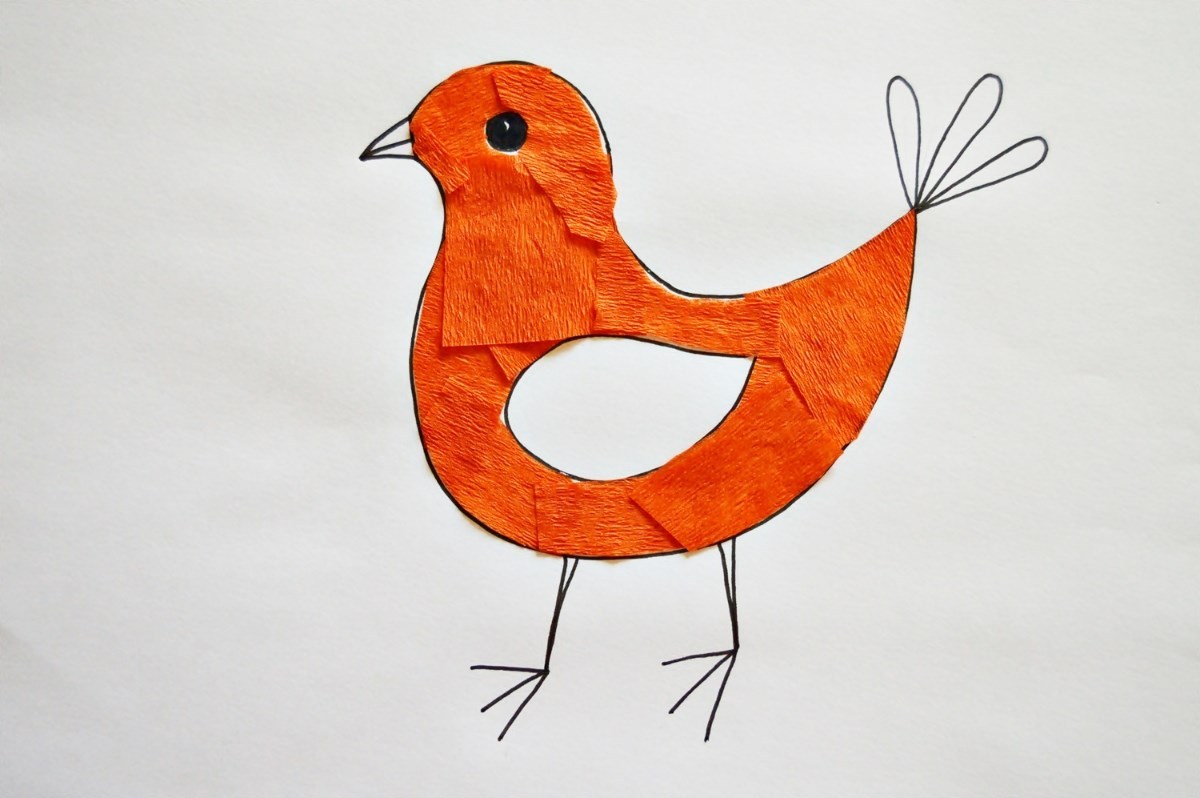
Inspired by Old Man Fookwire? From Deep Space Sparkle Art Lessons for Kids, see How to Draw a Bird for a great bird drawing, painting, and decorating project. Make beautiful bird portraits of your own.

The title characters of Kara LaReau’s Rabbit & Squirrel: A Tale of War and Peas (Harcourt Children’s Books, 2008) are neighbors, but not friends. When vegetables begin to disappear from their adjacent gardens, each blames the other. Squirrel hurls a rotten tomato at Rabbit; Rabbit turns the hose on Squirrel. Finally a huge human being – to whom, it becomes clear, the garden actually belongs – chases both Rabbit and Squirrel into the woods, where they stubbornly continue their battle. A lesson in how not to cope with conflict. For ages 4-8.

Naturalist Thornton Burgess wrote many nature-based books for children, beginning in 1910 with the publication of Old Mother West Wind. The stories are set in the Green Forest and star a vast cast of animal characters, among them Peter Rabbit, Jimmy Skunk, Sammy Jay, Reddy Fox, and Little Joe Otter. In The Adventures of Chatterer the Squirrel (Dover Publications, 1992), Chatterer – a thoroughly mischievous red squirrel – has a narrow escape from Shadow the Weasel (never tease a weasel) and a lucky escape from Farmer Brown’s boy who captures him (he was in the corn crib pinching corn) and puts him in a cage. A chapter book for ages 5-9.
Read The Adventures of Chatterer the Squirrel online.

Bill Adler’s Outwitting Squirrels (Chicago Review Press, 1993) is filled with squirrel stories, squirrel facts, and helpful strategies for keeping squirrels out of your birdfeeder. It’s also a hoot to read. Sample chapter titles include “Know the Enemy,” “The Unbearable Persistence of Squirrel Appetite,” and “What to Do if You Think Squirrels Are Cute.” A great resource for the squirrel-afflicted.
Real Squirrels

Jennifer Keats Curtis’s Squirrel Rescue (Schiffer Publishing, 2012) is a realistic account of two children finding and saving a baby squirrel who has fallen from the nest. (What to do: put it in a box and leave so that the mother squirrel can recover it.) For ages 4-8.

Mel Boring’s Rabbits, Squirrels, and Chipmunks (Cooper Square Publishing, 1996) in the Take Along Guide series is a nicely designed and illustrated introduction to common species of the three featured animal groups, with descriptions, eating habits, where to find each, and assorted anecdotes and interesting facts. Also included are a few hands-on projects, among them making a hanging nut ball for the squirrels and a peanut tightrope for chipmunks. For ages 5 and up.

Diane Swanson’s Welcome to the World of Squirrels (Walrus Books, 2001), illustrated with color photographs, is a great basic introduction to squirrels, with a 32-page reader-friendly text covering squirrel anatomy, different types of squirrels, worldwide distribution, behavior, habitats, food, and predators. Readers learn that tree squirrels can have up to ten different nests (and they can weave a nest in a day). And don’t bother going to Australia to see squirrels. Australia has no squirrels. For ages 5-9.
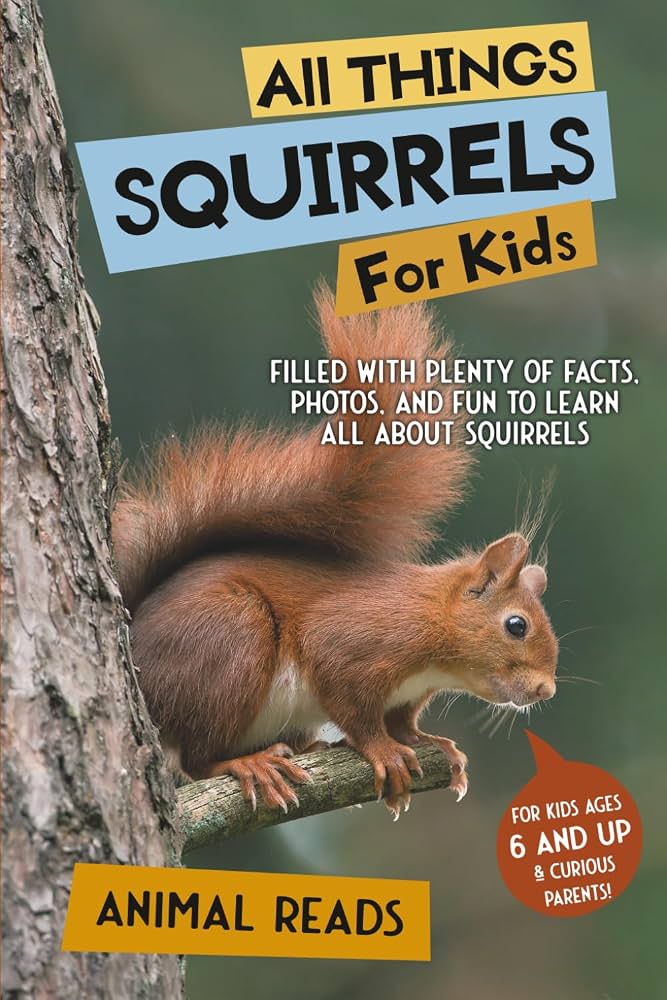
By Animal Reads, All Things Squirrels for Kids (Ardmore Publishing, 2025), illustrated with color photos, is packed with information and fascinating facts about squirrels. For ages 6-10.
Multicultural Squirrels

In Norse mythology, Ratatoskr was the squirrel who darted up and down the trunk of Yggdrasil, the world tree, spreading gossip and carrying messages. Read about him (briefly) in “Yggdrasil, the World Tree” in D’Aulaire’s Book of Norse Myths (New York Review of Books, 2005).


OBSERVING SQUIRRELS

Become a citizen squirrel scientist! Project Squirrel wants volunteers of all ages from all regions of the country to report squirrel sightings.
Not enough squirrels to observe? An almost foolproof way to attract some is to FEED THEM.
The Science of Squirrels

Natalie Angier’s Nut? What Nut? is a short fascinating science essay on squirrels. Readers learn, for example, that squirrels have yellow-tinted eye lenses that act as natural sunglasses, and find out a bit about squirrel robots.

Robosquirrels! See Robosquirrels versus Rattlesnakes, a short account of experiments using snakes and robot squirrels.
National Geographic: Squirrel has fast facts on squirrels and an infographic comparing the size of a squirrel to a teacup.

Find out how flying squirrels fly in How Squirrels Fly from Smithsonian magazine. (Scientists tested the squirrels in a wind tunnel.)
With help from ancient squirrels, Russian scientists have managed to regenerate 30,000-year-old plants. Find out about it in Scientists and Squirrels Regenerate a Plant.

Hibernating squirrels are teaching scientists about the workings of the brain. Find out how (and learn about the frigid winters of arctic ground squirrels) here.

A 100-million-year-old saber-toothed squirrel probably looked much like Scrat from the Ice Age movies. Really. Check it out at LiveScience's Saber-Toothed Squirrel.
Historic Squirrels

For information and period artwork (with squirrels), see When Squirrels Were One of America's Most Popular Pets.
For more on the popular pet squirrel (often seen with gold-chain leashes and collars) see 
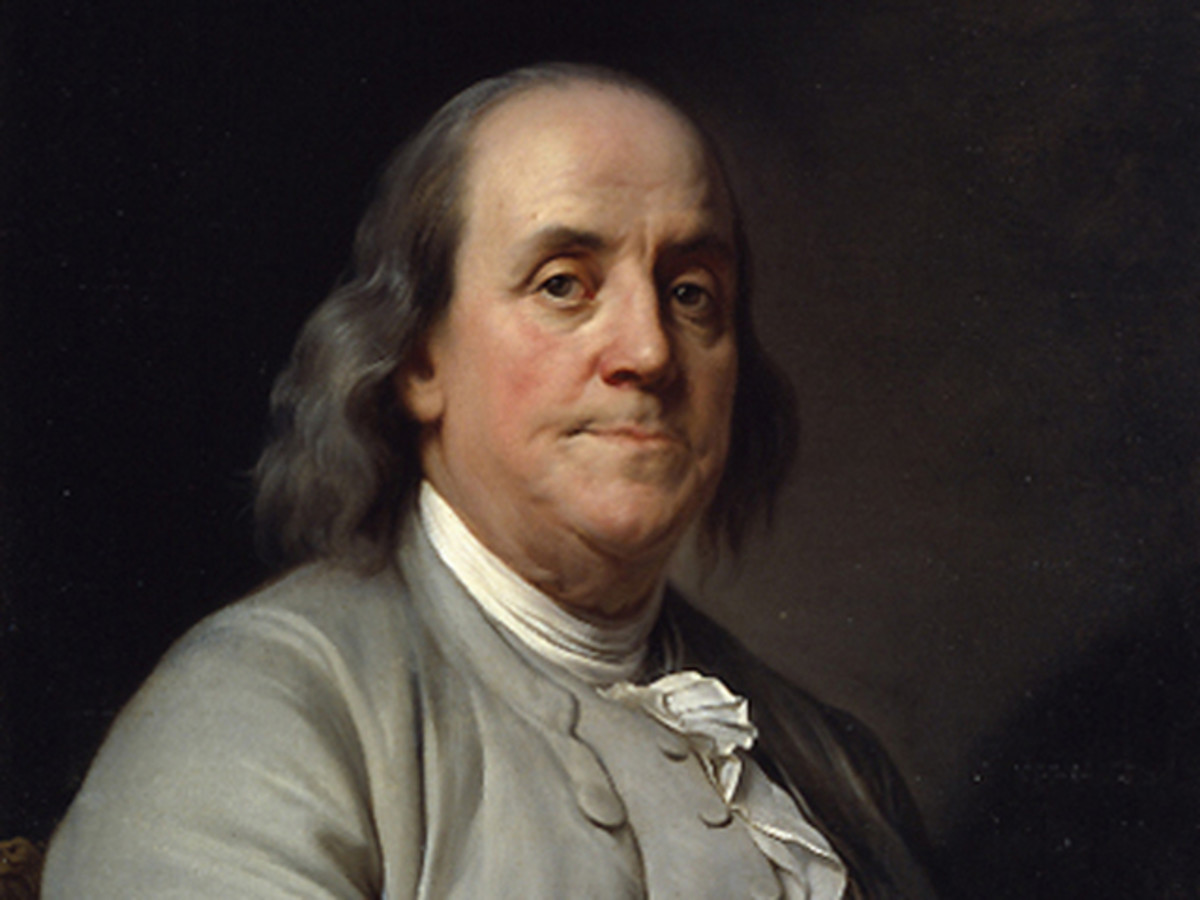
Ben Franklin’s famous epitaph for a departed pet squirrel (“Here SKUGG/Lies snug/As a bug in a rug”) is found in a letter to Georgiana Shipley, written in 1772. Read Franklin's letter here.
Squirrels in High Places discusses the relationships of U.S. presidents to squirrels. Ronald Reagan fed them; Harry Truman appointed an official White House squirrel feeder; Dwight Eisenhower attempted to ban them from the White House lawn because they dug holes in his putting green. The George W. Bush family dog, Millie, chased them.

Tommy Tucker – a very fashionable squirrel – was a national sensation in the 1940s. Check out this gallery of Tommy Tucker photos from the Life magazine archive at https://www.life.com/animals/a-squirrels-guide-to-fashion/.
I Never Saw a Purple Squirrel
There’s a wide range of color in squirrels. Gray squirrels, for example, can be black, brown, or tan; and red squirrels can range from black to brown to red (with white bellies). But…purple squirrels?

There are pockets of pure-white squirrels scattered across North America, which is why so many towns claim to be the “Home of the White Squirrels.” For information and a white-squirrel map, see White Squirrels.

Learn about black squirrels. (They're really gray.)
For more on white and black squirrels, see Roadside America’s White Squirrel Wars and
Black Squirrel Squabbles.

Check out this (real) bright-purple squirrel from Pennsylvania. Learn all about it and the theories of what made it purple.
Pink squirrels? Flying squirrels glow pink in the dark. Really. Find out about it here.
Squirrel Poems
Read W.B. Yeats’s To a Squirrel at Kyle-Na-No.
Ralph Waldo Emerson’s poem Fable begins “The mountain and the squirrel/Had a quarrel…”

Jack Prelutsky’s poem “Squirrels” is from the collection Something Big Has Been Here (Greenwillow, 2010). Or read it 
Squirrel Arts and Crafts

Build a squirrel! The
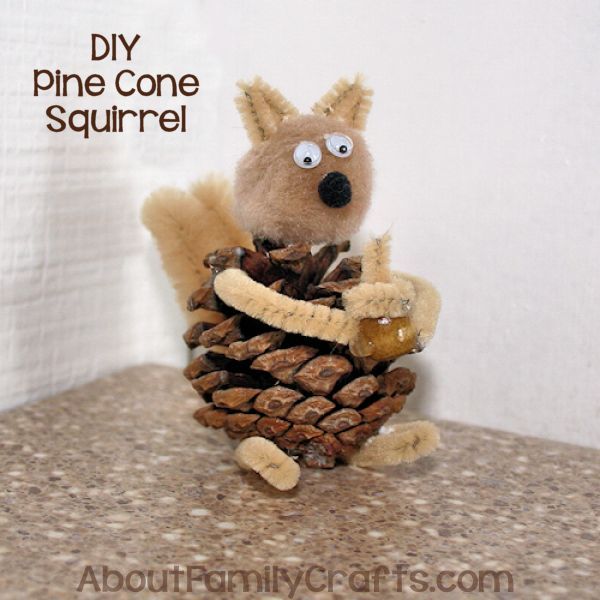
Make a pine cone squirrel!
You'll need pipe cleaners, pompoms, a pair of wiggly eyes, and a pine cone.
Activity Village’s Learn About Squirrels has squirrel coloring and notebooking pages, squirrel printables, and instructions for making a squirrel collage and spoon puppet.
A Girl Named Squirrel?

Emily Arnold McCully’s Squirrel and John Muir (Farrar, Straus & Giroux, 2004) is a fictionalized take on a real incident that took place in California’s Yosemite Valley in 1868. Young Floy Hutchings, whose parents run Yosemite’s first hotel, is nicknamed Squirrel because of her wild and rebellious behavior. When naturalist John Muir comes to the Valley and takes a job at the hotel, he and the lonely little girl form a bond. Illustrated with lovely watercolor paintings. For ages 4-8.
Squirrel Girl, Marvel Comics superheroine, has a tail, little claws in place of fingernails, and an ability to communicate with squirrels, hordes of which help her defeat enemies.