
Henry David Thoreau
In this collection
Philosophy, environmentalism, political activism, and life in the woods. It's all part of our heritage.
Celebrate Thoreau's birthday on July 12 (1817) by living simply and taking a hike.
About Henry

In D.B. Johnson’s Henry Hikes to Fitchburg (Houghton Mifflin Harcourt, 2006), inspired by Walden, Henry and a friend – both bears – prepare to go to Fitchburg, 30 miles away. The friend decides to work and save enough money to take the train; Henry, however, decides to walk, enjoying nature along the way. Sequels include Henry Builds a Cabin, Henry Climbs a Mountain, Henry Works, and Henry’s Night. For ages 4-8.

Thomas Locker’s Walking with Henry (Fulcrum Publishing, 2011), illustrated with Locker’s beautiful paintings, follows Thoreau as he hikes through the wilderness. (“When he awoke, the grass was covered/with morning dew. It looked like a mirror/broken into a thousand fragments/wildly reflecting the full blaze of the rising sun.”) Included is a timeline of Thoreau’s life. For ages 4-9.

In Robert Burleigh’s If You Spent a Day with Thoreau at Walden Pond (Henry Holt and Company, 2012) – illustrated with gorgeous paintings by Wendell Minor – a small boy in blue jeans knocks on the door of a little house in the woods and then proceeds to spend a gentle, magical day with the owner: Henry David Thoreau. (“If you spent a day with Henry David Thoreau, you would need to get there early because Henry wakes with the sun.”) Appendices include background information on Thoreau and a list of Thoreau quotes. A lovely read for ages 5-10.

In Julie Dunlap and Marybeth Lorbiecki’s Louisa May and Mr. Thoreau’s Flute (Dial, 2002), seven-year-old Louisa May Alcott is fascinated by independent-minded Henry David Thoreau, who carries a flute in his pocket, tucks a pencil behind his ear for jotting down notes in his journal, and takes the children on nature walks. Louisa – nicknamed Louy – has some independent thoughts of her own, and Mr. Thoreau’s example eventually helps her find her own way to writing. For ages 5-9.

Robert Burleigh’s A Man Named Thoreau (Atheneum, 1985) is out of print, but well worth tracking down – a simple story of how, though his life may have looked odd and pointless to some, Thoreau was thinking, observing, and having ideas that have become important to us all. Illustrated with lovely charcoal drawings. For ages 6-10.
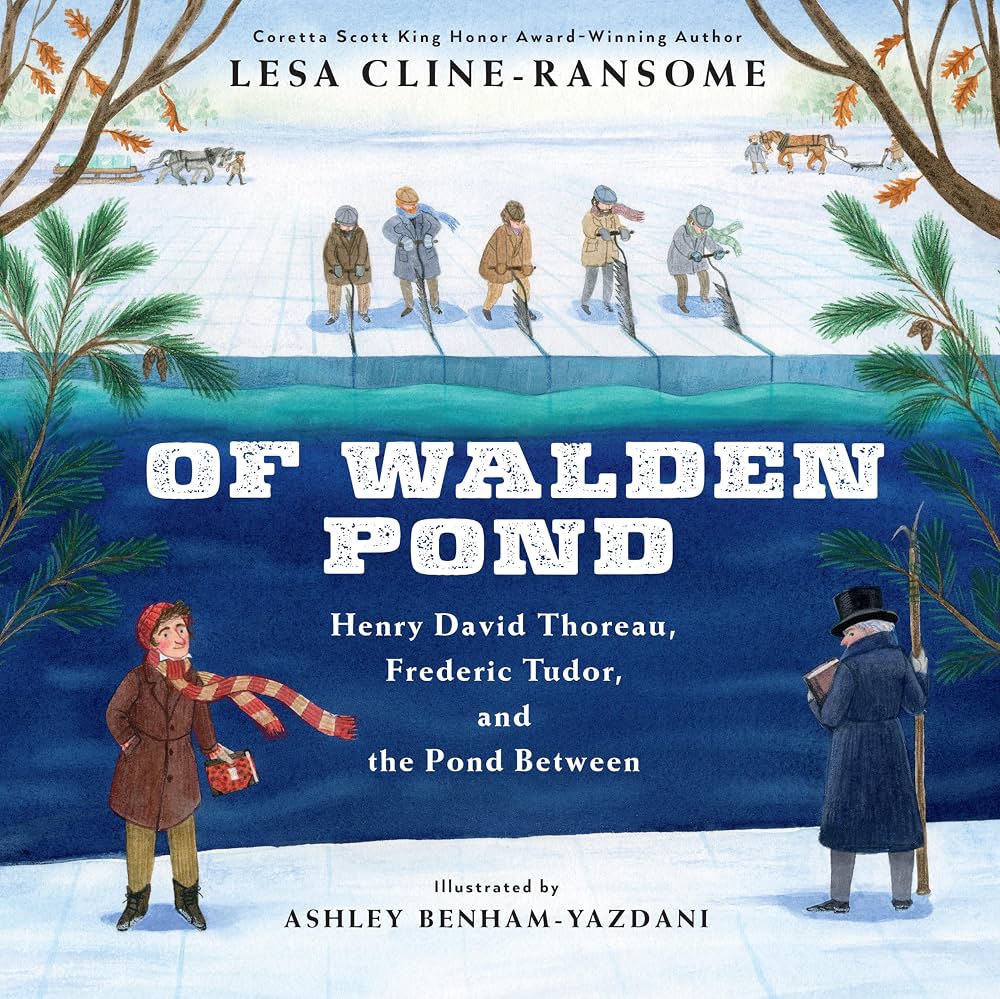
By Lesa Cline-Ransome, Of Walden Pond (Holiday House, 2025), written in verse, tells the contrasting stories of Henry David Thoreau, naturalist and philosopher, and Frederic Tudor, the capitalist bent on harvesting Walden Pond’s ice for profit. For ages 7-9.
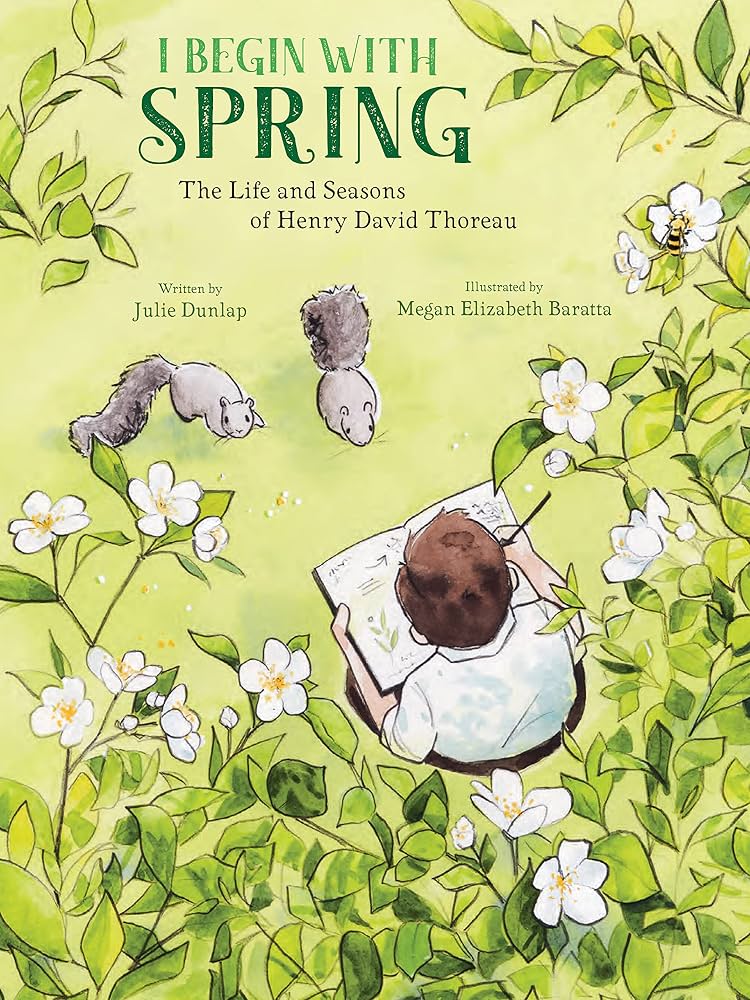
By Julie Dunlap, I Begin with Spring: The Life and Seasons of Henry David Thoreau (Tilbury House, 2022), written in the form of an illustrated nature journal, pairs natural history and the changing seasons with the story of Thoreau’s life and times. A wonderful resource for ages 8-12.

John Porcellino’s Thoreau at Walden (Disney-Hyperion, 2018) is a graphic novel version of Thoreau’s life and work, studded with famous quotations. For ages 10 and up.

By Jerome Lawrence and Robert E. Lee, the play The Night Thoreau Spent in Jail (Hill and Wang, 2001) is a brilliant account of Thoreau’s life and philosophy, centered around the night he spent in jail for refusing to pay taxes to support the Mexican-American War – a war fought without Congressional approval and a blatant example of imperialism. A wonderful, witty, and discussion-provoking read for teenagers and adults.
The Night Thoreau Spent in Jail is a teacher’s guide to accompany the play with background information and discussion questions.

Michael Sims’s The Adventures of Henry Thoreau (Bloomsbury USA, 2014) traces Thoreau’s life from his boyhood (he liked to ice skate, sing, and walk in the woods) through his education at Harvard, his friendship with Ralph Waldo Emerson, his famous cabin at Walden Pond, and his transformation into world-famous author and environmentalist. For teenagers and adults.

Robert Sullivan’s biography The Thoreau You Don’t Know (Harper Perennial, 2011) points out that Thoreau – rather than just an oddball loner who disliked new suits of clothes – was friendly, chatty, and lived most of his life in town. An interesting and informative read for teenagers and adults.

Ecologist David R. Foster’s Thoreau’s Country (Harvard University Press, 2002) describes how – equipped with Thoreau’s journals – the author built his own cabin in the woods, and then set out to explore how the New England landscape has changed since Thoreau took to the woods in the 19th century. For teenagers and adults.

Corinne Hosfeld Smith's Henry David Thoreau for Kids (Chicago Review Press, 2016) has an overview of Thoreau’s life, times, and ideas, with illustrations, fact boxes (“What is Transcendentalism?”), and related activities, including making a journal, conducting a plant inventory, and writing a protest letter to an official or editor. For ages 9 and up.
The Thoreau Society provides education about Thoreau’s life, works, philosophy, and place in the world, and hosts many events for all ages. The website has a Thoreau biography and family tree, maps of Thoreau’s travels, synopses of Thoreau’s works, and more.

By Ken Burns, Walden (2017) is a short documentary on the life and works of Henry David Thoreau.
See Transcendentalism: An American Philosophy for a brief overview, with mentions of some of its more prominent followers.
Henry David Thoreau is a collection of interesting and varied articles on Thoreau from the New York Times. For example, in
A Man For All Seasons, find out how Thoreau’s writings are helping modern scientists analyze climate change.
From Philosophy Slam, Henry David Thoreau has an overview of Thoreau’s philosophy with a list of discussion questions and associated links.
Into the Woods

Jim Murphy’s Into the Deep Forest with Henry Thoreau (Clarion Books, 1995), peppered with excerpts from Thoreau’s own journals, traces Thoreau’s trips through Maine, on foot and by canoe. For ages 7-11.

Michael Johnathon’s play Walden: The Ballad of Thoreau is a four-character play featuring a conversation between Thoreau and Emerson as Thoreau prepares to leave his cabin on Walden Pond. See
https://www.waldenplay.com/download/ to download the script and view accompanying lesson plans.
Michael Johnathon’s 

Back to Thoreau! Richard Louv’s Last Child in the Woods (Algonquin Books, 2008) discusses the demise of unstructured outdoor play – that is, going outside and running around in the woods – and points out how our alienation from nature (he calls it “nature-deficit disorder”) is damaging.
The Walden Woods Project is a non-profit organization dedicated to preserving the land, literature, and legacy of Henry David Thoreau. The website has information on the Walden Woods ecosystem, activity and curriculum guides, background information on Thoreau’s life and work, and photo galleries.

In May 1862, shortly after his death, the Atlantic magazine published Thoreau’s famous essay, Walking. Pair it with a hike.
By Henry

Henry David Thoreau’s Walden, first published in 1854, is a reflection on the simple life, a celebration of self-reliance and introspection, and an account of a year spent in a hand-built cabin on the shores of Walden Pond in Concord, Massachusetts. Now available in many editions, it’s an American classic.
“If the law is of such nature that it requires you to be an agent of injustice to another, then I say, break the law.” In his essay Civil Disobedience, originally published in 1849, Thoreau argues that the individual conscience should not be overruled by government. His beliefs have since influenced such prominent public figures as Mahatma Gandhi and Martin Luther King. Everyone should read it. See https://blogs.law.columbia.edu/uprising1313/files/2017/10/Civil-Disobedience-by-Henry-David-Thoreau.pdf.
See Civil Disobedience from the Stanford Encyclopedia of Philosophy.
The Writings of Henry David Thoreau has information on Thoreau’s books, journals, and correspondence, samples of Thoreau’s (terrible) handwriting, online journal transcripts, and more.
Fictional Henry

In Rebecca Rupp's Octavia Boone's Big Questions About Life, the Universe, and Everything (Candlewick, 2010), Octavia is struggling to come to terms with belief after her mother leaves the family to join the fundamentalist Redeemers. With the help of her best friend Andrew (whose big questions are about everything from time travel to alien jellyfish), Octavia finally comes to terms with her relationships, concluding - with Henry David Thoreau - that "The universe is bigger than our views of it." For ages 9-14.

In Robin Vaupel’s My Contract with Henry (Holiday House, 2003), four eighth-grade English students, as part of a class project, build a cabin in the local woods and set out to emulate Henry David Thoreau. In the process, they learn a lot about themselves and their values, and eventually galvanize the community into action when the woods is sold to developers. For ages 11-14.

In Cal Armistead’s Being Henry David (Albert Whitman & Company, 2013), a teenaged boy wakes up in Penn Station with no memory, ten dollars, and a copy of Thoreau’s Walden. He names himself Henry David and heads for Concord, Massachusetts, hoping to discover his past at Walden Pond – though it’s clear that something in his past is frightening. For ages 13 and up.

Henry David Thoreau: detective? In B.B. Oak’s Thoreau at Devil’s Perch (Kensington, 2013), Thoreau – in company with Dr. Adam Walker and Walker’s feisty and intelligent cousin, Julia Bell – investigates the murder of a young black man whose body has been found at the foot of a cliff called Devil’s Perch. The first of a series. For teenagers and adults.