Appreciating Elephants
In this collection
Elephants have commemorative days all their own: August 12 is World Elephant Day and September 22 is Elephant Appreciation Day.
And, of course, for both and all in between, there are zillions of wonderful elephant resources.
Fabulous Fictional Elephants

The most lovable, loyal, and admirable elephant of all time may just possibly be Dr. Seuss’s Horton. In Horton Hears a Who (Random House, 1954), big-eared Horton hears a cry for help from a small speck of dust and then bravely defends the tiny creatures who live on it, declaring “a person’s a person, no matter how small.” In Horton Hatches the Egg (Random House, 1968), Mayzie, a lazy and irresponsible bird, leaves Horton with her egg – which he doggedly cares for despite the taunts of his friends, because “an elephant’s faithful, one hundred percent.” You couldn’t have a better role model. For ages 2-7.

Mo Willems’s wonderful graphic-novel-style Elephant and Piggie series (Hyperion Books) star Gerald the Elephant, a down-to-earth practical type in spectacles, and his exuberantly optimistic friend Piggie. (“Today I will fly!” exalts Piggie. “No,” counters Gerald.). Many titles, among them Today I Will Fly! (2007), We Are in a Book! (2010), and Listen to My Trumpet! (2012).

The title character of David McKee’s Elmer (HarperCollins, 1989) is funny, adorable, and – unlike all the other elephants - brilliantly patchwork-colored. Still, he wants to be gray, just like everyone else – though when he has a try at it, he discovers the error of his ways. A delightful book about the importance of being who you really are for ages 4-7.
Make a colorful Elmer-inspired elephant garland with this printable template.

Make these great Elmer elephants with milk jugs and squares of tissue paper.

Jean de Brunhoff’s Babar first appeared in 1931, and today – along with family, friends, acquaintances, and enemies – appears in a long series of elephantine picture books for ages 4-8. In the first of these, The Story of Babar (Random House, 1937), young Babar loses his mother to a hunter, travels to the city, is adopted by a kindly old lady who outfits him in a green suit and sends him to school, and eventually returns to the jungle to become King of the Elephants.
For an interesting discussion of Babar’s pros and cons, see Adam Gopnik’s 2008 New Yorker piece Freeing the Elephants.

Remember the curious little elephant who met a crocodile on the banks of the great grey-green, greasy Limpopo River? The classic tale of how the elephant got his trunk is “The Elephant’s Child” in Rudyard Kipling’s Just-So Stories, originally published in 1902. There are many editions of the book – just avoid anything either Disney or abridged. The complete original text and illustrations can be found online.

Margaret Mahy’s 17 Kings and 42 Elephants (Dial, 1987) is a rhyming journey through the jungle, filled with rollicking wordplay and crammed with crocodiles, hippopotamuses, flamingos, peacocks, tigers, and – of course – elephants. For ages 4-8.

17 Kings and 42 Elephants is frequently used as a springboard to math – though many lesson plans simply reduce the book to unappealing word problems, as in “How many more pelicans than tigers were there?” Literature-Based Math Activities by Alison Abrohms (Scholastic, 1994), however – lessons based on 40 different picture books for grades K-3 – has a more interesting approach, suggesting that kids dramatize the book, make graphs based on the book, act as television reporters and “broadcast” numerical observations made during their jungle journey, and write a sequel to the book, describing the procession’s destination and what happens when they arrive. Abrohms’s book is out of print, but is available from online used-book suppliers and appears online as a Google book at https://books.google.com.ag/books. Worth tracking down.

The expression “the elephant in the room” traditionally refers to an obvious looming truth that everybody ignores. Lane Smith’s The Big Elephant in the Room (Hyperion Books, 2009) is a picture-book twist on just that for ages 5-9. “Can we talk about the big elephant in the room?” one donkey asks the other – which sends the friend off into a hilarious guilt-ridden litany of admissions of wrong-doing. (“Is it that I made fun of your Rainbow Pony backpack?”) The joke, of course, is that there really is a big elephant in the room.

The star of J.P. Martin’s Uncle (New York Review of Books Children’s Collection, 2007) is a millionaire elephant who wears a purple dressing gown, has a B.A., lives in a ramshackle castle called Homeward (“think of a hundred skyscrapers all joined together”), and presides over a kingdom filled with weird and wonderful characters. Also see the sequel, Uncle Cleans Up. For ages 8-12.

In Kate DeCamillo’s The Magician’s Elephant (Candlewick, 2009), ten-year-old orphan Peter Augustus Duchene learns from a fortuneteller that the sister he thought was dead is still alive – and that an elephant will lead him to her. That night a magician disastrously conjures up an elephant, who crashes through the roof of the town opera house. A dark, complex, and miraculous tale for ages 8-13.

In Jennifer Richard Jacobson’s Small as an Elephant (Candlewick Press, 2011), Jack’s unstable mother has abandoned him at a campground in Maine and left for the Bahamas with a boat owner she met in a bar. Jack, fearful of intervention by social workers, tells no one about his predicament and sets out to find his own way home to Boston – despite having no money, food, or means of transport. On the way – with the (sometimes inadvertent) help of others - he begins to understand his mother’s problems, to come to terms with their relationship, and ultimately to re-connect with his grandmother. The book is a beautifully done view of reality and mental illness as seen through a boy’s eyes – and the connecting thread here is elephants. Jack is passionate about elephants, and each chapter begins with an elephant fact, story, or quotation. Despite some agonized soul-searching, Jack steals a small plastic elephant that becomes his support and consolation throughout his journey; and his own story as it unfolds echoes the behaviors of elephant families and herds. A wonderful read for ages 9 and up.

Katherine Applegate’s The One and Only Ivan (HarperCollins, 2012) is narrated by Ivan, a gorilla who lives in a glass enclosure in the Exit 8 Big Top Mall and Video Arcade, along with an elderly elephant, Stella, and Bob, a stray dog with a pithy vocabulary. All are befriended by George, the caretaker, and Julia, George’s little daughter, who first introduces Ivan to art, by sliding paper and crayons through a hole in Ivan’s glass wall. Then Mack, owner of the mall, buys Ruby, a baby elephant, in an effort to beef up his business. Stella loves Ruby and – before she dies – begs Ivan to find a way to free her. Through his art – and with a little interpretive help from George and Julia – Ivan does, and at the end both he and Ruby have found new homes and families at a good zoo (“where humans make amends”). This is a marvelous book, filled with intense, funny, and sometimes painful observations on freedom, captivity, and art, all in Ivan’s distinctive voice. Ivan acts like a gorilla – he eats his crayons, pounds his chest, and throws dung balls – but he’s a very human gorilla. Which statement he wouldn’t take as a compliment. For ages 8 and up.
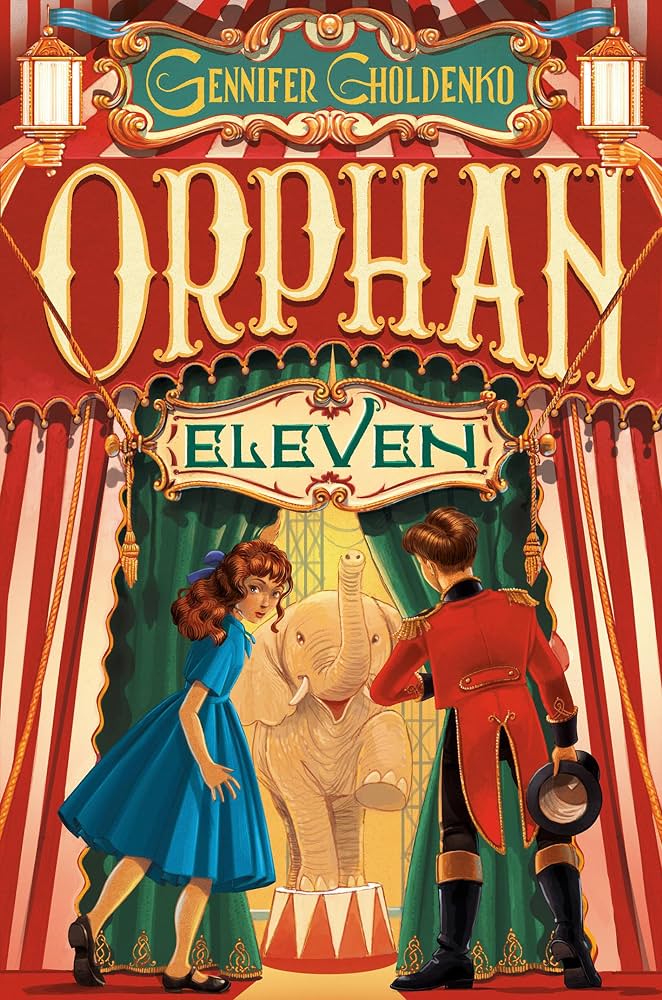
In Orphan Eleven by Gennifer Choldenko (Wendy Lamb, 2020), set in the 1930s, four kids have escaped from the miserable Home for Friendless Children and have ended up as apprentices working for a traveling circus. There one of the four, Lucy – unable to speak after some undisclosed trauma – forms a special bond with the elephants, but to warn her friends of danger, it’s imperative that she regains her voice. A story of hope, survival, and belonging for ages 9-12.
Multicultural Elephants

Karen Backstein’s The Blind Men and the Elephant (Cartwheel Books, 1992) is a picture-book retelling of an Indian fable in which six blind men encounter an elephant and each – touching different parts of the animal – variously describe it as being like a wall, a snake, a tree, a fan. The lesson is that it takes many perspectives to gain a whole view. For ages 5-7.

Ed Young’s Seven Blind Mice (Puffin, 2002) is another take on the classic tale, with gorgeous cut-paper illustrations. In this version, the seventh mouse, remembering what his predecessors reported, puts all the facts together and concludes that the mysterious something at the pond must be an elephant. The book ends with a Mouse Moral: “Knowing in part may make a fine tale, but wisdom comes from seeing the whole.”
John Godfrey Saxe’s classic poem “The Blind Men and the Elephant” can be found here. (“It was six men of Indostan/To learning much inclined/Who went to see the Elephant/(Though all of them were blind)”).
The Blind Men and the Elephant Lesson Plans is a multifaceted collection of projects variously emphasizing English, economics, science, and character education. Included are illustrated copies of the poem, a Buddhist story based on the poem, and the script of a play based on a Persian version of the poem.

In Bill Peet’s The Ant and the Elephant (Sandpiper, 1980), loosely based on Aesop’s fable “The Ant and the Dove,” the kindly elephant saves a stranded ant; in return, when the elephant falls into a ravine and all the other animals refuse to help him, the tiny ant comes to the rescue. For ages 4-8.
Actually elephants hate ants. Recent research shows that acacia trees escape the depredations of elephants because they’re protected by ants, which elephants avoid. Learn all about it at Scientific American's Ants Protect Acacia Trees from Elephants at https://www.scientificamerican.com/podcast/episode/ants-protect-acacia-trees-from-elep-10-09-02/.

Amy Novesky’s Elephant Prince: The Story of Ganesh (Mandala Publishing, 2004) is the story of how the Hindu god Ganesh came to have the head of an elephant. For ages 5-9.
Also see How Ganesh Got His Elephant Head by Harish Johari and Vatsala Sperling (Bear Cub Books, 2003).

Learn about this fabulous elephant mask from Cameroon.

In Shirin Bridges’s The Umbrella Queen (Greenwillow Books, 2008), the custom in a little village in Thailand is to make beautiful umbrellas decorated with flowers and butterflies, but young Noot insists on painting hers with elephants. For ages 5-8.
From YouTube, check out this short video on Thai umbrella-making.
Making Umbrellas is a simple painted umbrella craft for preschoolers using paper plates.

Thailand (once Siam) is also known as the Land of White Elephants. Margaret Landon’s Anna and the King of Siam (Buccaneer Books, 2001), originally published in 1944, is the fictionalized story of English governess Anna Leonowens at the court of King Mongkut of Siam in the mid-19th century, where she was hired to give the king’s many wives, concubines, and children a Western education. It’s a fascinating story – and includes an exciting account of the capture of a rare royal white elephant. For ages 13 and up.

The book was adapted as a Broadway musical by Rodgers and Hammerstein, and made into a film, The King and I, in 1956, starring Deborah Kerr as Anna and Yul Brynner as King Mongkut. Rated G.

A more recent (and music-less) film version of the story is Anna and the King (1999), with Jody Foster as Anna and Chow Yun-Fat as King Mongkut. There’s a clever ploy involving a white elephant sighting. Rated PG-13.
A “white elephant” is a term used for a valuable but burdensome possession – usually something impossible to get rid of, but crushingly expensive to maintain. Find out why and much more about the white elephants of Thailand.
Historical Elephants

What do elephants have to do with the Brooklyn Bridge? April Jones Prince’s Twenty-One Elephants and Still Standing (Houghton Mifflin Books for Children, 2005) describes how – after the landmark completion of the Brooklyn Bridge – showman P.T. Barnum demonstrated its safety by parading 21 elephants across it, led by the famous seven-ton Jumbo. For another picture-book version of this terrific story, see LeUyen Pham’s Twenty-One Elephants (Simon & Schuster, 2004). For ages 4-8.

In Pennies for Elephants by Lita Judge (Hyperion Books for Children, 2009), set in 1914, Dorothy and Henry discover that three talented circus elephants are for sale, and they determine to raise enough money to buy them for the Boston Zoo. Soon kids all over Boston – and the country – have joined their cause and, penny by penny, the money is raised. Illustrations include great little period images from the Boston Post. For ages 5-9.

Ralph Helfer’s The World’s Greatest Elephant ((Philomel, 2006) is the real-life picture-book tale of a young boy, Bram, and an elephant, Modoc, who grow up together in a circus in Germany and then – after disasters, adventures, and a shipwreck – make their way to America, where they become stars of the Ringling Brothers’ famous circus. For ages 7-10.

Paul Chambers’s Jumbo: This Being the True Story of the Greatest Elephant in the World (Steerforth, 2009) is the story of the elephantine superstar of the Victorian era, captured in Africa in 1862, bought by the London Zoo, and eventually purchased by P.T. Barnum, who engineered a “Jumbo craze” in the United States. For teenagers and adults.

Jumbo’s fame led Helen Aberson to chose the similar name Dumbo for the title character in her children’s book about a little flying elephant with enormous ears, originally published in 1939. The 1941 Disney movie Dumbo was based on Aberson’s book; and the Dumbo the Flying Elephant ride – based on the movie - was an original feature at Disneyland. Also see
Dumbo (2019), directed by Tim Burton.
War Elephants

“Seeing the elephant” was 19th-century slang for a first experience of battle. In Pat Hughes’s Seeing the Elephant: A Story of the Civil War (Farrar, Straus, & Giroux, 2007), 10-year-old Izzie’s two older brothers are off to fight for the Union. Izzie wants desperately to go too – but when he meets a wounded rebel soldier at the hospital where his Aunt Bell works as a nurse, he learns that war is far more complicated than he had believed. For ages 8 and up.

Michael Morpurgo’s An Elephant in the Garden (Felwel & Friends, 2011) – loosely based on a true story - is narrated by Lizzie, a teenager in Germany during World War II, whose mother worked as an animal-keeper at the Dresden zoo. As war approaches the city, Lizzie’s mother brings her beloved elephant, Marlene, home to live in the family garden - and when Dresden is bombed, Lizzie, her mother, little brother Karli, and the elephant all become refugees. They take up with Peter, a downed Canadian parachutist, and the kids from a school choir, are helped by a sympathetic countess, lose Marlene, and ultimately land in a refugee camp – but there’s a satisfying happy ending in which Lizzie and Peter marry, and they re-encounter Marlene. For ages 10 and up.

In Roland Smith’s Elephant Run (Hyperion, 2007), set in World War II, 13-year-old Nick is sent to stay with his father on a teak plantation in Burma since his mother believes he will be safer there than in London during the blitz. Instead the Japanese invade, Nick’s father is sent to labor camp, and Nick is forced to work for the plantation’s new Japanese overseer. Nick and his friend Mya – who wants to become an elephant trainer or mahout – eventually escape into the jungle, riding on Nick’s father’s elephant, Hannibal. An exciting adventure story that takes place against a complex historical and political background. For ages 9-14.

Philip Brooks’s Hannibal: Rome’s Worst Nightmare (Franklin Watts, 2009) in the “Wicked History” series is the story of the Carthaginian general who famously led a troop of elephants over the Alps to attack Rome in the Second Punic War. For ages 10 and up.

Konstantin Nossov’s War Elephants (Osprey Publishing, 2008) is a short illustrated history filled with art reproductions and fascinating information about the animals sometimes known as “living tanks.” For ages 12 and up.
Arts, Crafts, and Dancing Elephants

In Katya Arnold’s photo-illustrated Elephants Can Paint Too! (Atheneum/Anne Schwartz Books, 2005) Arnold, an art teacher, describes her experiences teaching art to both children and elephants. For ages 5-9.
See examples of elephant paintings online at the Elephant Art Gallery.
Watch elephants painting in this short YouTube video.

Leda Schubert’s Ballet of the Elephants (Roaring Brook Press, 2006) is the picture-book story of how circus owner John Ringling North, choreographer George Balanchine, and composer Igor Stravinsky collaborated to produce the phenomenal “Circus Polka” starring fifty elephants and fifty ballerinas. For ages 5 and up.

Walt Disney’s now-classic 1940 movie Fantasia features a bubble-blowing elephant ballet, performed to Amilcare Ponchielli’s “Dance of the Hours” from the opera La Giaconda.
Elephant Crafts at https://www.first-school.ws/theme/animals/wild/elephant.htm has assorted elephant crafts for preschoolers with instructions, printable templates, and “ E is for Elephant” worksheets.

Elephant Poems

Tracie Vaughn Zimmer’s 32-page Cousins of Clouds: Elephant Poems (Clarion Books, 2011) is a wonderful collection of elephant poems, illustrated with clever mixes of painting and collage, and punctuated with explanatory fact boxes. A great interconnection of genres for ages 5 and up.

Elephant Science

Ian Redmond’s 48-page The Elephant Book (Walker Books, 1991) is an excellent non-fiction overview of the elephant, illustrated with color photographs. For ages 8 and up.

Ian Redmond's Elephant (DK, 2000) is a volume in the Eyewitness series: each photo-illustrated double-page spread covers a different aspect of elephant anatomy, physiology, behavior, evolution, conservation, and more. For ages 8 and up.

Caitlin O’Connell’s The Elephant Scientist (Houghton Mifflin Books for Children, 2011) in the Scientists in the Field series is the story of her own 19-year career studying elephants in Namibia, learning how they live, interact, and communicate with one another – this last in part by sensing vibrations through their feet. The book is illustrated with spectacular color photographs. For ages 10 and up.
For elementary-level kids, Enchanted Learning's Elephants has background information, diagrams, coloring pages, a printable “Elephant Book,” crafts, and quizzes.
The African elephant has the world's biggest ears. Find out why at https://www.audiology.org/why-do-elephants-have-such-big-ears/.
Ancient Elephants

Neal Layton’s Oscar and Arabella are mammoths, the stars of a growing collection of delightfully funny books, all illustrated in clever ink-and-crayon scribble cartoons. In Oscar and Arabella and Ormsby (Hodder & Stoughton, 2008), for example, Oscar and Arabella’s friendship is intruded upon by Ormsby, a show-offy woolly rhinoceros; and in Hot Hot Hot (Candlewick, 2004), the woolly duo – initially happily frolicking in snow and ice – must cope with a sudden spate of warm weather.
In The Mammoth Academy (Square Fish, 2010), written in chapter-book format for an older audience (ages 7-10), Oscar and Arabella, along with a host of other young Ice Age animals, start school. (Most important lesson: “Beware humans!”) Included – in highly creative and varied hand-printed fonts – are mammoth and Ice Age facts.

Lisa Wheeler’s Mammoths on the Move (Harcourt Children’s Books, 2006) is a dramatically illustrated (scratchboard and watercolor) account of a mammoth migration, with a short rhyming text. (“Fourteen thousand years ago/the north was mostly ice and snow./But woolly mammoths didn’t care -/these beasts had comfy coats of hair.”) For ages 4-7.

Aliki’s Wild and Woolly Mammoths (HarperCollins, 1998) is a beautifully illustrated non-fiction introduction, filled with intriguing information about mammoths and the Stone Age humans who hunted them. For ages 4-8.

Cheryl Bardoe’s Mammoths and Mastodons: Titans of the Ice Age (Abrams Books for Young Readers, 2010), illustrated with maps and charts, photos of paleontological sites and relics, and artists’ depictions of mammoths and mastodons, begins with the discovery of a frozen baby mammoth in Siberia. An excellent scientific account for ages 8 and up.

Beth Shapiro’s award-winning How to Clone a Mammoth: The Science of De-Extinction (Princeton University Press, 2016) is an account of the cutting-edge science that might just enable us to bring extinct animals back. For teens and adults.
Also see Ben Mezrich’s Woolly: The True Story of the Quest to Revive History’s Most Iconic Extinct Creature (Atria Books, 2018).
From Smithsonian magazine, Mammoths and Mastodons: All-American Monster at https://www.smithsonianmag.com/science-nature/mammoths-and-mastodons-all-american-monsters-8898672/ is a fascinating and informative article on ancient elephants for older readers.
Elephants for Older Readers

For teenagers, see George Orwell’s essay “Shooting an Elephant,” based on his experiences as a government official in imperial Burma in the 1930s. The essay can be found in Shooting an Elephant and Other Essays (Penguin, 2003).
Read the essay online at the Orwell Foundation at https://www.orwellfoundation.com/the-orwell-foundation/orwell/essays-and-other-works/shooting-an-elephant/.

The life story of the grotesquely deformed John Merrick – nicknamed the Elephant Man – has been the subject of a play (The Elephant Man by Bernard Pomerance (Grove Press, 1979)); a major motion picture (The Elephant Man, 1980), starring John Hurt as Merrick and Anthony Hopkins as dedicated doctor Frederick Treves (rated PG); a documentary; dozens of scientific papers; and numerous books. Merrick (1862-1890) was exhibited as a carnival curiosity until his meeting with Treves; he and the doctor became close friends and Merrick spent the rest of his life at the London Hospital. Pomerance’s play is frequently featured on high-school-level reading lists.
Gene May Explain 'Elephant Man' Disorder is a brief reader-friendly account of new research on Proteus syndrome.
And a Brief Note on the Political Elephant

For an explanation of our modern political party logos, see The Democratic Donkey and the Republican Elephant.
From the Smithsonian, see Political Animals: Republican Elephants and Democratic Donkeys.