
The Seasons (and Find Out About Phenology)
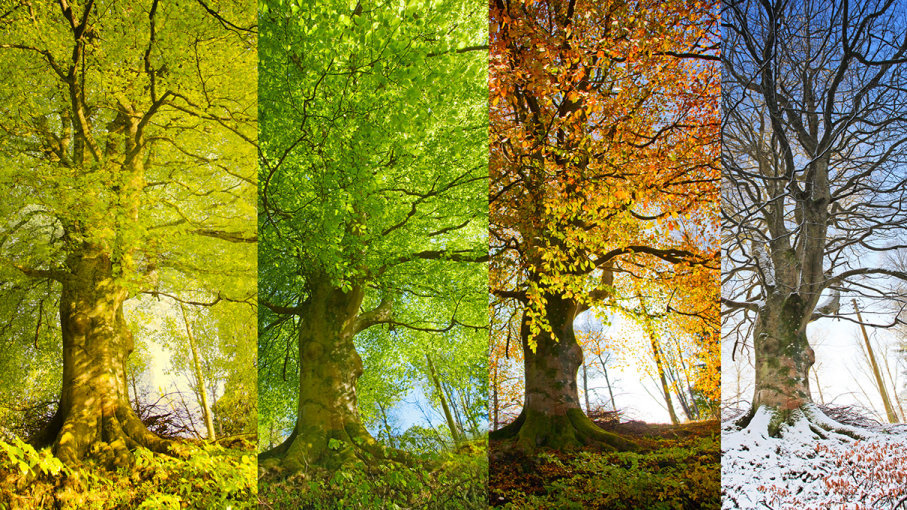
In this collection
Sing a song of seasons! Phenology is the science of what happens when in nature – that is, when the crocuses sprout, when the robins arrive, when the strawberries ripen, when the geese go south, when the last leaf falls. All it takes to be a phenologist is a pencil and an interest in what’s going on outdoors.
Nowadays scientists are using phenological records past and present to study climate change. They're also recruiting volunteer citizen scientists of all ages to help - by keeping notes on wildflowers, butterflies, birds, fireflies, and bees.
For books, resources, citizen-science programs, the scoop on nature journals, and some wonderful seasonal poetry and music, check out the list below.
Changing Seasons

In Linda Glaser’s four-volume Celebrate the Seasons! Series (Millbrook Press, 2001), illustrated with bright cut-paper collages, a young narrator explains how plants, animals, and people all change with the changing seasons. Titles are It’s Spring!, It’s Summer!, It’s Fall!, and It’s Winter! Each book includes an appendix with simple seasonal projects and activities. For ages 3-6.

In Mary McKenna Siddals’s Tell Me a Season (Sandpiper, 2001), four color-coded scenes for each season of the year culminate in a picture of a little red house, with a boy, girl, cat, and dog. For example, “Brown mud/Brown trees/Sky of gray/With pink and purple clouds” lead to “Spring morning,” with pastel sunrise, bare ground, a budding tree, puddles, and kids in pajamas peeking out the window. Readers can trace changes in the landscape from page to page, as trees leaf out and the grass turns green; then pumpkins ripen, smoke comes out the chimney, and finally snow falls on a “Winter night.” For ages 3-6.
For activities, online games, and multidisciplinary lesson plans to accompany the book, see Tell Me a Season at the Mary McKenna Siddals website.

In Il Sung Na’s picture book Snow Rabbit, Spring Rabbit: A Book of Changing Seasons (Knopf Books for Young Readers, 2011), a fat white rabbit watches the wild animals around him prepare for winter; bears hibernate, geese fly south, turtles head for warmer water, crocodiles bury themselves in mud. Then in spring the process, bit by bit, reverses itself, and at the very end of the book Rabbit himself has turned from winter white to spring brown. For ages 3-7.

In Anne Rockwell’s Four Seasons Make a Year (Walker Children’s Books, 2004), a little girl on a farm – clearly a young phenologist - observes the signs of the changing seasons, beginning in spring when the first robins arrive and the daffodils and crocuses bloom. In spring, she also plants a sunflower seed and watches as it sprouts, grows, blooms, and goes to seed. For ages 4-7.

Alice and Martin Provensen’s The Year at Maple Hill Farm (Aladdin, 2001) is a month-by-month account of plant and animal life on the farm. Animals, the authors explain, know nothing about the calendar months, but they all respond to the changing seasons: sheep and horses grow and shed winter coats; foals, calves, and kittens are born; chicks and ducklings hatch; fields fill with insects; flowers bloom and attract bees; hay is cut. For ages 4-7.

In Gail Gibbons’s The Seasons of Arnold’s Apple Tree (Sandpiper, 1998), the apple tree is Arnold’s special secret place. In winter, he builds a snow fort around it and hangs strings of popcorn on its bare branches for the birds; in spring, he builds a swing; in summer, a treehouse; and in the fall he rakes leaves and picks apples. Included is a recipe for apple pie and an explanation of cider-making. For ages 4-7.
Project Learning Tree is an award-winning environmental education program for kids from preschool through high school. Check out the free activities for families.

In James Prosek’s Bird, Butterfly, Eel (Simon & Schuster, 2009), Bird, Butterfly, and Eel all spend the summer on the same New England coastal farm, but as winter approaches, they all head out for very different places. For ages 4-8.

Thomas Locker and Candace Christiansen’s Sky Tree: Seeing Science Through Art (HarperCollins, 2001) traces a single tree through the seasons of the year, pairing Locker’s gorgeous oil paintings with a brief descriptive text. For ages 5-8.

Cynthia Rylant’s This Year’s Garden (Atheneum Books for Young Readers, 1987), follows a family garden through all the seasons of the year, starting in winter, the planning stage, when the garden has nothing in it but brown stalks and birds, through spring planting, summer growth, and fall harvest. For ages 4-8.
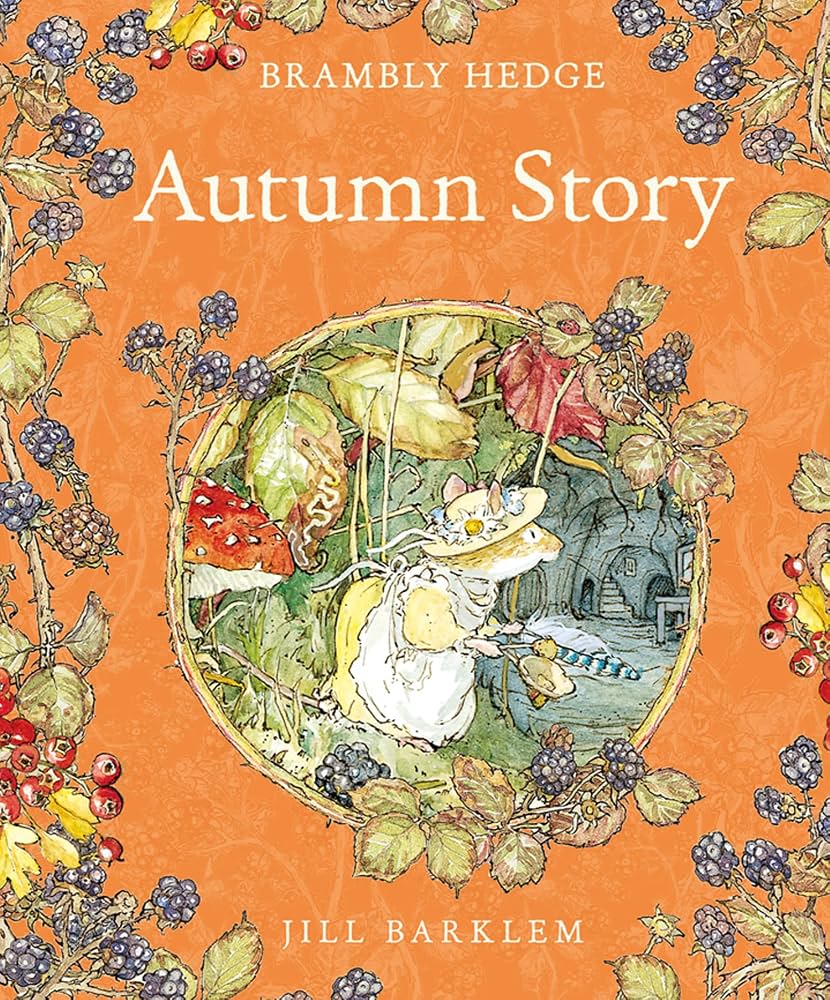
Jill Barklem’s Brambly Hedge books (HarperCollins) featuring a community of mice living in the English countryside. The detailed illustrations are adorable. For a year of Brambly Hedge, see Spring Story, Summer Story, Autumn Story, and Winter Story. For ages 6 and up.
Practicing Phenology
Phenology may be the world’s oldest environmental science. Farmers – in the days before weather satellites, thermometers, and calendars – got the agricultural go-ahead from homespun phenology: it was time to plant the corn when the oak leaves were the size of squirrels’ ears, spinach when the lilacs leafed, and potatoes when the dandelions bloomed. Carolus Linnaeus, Thomas Jefferson, Henry David Thoreau and Aldo Leopold were all phenologists, careful recorders of annual seasonal happenings.
The “Father of Phenology” is generally said to be 18th-century British landowner Robert Marsham who recorded 27 annual “Indications of Spring” over a period of sixty years. Learn more about him at the
Robert Marsham Tricentenary website.

Walden Warming is an online account of how researchers at Boston University used Henry David Thoreau’s 19th-century phenological notes to document modern-day climate change. Also see Richard B. Primack's Walden Warming: Climate Change Comes to Thoreau's Woods (University of Chicago Press, 2015). For teens and adults.

When do the first peas ripen? Susan Grigsby’s picture book First Peas to the Table (Albert Whitman & Company, 2012) is the story of a school garden competition based on the “First Peas to Table” contest Thomas Jefferson and his neighbors held each spring. For ages 5-9.
Windows to the Universe has information on the science and history of phenology, the importance of phenology today, and how scientists now study phenology using data from satellites.
The Earth Partnership for Schools program from the University of Wisconsin-Madison Arboretum has a downloadable phenology curriculum, adaptable for grades K-12. Among the activities: play a birthday phenology game and maintain a “wheelscape” phenological calendar.
The USA National Phenological Network sponsors a national plant and animal phenology observation program called “Nature’s Notebook.” Also available at the site are teaching resources, an informational database, and (click on “Participate”) a long list of citizen-science observation programs for all ages, among them Firefly Watch, Foliage Network, FrogWatch USA, Monarch Watch, Project BudBurst, the Great Goldenrod Challenge, and the Great Sunflower Project.

Journey North is a global study of wildlife migration and seasonal change in which citizen scientists report observations on robins, hummingbirds, and butterflies, plant test tulip gardens, and more. Included at the site are teaching tools, activities for kids, and season-tracking maps.

Budburst a citizen-science program for all ages in which participants report on budding times of local plants. The website has background information on phenology, plus curricula, lesson plans, and activities.

From the Cornell Labororatory of Ornithology in Ithaca, NY, NestWatch is a citizen-scientist project in which participants monitor nesting birds. The site has background information, instructions, and an online nesting database.

At the Backyard Bee Count (and Great Sunflower Project), participants plant pollinator-friendly plants (sunflowers, bee balm, cosmos, tickseed, purple coneflower) in their yards or gardens and monitor the number of visiting pollinators. The site has teaching resources and lesson plans, a discussion forum, and online data.
From the Minnesota Department of Natural Resources, Nature’s Calendar is a season-by-season list of natural events to monitor, with background information on phenology and examples of notebook entries. Included at the site is a teacher’s guide.
Nature Journals
Where to record your phenological observations? Most naturalists recommend a nature journal – and when it comes to nature journals, the sky is the limit. Try a simple sketchbook or invent a color-coded phenology journal or a scrapbook-style journal, combining data, drawings, multimedia illustrations, and poems.

Learn to keep a nature journal! See the downloadable Introduction to the Nature Journal from the Smithsonian Learning Lab.

Claire Walker Leslie’s The Nature Connection (Storey Publishing, 2010) is a multidisciplinary nature-study workbook, packed with activities, reproducible journaling pages, sketching instructions, and information. The book is divided into three sections: “How to Be a Naturalist,” “Learning the Sky,” and “Exploring Nature,” this last a month-by-month guide to outdoor investigation, with projects and reading recommendations. For ages 8-12.

Many commercial 
How to Make a Nature Journal.

L.K. Ludwig’s Mixed-Media Nature Journals (Quarry Books, 2008) is filled with examples and suggestions for making beautiful and unusual journals based on the natural world, using everything from leaf rubbings and pressed plants to prints, photos, found artifacts, and more. See the chapter on “Creating a Seasons-Based Journal.” Adaptable for a range of ages.

Susan Leigh Tomlinson’s How to Keep a Naturalist’s Notebook (Stackpole Books, 2010) covers tools and materials, field sketching techniques (basic and advanced), field identification, note-taking, and maps. For teenagers and adults.

Barbara Bash’s 160-page True Nature: An Illustrated Journal of Four Seasons (KTD Publications, 2012) is a reflective hand-lettered journal, illustrated with lovely pencil-and-watercolor drawings. Included is “A Way to Begin,” an instructional segment for readers inspired to create nature journals of their own. For teenagers and adults.

Edith Holden's Country Diary of an Edwardian Lady (Rizzoli, 2018) is a gorgeous facsimile of a nature journal kept in 1906.
For printable sheets for nature journals (many choices), see Donna Young’s Nature Journal.

See step-by-step instructions for making a beautiful nature journal for kids with a twig binding.
Local Eating: Food for Phenologists

In author/cut-paper artist Nikki McClure’s To Market, To Market (Abrams Books for Young Readers, 2011), a mother and son head to the local farmer’s market to buy (local, in-season) food, learning from each vendor just where their wares come from and how they are produced. For ages 4-8.

By Mark Beach and Julie Kauffman, the Simply in Season Children’s Cookbook (Herald Press, 2006) is a collection of garden-to-table recipes based on seasonally available foods, from spring peas to summer corn and berries, fall squash and pumpkins, and winter potatoes. For ages 6-12.

The National Farm to School Network has information about farm-to-school programs, a clickable map for locating programs in your area, and contact info for would-be volunteers.
The Science of Seasons

Franklyn M. Branley’s Sunshine Makes the Seasons (HarperCollins, 2005) in the Let’s-Read-and-Find-Out Science Series clearly explains how the earth’s tilt and rotation create seasons. Included is a hands-on demonstration using an orange and a flashlight. For ages 4-8.

Gail Gibbons’s The Reasons for Seasons (Holiday House, 1996) is a brightly illustrated explanation of seasons, solstices, and equinoxes, with notes on seasonal behaviors of plants and animals. For ages 5-8.
Cool project: track (and graph) the changing seasons by recording sunrise and sunset times.
Khan Academy has an excellent (free) series of short, well-done videos on the reasons for seasons. Topics covered range from the Earth’s tilt to Milankovitch cycles and precession.

Janice Van Cleave’s Science Around the Year (Wiley, 2000) is a collection of (very) simple and (mostly) seasonally themed experiments, grouped under Spring, Fall, Summer, and Winter. Each experiment is introduced with a scientific fact and a paragraph of background information, and followed by a short associated book list and an extension activity. For each season, there’s also a list of scientific and/or historical “Dates to Mark on Your Calendar.” Recommended for ages 9 and up but can be used for much younger.
Seasonal Poems

Bill Martin, Jr.’s picture book The Turning of the Year (Sandpiper, 2007) is a rhyming celebration of each month of the year. (“In February, bound with snow/I sled the hillside, top to toe.”) For ages 3-7.

Paul B. Janeczko’s Firefly July (Candlewick, 2018) is a collection of very short poems for each season of the year, with gorgeous illustrations by Melissa Stewart. For ages 4-8.

Maurice Sendak’s Chicken Soup with Rice: A Book of Months (HarperCollins, 1991), originally published in 1962, is as catchy now as ever. (“In January/it’s so nice/while slipping/on the sliding ice/to sip hot chicken soup/with rice.”) What better way to learn the months of the year? For ages 4-8.

Joyce Sidman’s Red Sings From Treetops: A Year in Colors (Houghton Mifflin Books for Children, 2009) is a wonderful multisensory celebration of the changing seasons through colors. In spring, for example, red “sings from treetops” and “sprouts in rhubarb spears;” green “peeks from buds,” and yellow “slips goldfinches their spring jackets.” For ages 4-8.

Nicola Davies’s Outside Your Window: A First Book of Nature (Candlewick, 2012) is a collection of evocative (and informational) poems, categorized by season, and illustrated with a creative multimedia mix of collages, woodcuts, watercolors, and ink. The book is a thoughtful lesson on the wonders of observation, as readers explore such phenomena as the life cycle of frogs, the sprouting of toadstools, and bird migration. For ages 4-8.

Miriam Weiner’s Shakespeare’s Seasons (Downtown Bookworks, 2012) is a lovely collection of short (very short) excerpts from Shakespeare’s poems and plays, illustrated with elaborate collage, cut-and-paste, and origami images, arranged in order by season. For example, a snippet from Sonnet 18 (“Shall I compare thee to a summer’s day?”) is paired with a summer beach scene. For ages 4-8.

By Anna Grossnickle Hines, Pieces: A Year in Poems and Quilts (Greenwillow Books, 2003) pairs simple seasonal poems with wonderful photographs of colorful season-themed patchwork quilts. (Try a cloth or paper quilt-and-poetry project of your own.) For ages 4-9.

Bob Raczka’s Guyku: A Year of Haiku for Boys (Houghton Mifflin Books for Children, 2010), with delightful illustrations by Peter Reynolds, is a collection of short poems about boys’ (just boys) outdoor activities throughout the year. (“The wind and I play/tug-of-war with my new kite./The wind is winning.”) For ages 5-8.

In Leo and Diane Dillon’s To Everything There Is a Season (Blue Sky Press, 1998), the famous verses from the Bible’s Book of Ecclesiastes (“To everything there is a season and a time to every purpose under the heaven…”) are illustrated with exquisite art representative of a wide range of periods and cultures, among them Egyptian tomb paintings, Japanese woodblock prints, Greek red-and-black ceramics, Australian aboriginal bark paintings, Russian icons, and more. For all ages.

The title of Joseph Bruchac’s Thirteen Moons on Turtle’s Back (Puffin, 1997) refers to the native American legend that the thirteen scales on Old Turtle’s back represent the thirteen lunar months of the year. For each moon – among them the Moon of Popping Trees, Baby Bear Moon, Moose-Calling Moon, and the Moon When the Wolves Run Together – there’s a seasonally descriptive poem and a gorgeous oil painting by Thomas Locker. For ages 6 and up.
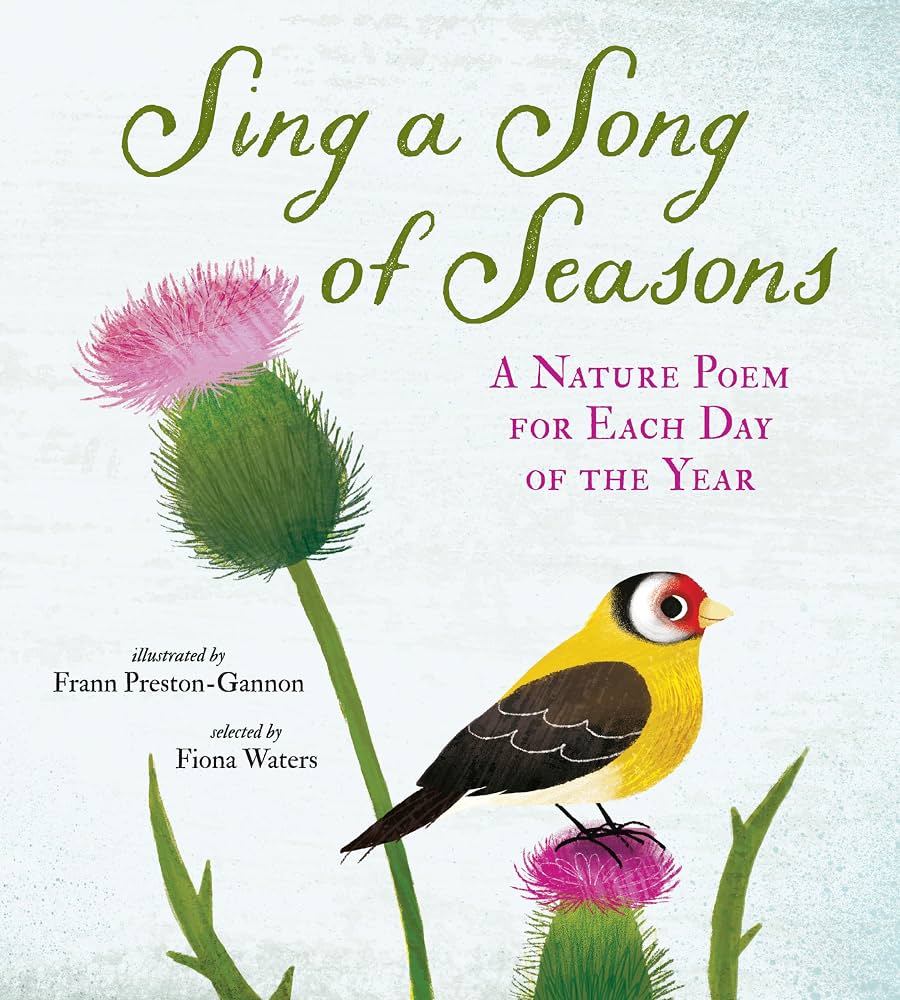
Edited by Fiona Waters, Sing a Song of Seasons (Candlewick, 2018) is a beautifully illustrated anthology of nature poems, one for each day of the year, by a wide range of poets, among them Emily Dickinson, Langston Hughes, and William Shakespeare. For ages 6 and up.

Julie Andrews’ Treasury for All Seasons (Little, Brown Books for Young Readers, 2012) is a beautifully illustrated collection of poems and songs celebrating the seasons of the year. Included are works by Emily Dickinson, Walt Whitman, Sara Teasdale, Jack Prelutsky, and Langston Hughes. For ages 6 and up.

Compiled by Lee Bennett Hopkins, Sharing the Seasons (Margaret K. McElderry Books, 2010) features twelve poems by various poets for each of the four seasons of the year, with wonderful illustrations by David Diaz. For ages 8 and up.

One of the excellent Poetry for Young People series, The Seasons (Sterling, 2005), edited by John N. Serio, is a 48-page illustrated and annotated collection of season-based poems by such poets as Langston Hughes, Nikki Giovanni, e.e. cummings, and William Shakespeare. For ages 9-12.

By Michael Harrison and Christopher Stuart-Clark, A Year Full of Poems (Oxford University Press, 1996) is an illustrated collection of seasonal poems - several for each month of the year – by a wide range of poets, among them Elizabeth Coatsworth, Louis Untermeyer, William Wordsworth, Christina Rossetti, and David McCord. For ages 9 and up.
And Seasonal Music

By Anna Harwell Celenza, professor of music at Georgetown University, Vivaldi’s Four Seasons (Charlesbridge Publishing, 2012) is the picture-book story – with included CD - of how Antonio Vivaldi, with the help of talented young girls at an orphanage in Venice, created his famous four violin concertos, collectively titled “The Four Seasons.” The concertos, the author explains, were written to accompany four seasonal sonnets – “Spring,” “Summer,” “Autumn,” and “Winter” – which are included at the back of the book. For ages 4-8.
Listen to Antonio Vivaldi's Four Seasons at https://www.youtube.com/watch?v=aryDMAP6oug.
Find out how your musical preferences change with the seasons.
Arts and Crafts

Kathy Ross’s charmingly illustrated Crafts to Make in Spring (Millbrook Press, 1998) has instructions for 29 creative spring-themed crafts, among them cotton-swab pussywillows, a robin door hanging, a wind puppet, and a crocus gift garden. Also by Ross, see Crafts to Make in Summer, Crafts to Make in Fall, and Crafts to Make in Winter. For ages 5 and up.

Marie LeBaron’s 144-page Make and Takes for Kids (Wiley, 2011) has crafts and recipes for each month of the year. Make clothespin butterflies, paper-tube snakes, apple garlands, and corncob prints. For ages 5 and up.
For seasonal crafts for elementary-level kids, Enchanted Learning’s The Seasons has an assortment categorized by season, among them eggshell tulips, a pop-up summer flower garden, a fall leaf string, and a snowflake card.

From TLC, How to Make Paper Planters has instructions for a Four Seasons Tree, sporting one decorated branch for each season of the year.

See Four Seasons of the Year Crafts - among them a great four-seasons felt board.
Crafts by Season has many, for every season of the year.
The That Artist Woman website has wonderful and creative children’s crafts categorized by season. Make paper hyacinths, a nesting bird weaving-and-poetry project, pastel-resist butterflies, felted fall trees, and much more.