
Mysteries
In this collection
Mystery reading makes us smarter. It does, really.
According to experts, mystery readers must assemble data, evaluate facts, and draw logical conclusions, which, willy-nilly, enhances critical and analytical thinking skills.
And we get such intellectual bennies painlessly, by simply indulging in Tintin, Agatha Christie, Sherlock Holmes, Encyclopedia Brown, and Nancy Drew. And there are, of course, hundreds of books and resources…
Getting Started

Both the British Crime Writers’ Association and the Mystery Writers of America have published lists of the 100 best mysteries of all time. (How many have you read?) See both lists here.
From Commonsense Media, check out these kids' mystery book reviews at https://www.commonsensemedia.org/lists/mystery-books.
First Clues is a good source for mystery series books for kids and young adults, categorized by age: New Sleuths (4-6), Future Sleuths (7-9), Sleuths in Training (10-12), and Apprentice Sleuths (13 and up).

Professor Plum with the candlestick in the library? In this classic board game of deductive reasoning (and mystery-solving), 
The Incomparable Sherlock Holmes

The most famous of fictional detectives is certainly the infallible Sherlock Holmes, noted for deductive reasoning, violin-playing, an opium habit, and his long-suffering sidekick, Dr. Watson. Sir Arthur Conan Doyle’s Holmes opus consists of four novels (A Study in Scarlet, The Sign of the Four, The Hound of the Baskervilles, and The Valley of Fear) and 56 short stories, available in many print editions. The complete texts are also available online at www.sherlockian.net, a large and multifaceted web site with a wealth of information on all things Holmes, Watson, and Doyle.

Those looking for Sherlock Holmes on video have a wide choice of interpretations and actors, among these last everyone from Basil Rathbone to Jeremy Brett to Benedict Cumberbatch. For a brief history of Sherlock Holmes movies, see the Atlantic’s Film’s 111-Year Obsession With Sherlock Holmes which includes a video of the 30-second 1900 silent film “Sherlock Holmes Baffled” (possibly the first mystery movie ever) and a great slide show of Holmesian movie scenes.
For an annotated list of Sherlock Holmes films and TV series, see the Internet Movie Database at https://www.imdb.com/list/ls066973103/.

Adapted by Judith Conaway, the 96-page Mysteries of Sherlock Holmes (Random House Books for Young Readers, 1984) is a large-print collection of three Holmes stories – “The Speckled Band,” “The Red-Headed League,” and “The Blue Carbuncle” – retold in simple language for ages 6-9.
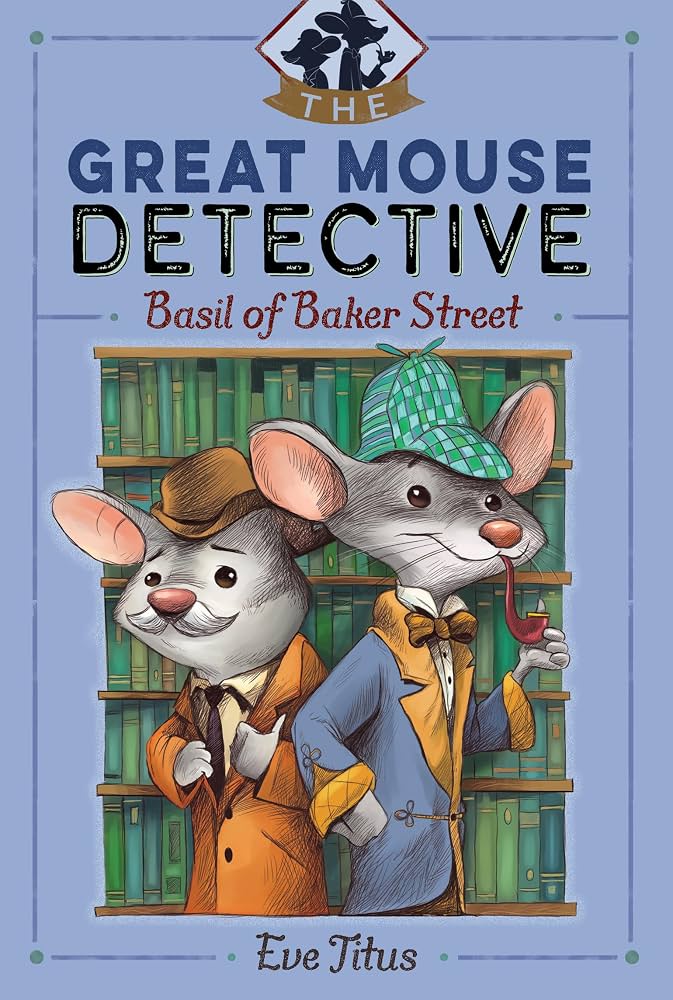
In Eve Titus’s Basil of Baker Street (Aladdin, 2016) - first of the Great Mouse Detective series – Basil lives in the cellar of Sherlock Holmes’s house and has picked up his sleuthing skills from Holmes himself. For ages 6-9.

In Betty G. Birney’s Mysteries According to Humphrey (Putnam Juvenile Books, 2012) – seventh in a series of chapter books starring the lovable (and “SMART-SMART-SMART”) classroom hamster, Humphrey – teacher Mrs. Brisbane has just read “The Adventure of the Red-Headed League” to her class. Humphrey, inspired, uses Sherlock Holmes’s methods to solve cases of his own. For ages 7-10.

Walter R. Brooks’s 26 Freddy the Pig books, originally written in the 1930’s and 40’s, all feature Freddy, a versatile, poetic, and hilarious pig, and his animal friends on the Bean farm. In Freddy the Detective (Overlook Juvenile Books, 2010), Freddy discovers Sherlock Holmes and promptly sets out to emulate his new hero, solving assorted mysteries involving a stolen toy train, a criminal gang of rats, a missing bunny named Egbert, and a false charge of murder. For ages 7-11.
Freddy the Pig’s Home Page has synopses of all the Freddy books, more information on Freddy and the Bean farm, illustrations, and a biography of Walter R. Brooks. Visit the site and become an official Friend of Freddy.


Tracy Barrett’s Sherlock Files Series stars twelve-year-old Xena and Xander Holmes, descendants of the famous detective. In The 100-Year-Old Secret (Square Fish, 2010), first of the series, Xena and Xander move to London and find that they have inherited Sherlock Holmes’s casebook of unsolved mysteries. They decide to crack the cases themselves. Subsequent titles are The Beast of Blackslope, The Case That Time Forgot, and The Missing Heir. For ages 8-12.

Adapted by Murray Shaw and M.J. Cosson, the On the Case with Holmes and Watson Series (Graphic Universe) is a nicely illustrated graphic-novel collection of Holmes (and Holmes-derived) stories, among them Sherlock Holmes and a Scandal in Bohemia, Sherlock Holmes and the Adventure at Abbey Grange, and Sherlock Holmes and the Adventure of the Sussex Vampire. For ages 9 and up.
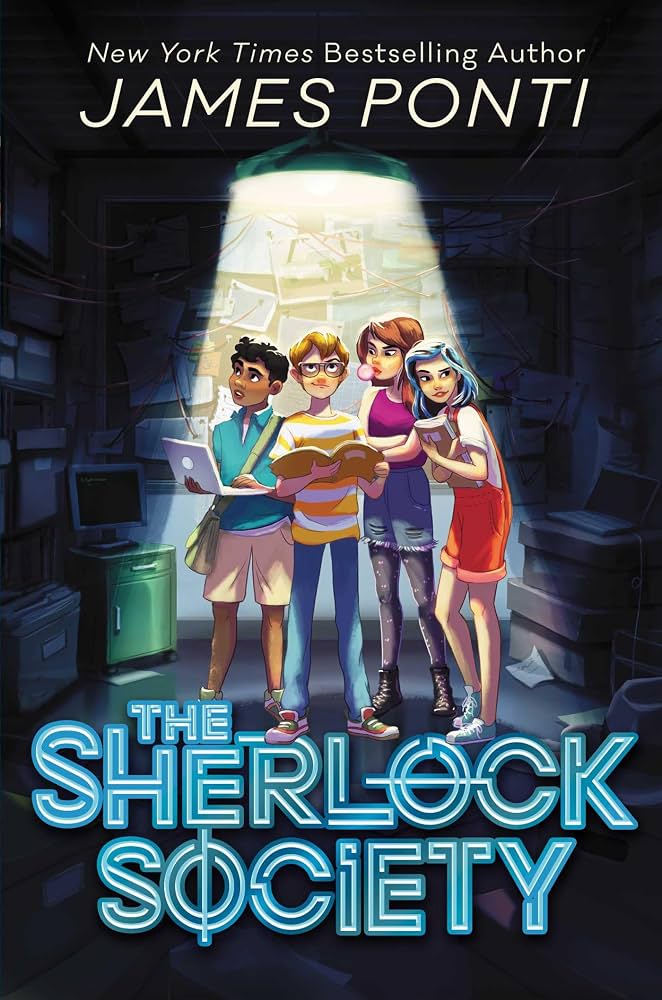
In James Ponti’s The Sherlock Society (Aladdin, 2025) Alex and Zoe Sherlock – along with friends Lina, a bookworm, and Yadi, a cinematographer – decide to start a detective agency, backed by the Sherlocks’ grandfather, a retired reporter with a storage unit full of cold cases. Their first case involves long-lost treasure and gangster Al Capone. For ages 9-11.

Nancy Springer’s The Case of the Missing Marquess (Puffin, 2007) features Enola Holmes, Sherlock’s unconventional 14-year-old sister, who shares her brother’s talent for deductive reasoning and crime-solving. This is the first of many Enola mysteries, among them The Case of the Left-Handed Lady, The Case of the Gypsy Goodbye, The Case of the Peculiar Pink Fan, and The Case of the Cryptic Crinoline. For ages 9-14.
Also see the totally terrific Enola Holmes movies starring Milly Bobby Brown (rated PG-13). See https://www.imdb.com/title/tt7846844/

In Shane Peacock’s award-winning The Boy Sherlock Holmes Series, Sherlock is thirteen, son of an aristocratic mother and a poor Jewish father, bullied and unhappy at school. He’s also brilliant and is already using his impressive analytical talents to solve crimes. Titles in the series are Eye of the Crow, Death in the Air, Vanishing Girl, The Secret Fiend, The Dragon Turn, and Becoming Holmes. For ages 10 and up.

By Tracy Mack and Michael Citrin, The Fall of the Amazing Zalindas (Orchard Books, 2009) is the first of the Sherlock Holmes and the Baker Street Irregulars Series, featuring Holmes, Watson, and a gang of homeless urchins who prove invaluable for their help in solving crimes. In this volume, three circus tightrope walkers have fallen to their deaths, and the crime leads to the Prince of Wales and a stolen 17th-century book. A helpful appendix of “Facts and Practicals for the Aspiring Detective” provides historical background information. There are several sequels. For ages 10 and up.

In Peter Abrahams’s Down the Rabbit Hole (HarperCollins, 2006), set in the town of Echo Falls, 13-year-old Ingrid Levin-Hill – a devoted fan of Sherlock Holmes – finds herself embroiled in a murder mystery, a community theater production of Alice in Wonderland, and a friendship with Joey Strade, the police chief’s son. Other Echo Falls mysteries, also featuring investigative Ingrid, Joey, and the Prescott Players, are Into the Dark and Behind the Curtain. For ages 10 and up.

In Andrew Lane’s Death Cloud (Farrar, Straux & Giroux, 2011), Sherlock is fourteen, and has been sent to spend the summer with an eccentric aunt and uncle on their vast country estate. Elder brother Mycroft, attached to the Foreign Office, hires an American tutor, Amyus Crowe, to keep Sherlock occupied and out of trouble; instead the two discover a body and young Sherlock and friends end up solving a crime that involves the sinister Baron Maupertuis and a plot to destroy the British Empire. There are several sequels. For ages 12 and up.

In Brittany Cavallaro’s A Study in Charlotte (Katherine Tegen Books, 2016), teenaged Charlotte Holmes and Jamie Watson – descendants of the original Holmes and Watson – meet at a Connecticut boarding school and promptly become embroiled in a murder. Several sequels. For ages 14 and up.

The heroine of Laurie R. King’s The Beekeeper’s Apprentice (Picador, 2007), set in 1915, is orphaned teenage heiress Mary Russell, bright, gawky, and unhappily living with her guardian, a nasty aunt. Then, out for a walk, she meets the elderly Sherlock Holmes, now retired and devoting himself to the study of bees. Impressed by Mary’s sharp wits, he decides to tutor her in investigative techniques. In this, the first of a series, Mary and Holmes tackle a mystery that involves a kidnapping, a master criminal, and a threat to both their lives. For teens and adults.

Julian Barnes’s superb Arthur & George (Vintage, 2007) is based on a true story, in which Arthur – that is, Arthur Conan Doyle, creator of Sherlock Holmes - comes to the defense of George Edalji, a half-Indian British solicitor, wrongly convicted of a crime in a case clearly decided by racial prejudice. For teens and adults.

Psychologist Maria Konnikova’s Mastermind: How to Think Like Sherlock Holmes (Viking, 2013) analyzes Holmes’s methods, with insights from neuroscience and psychology, and many telling Sherlockian anecdotes. For teens and adults.

E.J. Wagner’s The Science of Sherlock Holmes (Wiley, 2007) uses the Sherlock Holmes stories as jumping-off points for a fascinating history of forensics. Chapter titles include “Dialogue with the Dead,” “Beastly Tales and Black Dogs,” and “Disguise and the Detective.” An absorbing read for teens and adults.

In
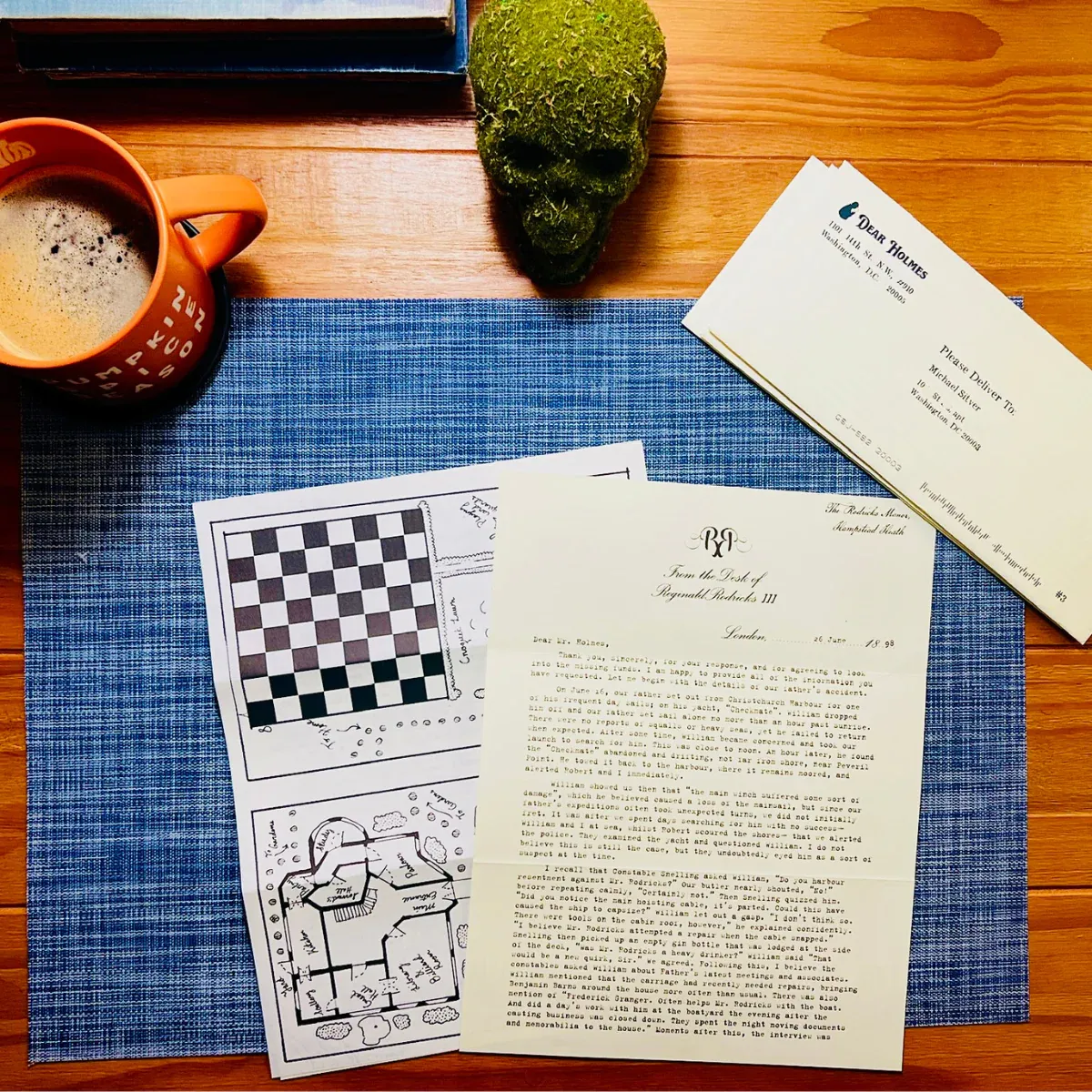
From Dear Holmes, get a Sherlockian mystery a month to solve based on clue-filled letters delivered to your mailbox. For ages 14 and up. See https://www.dearholmes.com/.
For Elementary-level Mystery Readers

In Audrey Wood’s Alphabet Mystery (Blue Sky Press, 2003), Little x – depressed because he’s never used – runs away from home and it’s up to the other letters of the alphabet to find him in time for Charley’s mother’s birthday party. For ages 3-7.
See also

In Graeme Base’s The Eleventh Hour: A Curious Mystery (Puffin, 1997), Horace the elephant turns eleven, and decides to celebrate his birthday with a banquet and a costume party. Dozens of gorgeously outfitted animals show up – only to find that the birthday feast has been stolen. Riddles and clues allow readers to figure out just whodunit. Also by Base, see Enigma: A Magical Mystery. For ages 5 and up.

The star of Marjorie Weinman Sharmat’s Nate the Great (Delacorte Books for Young Readers, 2002) is a miniature detective in trench coat and deerstalker cap, who – in company with his faithful dog, Sludge – competently solves mysteries. There are many sequels, all hilarious in a deadpan sort of way. (“My name is Nate the Great. I am a detective. I work alone.”) For ages 5-9.

In John Erickson’s Hank the Cowdog Series, beginning with The Original Adventures of Hank the Cowdog (Maverick Books, 2011), the ever-suspicious Hank is the head of security on a Texas ranch where - with the help of his assistant, Drover (whose old leg wound acts up at the least hint of danger) – he solves giggle-provoking mysteries involving Night-Stalking Bone Monsters, Swirling Killer Tornadoes, Kidnapped Collies, and Vampire Cats. For ages 5-9.

Ron Roy’s A to Z Mysteries Series consists of 26 short chapter books, from The Absent Author (Random House, 1997) to The Zombie Zone (2005). In each, friends Dink, Josh, and Ruth Rose use logic and imagination to solve mysteries. For ages 6-9.

The detective of Doreen Cronin’s The Trouble With Chickens (Balzer + Bray, 2012) is cynical J.J. Tully, retired search-and-rescue dog, co-opted by Millicent, an upset hen, to track down her missing chicks. For ages 6-10.
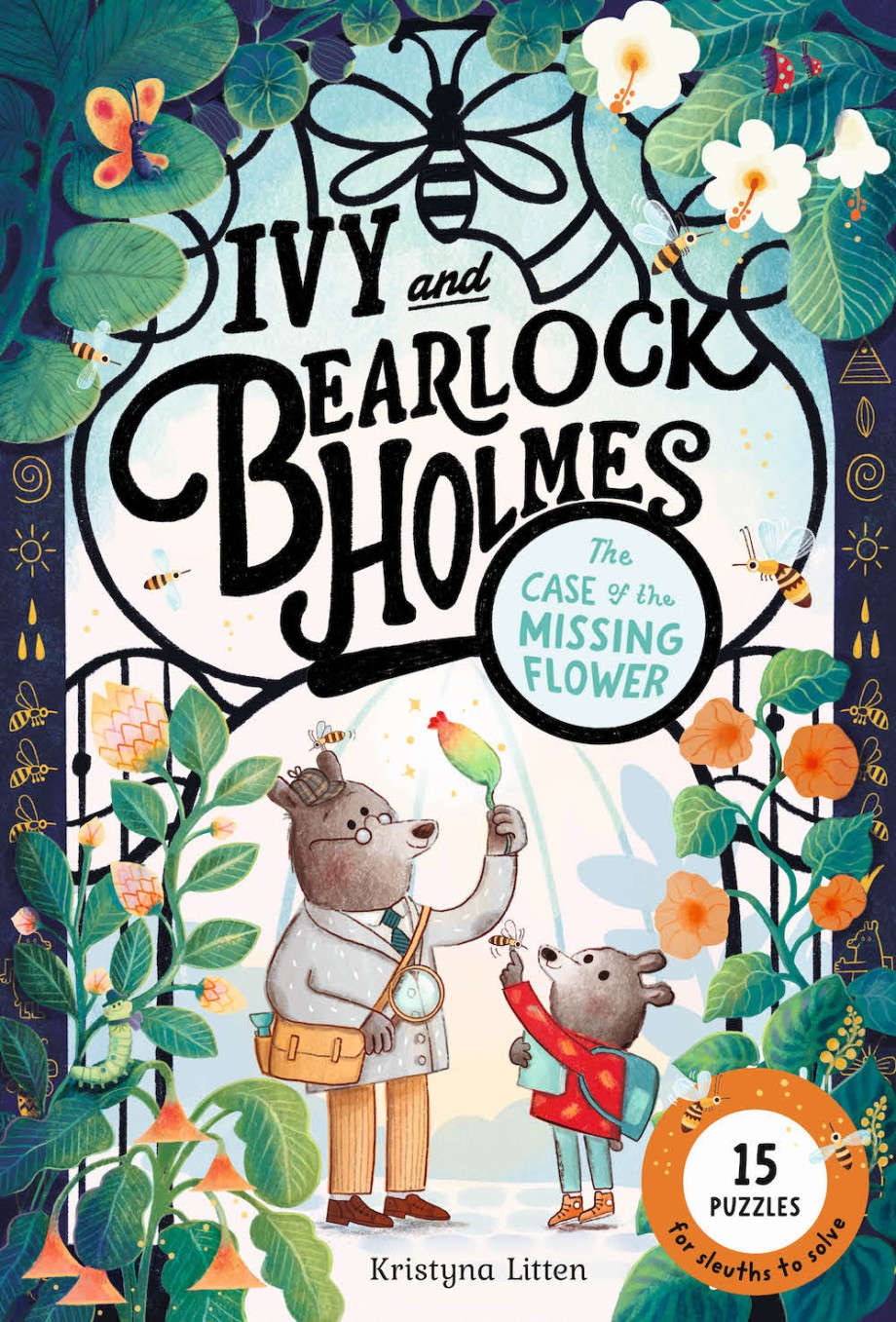
In the Ivy and Bearlock Holmes series by Kristyna Litten, Ivy and her grandpa, Bearlock Holmes, share a knack for solving mysteries. In the creatively designed books, interactive puzzles – with connections to history, science, and nature - are woven into the story line. First book in the series is The Case of the Missing Flower (Magic Cat, 2026), which involves time travel to ancient Egypt. Brilliant for ages 6-10.
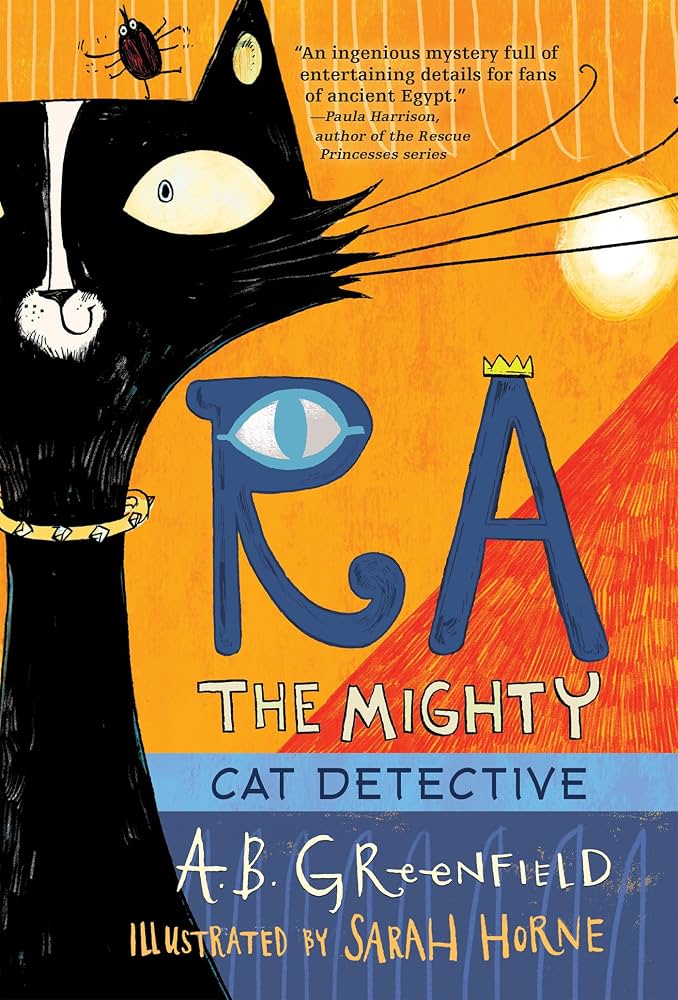
By A.B. Greenfield, in Ra the Mighty: Cat Detective (Holiday House, 2019), Ra is the pharaoh’s beloved (spoiled and lazy) cat – but when an amulet goes missing, he pitches in with friend Khepri, a scarab beetle, to clear the name of the young servant girl who has been framed for the crime. For ages 7-10.
Next titles in the series are Ra the Mighty: The Great Tomb Robbery and Ra the Mighty: The Crocodile Caper.

Purportedly by Geronimo Stilton, mouse journalist for The Rodent’s Gazette, this series of adventurous mysteries begins with Lost Treasure of the Emerald Eye (Scholastic, 2004) in which Geronimo and friends set out to look for treasure on a desert island. There are many sequels, all fast-paced and addictive reads, with catchy texts printed in a variety of colors and fonts. For ages 7-10.
For more on Geronimo Stilton, see Geronimo Stilton World, which features games, books, and activities. (Write your own article for The Rodent's Gazette.)

In David Adler’s Cam Jansen Series, targeted at upper-elementary-level readers, each of the (many) titles is 64 pages long and stars a fifth-grade sleuth officially named Jennifer. She has a photographic memory which helps her solve mysteries; hence her nickname “Camera” (“Cam” for short). Book #1 is Cam Jansen and the Mystery of the Stolen Diamonds (Puffin, 2004). For ages 7-10.
Younger readers can follow the adventures of Cam in the Young Cam Jansen Series, which features a younger Cam and shorter simpler (32-page) mysteries. First title in the series is Young Cam Jansen and the Dinosaur Game (Penguin Young Readers, 1998). For ages 5-7.

Gertrude Chandler Warner’s The Boxcar Children, originally published in 1942, introduces orphaned siblings Henry, Jessie, Violet, and Benny who, threatened with separation, set up home for themselves in an abandoned boxcar. There are dozens of sequels, in which the children – now living in luxury with their wealthy grandfather – solve many mild mysteries. For ages 7-10.
For book lists, a downloadable activity guide, background information, and more, see the Boxcar Children website.

Alexander McCall Smith’s The Great Cake Mystery (Anchor Books, 2012), set in Botswana, stars Smith’s heroine Precious Ramotswe of the No. 1 Ladies’ Detective Agency as a young girl. Here, she solves her first case, when a pudgy classmate is unfairly accused of stealing sweets. For ages 7-10.

Donald Sobol’s Leroy (a.k.a. “Encyclopedia”) Brown. son of the Idaville, Florida, police chief, is a very knowledgeable ten-year-old, and in each of the many books in the series he uses his wits to solve several intriguing mysteries. Each story ends with a question, giving readers a chance to come up with their own explanations before discovering the truth according to Encyclopedia Brown. First book in the series is Encyclopedia Brown: Boy Detective (Perfection Learning, 2010), in which Encyclopedia and sidekick Sally Kimball solve ten mysteries, variously dealing with a Civil War sword, a diamond necklace, a stabbed watermelon, and a pair of missing roller skates. For ages 7-12.

In James and Deborah Howe’s Bunnicula: A Rabbit Tale of Mystery (Atheneum Books for Young Readers, 2006), narrated by Harold, the family dog, the Monroe family brings home a bunny, found abandoned in a movie theater during a showing of Dracula. Soon white sucked-dry vegetables begin to appear, and Chester – the literate and hysterical family cat – becomes convinced that Bunnicula is a vampire. There are several sequels. For ages 7-11.

Hergé’s Tintin, boy detective/journalist, is the star of a text-heavy comic book series, originally published in Europe during the 1930s and 40s. The stories are clever, funny, and interest-grabbing, and are presented in a format that appeals to all, including the text-shy. There are some 20 titles (published by Little, Brown), among them The Castafiore Emerald, Red Rackham’s Treasure, The Calculus Affair, and Cigars of the Pharaoh. For background information, book synopses, descriptions of key characters – among them the irascible Captain Haddock, the dimwitted detective duo Thomson and Thompson, and the eccentric scientist Professor Calculus – and a Tintin store, see The Adventures of Tintin website.

The Adventures of Tintin (2011), directed by Steven Spielberg, is a computer-animated movie based on three Tintin books: The Crab with the Golden Claws (1941), The Secret of the Unicorn (1943), and Red Rackham’s Treasure (1944). It’s rated PG because (1) there are sword fights and (2) Captain Haddock drinks.

In Eric Berlin’s The Puzzling World of Winston Breen (Puffin, 2009), Winston sees puzzles everywhere. When his little sister Katie finds a hidden puzzle – strips of wood with words printed on them – in the false bottom of an old box that Winston bought her for a birthday present, Winston, Katie, and a large and varied cast of characters become involved in a high-stakes treasure hunt that involves – yes – lots of puzzles. Sequels include The Potato Chip Puzzles and The Puzzler’s Mansion. For ages 8-12.

James Ponti’s Framed (Aladdin, 2017), the first of a mystery series, stars 12-year-old Florian Bates, whose Theory of All Small Things (TOAST) allows him to solve mysteries large and small. In this book, Florian and friend Margaret tackle a mystery involving the National Gallery of Art and a crime syndicate known as EEL. For ages 8-12.

In Chris Grabenstein's Escape from Mr. Lemoncello's Library (Yearling, 2014), the town library has been designed by a world-famous game maker and Kylie and friends - locked in - must solves puzzles to get out. Several sequels. For ages 8-12.
More escapes! Check out this list of recommended escape room games for kids and families.

The reader gets to be the detective in Super Puzzletastic Mysteries (HarperCollins, 2020), an anthology of thoroughly puzzling cases from a range of best-selling authors involving everything from stolen squirrel monkeys to murderous triplets. For ages 8-12.

In Lizzie K. Foley’s Remarkable (Dial, 2012), the residents of the town of Remarkable are all impressively above average – except ten-year-old Jane Doe who, unlike her mother (famous architect), father (renowned novelist), brother (talented artist), and sister (brilliant mathematician), is just plain ordinary. When disaster strikes, however, variously involving the wicked Grimlet twins, pirates, a lake monster, and a mystery involving a missing composer, unremarkable Jane comes into her own. For ages 8-12.

John Bellairs’s The House With a Clock in its Walls (Puffin, 2004) – illustrated by Edward Gorey – is a terrific (and spooky) middle-grade Gothic mystery novel. Orphaned Lewis Barnavelt is sent to live with his Uncle Jonathan, a wizard, whose mysterious mansion harbors, hidden in its walls, a Doomsday clock, set to bring about the end of the world. Lewis must – somehow – figure out how to stop the clock. There are many other titles by Bellairs in the same vein. For ages 8-12.
For an annotated list of Bellairs’s books, a biography of John Bellairs, and more, see http://www.bellairsia.com/.

The 2018 movie version of The House With a Clock in its Walls is rated PG for scary pumpkins and name-calling.

In Betty Ren Wright’s The Dollhouse Murders (Holiday House, 2008), Amy finds a wonderful dollhouse in the attic of the old family home – in fact, a perfect replica of the house itself. Eerily, however, the dolls move around on their own, and Amy is convinced that they hold the key to the long-ago murder of her great-grandparents. For ages 9-12.

Wendy Mass’s The Candymakers (Little, Brown Books for Young Readers, 2011) – in which four very different 12-year-olds are chosen to compete in a national candy-making contest – sounds at first like a tale of Willie Wonka, but soon turns into a gripping mystery story filled with complex and unexpected characters, sabotage, and spies. For ages 9-12.

In Trenton Lee Stewart’s The Mysterious Benedict Society (Little, Brown Books for Young Readers, 2008), four creative and gifted children are recruited by the mysterious Mr. Benedict for a crucial mission: they must infiltrate the nefarious Mr. Curtain’s Learning Institute for the Very Enlightened and unmask his plot to take over the world. There are several sequels in which the talented foursome tackle even more harrowing missions. For ages 9-12.

In Brian Selznick’s exquisitely illustrated The Invention of Hugo Cabret (Scholastic, 2007), set in the 1930s, young Hugo, an orphan, lives secretly behind the walls of a Paris train station, keeping the clocks in working order and struggling to repair a marvelous artifact once belonging to his father: a mechanical man, designed to write messages. The book is a fascinating and multifaceted mystery, told in a mix of pictures and text, ultimately involving the brilliant and bookish Isabelle, a mysterious notebook, and a famous illusionist and master of silent film. For ages 9 and up.

The 2011 film Hugo, based on Selznick’s book and directed by Martin Scorsese, is rated PG, apparently for kissing, smoking, and a derailed train scene.
Mysteries for Older Readers

Anthony Horowitz’s Diamond Brothers mysteries feature bumbling Tim Diamond, the world’s dimmest detective, and his younger and smarter 13-year-old brother Nick. In the first of the series, The Falcon’s Malteser (Puffin, 2004), Tim ineptly lands himself in jail and Nick must both save his brother and solve a mystery involving a murdered dwarf, a clue-laden box of chocolates, and a safe full of diamonds. For ages 9-13.

The star of Eoin Colfer’s Half Moon Investigations (Hyperion Books, 2007) is twelve-year-old Fletcher Moon – nicknamed “Half Moon” because he’s short – who, by dint of a little finagling with a birth certificate, has become the world’s youngest private investigator. For ages 9-13.

In Polly Horvath’s Mr. and Mrs. Bunny – Detectives Extraordinaire (Schwartz & Wade, 2012), competent and responsible ten-year-old Madeline returns home from school to find that her feckless hippie parents (who play the marimba and make jewelry out of sand dollars) have been kidnapped by foxes. Luckily Madeline speaks fluent Bunny, and is able to get help from fedora-wearing investigators Mr. and Mrs. Bunny. Clever and hilarious. For ages 9-14.

In Ellen Raskin’s Newbery winner The Westing Game (Puffin, 2004), eccentric millionaire Samuel Westing has died, leaving behind a fortune of $200 million for whichever of his sixteen heirs can solve a mysterious puzzle. Wonderful characters, dozens of unexpected twists and turns, and a beautifully satisfying ending for ages 10 and up.
Other mysteries by Raskin include The Tattooed Potato and Other Clues (Puffin, 2011) and The Mysterious Disappearance of Leon (I Mean Noel) (Puffin, 2011).

Deron R. Hicks’s The Van Gogh Deception (HMH, 2018) is an edge-of-your-seat thriller in which a young boy is found in Washington, DC’s National Gallery of Art with no recollection of who is he or why he’s there. A wow for ages 10-13.

Siobhan Dowd’s The London Eye Mystery (Yearling, 2009) begins when Ted, who suffers from Asperger’s syndrome, and his sister Kat, take their visiting cousin Salim for a ride on the famous Ferris wheel known as the London Eye. Salim gets a free ticket from a mysterious stranger and boards the Eye – but never gets off at the end of the ride and seemingly has disappeared into thin air. Ted, with his “different” way of thinking, is instrumental in solving the (gripping) mystery. For ages 10 and up.

In Willo Davis Roberts’s The View From the Cherry Tree (Aladdin, 1994), Rob, from the vantage of his favorite tree branch, witnesses a murder, but no one believes him. Except, that is, the murderer. A thriller for ages 10 and up.

Michael D. Bell’s The Red Blazer Girls: The Ring of Rocamadour (Yearling, 2010) introduces girl detectives Sophie, Margaret, and Rebecca – all of whom attend St. Veronica’s, whose school uniform includes a signature red blazer. In this, the first of a series, the girls help old Mrs. Harriman solve the clues leading to a hidden treasure. The clues challenge the girls to use their (school-derived) knowledge of math, literature, and logic, which feels contrived (Bell is a teacher), but ultimately it doesn't detract from the story. For ages 10-13.

Sheila Turnage’s Three Times Lucky (Dial, 2012) is set in the little town of Tupelo Landing, North Carolina – population 148 – or rather, 147, now that Jesse Tatum has been killed by a blow to the head. Feisty sixth-grader Mo LoBeau – washed into town by a hurricane eleven years ago and adopted by Miss Lana and the Colonel, the local café owners – sets out to find the murderer. A wonderful cast of characters and terrific dialogue make this a great read. For ages 10-14.

In Mel Glenn’s Who Killed Mr. Chippendale?: A Mystery in Poems (Puffin, 1999), high-school English teacher Mr. Chippendale is shot and killed while out for his morning run. The question of who did it is solved through a series of interlocking poems, in many different voices, among them those of students who loved or hated him, the school guidance counselor, and the police investigator. More than a whodunit, the book is a painful exploration of emotions and violence. For teenagers.
Dame Agatha
Often on high-school recommended reading lists are works by renowned mystery author Agatha Christie.
The official Agatha Christie website has a biography of Christie, summaries and descriptions of her books and characters, Christie maps, film adaptations, mystery-based games, and much more.
Delicious Death at http://www.deliciousdeath.com/ has a complete list of Agatha Christie’s works, categorized by detective. Click on a title for a publishing history, plot synopsis, character descriptions, and list of movie and TV adaptations.

A good starting point for Christie readers is And Then There Were None (Harper, 2011), originally published in 1939, and said to be the best-selling murder mystery of all time. Ten strangers are invited to an isolated island off the English coast. They arrive to find an absent host, and then, one by one, they begin to die. For teenagers and adults.
Nancy Drew and the Hardy Boys

Nancy Drew, girl sleuth, first appeared in the 1930s, written by “Carolyn Keene,” a pseudonym for several different authors. There are now dozens of Nancy Drew titles available – updated since the 30s; Nancy no longer wears a cloche hat or drives a roadster. First of the series is The Secret of the Old Clock (Grosset and Dunlap, 2010), in which Nancy solves a mystery involving a hidden will. For ages 8 and up.

Melanie Rehak’s Girl Sleuth: Nancy Drew and the Women Who Created Her (Mariner Books. 2006) is a history of Nancy and her authors – beginning with publisher Edward Stratemeyer, who also created the Bobbsey Twins and the Hardy Boys. For teenagers and adults.

Also from the Stratemeyer syndicate: in the Hardy Boys series by the (pseudonymous) Franklin Dixon, first published in the 1920s, teenage brothers Frank and Joe Hardy – sons of a world-famous private detective – solve many mysteries on their own. In the first book of the (enormous) series, The Tower Treasure (Grosset & Dunlap, 1927), the boys investigate a jewel theft.
In the TV series Nancy Drew (2019-2023) is generally recommended for ages 14 and up. See https://www.imdb.com/title/tt10313176/.
For Nancy Drew interactive games (and free study guides), see https://www.herinteractive.com/.
Mysteries, Magic, and Fairy Tales

David Levinthal’s Who Pushed Humpty Dumpty? (Schwartz & Wade, 2012) is a hilarious picture-book retelling of five classic fairy tales from the point of view of hardboiled investigating Officer Binky, a toad in a fedora. (A survey of evidence at the Bears’ house leads him to the conclusion that “It could only be one dame: Goldilocks!”) For ages 5-9.

Pseudonymous Bosch’s The Name of This Book Is Secret! (Little, Brown Books for Young Readers, 2008) introduces 11-year-old detective duo Cassandra (who has large pointy ears and is always prepared for disaster) and Max-Ernest (aspiring stand-up comedian). Here – in company with a lot of snarky background comments from the author, which teeter between funny and annoying – the two discover the Symphony of Smells, a peculiar box filled with odoriferous vials, and clues which lead them to a secret society bent on immortality. There are four sequels: If You’re Reading This, It’s Too Late; This Book Is Not Good for You; This Isn’t What It Looks Like; and You Have to Stop This. For ages 9-12.

In Michael Buckley’s The Fairy Tale Detectives (Harry N. Abrams, 2007), first book in The Sisters Grimm Series, young Sabrina and Daphne Grimm are sent to live with their grandmother in the town of Ferryport Landing – where they discover that they are descendants of the famous Brothers Grimm, whose fairy-tale collections are not tales, but case histories. The town of Ferryport, in fact, is inhabited entirely by fairy-tale characters, known as Everafters. When their grandmother is kidnapped, the girls must rescue her, discover the culprit, and bring the rogue Everafter to justice. There are many sequels. For ages 9-12.

In Lissa Evans’s Horten’s Miraculous Mechanisms (Sterling Children’s Books, 2012), ten-year-old Stuart Horten – the very short son of very tall parents – is dismayed when the family moves back to his father’s hometown. Until, that is, he discovers the story of his Uncle Tony, a magician and inventor, who mysteriously disappeared fifty years ago, leaving behind a peculiar puzzle box. Stuart sets about solving the clues to Tony’s disappearance and makes startling discoveries about his family’s magic legacy. He’s helped in his endeavors by the persistent triplets (April, May, and June) who live next door – and runs into trouble with an unscrupulous enemy, also in pursuit of Tony’s treasures. Also see the sequel, Horten’s Incredible Illusions. For ages 9-14.

In Polly Shulman’s The Grimm Legacy (Puffin, 2011), teenaged Elizabeth takes a job as a page at the New York Circulating Materials Repository – a lending library of historical artifacts, including the marvelous Grimm Collection, filled with such items as mermaid combs, Seven-League boots, winged sandals, bottled genies, and a particularly nasty Magic Mirror. When items from the Collection start mysteriously disappearing, Elizabeth and friends set out to catch the thief. For ages 12 and up.
Sir Arthur Conan Doyle…and fairies?

Marc Tyler Nobleman’s Fairy Spell: How Two Girls Convinced the World That Fairies Are Real (Clarion, 2018) is a picture-book account of the Cottingley Fairy hoax for ages 6-9.

By Mary Losure, The Fairy Ring: Or Elsie and Frances Fool the World (Candlewick, 2012) is the story of how two young English girls – with painted paper dolls and fake photographs – managed to convince Sir Arthur Conan Doyle that fairies were real. Illustrated with period paintings and fairy photographs. (Sherlock Holmes would not have fallen for it.) For ages 10 and up.

Fairy Tale: A True Story (1997) is a film version of Elsie and Frances’s fairy hoax. The underlying theme is the nature of belief; the story is set in the aftermath of World War I, when bereaved families flocked to clairvoyants in hopes of communicating with lost loved ones. Rated PG.
For reproductions of Elsie and Frances’s fairy photographs, the girls’ descriptions, and background information, see the Museum of Hoaxes’ Cottingley Fairies.
Mysteries + History

In Henry Winterfeld’s Detectives in Togas and Mystery of the Roman Ransom (reprints; Sandpiper, 2002), seven Roman schoolboys solve crimes with the help of their crochety tutor, the mathematician Xanthos. A nice mix of historical fact and humor. For ages 8-12.

Caroline Lawrence’s The Case of the Deadly Desperados (Putnam Juvenile Books, 2012) – set in the Nevada Territory in the 1860s - is narrated by twelve-year-old Pinky Pinkerton, trapped at the bottom of a mine shaft, and writing his story on ledger sheets as he’s pursued by the ruthless gang of thugs who killed his foster parents. Pinky has a “Thorn” – a problem in recognizing emotions, now known as Asperger’s syndrome – which gives his account of his adventures an eccentric (and funny) tone, but his strengths, which include impressive powers of observation, make him a first-class young detective. Included are a map, a glossary, and a good deal of historical background information on the Wild West. For ages 8-12.

Caroline Lawrence’s The Thieves of Ostia (Orion Children’s Books, 2002), set in 79 CE, stars Flavia Gemina, the young daughter of a sea captain, and a brilliant amateur detective. In this, the first of a series, Flavia, along with friends Jonathan and Miriam, Nubia, an African slave girl, and Lupus, a mute beggar boy, sets out to discover who is killing the neighborhood guard dogs. Exciting adventure paired with historical detail. There are several sequels, among them The Secrets of Vesuvius, The Pirates of Pompeii, and The Assassins of Rome. For ages 9-14.

In Rick Riordan’s The 39 Clues (Scholastic, 2008), wealthy Grace Cahill has died, leaving her descendants – among them our heroes, orphaned brother and sister Dan and Amy Cahill - a perilous challenge: to track down the 39 clues leading to the source of the Cahill family’s power. Which power, as it turns out, is substantial: practically every important historical figure, among them Isaac Newton, Winston Churchill, Napoleon, and Benjamin Franklin, was a Cahill, or at least a Cahill second cousin. Included in the first volume is a good deal of (non-fiction) information about Benjamin Franklin, who was (fiction) responsible for the initial clues. There are nine sequels, written by a variety of authors. For more information and an accompanying game involving packets of Clue Cards (six per book), see the 39 Clues website.

In Elise Broach’s Shakespeare’s Secret (Square Fish, 2007), twelve-year-old Hero Netherfield is named for a character in Shakespeare’s play, Much Ado About Nothing – which brings her nothing but misery and teasing in her new school. Then, in company with an elderly neighbor and an attractive eighth-grader, Danny, she becomes involved in a quest to find an heirloom diamond, once belonging to Anne Boleyn, and said to be hidden in Hero’s house. As they search for the missing jewel, they also discover clues that may reveal the true identity of the man who wrote Shakespeare’s plays. For ages 9-12.

In Virginia Hamilton’s The House of Dies Drear (Aladdin, 2006), 13-year-old Thomas Small and family move into an old house in Ohio, once a station on the Underground Railroad, where abolitionist Dies Drear was murdered. Strange happenings at the house lead Thomas to explore its hidden passages and solve a mystery from the past. For ages 11 and up.

Avi’s The Man Who Was Poe (HarperCollins, 1997) is a fictional historical mystery: eleven-year-old Edmund’s family has disappeared – his sister, impossibly, from a locked room – and the distraught Edmund gets help from the mysterious Auguste Dupin, in reality Edgar Allan Poe. Readers, in the course of solving Edmund’s mystery, learn a great deal about Poe’s life and work. For ages 10-14.

Philip Pullman’s The Ruby in the Smoke (Knopf Books for Young Readers, 2008) is a thriller set in Victorian London, the first of a series featuring 16-year-old Sally Lockhart, who sets out to find her father’s murderer, and becomes embroiled in a mystery involving the lost Ruby of Agrapar. Sequels include The Shadow in the North, The Tiger in the Well, and The Tin Princess. For ages 12 and up.

Rudyard Kipling’s Kim, originally published in 1902, is the now-classic story of the young son of an Irish soldier stationed in India, raised in the bazaar by a half-caste woman after his father’s death. Kim’s unique knowledge of the Indian world leads to his recruitment as a spy for the British in what was known as the “Great Game” – the complex intrigues for British domination in Asia. For ages 12 and up.
Kim’s Game, part of Kim’s training as a spy, is a memory exercise in which players compete to remember a dozen or so disparate objects, placed on a tray, studied for one minute, and then covered. Try it! (A version of Kim’s Game is also one of the experiments in Jim Wiese’s Detective Science. See Mysteries + Science, below.)

How would you do as an eyewitness? In the game

Josephine Tey’s The Daughter of Time (Scribner, 1995) is a catchy classic of historical detection, in which Inspector Alan Grant - hospitalized with a broken leg - sets about solving the 15th-century case of Richard III, accused of murdering his nephews, the little princes in the Tower. A great read for teenagers and adults.

The title character of Ellis Peters’s addictive Brother Cadfael Series is a Welsh monk, herbalist, investigator, ex-Crusader, and resident of Shrewsbury Abbey in the early 12th century. Brother Cadfael solves mysteries (and furthers romances) to a background of conflict and intrigue, as King Stephen and Empress Maud battle for the throne of England. First book in the extensive series is A Morbid Taste for Bones (Grand Central Publishing, 1994). For teenagers and adults.

The Cadfael TV series is superbly done, with Derek Jacobi as Brother Cadfael. See https://www.imdb.com/title/tt0108717/.
Tackle these History Mystery Labs! See if you can solve mysteries surrounding the assassination of Caesar, the Black Death, the lost colony of Roanoke, and more. For ages 12 and up.
Mysteries + Science

In Blue Balliett’s The Danger Box (Scholastic, 2012), 12-year-old Zoomy – so near-sighted that he’s legally blind – has been raised by his grandparents. Then his alcoholic father shows up and leaves with Zoomy a stolen box that contains an old notebook. The identity of the author of the notebook is the major mystery of the book – hints are provided through Zoomy’s personal newspaper, the Gas Gazette – though Zoomy and his friend Lorrol must also solve plenty of puzzles and cope with a criminal who wants the box and notebook back. The secret scientist (Spoiler!) is Charles Darwin. For ages 9-13.

By Eric Yoder and Natalie Yoder, One Minute Mysteries: 65 Mysteries You Solve With Science (Platypus Media, 2008) is a collection of short catchy stories, the solutions to which require a knowledge of science facts. (For example, how do you know which zoo employee was bogus? Answer: she sent visitors to the bird house to see bats.) Each mystery is followed by a short paragraph of explanation. Fun for ages 8-12.

Julia Rothman’s The Where, the Why, and the How (Chronicle Books, 2012) pairs short science essays with interpretive illustrations by 75 artists. The theme is unanswered mysteries of the natural world, large and small: What existed before the Big Bang? How does gravity work? Why do cats purr? Why do we dream? Fascinating and thought-provoking. For teens and adults.

Michael Brooks’s 13 Things That Don’t Make Sense (Vintage, 2009) tackles the puzzling mysteries and anomalies that science has yet to cope with, among them cold fusion, signals from space, free will, and the placebo effect. For teens and adults.

Jim Wiese’s Detective Science (Wiley, 1996), subtitled “40 Crime-Solving, Case-Breaking, Crook-Catching Activities for Kids,” is a collection of hands-on experiments and activities involving everything from mapping crime scenes and interviewing witnesses to fingerprinting, ballistics, DNA testing, and handwriting analysis. Clear explanations follow each experiment and periodic “Detective Science in Action” boxes give accounts of investigators using science in the real world. For ages 9-13.
ScienceMystery is a collection of interactive science mysteries to solve online, targeted at middle- and high-school-level students. Among these are “Croak,” a mystery about frog extinctions; “The Blackout Syndrome,” which involves a strange disease outbreak; and “Angry Red Planet,” about a disintegrating biosphere.
Hands-on science for mystery lovers:
Forensic Science Kits for a range of ages are available from Home Science Tools (https://www.homesciencetools.com/science-kits/forensic-science-kits/), Carolina Biological Supply (
https://www.carolina.com), and other science and educational supply companies. (Often these are sold as classroom-sized kits – recruit some friends!)
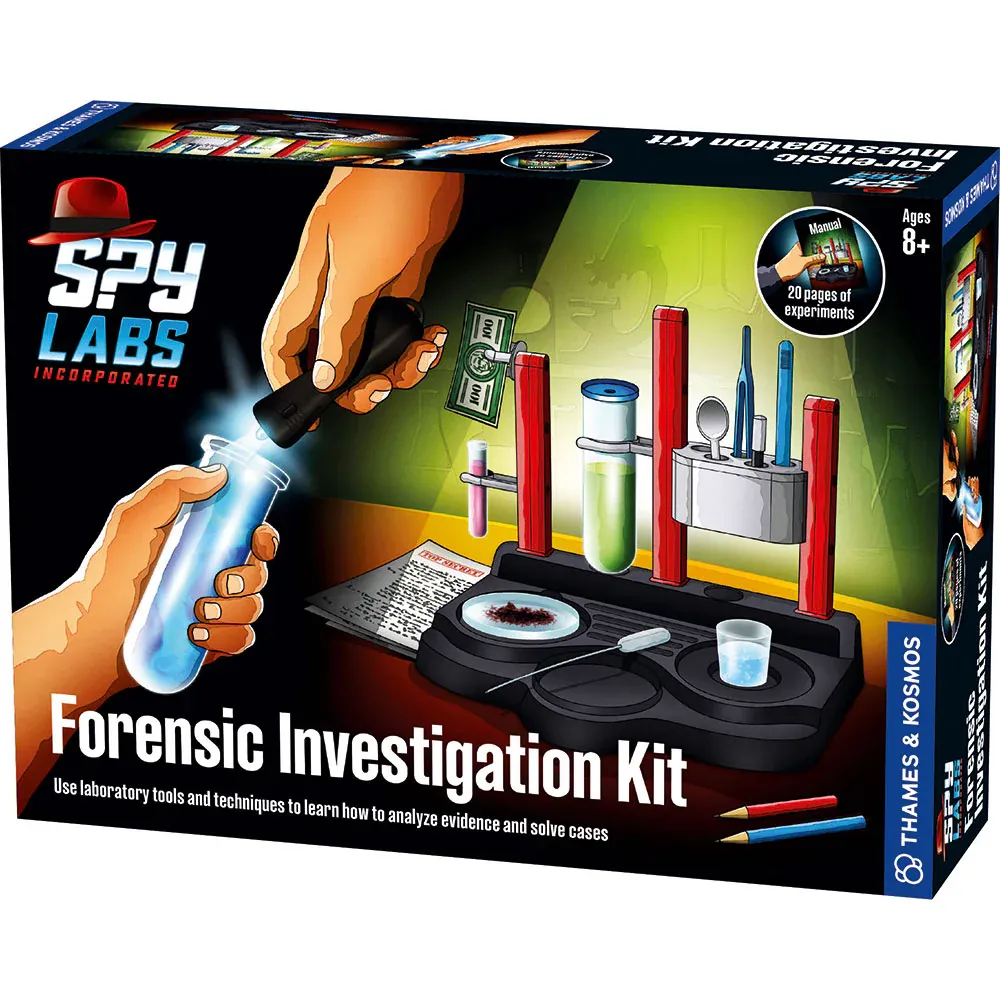
The Spy Labs, Inc. Forensic Investigation Kit from Thames & Kosmos includes laboratory materials – fingerprint powder, a UV flashlight, pH test strips, and more – plus an illustrated detective manual for ages 8 and up. See https://thamesandkosmos.com/collections/spy-labs-inc/products/spy-labs-forensic-investigation-kit.
MYSTERIES + MATH

The mysteries in Eric Yoder and Natalie Yoder’s One Minute Mysteries: 65 Short Mysteries You Solve With Math (Science, Naturally!, 2010) are categorized under “Math at Home,” “Math Outside,” “Math at Play,” and “Math Everyday.” These are basically wordy word problems, but may be worth a look. For ages 9-12.

Logic: an essential skill for would-be detectives. There are many collections of logic puzzles for all ages, though a master of the genre is Martin Gardner. See, for example, Gardner’s My Best Mathematical and Logic Puzzles (Dover Publications, 1994).

In Stuart Gibbs’s Charlie Thorne and the Last Equation (Simon & Schuster, 2019), twelve-year-old Charlie, a math-and-science genius, has been called in by the CIA to help track down Albert Einstein’s last equation, which has the potential to save or destroy the earth. A fast-paced thriller for ages 10 and up.

The main character of Mark Haddon’s The Curious Incident of the Dog in the Nighttime (Vintage, 2004) is a mathematically gifted autistic 15-year-old boy with a love for prime numbers, quadratic equations, and the graphing of animal populations. His talents uniquely suit him for solving the mystery of the suspicious death of a neighborhood dog. For teens and adults.

Tom Stoppard’s wonderful play Arcadia (Grove Press, 2017) features brilliant teenager Thomasina Coverly, mathematically far ahead of her time. The play moves back and forth in time between 13-year-old Thomasina in 1809 and the same house 180 years later. For teens and adults.

Tackle a real math mystery! Simon Singh’s Fermat’s Enigma (Anchor, 1998) is the amazingly entertaining story of the 350-year struggle to solve the mystery of Fermat’s last theorem. For teens and adults.
Mysteries + the Arts

In Lemony Snicket’s The Composer Is Dead (HarperCollins, 2009), the (nameless) composer has kicked the bucket and an Inspector has been summoned to find the perpetrator. He questions all the players in the orchestra, instrument by instrument (all claim to have alibis: the Violins were playing a waltz; the Trombones were having a drink). An accompanying CD by the San Francisco Symphony brings the action to musical life. For ages 6-10.

In E.L. Konigsberg’s Newbery-winning From the Mixed-Up Files of Mrs. Basil E. Frankweiler (Atheneum Books for Young Readers, 2007), resourceful Claudia and younger brother Jamie run away from home to live in the Metropolitan Museum. There they discover a statue of an angel that just might be the work of Michelangelo. Their attempts to solve the mystery lead them to the fascinating Mrs. Basil E. Frankweiler. For ages 8-12.
A movie version of the book, titled The Hideaways (1973), starred Ingrid Bergman as Mrs. Frankweiler.

In Blue Balliett’s Chasing Vermeer (Scholastic, 2005), sixth-graders Calder Pillay – who has a talent for puzzles, patterns, and pentominos – and Petra Andalee, who loves to write, use their skills and shared love of art to solve a mystery involving a vanished Vermeer painting. Other art-based mysteries by Balliett are The Calder Game, which features a stolen Alexander Calder sculpture and The Wright 3, an architectural mystery involving Frank Lloyd Wright’s Robie House. For ages 9 and up.

Experiment with Calder Pillay’s pentominos. Eric Harshbarger’s Pentomino Puzzles (Puzzlewright, 2011) includes a set of pentomino tiles (12 shapes) and 365 challenging puzzles. For all ages.
Play Pentominoes online. Players drag and drop pentomino shapes onto a grid to complete a puzzle. See https://polypad.amplify.com/lesson/pentomino-zoo and
https://toytheater.com/pentomino/.

Printable Pentominoes are available from Scholastic. Need a lot of pentominoes? Check out this

In Elise Broach’s Masterpiece (Square Fish, 2010), Marvin, a talented beetle who lives under the floor of the Pompadays’ New York City apartment, befriends 11-year-old James Pompaday, who is neglected by his snooty mother and grouchy stepfather. When Marvin makes a beautiful pen-and-ink drawing for James’s birthday, Mrs. Pompaday, seeing it, becomes convinced that her son is an artistic genius. An excited curator at the Metropolitan Museum of Art compares the drawing to that of Albrecht Durer, and soon beetle and boy are embroiled in a plot to foil an art heist and recover a stolen Durer masterpiece. For ages 9-14.

Angela Wenzel’s 13 Art Mysteries Children Should Know (Prestel, 2011) is a gorgeously illustrated book of historical art puzzles. Each double-page spread has a reproduction of an artwork, a timeline, and nicely presented information about the mystery, the artist, and the historical context. Mysteries include “What Did Jesus Really Look Like?,” “Why is Mona Lisa Smiling?,” “How Did Caravaggio Die?,” “The Missing Amber Room,” and “Goya and the Ugly Queen.” This one might also be a great starting point for mystery-writing projects. For ages 9 and up.

In Iain Pears’s Art History Mystery Series, detective/art historian Jonathan Argyll deals with forgery, fraud, and murder in company with the Italian Art Squad (and gorgeous Roman investigator Flavia di Stefano). First book in the series is The Raphael Affair (Berkley, 2001). For teenagers and adults.

Hailey Lind’s Art Lover’s Mystery Series features ex-art-forger Annie Kincaid, who now uses her expertise and underworld connections to combat art crime. In Feint of Art (Signet, 2006), the first of the series, Annie deals with a fake Caravaggio, a missing museum curator, and a murder. For teenagers and adults.

At A. Pintura, Art Detective, an online exercise in art detection, kids study the works of famous artists and solve “The Case of Grandpa’s Painting.”
In NOVA’s “Mystery of a Masterpiece”, experts investigate the portrait of a Renaissance woman that might or might not be by Leonardo da Vinci.
Writing Mysteries
From the ReadWriteThink, What's in a Mystery? is a multipart lesson plan for grades 3-5 in which kids identify the elements of a mystery story and invent mysteries of their own. Included is a printable Mystery Graphic Organizer for writers. See https://www.readwritethink.org/classroom-resources/lesson-plans/what-mystery-exploring-identifying.
Mystery Cube is a simple organizational tool to help young writers plan a mystery story. See https://www.readwritethink.org/classroom-resources/student-interactives/mystery-cube.
It’s all about the characters! Learn all about it from Psychology Today’s Taking the Mystery Out of Mystery Writing.
Contests
Write a mystery! Win a prize!
From St. Martin’s Minotaur and the Mystery Writers of America, the First Crime Novel Competition is open to writers ages 18 and up who have never before been published. For submission guidelines, see https://mysterywriters.org/about-mwa/st-martins/.
For fans of Rex Stout’s Nero Wolfe, the Wolfe Pack sponsors the Black Orchid Award, an annual award for a novella-length mystery manuscript.
Mysteries by Mail
Mail Order Mystery offers several different mysteries to be solved by kids ages 6 and up, variously involving lost treasure, spy school, and time travel. (Kids get “cool objects and curious letters” from knights, trolls, spies, and pirates.) Each mystery consists of six installments that can be pieced out weekly or sent all in one box. See https://www.mailordermystery.com/.
Mysterious Mail has mystery games for both kids and adults. Letters, realistic documents, artifacts, clues, and puzzles arrive by mail. For kids, “Pharaoh’s Curse” is recommended for ages 7-12; “Search for Atlantis” for ages 10 and up. See https://mysteriousmail.com/.
From the New York Times, see reviews of recommended mystery box game subscriptions at https://www.nytimes.com/wirecutter/reviews/best-mystery-box-game-subscriptions/.