
Rabbits

In this collection
Rabbit books and rabbit resources seem to proliferate like…well, rabbits. Famous rabbits include the fussy and opinionated Rabbit of A.A. Milne’s Winnie-the-Pooh, the pocket-watch-toting White Rabbit of Lewis Carroll’s Alice in Wonderland, Bambi’s friend Thumper, and Harvey, the giant invisible pooka rabbit in the 1950 James Stewart movie of the same name. And there are many many more.
According to a Chinese legend, there's even a rabbit in the Moon.
Imaginary Rabbits

First book for a lot of babies is a bunny book. Dorothy Kunhardt’s furry and pattable Pat the Bunny (Golden Books, 2001), originally published in 1940, is now the best-selling interactive book of all time. (“Judy can pat the bunny. Can YOU pat the bunny?”) It makes for a great baby present, featuring six other appealing activities along with bunny-patting.

Margaret Wise Brown’s Goodnight Moon (HarperCollins, 2005), first published in 1947, is the enchanting now-classic bedtime story of the sleepy little bunny in the great green room (with a telephone, a red balloon, and a picture of a cow jumping over the moon). For ages 2-6.

Also by Brown, see The Runaway Bunny (HarperCollins, 2005), an imaginative tale of running away, with a comforting background of maternal reassurance. The little bunny comes up with any number of run-away scenarios – he’ll become a fish, a rock on a mountain, a flower, a bird. His mother counters that she will always come and find him: she’ll be a fisherman, a mountain climber, a gardener, or the sheltering tree that he flies home to. For ages 2-6.

The protagonist of Kevin Henkes’s Little White Rabbit (Greenwillow, 2011) bounds off on a bright spring day, adventurously imagining himself green as the grass, tall as a tree, or flying with the butterflies. Then he encounters a cat – and is happy to scamper home to his mother. For ages 2-5.

A.A. Milne’s “Market Square” is a wonderful poem about rabbits: “…I wanted a rabbit/A little brown rabbit/And I looked for a rabbit/’Most everywhere.” The poem originally appeared in Milne’s When We Were Very Young (Puffin, 1992).

In Sam McBratney’s Guess How Much I Love You? (Candlewick, 2008), Little Nutbrown Hare and his much larger parent vie to see who loves the other best. (“I love you as high as I can hop.” “I love you right up to the moon.”) A charmer for ages 2-6.

Peter McCarty’s Little Bunny on the Move (Owlet Paperbacks, 2003), illustrated with luminous pencil-and-watercolor drawings, is the story of a long journey home for ages 3-6.

White Rabbit’s Color Book by Alan Baker (Kingfisher, 1999) won’t tell you much about rabbits, but it’s a charmingly illustrated picture-book account of colors and color mixing for ages 2-5. Similar in concept is Ellen Stoll Walsh’s Mouse Paint (Sandpiper, 1995).

In Philippa Leathers's The Black Rabbit (Candlewick, 2013), a little white rabbit is pursued wherever he goes by a looming black rabbit. (Readers can see that it's his shadow.) He does everything he can think of to get rid of it, but nothing works - until finally he plunges into a shady forest. Where he runs into a wolf. For ages 3-7.

In Charlotte Zolotow’s Mr. Rabbit and the Lovely Present (HarperCollins, 1977), illustrated by the incomparable Maurice Sendak, a little girl enlists Mr. Rabbit’s help to find the perfect birthday gift for her mother, who loves colors. Red underwear, yellow taxicabs, green caterpillars, and blue lakes all seem like bad ideas – but Mr. Rabbit manages to find a perfect solution. For ages 4-8.

Rabbits turn white in winter – but what do other animals do? Il Sung Na’s charmingly illustrated Snow Rabbit, Spring Rabbit (Knopf Books for Young Readers, 2011) describes animal adaptions to the changing seasons for ages 3-6.

Rosemary Wells’s endearing Max and Ruby characters – featured in many books – are bunnies. In Bunny Cakes (Puffin, 2000) – one of my favorites – it’s time to bake a cake for Grandma’s birthday. Max is making an earthworm cake; big sister Ruby (“Don’t touch anything, Max”) is making an angel surprise cake with raspberry-fluff icing. Funny and priceless. For ages 3-6.

In Mo Willem’s Knuffle Bunny (Hyperion, 2004), Trixie – a toddler who is too young to talk – goes to the Laundromat with her father, taking along her stuffed bunny. The bunny is left behind, and Trixie, unable to explain what has happened, struggles, fusses, and finally melts down into an over-the-top tantrum. Her mother realizes what’s wrong and back to the Laundromat they go to retrieve the lost toy, upon which Trixie says her very first words: “Knuffle Bunny!” Illustrated in a mix of black-and-white photographs and bright cartoon drawings. For ages 3-6.

Rabbit’s Gift by George Shannon (Harcourt Children’s Books, 2007) is a lovely adaptation of a Chinese folktale. It’s cold and snowy, but Rabbit manages to find two turnips. Since one is plenty for him, he leaves the second for his friend Donkey. Donkey has found a potato, so he passes the turnip on to Goat – who has a cabbage, so he gives the turnip to Deer. On it goes until the turnip finally returns to Rabbit, who shares with all. The illustrations are great, including wonderful borders of stylized purple turnips. Included are Chinese ideograms for animal names. For ages 4-8.

In Marilyn Sadler’s It’s Not Easy Being A Bunny (Random House Books for Young Readers, 1983), P.J. – unhappy with his large family, oversized ears, and diet of carrots – decides to be something else. Perhaps a bear – but hibernation is no fun. After many disappointing experiments, P.J. decides that bunnyhood is the best for him after all. For ages 3-.

In Aaron Reynolds's Creepy Carrots (Simon & Schuster, 2012), Jasper Rabbit is mad for carrots - especially the scrumptious carrots of Crackenhopper Field. Then greedy Jasper discovers that the carrots are following him. (Behind him: "the soft...sinister...tunktunktunk of carrots creeping.") A hilarious just-creepy-enough horror story for ages 4-8.

The Rabbits’ Wedding by Garth Williams (HarperCollins, 1958) – best-known for his illustrations of the Little House books – is a gentle story of a black rabbit and a white rabbit who want to be together “forever and ever.” Illustrations are almost entirely black and white, except for some glorious bright-yellow wedding dandelions. For ages 3-7.

Annette Cate’s The Magic Rabbit (Candlewick, 2007) is the tale of a street magician and his beloved rabbit assistant who suddenly find themselves separated after a performance disaster. All looks bleak until a passion for popcorn (and a magical trail of gold stars) bring the two together again. For ages 4-8.

In Eric Rohmann’s My Friend Rabbit (Roaring Brook Press, 2011), Rabbit – as described by his friend Mouse – “means well. But whatever he does, wherever he goes, trouble follows.” Rabbit has pitched Mouse’s airplane into a tree, but – never at a loss (“Not to worry, Mouse. I’ve got an idea.”) – he organizes a pyramid of animals to reach the stuck plane. Just as all topple furiously to the ground, the plane is freed, and Mouse and Rabbit soar off, disturbingly off-course. To which Rabbit announces buoyantly: “Not to worry, Mouse. I’ve got an idea.” For ages 4-8.

Verna Aardema’s Who’s in Rabbit’s House? (Puffin, 1992) is set in an African village where performers are donning fantastic animal masks in preparation for a play based on the folktale “Who’s in Rabbit’s House?” The story is told through the performance. Rabbit cannot get into her house because a horrible monster is inside, bellowing “I am the Long One. I eat trees and trample on elephants. Go away! Or I will trample on you!” The problem is finally solved by Frog, and the monster turns out to be a tiny caterpillar. For ages 5-9.
Susan Seale’s 

In Sarah Klise’s Little Rabbit and the Meanest Mother on Earth (Harcourt Children’s Books, 2010), Little Rabbit’s mother has told him that he can go to the circus – but only after he’s cleaned up his truly disastrous playroom. Instead, Little Rabbit sneaks off to the circus and offers the ringmaster a “Mysterious Marvel of Maternal Monstrosity” – the Meanest Mother on Earth, who has two heads, green teeth, and enjoys punishing the small and innocent. His mother turns the tables by showing the crowd the playroom (an “Emporium of Odiferous Oddities”). For ages 5-9.

The collected stories in Robert Garis’s Uncle Wiggily’s Story Book (Grosset & Dunlap, 1987) were first published in 1921. All feature the kindly bunny gentleman, Uncle Wiggily Longears, who wears a top hat, carries a striped cane, and devotes himself to solving children’s problems. Problems, circa 1921, were things like toothaches and freckles. For ages 5-10.

In the 

What eats rabbits? In Emily Gravett’s Wolves (Simon & Schuster, 2006), Rabbit has borrowed a book on wolves from the library and is so absorbed in it that he fails to notice the real-live wolf following him home. Readers learn about wolves along with the reading Rabbit, but they also – unlike the oblivious Rabbit – can see the stalking wolf. The final pages show a tattered book and no rabbit, but the author neatly provides reassurance. For ages 6-9.

Margery Williams’s The Velveteen Rabbit, first published in 1922, is now available in many editions, though my favorite remains the original with illustrations by William Nicholson (Doubleday, 1958). This is a lovely short chapter book about how beloved toys become real. It begins when the Boy gets the Rabbit as a Christmas gift – “fat and bunchy, as a rabbit should be; his coat was spotted brown and white, he had real thread whiskers, and his ears were lined with pink sateen.” For all ages.
See The Velveteen Rabbit online with the original text and illustrations.

A 2009 movie version of The Velveteen Rabbit, directed by Michael Landon, combines live-action and cartoon animation in a story that has at best a vague connection to the book. (First hint is the summary which reads “A lonely boy wins over his distant father and strict grandmother with help from a brave velveteen rabbit whose one wish is to become a real rabbit someday.”)

Robert Lawson’s Newbery-winning Rabbit Hill (Puffin, 2007), originally published in 1944, is the story of what happens when new people move into the long-empty Big House and how they react with the animal residents (many of them rabbits) of Rabbit Hill. A gentle 128-page classic for ages 6-11.
Design a Rabbit Hill Garden has instructions and a lesson plan.


In a wheat field on her father’s farm, lonely eight-year-old Harriet of Dick King-Smith’s Harriet’s Hare (Yearling, 1997) meets Wiz – a talking hare who is actually a shape-shifting alien from the planet Pars. Unfortunately her new friend has to return home when the full moon rises. For ages 6-10.
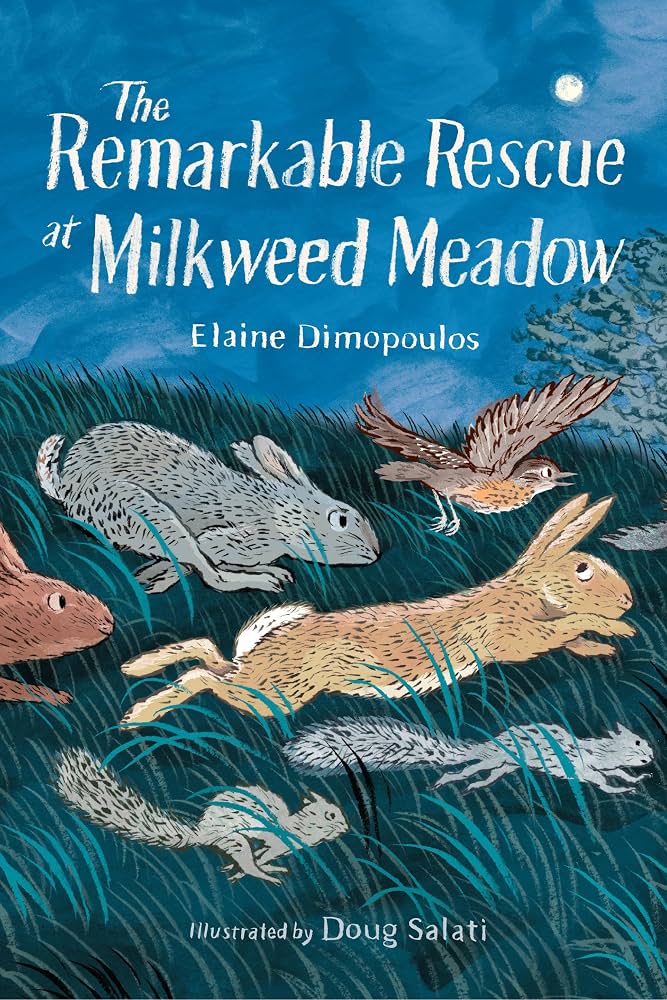
By Elaine Dimopoulos, The Remarkable Rescue at Milkweed Meadow (Charlesbridge, 2024) is the story of Butternut, one of nine rabbit siblings, all taught by their mother and grandmother to stick strictly to their own kind. Butternut, however – a perennially anxious rabbit with a talent for storytelling – befriends Piper, a young robin, saves an injured fawn, and eventually pulls the creatures of Milkweed Meadow together to embark on a truly generous and heroic rescue. For ages 8-11.
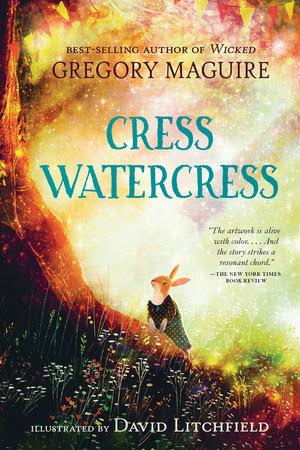
In Gregory Maguire’s Cress Watercress (Candlewick 2024), after Cress’s father fails to return one night, Cress’s mother moves the family into the basement of the Broken Arms, a rundown apartment oak inhabited by a frightening owl landlord, a family of squirrels, and a nosy pair of songbirds. A lovely coming of age story for ages 8-12.

The hero of Kate DiCamillo’s The Miraculous Journey of Edward Tulane (Candlewick, 2009) is a self-satisfied china rabbit, possessor of a huge wardrobe of silk suits, owned and adored by a little girl named Abilene. Then Abilene and her parents embark on a sea voyage and disaster strikes: Edward is hurled overboard. So begins his journey. He is dredged up from the ocean and brought home by a fisherman, and then passes on to a succession of caretakers, who – collectively – help him come to understand love, loss, and hope. For ages 7-12.
Put on a play based on the book!

In Polly Horvath’s hilarious Mr. and Mrs. Bunny – Detectives Extraordinaire (Yearling, 2014), Madeline’s parents – who play the marimba and make jewelry out of sand dollars, have been kidnapped by foxes. Madeline sets out to find them – and ends up hiring Mr. and Mrs. Bunny. A fun read for ages 8-12. Also see the sequel: Lord and Lady Bunny – Almost Royalty (2016).
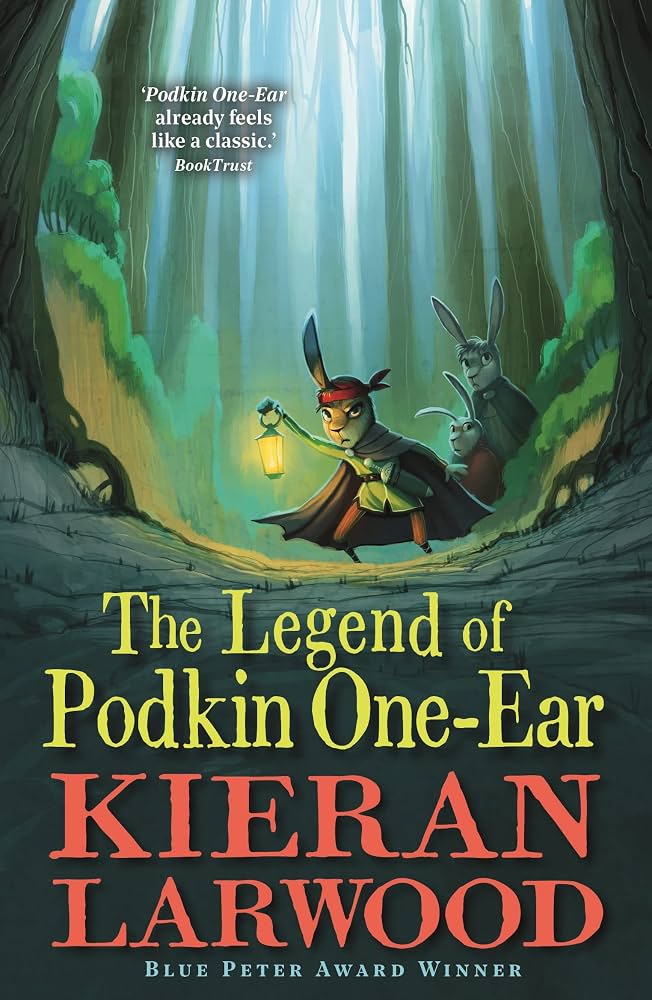
The Legend of Podkin One-Ear by Kieran Larwood (Faber & Faber, 2017) is the first of a series starring Podkin, the lazy son of a rabbit warrior chieftain – who, when their warren in brutally attacked, must take command, protect his family, and find a way to defeat the terrifying Gorm. For ages 8-12.
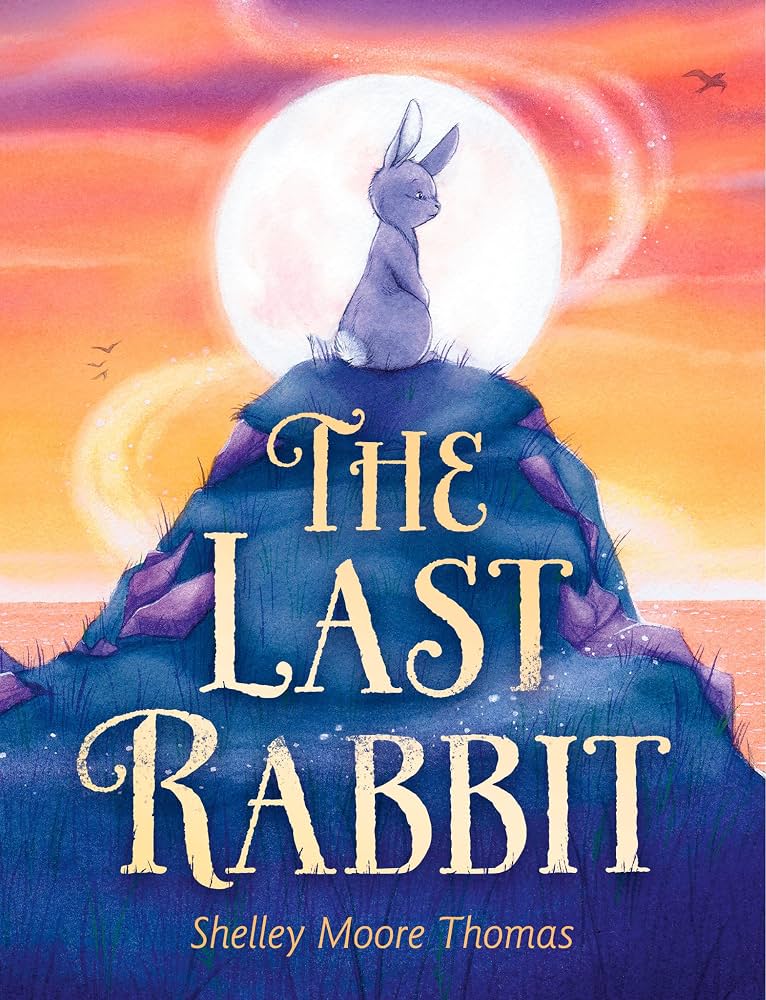
Shelley Moore Thomas’s The Last Rabbit (Yearling, 2022) is set on the island of Hybrasil where a Magician lives with four enchanted rabbit sisters – who, as they leave the island one by one, turn back into girls. Finally only one last rabbit, Albie, remains, and the island is sinking – so Albie sets off on a quest through time and space to find her sisters. For ages 8-12.

In Cynthia Lord’s Because of the Rabbit (Scholastic, 2019), homeschooled Emma is starting school for the first time; there she and an unpopular boy named Jack forge a bond over a rescue rabbit. It’s a lovely story of friendship, honesty, and accepting differences. For ages 8-12.

James Thurber’s Fables for Our Time (HarperPerennial, 1983) includes the story of “The Rabbits Who Caused All the Trouble,” a sobering (though darkly funny) fable, the moral of which is “Run, don’t walk, to the nearest desert island.”

Richard Adams’s rabbit world of Watership Down (Scribner, 2005) is now a staple of high-school reading lists – and deservedly. The plot centers around a small band of rabbits – Hazel, Fiver, Bigwig, Bluebell, and Dandelion – who leave their home warren after a warning from the clairvoyant Fiver that destruction (land developers) is imminent, looking for a new and safer home. Adams creates a complex and believable culture of rabbits, with social structure, language, customs, and religion.

An excellent animated version of Watership Down was released in 1978. Despite the cartoon format, it is not recommended for young children – this is a serious drama and there are some frightening and bloody scenes.

A TV mini-series of Watership Down (2018) is rated PG.
Peter Rabbit and Company
As classic rabbit tales go, the best-known of all is surely Beatrix Potter’s The Tale of Peter Rabbit, which first appeared in 1902, and since has sold over 150 million copies in 35 different languages. If you have not yet acquired one of these, my only advice is that when you do, get an edition with the original Potter illustrations. For reasons that pass understanding, a scattering of publishers have produced Peters illustrated by other people. Don’t fall for it.

The Tale of Peter Rabbit has the original text and illustrations online.
The Peter Rabbit website has a photo-illustrated biography of Beatrix Potter, information on the book characters, games and animations for kids, and more.
From First School, The Tale of Peter Rabbit has activities for preschoolers to accompany a reading of Potter’s Peter Rabbit. Included are printable paper crafts and an “R is for Rabbit” project.

Mr. McGregor’s Garden Sticker Activity Book (Dover Publications) comes equipped with many vegetables and rabbits. Also from Dover is The Tale of Peter Rabbit Coloring Book, with black-line illustrations and text from the book.

Alma Flor Ada’s picture book Dear Peter Rabbit (Atheneum Books for Young Readers, 1997) is a series of letters among favorite picture-book characters, among them Peter Rabbit, the Three Little Pigs, Goldilocks and Baby Bear, and Red Riding Hood. For ages 4-9.

Jane Johnson’s The True Story of Peter Rabbit: How a Letter Became a Beloved Children’s Classic (Puffin, 2006) is a picture-book account of how Potter’s clever illustrated letter to a young friend grew into the first of 23 wonderful children’s books – which, incidentally, include several others featuring rabbits, among them The Tale of Benjamin Bunny, The Tale of the Flopsy Bunnies, and The Story of a Fierce Bad Rabbit.

Miss Potter is a 2006 movie about Beatrix Potter’s life and work, with Renee Zellweger as Beatrix Potter and Ewan McGregor as Norman Warne, her publisher, with whom she fell in love. It’s rated PG for “mild language.”

Linda Lear’s Beatrix Potter: A Life in Nature (St. Martin’s Griffin, 2008) is a comprehensive biography for teenagers and adults.

Beatrix Potter’s Peter Rabbit isn’t the only one. Author/naturalist Thornton Burgess wrote over 150 animal books for children, starring such characters as Peter Rabbit, Reddy Fox, Little Joe Otter, Jimmy Skunk, and Johnny Chuck. Intended for ages 5-10, these short chapter books combine story and personality – the animals talk – with realistic depictions of animal behaviors and habitats. See the complete list of Burgess titles here.
Tricky Rabbits

Zomo, the too-clever-for-his-own-good black rabbit in Gerald McDermott’s Zomo the Rabbit: A Trickster Tale from West Africa (Sandpiper, 1996), has asked the Sky God for wisdom, in exchange for which he must deliver the scales of the Big Fish of the sea, the milk of the Wild Cow, and the tooth of the Leopard. He manages, through outrageous trickery, to obtain all three – and then learns that wisdom sometimes consists of knowing when to run away fast. A brilliantly illustrated picture book for ages 4-8.

Joel Chandler Harris’s Uncle Remus stories are collections of African-American folktales – starring the tricky and irrepressible Brer Rabbit – first published in book form in 1881. They can be heavy going, since Chandler’s books are written in a form of Deep-South dialect. (“’Mawnin’!’ sez Brer Rabbit, sezee – ‘nice wedder dis mawnin’, sezee.”) Check out Chandler’s Uncle Remus: His Songs and His Sayings online.
Uncle Remus: The Complete Tales, adapted by Julius Lester (Dial, 1999) is a modernized version of the stories – there’s an occasional reference to shopping malls and jogging suits – but by and large it keeps the flavor of the originals, while making them more accessible to children. The short stories – of which there are many in this book; it’s nearly 700 pages long - are appropriate for ages 4 and up.

The Adventures of Brer Rabbit and Friends, adapted by Karima Amin (Dorling Kindersley, 1999) is a 64-page collection of ten popular Harris tales, along with background information on the African storytelling tradition and a wonderful picture map of “Brer Rabbit’s World.” For ages 6 and up.
The Wren's Nest, Joel Chandler Harris’s home in Atlanta, Georgia, is now a museum. See https://www.wrensnest.org/the-house.
Racing Rabbits

Brian Wildsmith’s The Hare and the Tortoise (Oxford University Press, 1966) is a great retelling of the story of the famous race, with wonderful crayon-bright illustrations. For ages 4-8.

Eric Carle’s The Rabbit and the Turtle (Orchard Books, 2008) is a collection of eleven of Aesop’s fables, among them the title tale, all illustrated with Carle’s signature paper collages.
The Tortoise and the Hare has several versions of the story, along with many multicultural stories about races between unequal contestants (frog and snail, hare and hedgehog, frog and antelope, mole and hawk). (It’s an easy jump from here to inventing race stories of your own.)
Aesop's Fables has illustrated versions of several of Aesop’s fables with accompanying coloring pages, puzzles, and craft projects.
Interactivate has an interactive mathematical race between tortoise and hare, printable worksheets, and helpful information on Zeno’s paradox.

Join the race with The Tortoise and the Hare interactive storybook app.
How to make Aesop's Fable shadow puppets, among them the Tortoise and the Hare.
Real Rabbits

Bunny in the “See How They Grow” series from DK Publishing (2007) follows the life of a bunny from birth to adulthood. The simple text is paired with great color photographs. For ages 3-6.

The star of Judy Dunn’s The Little Rabbit (Random House, 1980) is a real rabbit, found by Sarah in her Easter basket and named Buttercup. The book, illustrated with color photographs, is an introduction to the habits and behaviors of rabbits. For ages 4-8.

Gail Gibbons’s Rabbits, Rabbits, & More Rabbits (Holiday House, 2000) is a non-fiction introduction to rabbits for ages 4-8. As with all Gibbons’s books, the illustrations are bright and appealing, and the text is informative, but dry.

Mel Boring’s Rabbits, Squirrels, and Chipmunks (NorthWord Books, 1996) is a beginner’s field guide in the “Take Along Guide” series, nicely designed, with reader-friendly information (“What It Looks Like,” “What It Eats,” “Where to Find It”) and a scattering of projects. For example, kids make a rabbit refuge, a squirrel nut-ball, and a chipmunk tightrope (hung with peanuts). For ages 4-9.

By Susan E. Davis and Margo DeMello, Stories Rabbits Tell: A Natural and Cultural History of a Misunderstood Creature (Lantern Books, 2003) covers the mythology, symbology, and biology of rabbits. A wealth of information for teenagers and adults.
Enchanted Learning has labeled print-outs of lagomorphs (including rabbits and hares) and a rabbit quiz.
Rabbit? Or hare? The Difference Between website explains which is which.
The House Rabbit Society has detailed information about rabbit care and behavior, rabbit booklists, and a selection of free rabbit e-postcards.
Supersized Superbunny is an account of the giant fossil rabbit recently discovered on the Mediterranean island of Minorca.
The oldest ancestor of modern rabbits may have been a hamster-sized bunny who lived 53 million years ago in India. Read about it at Live Science.
Strange Rabbits?

In Deborah and James Howe’s Bunnicula: A Rabbit Tale of Mystery (Atheneum Books for Young Readers, 2006), the Monroe family goes to the movies to see Dracula and brings home a suspiciously vampiric baby rabbit, duly named Bunnicula. The story is told from the point of view of the patient family dog, Harold, who has to deal not only with Bunnicula and a lot of drained white vegetables, but with Chester, the overwrought family cat. An hilarious short chapter book for ages 8-12. Luckily there are several sequels.


In Wallace & Gromit: The Curse of the Were-Rabbit, the riotous 2005 film by Claymation wizards Steve Box and Nick Park, Wallace and his trusty dog, Gromit – now operating a humane pest-control business called Anti-Pesto – are attempting to nab the huge night-prowling saboteur who is threatening the village Giant Vegetable Competition. It’s 85 minutes long and rated G.
Mathematical Rabbits

Alan Baker’s Gray Rabbit’s Odd One Out (Kingfisher, 1999) is a sorting book. Gray Rabbit, looking for a book, is trying to organize his belongings. Things fall in place, two by two – except that there’s always one odd thing out. For ages 2-5.

In Anita Lobel’s gorgeously illustrated 10 Hungry Rabbits (Knopf Books for Young Readers, 2012), ten hungry bunnies find colorful vegetables for the family soup pot, starting with one purple cabbage, two white onions, and three yellow peppers. For ages 2-5.

Virginia Grossman’s Ten Little Rabbits (Chronicle Books, 1995) is a rhyming counting book with a native American theme. The rabbits, from one to ten, wear gorgeously patterned blankets, and are shown performing a rain dance, sending smoke signals, tracking a bear with bows and arrows. For ages 2-5.

Ann McCallum’s Rabbits, Rabbits Everywhere (Charlesbridge Publishing, 2007) is a picture-book fable set in the little town of Chee, famous for its gardens, its Pied Piper, and its ravenous and rapidly multiplying rabbits. It’s a Fibonacci problem. For ages 6-10.

Emily Gravett’s The Rabbit Problem (Simon & Schuster, 2010) is a delightful month-by-month take on the Fibonacci series – which is named for the mathematician who first described it in the 13th century, while solving a problem about multiplying rabbits. First there’s one lonely rabbit (an invitation stuck to the page reads “Join me”); subsequent months feature baby rabbit record books, rabbit newspapers, carrot recipes, and – by November – wildly overcrowded rabbits. For ages 6-11.

Joy N. Hulme’s Wild Fibonacci (Tricycle Press, 2010) – via a somewhat awkward rhyming text – introduces the Fibonacci sequence and its prevalence in nature to ages 7-10.

Sarah C. Campbell’s Growing Patterns (Boyds Mills Press, 2010) introduces Fibonacci numbers in nature through gorgeous color photographs of flowers, pinecones, pineapples, and a cutaway nautilus shell. For ages 6-12.
The Fibonacci Sequence in Nature has photographs, animations, and explanations of the Fibonacci sequence in everything from pine cones to hurricanes.

Joseph D’Agnese’s Blockhead: A Life of Fibonacci (Henry Holt and Company, 2010) is a picture-book biography of the famous medieval mathematician. For ages 6-11.
Rabbits and Art

Rabbits on Stamps is a cool gallery of rabbits on postage stamps.
See these instructions and a pattern for making a rabbit pop-up card.

Check out a short history of Bugs Bunny, possibly the world’s most recognized bunny.
Draw a bunny with comic-book artist Simone Lia via The Guardian.

Make a blow-up origami bunny. For step-by-step instructions, see Origami USA.
See Bunny Crafts for kids from Red Ted Art at https://www.redtedart.com/cute-bunny-crafts-for-kids/. Stuffed bunnies, sock bunnies, bunny bookmarks, and more.