
All About Cows
In this collection
Check out these lists for typing cows, flying cows, purple cows, and pirate cows; find out what cows have to do with whales; and learn all about sacred cows, Mrs. O'Leary's cow, and the cow that jumped over the moon. (There was even a lunar space probe named Cow.)
Cool Fictional Cows
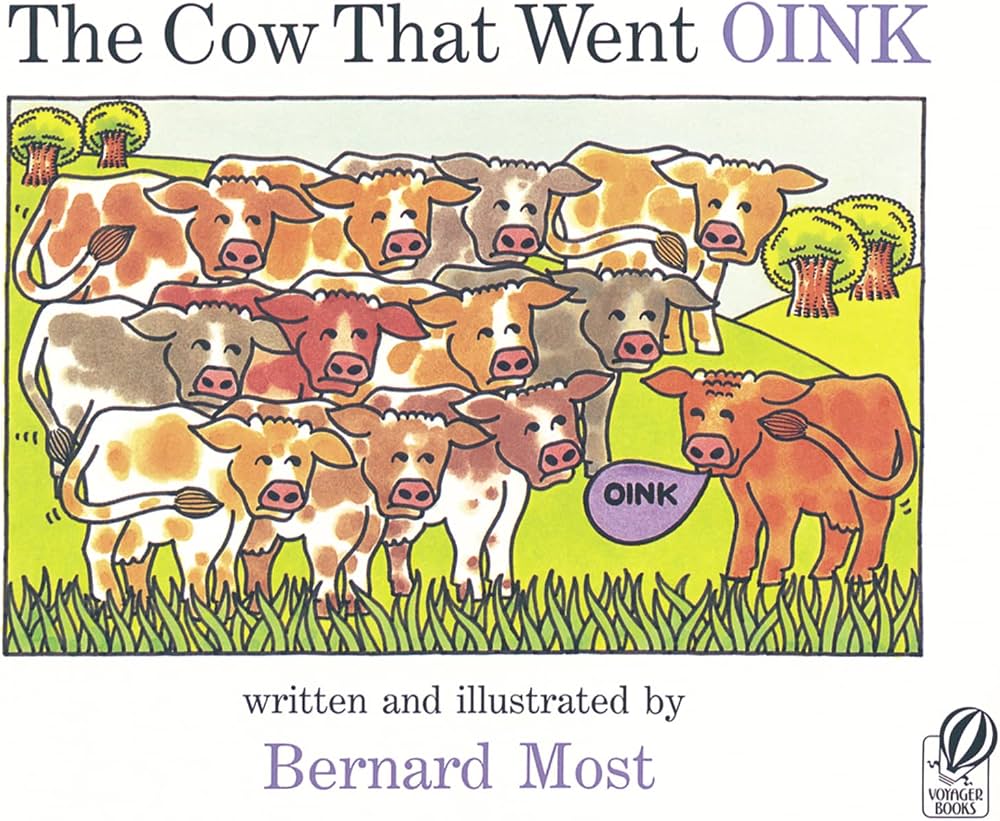
In Bernard Most’s The Cow that Went OINK (Clarion, 2003), a cow that oinks is laughed at by all the other farm animals. Then she meets a pig that moos. A funny picture book with a serious message (and a lot of opportunities for counting farm animals) for ages 2-5.
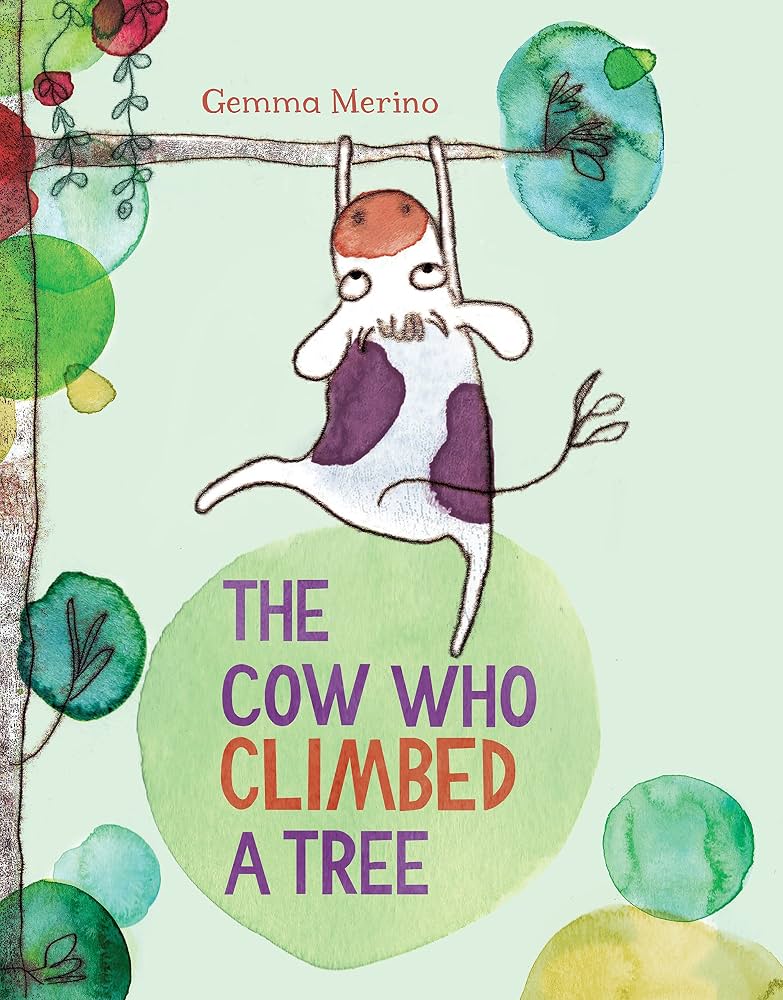
In Gemma Merino’s The Cow Who Climbed a Tree (Macmillan, 2015), Tina – a curious cow with a thirst for discovery – claims to have climbed a tree and met a dragon. But nobody believes her. For ages 3-6.

In Karma Wilson’s rhyming The Cow Loves Cookies (Margaret K. McElderry Books, 2010), readers learn what farm animals eat – the horse loves hay, the geese munch corn – but the cow loves cookies! At the end, cow and farmer share a snack of cookies and milk. For ages 3-6.
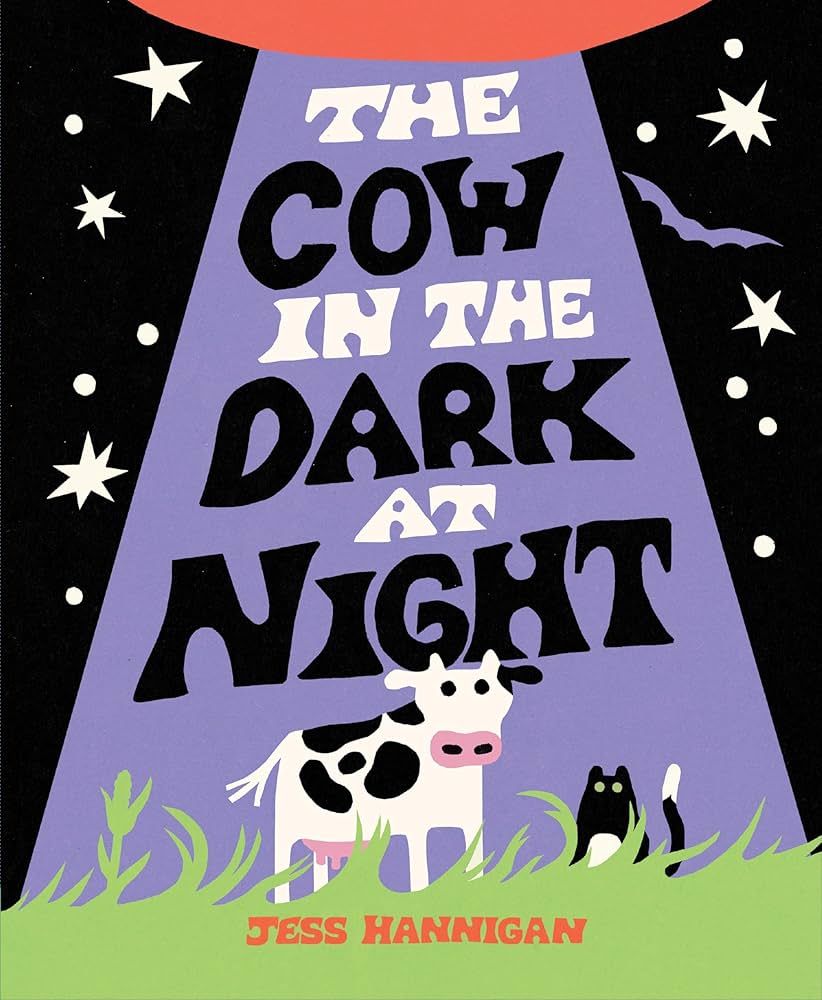
In Jess Hannigan’s The Cow in the Dark at Night (Quill Tree Books, 2026), the cow is off the explore the night along with her guardian cat – a ramble in which they encounter everything from a vampire to an alien abduction. Silly and fun for ages 3-7.
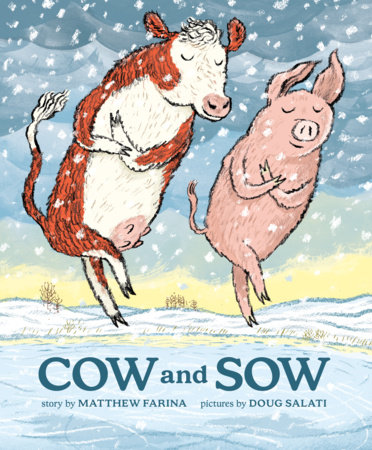
In Matthew Farina’s witty Cow and Sow (Tundra Books, 2026), it’s winter and Cow and Sow are tired of being cooped up inside. Then they discover frozen Shallow Pond and the excitement of skating. Soon other animals join them – until an argument breaks out that leads to Cow falling through the ice. For ages 3-7.

In Doreen Cronin’s wonderful Click, Clack, Moo (Atheneum Books for Young Readers, 2000), Farmer Brown’s cows have acquired a typewriter and promptly begin to make their problems known: “Dear Farmer Brown, The barn is very cold at night. We’d like some electric blankets. Sincerely, The Cows.” Farmer Brown refuses and the cows go on a milk strike. All is finally resolved with the helpful intervention of Duck, who ends up with the typewriter – and promptly fires off a note announcing that the duck pond is boring and the ducks would like a diving board. Hilarious for ages 3 and up. There are several sequels featuring the Click, Clack, Moo characters.
Put on a play! Readers’ Theater: Click, Clack, Moo is a script to accompany the book., adaptable for various numbers of actors. As it stands, it calls for multiple narrators and any number of cows.
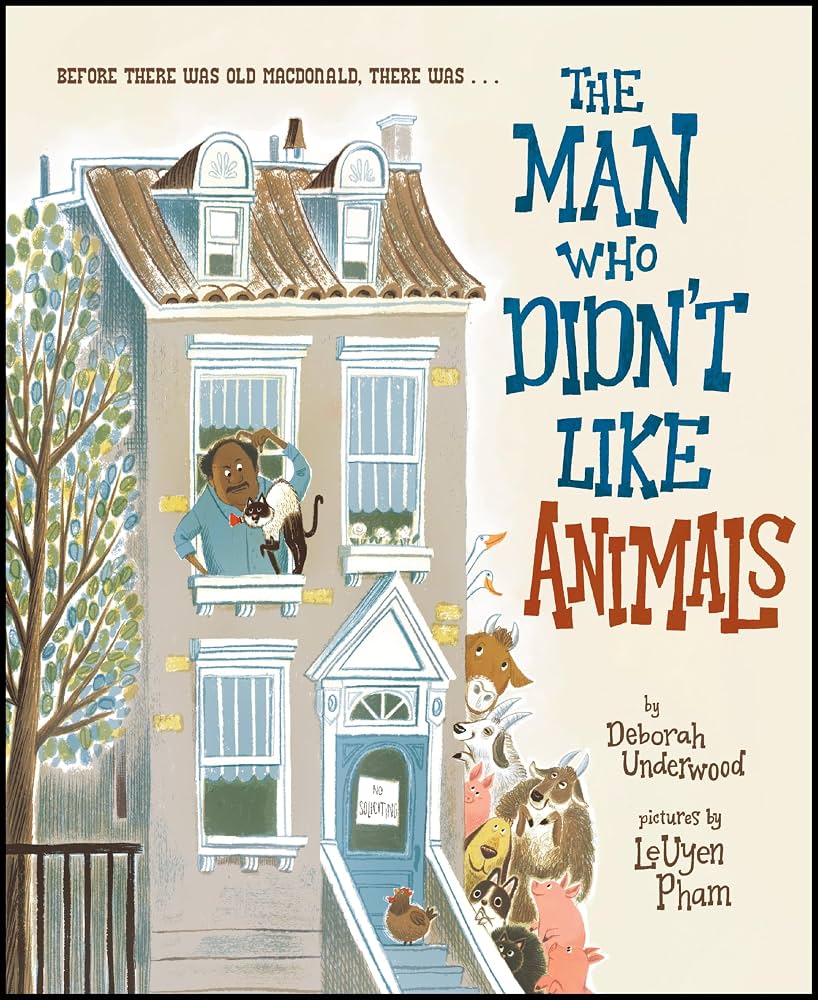
By Deborah Underwood, The Man Who Didn’t Like Animals (Clarion, 2024) - the back story to Old MacDonald and his farm – begins with a man who likes his tidy home and doesn’t like animals. But then a cat comes along, then a dog, then a duck and some chickens...and, of course, there are cows. For ages 4-8.

John Himmelman’s picture book Cows to the Rescue (Henry Holt and Company, 2011) is one of a series, beginning with Chickens to the Rescue (2006) and Pigs to the Rescue (2010). They’re all hilarious: problems arise and frantic hordes of animals arrive to (more or less) save the day. Here, it’s the day of the county fair and the Greenstalks’ car won’t start. Enter the cows! For ages 4-8. (And up.)
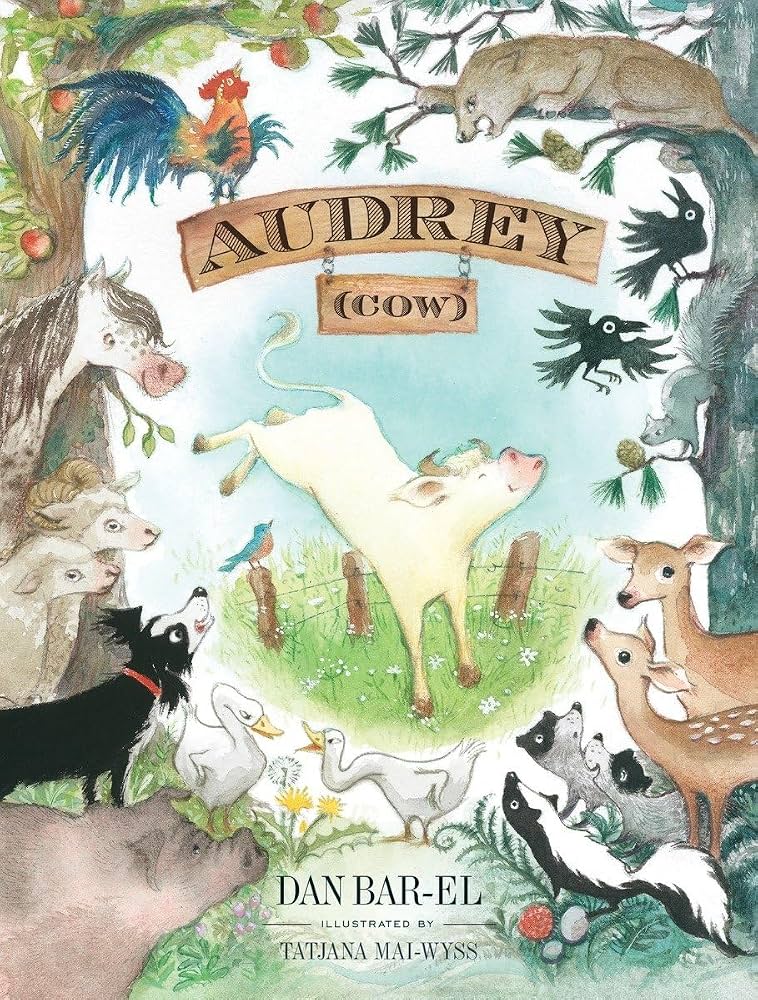
In Audrey (cow) by Dan Bar-el (Tundra Books, 2014), the title character is a poetic and thoughtful cow who – when she realizes that she’s headed for the slaughterhouse – is determined to escape the farm. Creatively told in short interview snippets with multiple contributors, including four cows, six humans, a horse, two dogs, three sheep, a pig, and a rooster. A good discussion book for ages 7-10.
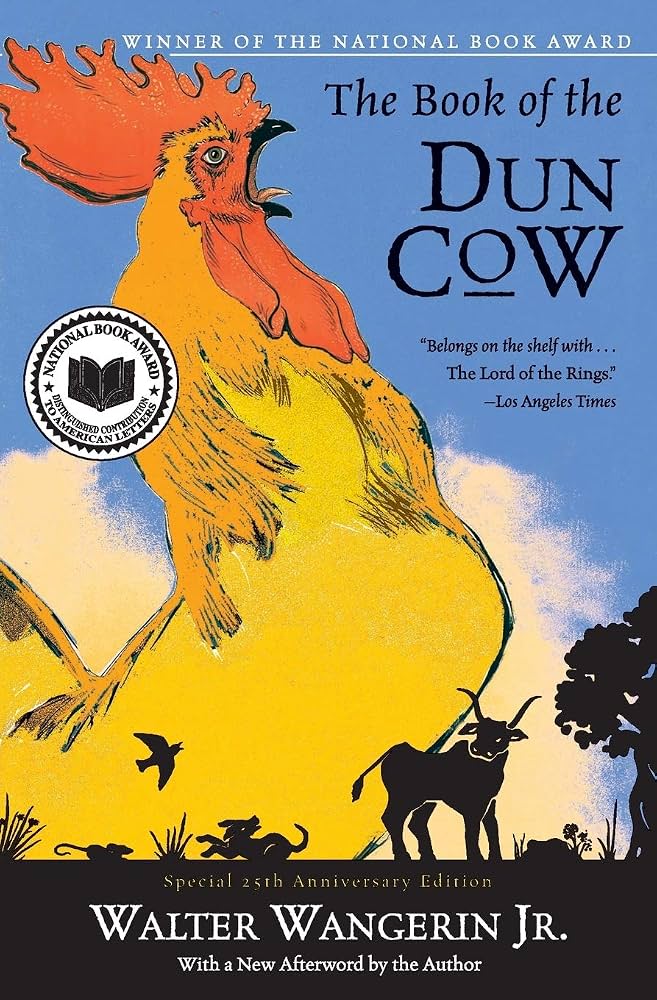
Walter Wangerin’s The Book of the Dun Cow (HarperOne, 2003) - a National Book Award winner – is an allegorical fantasy about the battle between good and evil, set in a time when animals could talk and Chauntecleer the Rooster ruled the world. Beneath the peaceful kingdom, though, the mostrous Wyrm is breaking free. "Belongs on the shelf with Animal Farm, Watership Down, and Lord of the Rings." For teens and adults.
Real Live Cows

Gail Gibbons’s brightly illustrated The Milk Makers (Aladdin, 1987) is a straightforward step-by-step account of the milk-making process, from cow to glass. For ages 4-9.

In Jennifer Holland’s photo-illustrated Unlikely Friendships for Kids series, the title story in The Leopard & the Cow (Workman Publishing, 2012) is the tale of a young leopard cub, adopted by an Indian cow. For ages 5-8.
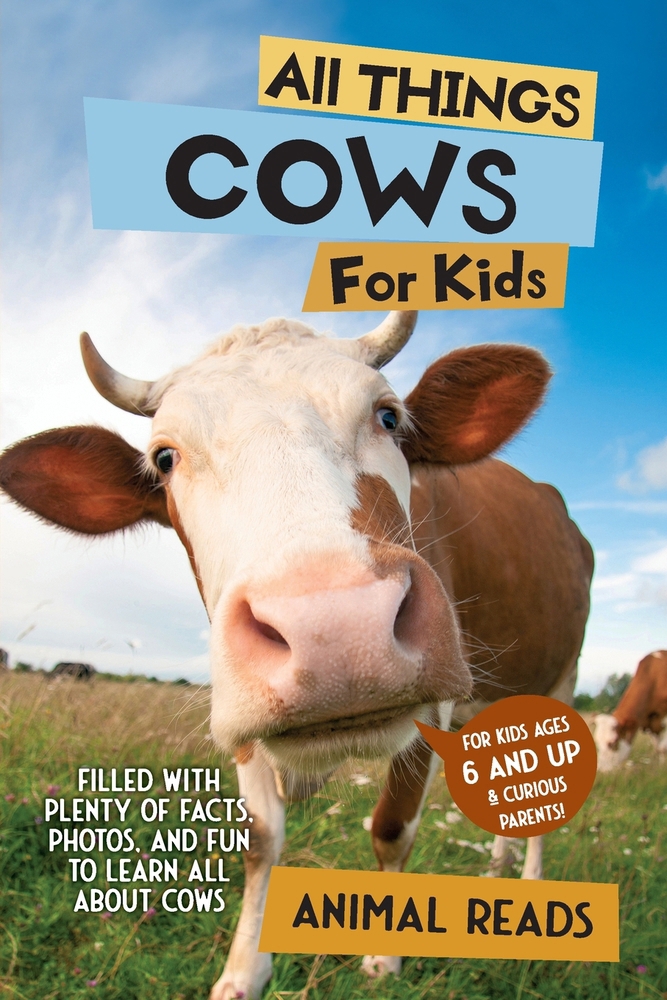
One of a series from Animal Reads, All Things Cows for Kids (Admore Publishing, 2025) is a short photo-illustrated chapter book filled with information, catchy facts, and the occasional joke about cows. For ages 6-9.

Learn to identify all 52 American breeds of cows! John Pukite’s A Field Guide to Cows (Penguin Books, 1998) has illustrations, statistics, cool cow trivia, and general information on each featured breed of cow. (We have a copy in the car.) Fun for all ages.
Also see Jack Byard’s Know Your Cows (Old Pond, 2019), a photo-illustrated guide to cow breeds, from Ayrshire to White Park. History and fun facts for all ages. (See how many you can spot.)

Marvin Harris’s Cows, Pigs, Wars and Witches (Vintage, 1989) is a fascinating study in anthropology, explaining the economic and social underpinnings of traditional cultural beliefs. Find out, for example, why Hindus have sacred cows. For teens and adults.
Milk and Cheese (and Baby Whales and President Jefferson)

Aliki’s charmingly illustrated Milk: From Cow to Carton (HarperCollins, 1992) covers the story of milk from grazing cows to dairy to the many different foods made from milk. For ages 4-8.
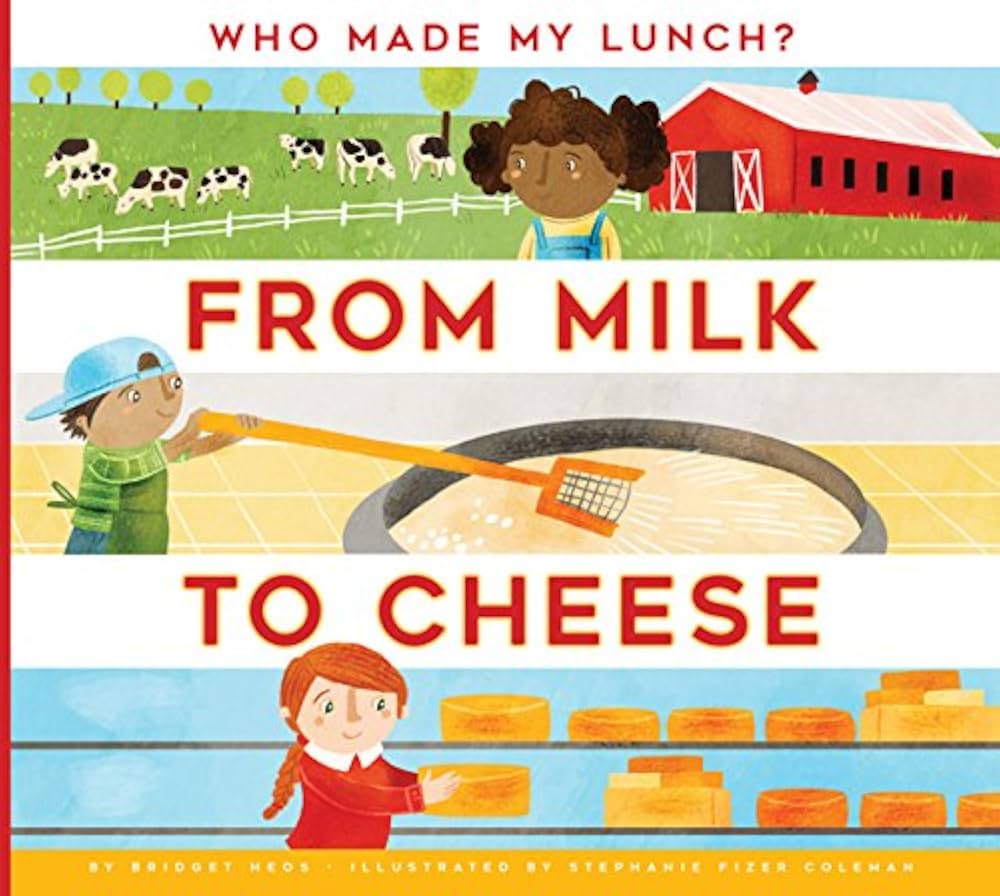
In the Who Make My Lunch? Series, From Milk to Cheese by Bridget Heos (Amicus Ink, 2018) is a simple picture-book explanation for ages 4-7.
Also be Heos, see From Milk to Ice Cream (2018).
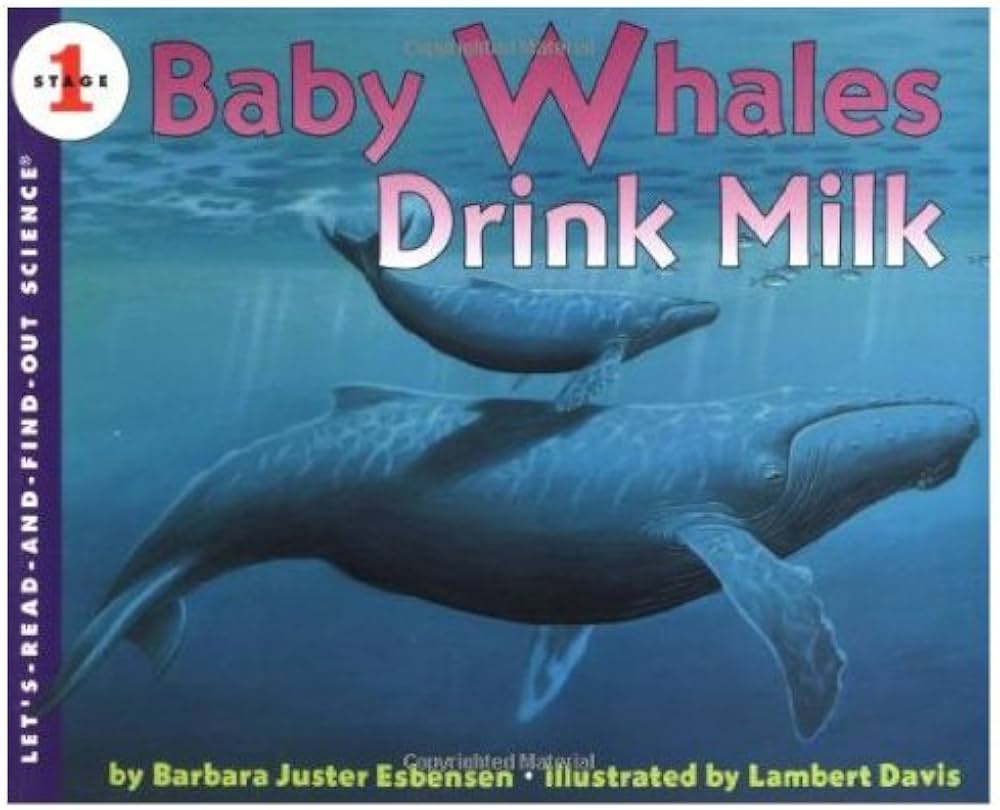
By Barbara Juster Esbensen in the Let’s-Read-and-Find-Out Science series, Baby Whales Drink Milk (HarperCollins, 1994) explains the many things whales have in common with other mammals – including babies who drink milk. For ages 4-7.
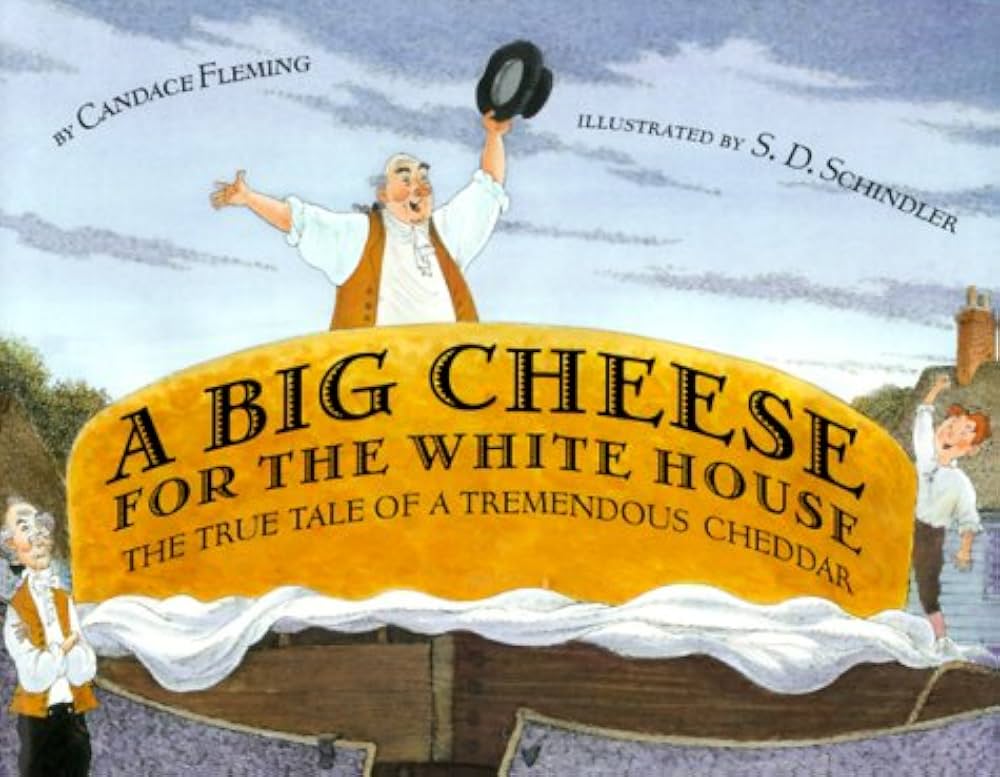
By Candace Fleming, A Big Cheese for the White House (DK, 1999) is the picture-book tale of the enormous cheese made in Cheshire, Massachusetts, in 1801 as a gift for President Thomas Jefferson. For ages 6-8.
From National Geographic, see Rebecca Rupp’s “What’s More Presidential Than a Gift of Big Cheese?” at https://www.nationalgeographic.com/culture/article/whats-more-presidential-than-a-gift-of-a-big-cheese.
From Listening to America, see “President Jefferson and the Big Cheese” at https://ltamerica.org/president-jefferson-and-the-big-cheese/.
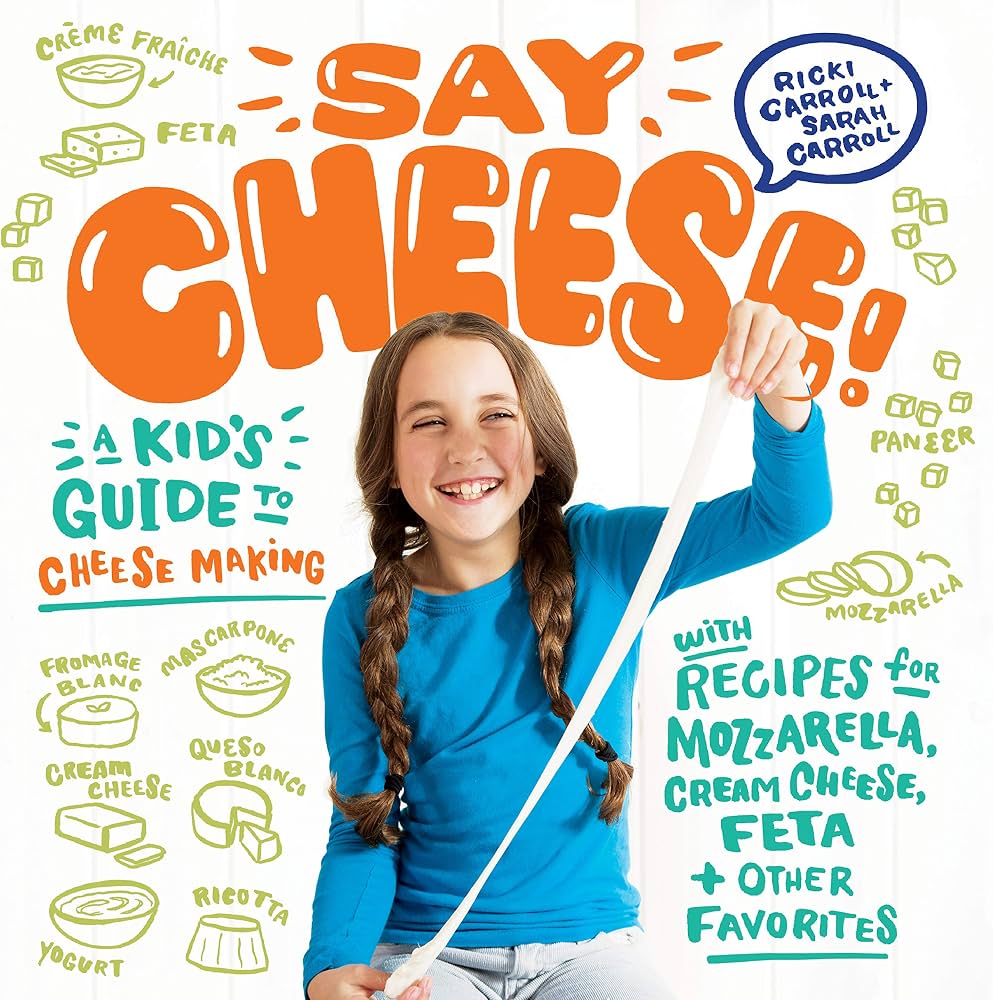
By Ricki Carroll and Sarah Carroll, Say Cheese! (Storey, 2018) is a photo-illustrated kid’s guide to cheese making with recipes for 12 favorites, among them mozzarella, ricotta, feta, and cream cheese. For ages 8-12.

Try making your own mozzarella! 
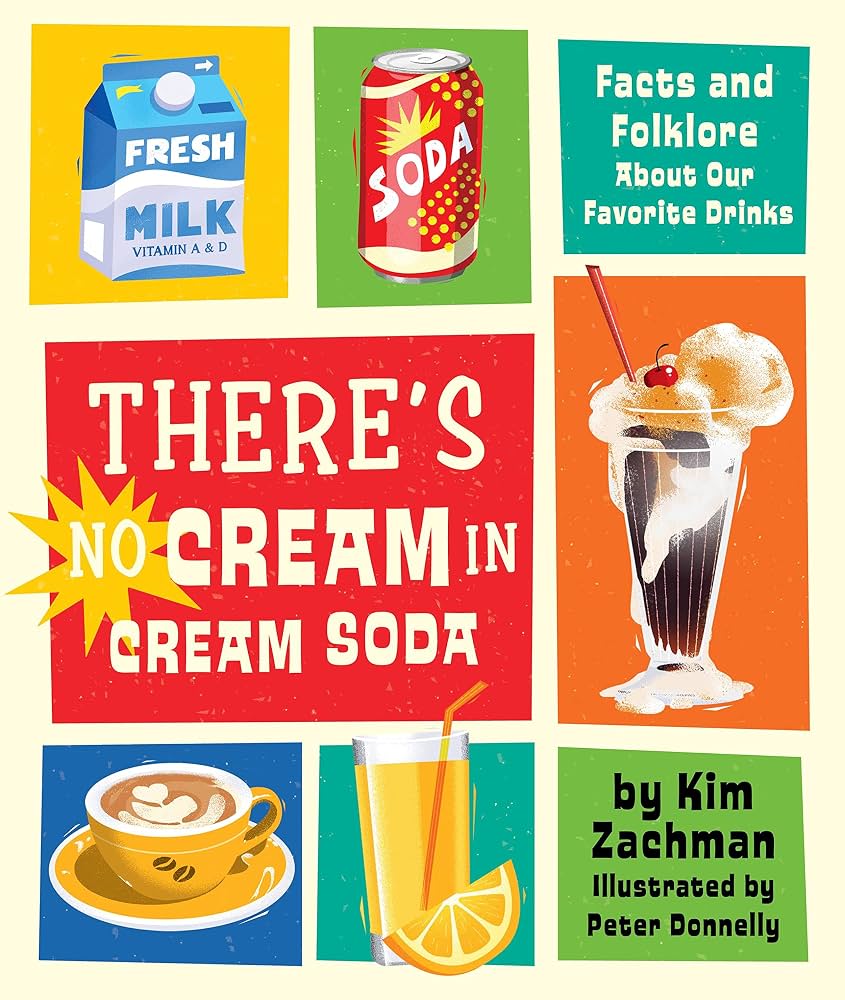
By Kim Zachman, There’s No Cream in Cream Soda (Running Press Kids, 2023) is filled with history, science, facts, and folklore about our favorite drinks – among them water, milk, tea, coffee, and Coca-Cola. For ages 9-12.
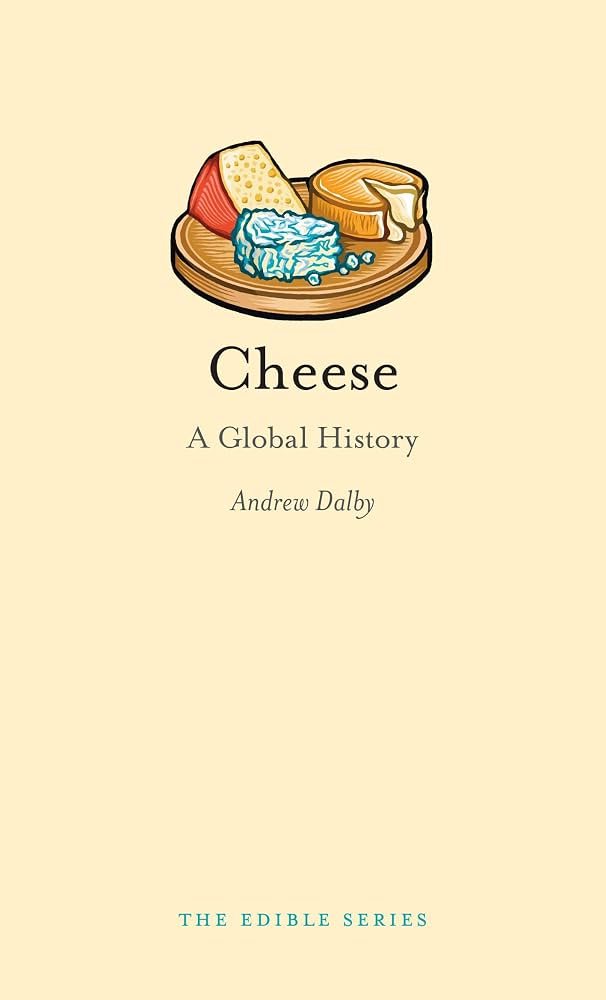
In the Edible series, Andrew Dalby’s Cheese: A Global History (Reaktion Books, 2009) is a short (128 pages) multifaceted history of cheese for teens and adults.
Cheese.com is a database of all things cheese, covering nearly 600 cheeses by name, country, and type of milk, plus cheese facts and cheese recipes. (Find out why American cheese is not really cheese.)
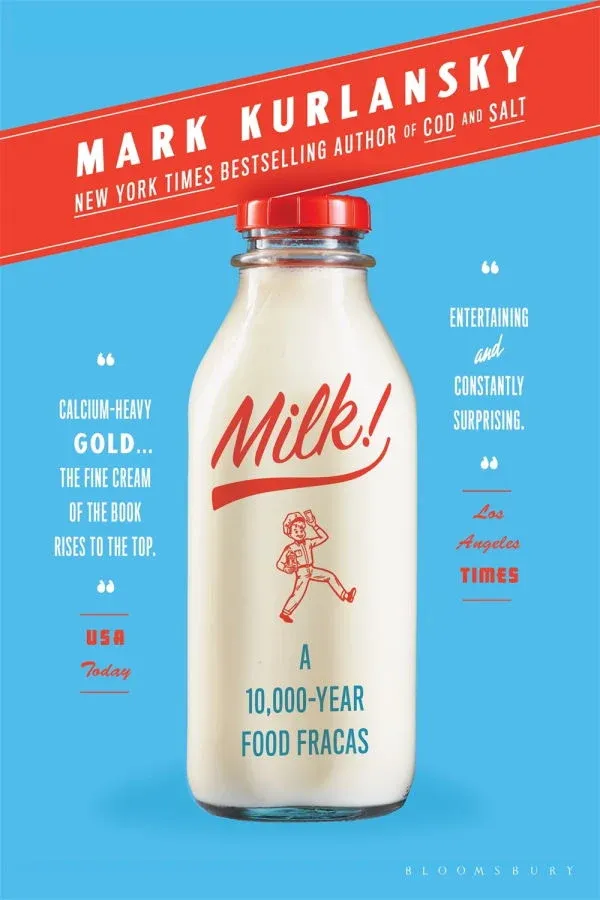
Milk by Mark Kurlansky (Bloomsbury, 2018) is a 10,000-year history of milk. For teens and adults.
Just for Fun
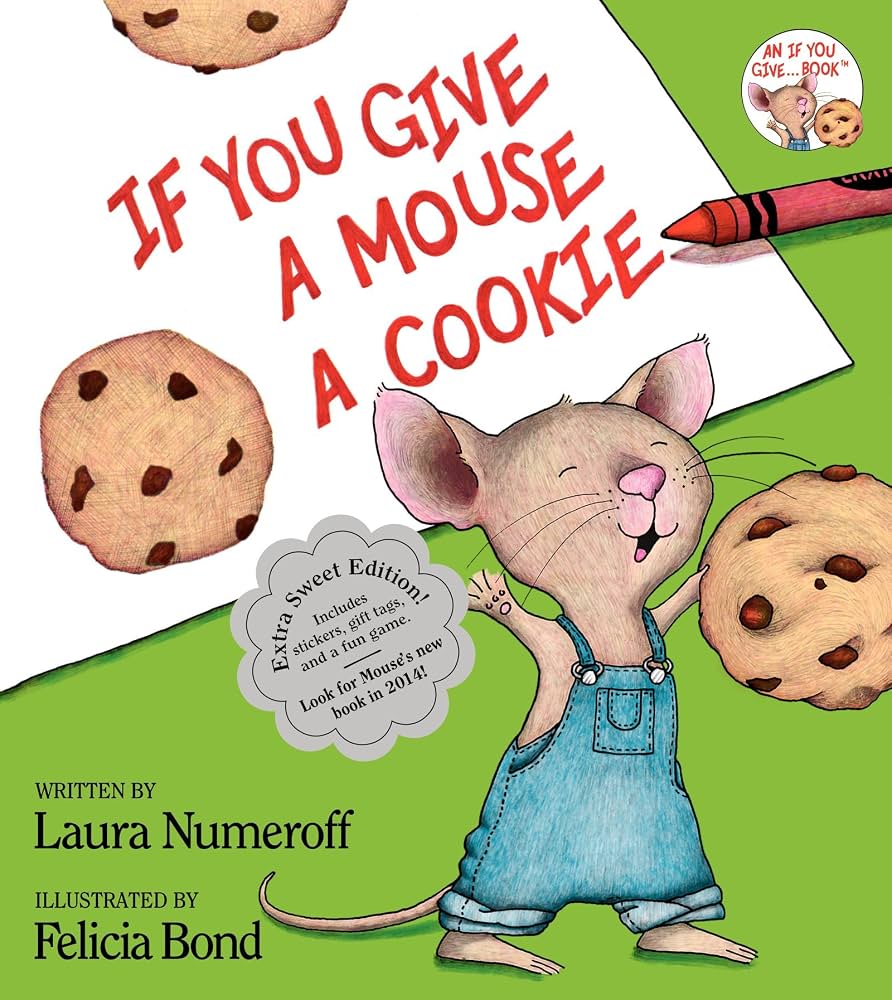
By Laura Joffe Numeroff, in If You Give a Mouse a Cookie (HarperCollins, 1985), if you hand over the cookie, you’re asking for trouble: next the mouse will need a glass of milk, then a mirror to see if he has a milk mustache...For ages 3-6.
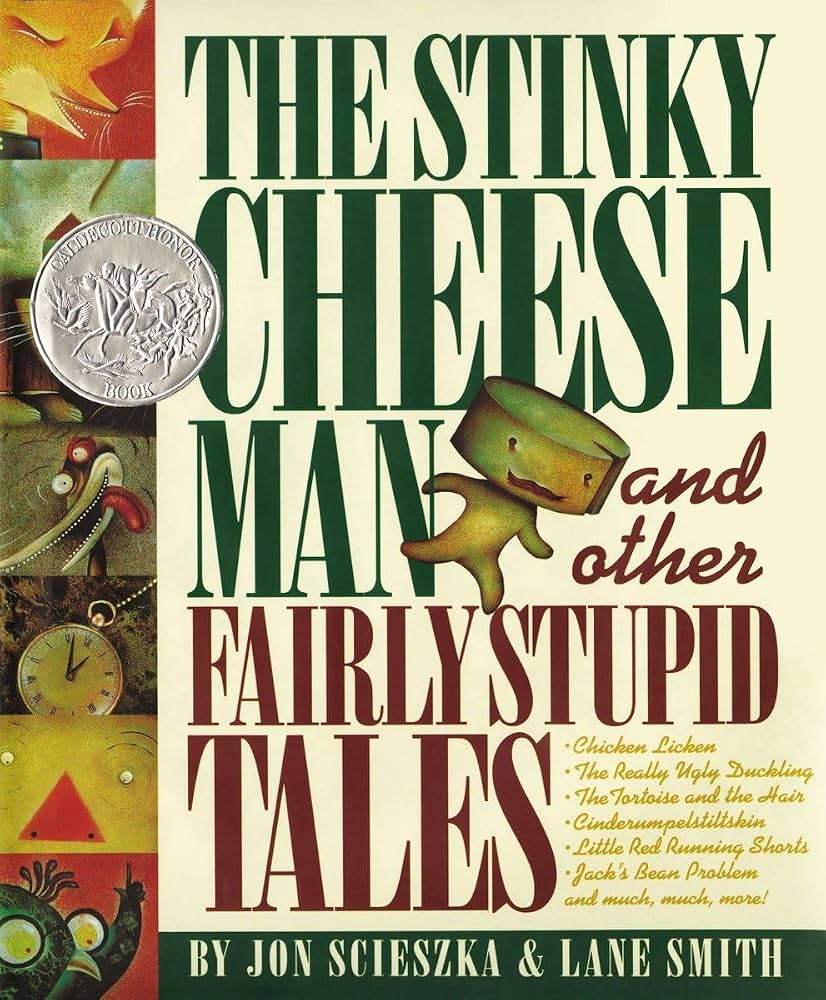
The Stinky Cheese Man and Other Fairly Stupid Tales by Jon Scieszka and Lane Smith (Puffin, 1998) features hilarious and off-the-wall versions of familiar fairy tales, among them “The Princess and the Bowling Ball,” “The Really Ugly Duckling,” and “The Stinky Cheese Man.” For ages 5 and up. Everybody will love it.
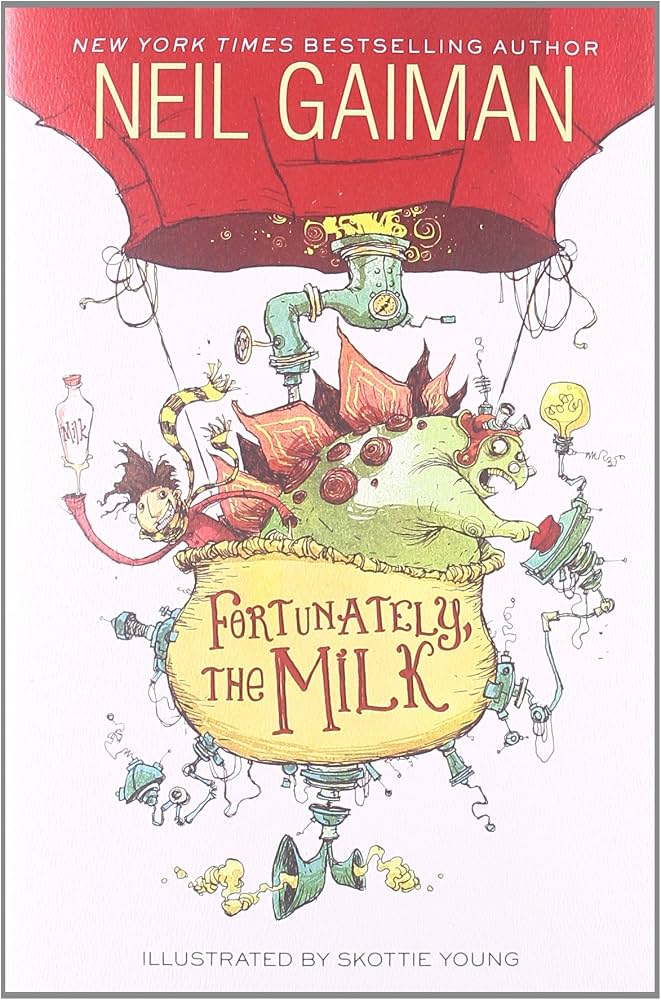
In Neil Gaiman’s riotous Fortunately, the Milk (HarperCollins, 2014), the narrator’s father heads out to get milk for the kids’ breakfast cereal – which turns into an edge-of-the-seat adventure saga involving alien abduction, pirates, and a time-traveling dinosaur in a hot-air balloon. For ages 6-10.
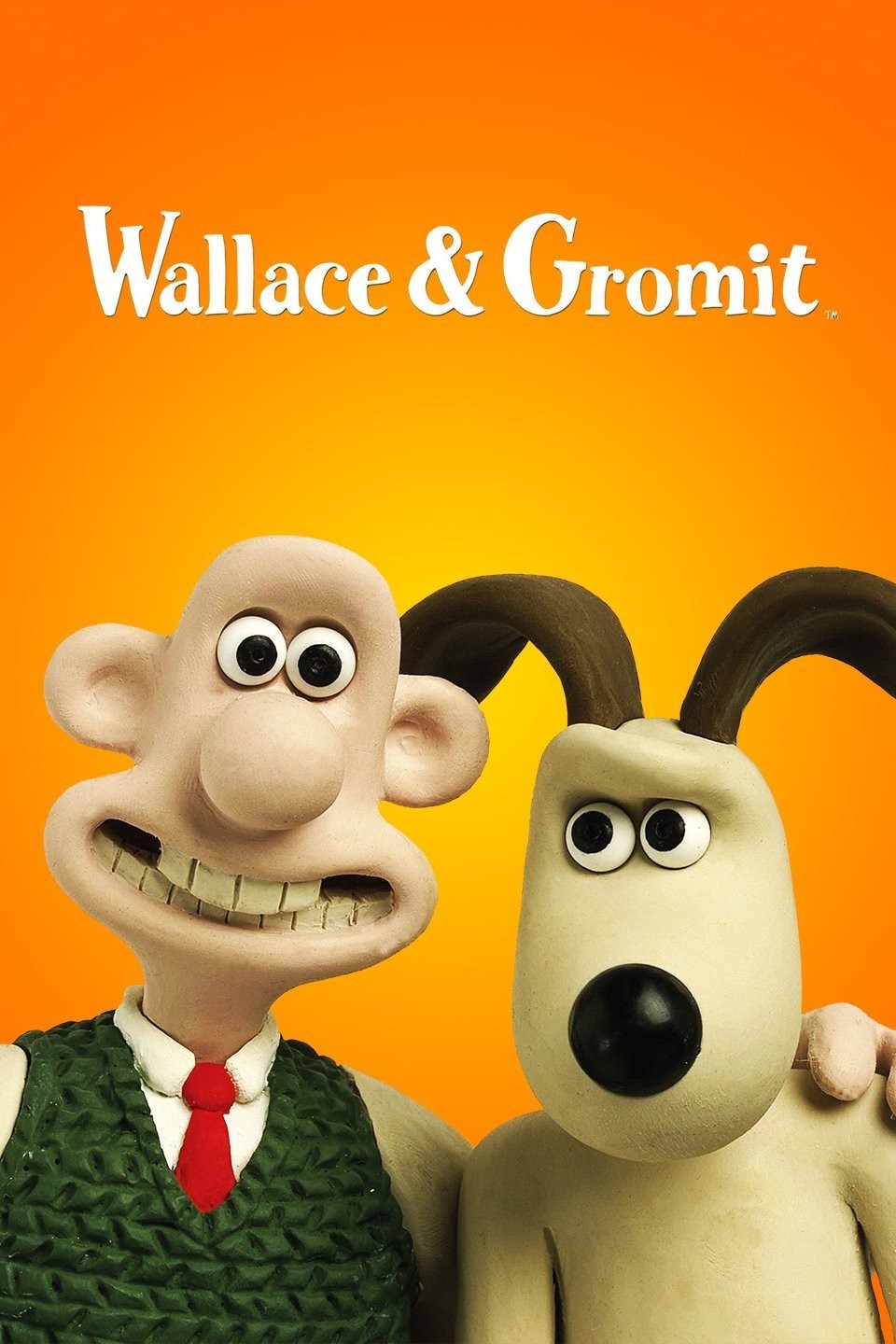
Nick Park’s hilarious claymation Wallace & Gromit films feature cheese-loving inventor Wallace and his faithful (and very intelligent) dog, Gromit. In A Grand Day Out, for example, Wallace and Gromit, in a homemade rocket ship, head to the moon – which, of course, is made of cheese.
Famous Cows
Yes, there are famous cows! See Famous Cows Throughout History at https://www.morningagclips.com/famous-cows-throughout-history/ for accounts of Ferdinand the Bull, Elsie the Cow, and Pauline Wayne, who grazed on the White House lawn during the administration of William Howard Taft.

Borden’s Elsie the Cow was at one time one of the most recognizable advertising symbols in the world.

The (life-sized) Butter Cow has been a star of the Iowa State Fair since 1911.
Check out the stories of these Seven Cows That History Won't Forget, among them Mrs. O’Leary’s Cow (who may or may not have started the Great Chicago Fire of 1871); President Taft’s cow, Pauline Wayne, who supplied milk for the White House; and Borden's Elsie.
See The Great Chicago Fire Wasn't Started by a Cow.
From Education World, The Great Chicago Fire: Did Mrs. O’Leary’s Cow Really Cause It? is a lesson plan on the fire and the cow for grades 6 and up. Included are discussion questions and a helpful resource list.

Jim Murphy’s Newbery Honor Book, The Great Fire (Scholastic, 2006), is the story of the 1871 Chicago fire, including eyewitness accounts, and illustrated with photographs and period prints. (He says it wasn’t the fault of the cow.) For ages 9 and up.
The Science of Cows
Cows or Cattle? All cows are cattle, but not all cattle are cows. This elementary-level lesson plan (with printable worksheet) explains it all.

Do Cows Pollute as Much as Cars? Agriculture is responsible for an estimated 14 percent of the world’s greenhouse gases – a lot of it in the form of methane, belched, burped, or farted by cows.

From the San Francisco Exploratorium, Cow's Eye Dissection has information about eyes, an online demonstration, and illustrated step-by-step instructions for performing a cow’s eye dissection. See https://www.exploratorium.edu/explore/cow-eye.
A cow’s eye dissection kit (preserved cow’s eye, instruction guide, dissecting tools, and disposable dissecting tray) is available from Home Science Tools. The website also has a virtual dissection and printable eye diagrams to label.
Is Cow-Tipping Possible? Probably not. Find out why.
Though the cow may just be the most important domesticated animal in human history, recent research indicates that cows may have been almost impossible to domesticate. Find out why.

What do cows have to do with vaccination? Learn about Edward Jenner, cowpox, and smallpox here.
The Cow Jumped Over the Moon

Linda Alchin’s The Secret History of Nursery Rhymes (Neilson, 2013) discusses the historical backgrounds of many classical nursery rhymes, among them “Hey Diddle Diddle,” featuring cat, fiddle, and moon-jumping cow.
BellaOnline’s Hey Diddle Diddle is a short history of the poem. It’s really about a love triangle and the Cow just might have been Queen Elizabeth I.

P.L. Travers’s Mary Poppins (Houghton Mifflin Harcourt, 2006) includes the story of “The Dancing Cow” who has a star stuck on one horn from her famous jump over the moon.
A space probe named Cow? (There was one. Well, almost.) Read all about the moon-circling space probe designed in 1957 by Krafft Ehricke and George Gamow in The Cow Jumped Over the Moon at https://www.wired.com/2012/11/the-cow-jumped-over-the-moon-1957/.
Art and Cows (and Some Spilled Milk)
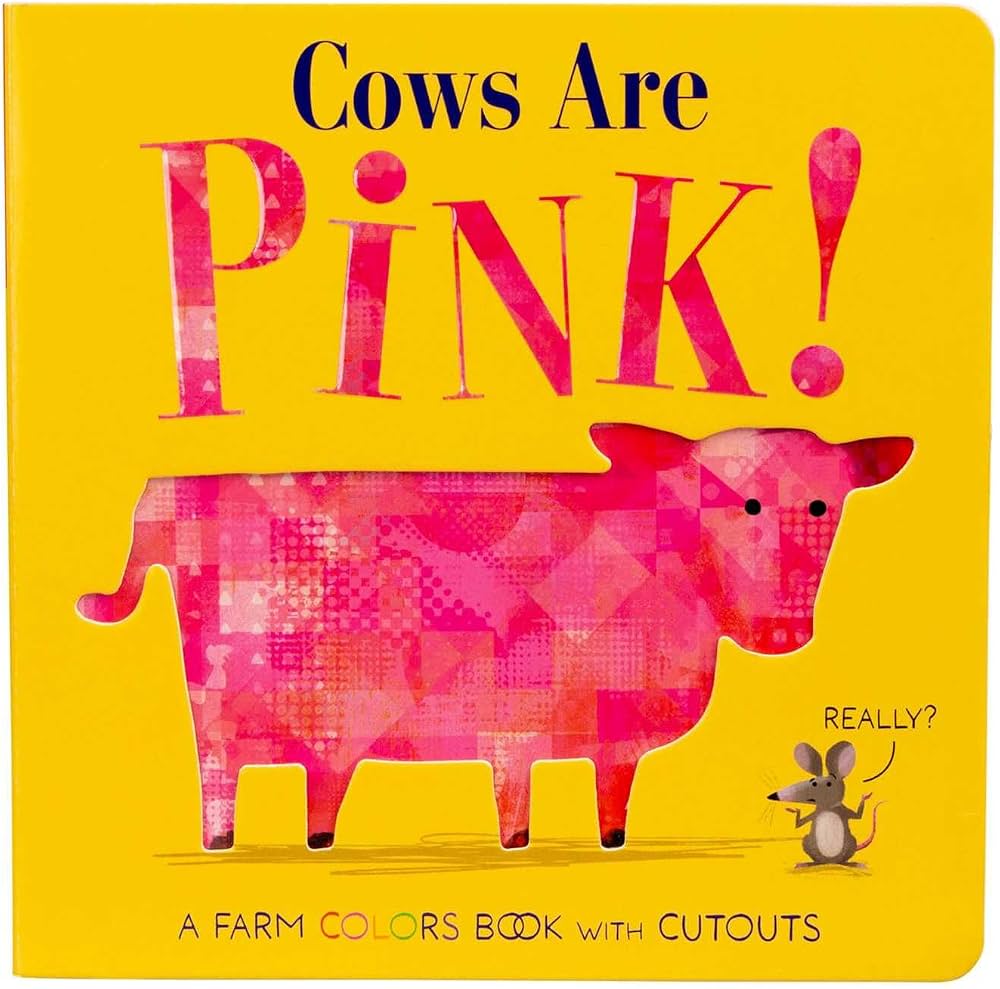
By Becky Davies, Cows Are Pink (Silver Dolphin Books, 2025) is a clever interactive board book in which cows are pink, sheep red, and cats green – but turning the cut-out pages can restore the right colors to the farm. For ages 1-3.
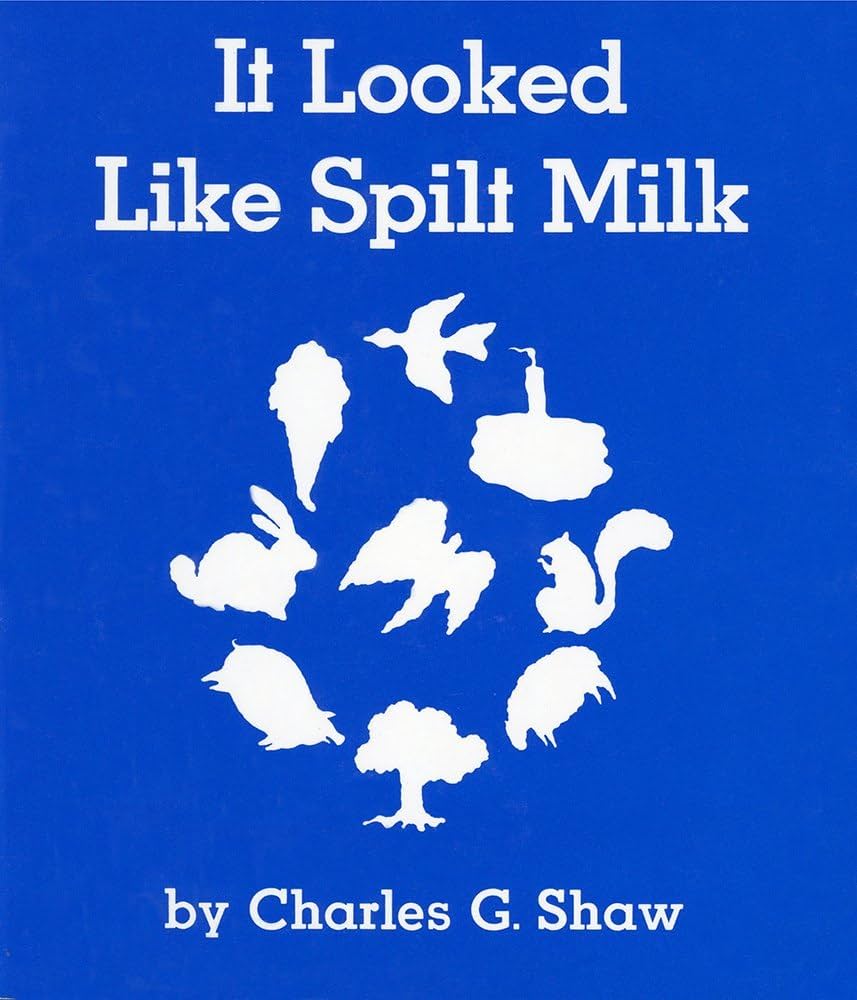
By Charles Shaw, It Looked Like Spilt Milk (HarperCollins, 1988) is a classic guessing game of white shapes on a blue background. (“Sometimes it looked like spilt milk. But it wasn’t spilt milk.”) An exercise in imagination for ages 2-6.

Nina Laden’s witty When Pigasso Met Mootisse (Chronicle Books, 1998) pictures artist Pablo Picasso as a beret-wearing pig and Henri Matisse as a bright-red bull. The artistic pair move into neighboring country houses, which they transform into works of art – but gradually their friendship falls apart as they criticize each other’s styles. (“You paint like a two-year-old!” “You paint like a wild beast!”) Eventually, however, they solve their differences by painting a pair of masterpieces on either side of their dividing fence. For ages 4-9.

Doris Kutschbach’s The Blue Rider: The Yellow Cow Sees the World in Blue (Prestel, 1997), one of the Adventures in Art series, is the beautifully designed story of a group of innovative painters collectively known as the Blue Riders – among them Wassily Kandinsky and Paul Klee – who turned the art world upside-down with their creative uses of form and color. Illustrated with brilliantly colored art reproductions and photos of the artists at work. Check out the yellow cow. For ages 8-12.
Try your hand at the Andy Warhol Cow Wallpaper Game.
From DLTK, Paper Plate Cow Craft has instructions and a template for making a cool cow mask on a stick.
At 
From Busy Bee, Cow Crafts for Kids has a nice assortment of projects, among them a clothespin calf, a talking cow card, and a cut-and-paste picture of a lush green field filled with thumbprint cows.

We all know about sock monkeys – so why not a sock cow? Learn to make an adorable one at 

CowParade is a public art exhibit (possibly the world’s largest) in which fiberglass sculptures of cows are decorated by artists and displayed in public places.

For a cow drawing project for early-elementary kids, see Deep Space Sparkle’s How to Draw a Cow.
Cow Poems

The National Geographic Book of Animal Poetry (National Geographic Children’s Books, 2012), compiled by J. Patrick Lewis, is a collection of 200 animal-themed poems paired with stunning full-page color photographs. Among the poems: “The Cow” by Robert Louis Stevenson. A gorgeous book for ages 4 and up.

Robert Louis Stevenson’s poem “The Cow” can also be found in A Child’s Garden of Verses (Simon & Schuster, 1999) or online here.
Gelett Burgess is best known for the immortal four-line poem “I Never Saw a Purple Cow.” This website has a great biography of Burgess (including an account of the fatal Cogswell Fountain Incident), the text of “Purple Cow,” and a list of Burgess’s publications.
For more on Burgess’s Purple Cow, a lot of purple cow parodies, and a poetry challenge, see 

Susan Hawthorne’s Cow (Spinifex Press, 2011) is a fascinating poetry collection in which Queenie, leader of the herd, guides readers through mythology, philosophy, history, and language. For teens and adults.
Cows and Math

In Woody Jackson’s Counting Cows (Harcourt, 1995), illustrated with gorgeous black-and-white cows and electric-colored watercolor landscapes, readers count backwards from ten cows to zero – and then wind up with a barn dance. For ages 1-4.
From Cool Math Games, Find the Cow and
Mooo! are collections of clever and varied interactive puzzles, all involving problem-solving and cows.
For math students who like a challenge, Newton’s Cows is a deceptively simple-sounding problem (originally attributed to Sir Isaac Newton) about the amount grass eaten by cows. There’s an accompanying step-by-step explanation of the solution.

Ian Stewart’s Cows in the Maze and Other Mathematical Explorations (Oxford University Press, 2010) is a chatty collection of creative mathematical puzzles and recreations. Readers learn about time travel, sphericons, cat’s cradle, probability in the courtroom, and cows, lost in a maze. For teenagers and adults.
In this Cats, Cows, and Pigs puzzle, a farmer has nine animal pens arranged in three rows of three. Each pen must contain a cat, a pig, or a cow – but no row or column can contain two of the same animal. It’s a sort of Sudoku puzzle for kids, with cows.
Argh! Check out Archimedes' Cattle Puzzle at https://physics.weber.edu/carroll/archimedes/numbers.htm.
And What About the Bulls?

By Munro Leaf, The Story of Ferdinand (Viking Juvenile, 2011) is the classic tale of the peaceful bull who wanted only to sit under a cork tree, smelling the flowers. Then he’s stung by a bee just as recruiters arrive from Madrid to choose the biggest, fiercest bull for the bullfights. For ages 3-8.

Ferdinand’s story is also available in Latin. Check out Ferdinandus Taurus (David R. Godine, 2000).
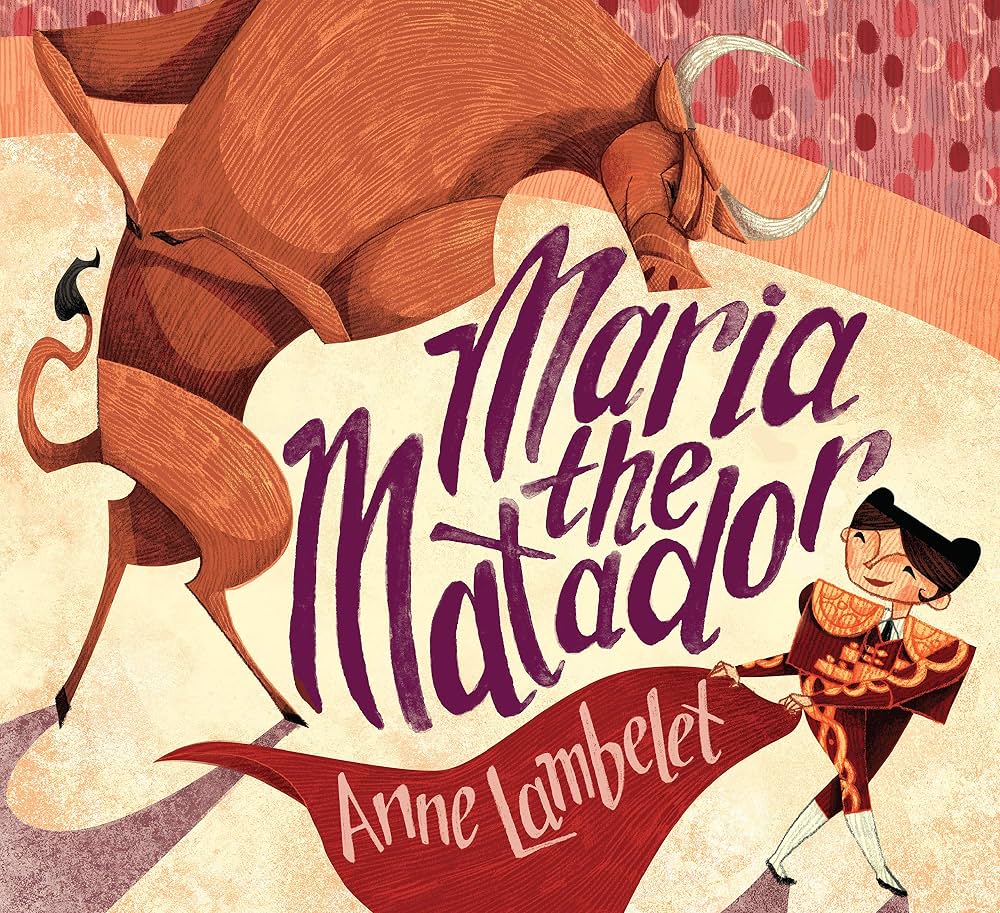
In Anne Lambelet’s Maria the Matador (Page Street Kids, 2019), a prize of a lifetime supply of churros is offered to the matador who can stay in the ring with the bull the longest. Maria is no matador – but she loves churros and has a knack for thinking outside the box. For ages 4-7.
Make your own yummy churros! See https://www.allrecipes.com/recipe/24700/churros/.

Aaron Zenz’s picture book Hug a Bull: An Ode to Animal Dads (Walker Children’s Books, 2013) introduces kids to the names of 27 different animal dads. (For 27 animal moms, see the companion book I Love Ewe.) For ages 3-6.
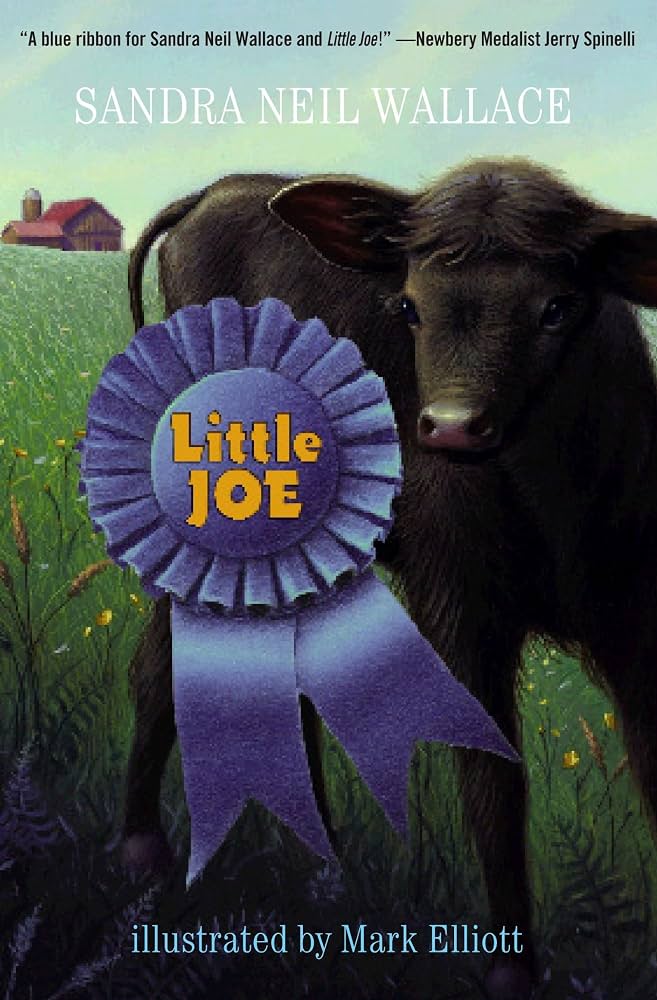
In Sandra Neil Wallace’s Little Joe (Knopf Books for Young Readers, 2010), nine-year-old Eli is given a calf of his own to raise. (But don’t bother naming him, Eli’s father warns, because he’s just going to be eaten.) Even so, Eli names him Little Joe – and, after Joe wins the blue ribbon as best bull at the county cattle show, Eli’s grandfather buys him to save him from the butcher. It’s a great story of old-fashioned farm life, the difficulties of family relationships, and the struggles that come with growing up. For ages 9-12.
You might pair thiswith Robert Newton Peck's A Day No Pigs Would Die (Laurel Leaf, 1994).

In Maia Wojciechowska’s Newbery-winning Shadow of a Bull (Aladdin, 2007), eleven-year-old Manolo’s father, a world-famous bullfighter, died when he was three. Everyone has always expected Manolo to follow in his father’s footsteps – but Manolo wants to pursue his own path. A wonderful story of courage and friendship. For ages 9 and up.

In Suzanne Morgan Williams’s Bull Rider (Margaret K. McElderry Books, 2010), 14-year-old Cam O’Mara isn’t much interested in the family sport of bull-riding – he’s a skateboarder – until his older brother Ben comes home from Iraq with a brain injury. If Cam can only ride the champion bull Ugly for just eight seconds, the prize money will make all the difference in the world to Ben. For ages 12 and up.

Mary Renault’s The King Must Die (Vintage, 1988) is an historical retelling of the story of Theseus. Here the young Theseus discovers the identity of his father and joins the fourteen young men and women sent as tribute to King Minos of Crete, where all are trained to become bull-dancers – vaulting over the horns of bulls. (Bulls! It's not clear why this edition has a horse on the cover.) The story continues in The Bull from the Sea (Vintage, 2001). Terrific reads for older teens and adults, these are compellingly told using a wealth of research into the history, archaeology, and culture of the time.