
Math II
In this collection
- Math War!
- Not Just Your Ordinary Books About Math
- The Lure of Really Big Numbers
- Hands-on Math
- Math Tools
- Math Lessons
- Graphs
- Probability and Statistics
- Math and Fiction
- Math and Art
- Math and Cooking
- Math in the Movies and on TV
- Mathematical Poetry
- Famous Mathematicians
- Math and Sports
- Compete?
- Or What About a Field Trip?
Math War!
What to teach? How to teach? How much to teach? Does everybody need higher math? Opposing theories about this last have led to what is now known as the “math war.”

Nicholson Baker’s “Wrong Answer: The Case Against Algebra II” appeared in the September 2013 issue of Harper’s Magazine. Baker argues that higher math in the form of Algebra II is a major cause of school drop-outs; and that most people, for most professions, don't need it anyway. See the essay at the Harper’s Magazine website.
From the New York Times, professor Andrew Hacker’s Is Algebra Necessary? argues that for many of us, it isn’t.

Paul Lockhart’s A Mathematician’s Lament (Bellevue Literary Press, 2009) is just 140 pages long but it’s a powerful critique of math education as currently practiced. Lockhart writes, “Students learn that mathematics is not something you do, but something that is done to you. Emphasis is placed on sitting still, filling out worksheets, and following directions.” Instead, math should involve exploration, imagination, and creativity. For teens, adults, and concerned parents.
See Dan Meyer’s TED Talk, Math Class Needs a Makeover.

By John Allen Paulos, Innumeracy: Mathematical Illiteracy and Its Consequences (Hill and Wang, 2001) is invaluable. Paulos explains, fascinatingly, just why a basic grasp of math – notably a familiarity with probability and statistics – is essential for making reasonable decisions about the world we live in. By the same author, see A Mathematician Reads the Newspaper and Once Upon a Number. For teenagers and adults.
From the Common Core State Standards (CCSS) Initative, Standards for Mathematical Practice lists and explains them the recently adopted national math standards.
The Best Evidence Encyclopedia, created by the Johns Hopkins University School of Education, rates curricula and teaching approaches in math, reading, and science for elementary, middle, and high school students. Find out what the research says works. Useful for parents and educators. (Best approach for elementary-level math: peer tutoring.)
According to the What Works Clearinghouse (Institute of Education Sciences), here’s what works in terms of math curricula.
There are hundreds - thousands - of math books, math programs, and math curricula - but remember sometimes what's most effective in terms of promoting mathematical thinking doesn't look much like conventional math at all. Let the kids do puzzles and teach them to play chess.
Not Just Your Ordinary Books About Math

In Mitsumasa Anno’s Anno’s Magic Seeds (Puffin, 1999), Jack meets a wizard who gives him two golden seeds, telling him to plant one and eat the other (“You will not be hungry again for a whole year”). Jack does, and the seed grows into a lovely blue-flowered plant that produces two seeds. Eventually Jack decides to eat something different for a change, and this time plants both seeds, getting two plants and a harvest of four seeds. This time he eats one and plants three – and things rapidly multiply, becoming more and more complicated. For ages 4 and up.

By Masaichiro Anno and Mitsumasa Anno, Anno’s Mysterious Multiplying Jar (Penguin Putnam, 1999) is a wonderful introduction to the concept of factorials through the medium of a blue-and-white Oriental jar. The jar, opened, contains an ocean in which there are two islands. Each island has two countries; each country has three mountains; on each mountain, there are four walled kingdoms; and so on. A gorgeous multiplication problem ending up with a phenomenal number of jars. For ages 4 and up.

By Robert E. Wells, Can You Count to a Googol? (Albert Whitman & Company, 2000) is a counting book by tens (beginning with one banana, balanced on a nose) and moving up through 1000 (scoops of ice cream), 100,000 (marshamallows), and so on, ending with an explanation of the googol (a 1 with 100 zeroes after it) and how it was named by a nine-year-old boy. A googol, Wells points out, is much too enormous to illustrate (“If you counted every grain of sand on all the worlds’ beaches and every drop of water in all the oceans, that wouldn’t even be CLOSE…”). For ages 6-9.

Emily Gravett’s The Rabbit Problem (Simon & Schuster, 2010) is a delightful month-by-month take on the Fibonacci series – which is named for the mathematician who first described it in the 13th century, while solving a problem about multiplying rabbits. First there’s one lonely rabbit (an invitation stuck to the page reads “Join me”); subsequent months feature baby rabbit record books, rabbit newspapers, carrot recipes, and – by November – wildly overcrowded rabbits. For ages 6-11.

Theoni Pappas is the inventor of Penrose the Mathematical Cat, featured in The Adventures of Penrose the Mathematical Cat (World Wide Publishing/Tetra, 1997) and Fractals, Googols, and Other Mathematical Tales (1993). Each is a collection of mathematical stories in which Penrose variously explores pancake world, meets a fractal dragon and a Fibonacci rabbit, discovers the golden rectangle and the world of Tangrams, visits the planet Dodeka, and more. Friendly introductions to interesting math concepts for ages 7-11.

Laura Overdeck’s How Many Guinea Pigs Can Fit on a Plane? (Feiwel and Friends, 2017) includes such irresistible math questions as: How many bees does it take to make a jar of honey? How many soccer balls would fit inside a hollow Earth? For ages 7-11.

Author Cindy Neuschwander introduces kids to geometry through the adventures of gallant Sir Cumference, his wife, Lady Di of Ameter, their son, Prince Radius, and a cast of supporting characters. Titles in the series include Sir Cumference and the First Round Table (Charlesbridge, 1994), Sir Cumference and the Dragon of Pi (1999), and Sir Cumference and the Great Knight of Angleland (2001). For ages 8-12.

Cynthia Zaslavsky’s Number Sense and Nonsense (Chicago Review Press, 2001) is subtitled “Building Math Creativity and Confidence Through Number Play” – which it attempts to do by encouraging kids to fool around with number games and puzzles. Chapter titles include “Odds and Evens,” “Prime and Not Prime,” “Zero – Is It Something? Is It Nothing?” “Money, Measures, and Other Matters,” “Counting: Fingers, Words, Sticks, Strings, and Symbols,” and “The Calculator and Number Sense.” Figure out how many of what arrive over the Twelve Days of Christmas, solve the problem of the King’s Chessboard, play a Liberian stone game, and much more. For ages 8 and up.

Johnny Ball’s award-winning Go Figure! (Dorling Kindersley, 2005) is subtitled “a totally cool book about numbers,” and it is just that. Illustrated with great color photos, charts, and diagrams, the book covers the origins of counting, “magic numbers” (such as Fibonacci numbers, the golden ratio, pi, and Pascal’s triangle), geometry (including polyhedra, buckyballs, cones and curves, and symmetry), and “The World of Math” (including probability, chaos theory, and fractals). Challenging puzzles and questions and a great read for ages 8-12.

Simon Basher’s Math: A Book You Can Count On (Kingfisher, 2010) – in classic snarky Basher fashion – personifies mathematical concepts as first-person entities, each with its own Japanese-style cartoon character. For example, here's Subtract: “People often think I’m gloomy. Okay, I admit it, I’m the exact opposite of Add, that bubbly ball of smirking positivity.” Learn all about Zero, Line, Quadrilateral, Ratio, and X. And more. For ages 9-14.

In Sean Connolly’s The Book of Perfectly Perilous Math (Workman, 2012), kids tackle problems like: “How many months would it take a single vampire to completely take over a town of 500,000 people?” For ages 9-15.

Math Trek by mathematician Ivars Peterson and Nancy Henderson (John Wiley & Sons, 1999) is a terrific interactive math book in ten short chapters, organized as an “amusement park” of mathematical concepts. Entry into the park – Chapter 1 – is through the Knot Zone; to get in, you have to figure out which of the knots that locks the gate is NOT a KNOT. Kids then experiment with knots (and non-knots) by duplicating patterns with string, find out how to make a trefoil knot (the simplest of mathematical knots) and a Jacob’s ladder knot (an impressive-looking non-knot) and learn a good deal about knot theory, its uses, and its history. At the Crazy Roller Coaster – it’s a Mobius strip – kids make Mobius strip models, learn about topology, and see some interesting examples of topological artwork. In other chapters, they learn about fractals and make fractal snowflakes, experiment with “weird dice,” build a chaos machine, learn to decode a binary secret message, and much more. Included are a glossary and a supplementary reading list. For ages 9 and up.

Glory St. John’s How to Count Like a Martian (Random House, 1975) begins with mysterious beeps from Mars – which might just be numbers. The book then covers a range of number systems, among them those of the Egyptians, Babylonians, Mayans, Greeks, Chinese, and Hindus, plus abaci and computers. Out of print; check your local library. For ages 9-12.
Available online at https://archive.org/details/howtocountlikema00stjo.

Actress Danica McKellar is also a math whiz, and is now known not only for movies and TV, but for educational advocacy, especially when it comes to girls and math. Titles of her informative, friendly, and funny books include Math Doesn’t Suck: How to Survive Middle School Math (Plume, 2008), Kiss My Math: Showing Pre-Algebra Who’s Boss (Plume, 2009), Hot X: Algebra Exposed (Plume, 2011), and Girls Get Curves: Geometry Takes Shape (Hudson Street Press, 2012). Readers learn math using friendship bracelets, shoes, shopping, pizza, and cute boys. And anyway, who can resist chapter titles like “How to Entertain Yourself While Babysitting a Devil Child” and “Creative Uses for Bubblegum”? For ages 11 and up.

Clifford A. Pickover’s The Math Book (Sterling, 2012) is a fascinating chronological history of mathematics “From Pythagoras to the 57th Dimension” in 250 double-page spreads, each illustrated with great color photographs. Actually it starts well before Pythagoras: the first entry, “Ant Odometer,” is dated 150 million BC. Other entries include Zeno’s Paradox, Archimedes’s Spiral, Franklin’s Magic Squares, Turing Machines, Rubik’s Cube, and Fractals. Something for everybody.

Derrick Niederman’s Number Freak (Perigee, 2009) runs from 1 to 200, listing interesting facts and background information about each number. For example, at 23, you find out about the birthday paradox; at 46, you learn that there are 46 peaks in the Adirondack Mountains and that a “46-er” is someone who has climbed them all; and at 85, you find that there are just 85 ways in which to knot a necktie. For teenagers and adults.

By Alexander Humez, Zero to Lazy Eight (Touchstone, 1994) is an information-packed collection of essays, variously on zero, the numbers 1 to 13, and infinity. Readers learn about everything from numerical word origins to the mathematics of ciphers, bell-ringing, and dice games. Find out why we say “three sheets to the wind” and “dressed to the nines.” For teenagers and adults.

When it comes to communicating complex concepts, analogies are often the way to go, and Joel Levy’s A Bee in a Cathedral and 99 Other Scientific Analogies (Firefly Books, 2011) is crammed with nothing but. The book is divided into seven graphically creative sections, variously covering physics, chemistry, biology, astronomy, earth science, the human body, and technology. For example, if an atom were the size of a cathedral, its nucleus would be the size of a bee. For teenagers and adults.
Mathematician Keith Devlin teaches the online Introduction to Mathematical Thinking course at Coursera. School math typically concentrates on learning procedures to solve stereotyped problems; real mathematical thinking, however, means thinking outside the box. For older students. See https://www.coursera.org/learn/mathematical-thinking.

By autistic savant Daniel Tammet (author of Born on a Blue Day), Thinking in Numbers (Little, Brown, 2013) is a collection of 25 essays about seeing the world through numbers, with anecdotes and examples that range from haiku to chess, snowflakes, and Omar Khayyam’s calendar. Recommended for both math-loving and totally math-phobic teenagers and adults.

Jennifer Ouellette’s The Calculus Diaries (Penguin Books, 2010), subtitled “How Math Can Help You Lose Weight, Win in Vegas, and Survive a Zombie Apocalypse,” is a truly reader-friendly account of applying calculus to everyday life by a self-described math-phobic. Crammed with intriguing anecdotes and examples, from Disneyland’s spinning tea cups to speedometers, the Black Death, tulipomania, and the housing bubble. For teenagers and adults.

Larry Gonick’s 230+-page The Cartoon Guide to Calculus (William Morrow, 2011) covers all the basics with wonderful little cartoon illustrations and a sense of humor. Delightful, which is something I never thought I’d hear myself say about calculus. Chapter titles include “Speed, Velocity, Change,” “Meet the Functions,” “Limits,” “The Derivative,” and “Introducing Integration.” For all students of calculus.
Also by Gonick, see The Cartoon Guide to Geometry (2024).
The Lure of Really Big Numbers

Andrew Clements’s picture-book A Million Dots (Simon & Schuster Children’s Publishing, 2006) indeed contains one million dots, along with a lot of catchy factoids to help readers visualize enormous numerical quantities. Readers learn, for example, that there are 525,600 minutes from one birthday to the next and that when the cow jumped over the moon, she soared upward 238,857 miles. For ages 4-8.

In David Birch’s picture book The King’s Chessboard (Puffin, 1993), rice is used to teach simultaneous lessons in morals and the mathematics of big numbers. A proud and pushy king insists on giving his counselor, who doesn’t want it, a reward; the pestered counselor finally asks for a grain of rice, the amount to be doubled each day for as many days as there are squares (64) on the king’s chessboard. The king thinks this is a fine joke and sends one grain, then two, then four – but as the days pass and the doubling continues, soon amounting to humongous quantities of rice, he realizes that he has made a fatal mistake.

In Demi’s version of the story, One Grain of Rice: A Mathematical Folktale (Scholastic, 1997), gorgeously illustrated with touches of gold, young Rani outsmarts a selfish raja and saves her hungry village with her rice-and-chessboard request. Here the rice is delivered by animals: birds, leopards, tigers, a goat pulling a cart, and – impressively, on day 30 – a fold-out page of 256 rice-toting elephants.

David A. Adler's Millions, Billions, & Trillions (Holiday, 2014) introduces big numbers with lots of cool examples. (A quarter cup of sugar contains about 1 million sugar granules.) For ages 6-9.

Big Numbers by Mary and John Gribbin (Wizard Books, 2005), subtitled “A Mind-Expanding Trip to Infinity and Back,” traces the history of big numbers and shows how big numbers are used in a range of scientific disciplines, such as astronomy, biology, and geology. For ages 9-12.

Megan Watzke and Kimberly Arcand’s Magnitude: The Scale of the Universe (Black Dog & Leventhal, 2017) includes comparisons of distance, area, volume, mass, and speed. A fascinating journey through big and small numbers. For ages 12 and up.

Caleb Scharf’s The Zoomable Universe (Scientific American, 2017) is an epic tour from the limits of the observable universe to the inside of the atom, packed with photos and infographics. For ages 12 and up.

David J. Smith’s iF... (Kids Can Press, 2014), subtitled “A Mind-Bending New Way of Looking at Big Ideas and Numbers,” is a terrific overview of measurement. Smith has come up with clever ways of scaling large numbers and concepts down to readily graspable form. (If the Milky Way Galaxy were the size of a dinner plate, our solar system would be smaller than a speck of dust.) Fascinating for all.

The Megapenny Project demonstrates big numbers with stacks of pennies, from a piddling pile of sixteen to a foot-square cube of 50,000 to a towering structure of a million and more.

Powers of Ten: About the Relative Size of Things in the Universe is a film by Charles and Ray Eames in which viewers journey from the outer limits of the universe to the subatomic quark in 42 ten-fold steps. It’s a wonderful progression in color photographs, beginning with two picnickers in a park and moving outward through city, continent, planet, solar system, and galaxy; then inward through skin, cells, DNA, atoms, and subatomic particles. Fascinating for all ages.
A Question of Scale is a clickable illustrated tour of the universe (“from quarks to quasars”) in powers of ten.
Cosmic View, based on Kees Boeke’s classic 1957 books, travels to the ends of the universe and to the innards of the atom, beginning with a little girl with a cat on her lap. Includes detailed explanations. (Click on Powers of Ten.)
The View From the Back of the Envelope is a creative and multifaceted website on big numbers, featuring – among much else – a page displaying a million dots; a big-number Pinocchio estimation game; a guide for scaling the universe to a desktop; explanations of exponential notation; a list of “Powers of Ten” scales; and a demonstration of the scope of big numbers using grains of salt.

The Stan’s Café Theatre Company’s installation exhibit Of All the People in All the World uses piles of rice to represent a host of human statistics. One person is represented by one grain of rice; the entire population of the world – that is, some six and a half billion grains of rice - by a 104-ton rice mountain. Other piles of rice variously represent the population of the United States, the number of Americans who are millionaires, the number of people worldwide who play the computer game “World of Warcraft,” the number of people killed in the Holocaust, the number of people in an average year who go on a pilgrimage to Mecca. (And much more.) A fascinating exercise in statistics, a startling social commentary, and a powerful demonstration of big (and small) numbers. See https://en.wikipedia.org/wiki/Of_All_the_People_in_All_the_World

How to even think about something as big as infinity? Kate Hosford's Infinity and Me (Carolrhoda, 2012) is a fascinating and thoughtful approach to the incredibly large. For ages 5-10.
Hands-on Math

From UC Berkeley’s Lawrence Hall of Science, Family Math, by Jean Stenmark, Virginia Thompson, and Ruth Cossey (Equals Series), promotes math as an enriching whole-family activity. This 300+-page information and activity collection promotes understanding of basic arithmetic, logical thinking, probability and statistics, geometry, measurement, and calculator math. The book also contains reproducible game boards, hundred charts, graph paper, and a fill-in-the-blank calendar. Great for a range of ages.
Also see the sequel, Family Math II, for ages 5-12.

In the same series, Family Math for Young Children (Grace Coates and Jean Stenmark; Lawrence Hall of Science, 1997) is a creative investigative approach to early math, concentrating on such skills as counting, estimating, comparing, measuring, shape recognition, directions, logic, and sorting. Sample activities include making jigsaw puzzles, making (and sorting) a stamp collection, making and playing number games, playing shadow games, measuring yourself (and family and friends) with adding machine tape, and designing a quilt patch. All instructions, game boards, matching cards, and number charts are included in the book. For each activity, there’s an explanation of the math skills involved, a materials list, and complete instructions. For ages 3-7.

Family Math: The Middle School Years (Lawrence Hall of Science, 1998) concentrates on activities intended to inculcate algebraic thinking and number sense. Kids explore simultaneous equations with a game of Flowerpots; study area and perimeter with pentominoes and polyominoes; learn a series of clever tricks for quick mental arithmetic; study fraction/decimal equivalents with a game of Towers; tackle greatest common divisors with the Game of Euclid; and fool around with fraction calculators. Game boards and patterns are included in the text; there is also a list of additional family math resources and a description of the math concepts ordinarily covered in the middle school. For ages 10-14.

By James Overholt and Laurie Kincheloe, Math Wise! (Jossey-Bass, 2010) is a collection of over 100 hands-on activities designed to promote “real math understanding.” For example, kids make toothpick storybooks and "everyday things" number books, experiment with paper plate fractions, and make flexagons, sugar-cube buildings, and paper airplanes. For ages 5-13.

In similar format, see Judith Muschla and Gary Robert Muschla’s Hands-On Math Projects with Real-Life Applications (Jossey-Bass, 2009) for ages 7-10; and Joyce Stugis-Blalock’s Math Projects (Mark Twain Media, 2011) for ages 10 and up.

Marilyn Burns’s dynamic duo, The I Hate Mathematics Book (Cambridge University Press, 1987) and Math for Smarty Pants (Little, Brown, 1982) are wonderful 120+-page illustrated collections of math puzzles, games, and experiments designed to show kids that math – rather than a series of rote exercises – is an inventive way of thinking. Determine how close you can get to a pigeon, take a shoelace survey, make a topological map of your house, make sidewalk chalk shapes that can be drawn without lifting the chalk from the sidewalk or retracing any line. Highly recommended for ages 8 and up.

Amazing Math Projects You Can Build Yourself by Laszlo C. Bardos (Nomad Press, 2010) is arranged in four sections - Numbers & Counting; Angles, Curves, and Paths; Shapes; and Patterns – each of which features hands-on projects with instructions and templates, activities, interesting information in text and sidebars, and new word definitions in boxes. Readers learn, for example, about Fibonacci rabbits, four-color maps, and Koch snowflakes, and discover that a potato chip is in the shape of a hyperbolic paraboloid. The projects are cool. For ages 9 and up.

Claudia Zaslavsky’s Math Games and Activities from Around the World (Chicago Review Press, 1998) is a 160-page collection of multicultural math games, puzzles, and projects arranged by game category. Chapters include “Three-In-a-Row Games,” “Games of Chance,” “Puzzles with Numbers,” “Geometry All Around Us,” and “Repeating Patterns.” Kids can play 9 Men’s Morris or Mankala, experiment with hexagrams and Magic Squares, make Pennsylvania Dutch love patterns and Japanese Mon-Kiri cut-outs, and much more. Included for each game or project are background information, instructions, and “Things to Think About.” For ages 9 and up.

Mark Wahl’s A Mathematical Mystery Tour (Prufrock Press, 2008) is an interactive exploration of numbers in nature and art. For example, discover Fibonacci numbers in pinecones, daisies, and pineapples; learn about spiral galaxies and Plato’s polyhedra; and study geometry while building a model of the Great Pyramid. For ages 11 and up.

Anders Mann Hanson’s Cool Arts with Math and Science series (Checkerboard Publishing) has creative mathematical projects and activities with photo-illustrated instructions. Titles include Cool Paper Folding; Cool Structures; Cool Optical Illusions; Cool Tessellations; Cool Flexagon Art; and more.

In Robert J. Lang’s Origami in Action: Paper Toys That Fly, Flap, Gobble, and Inflate (Martin’s Griffin, 1997), math/origami expert Robert Lang has instructions for everything from a flapping butterfly to (our favorite) a blow-up bunny.

Hands-On Equations is an algebra program that uses fat red and green number cubes (representing positive and negative numbers), colored pawns (positive and negative unknowns), and a balance scale (printed and laminated) to teach kids how to set up and solve algebraic equations. Fun and clever for ages 8 and up.
TOPScience sells multi-lesson modules of coordinated hands-on learning activities for grades 3-10 – and these are extraordinarily clever in that they do a lot with truly simply materials such as pennies, tape, clothespins, and paper clips. Click on “Math and Measurement” for math-oriented units for a range of ages. Highly recommended.
Hands-On Math Activities is a collection of printable games and projects, categorized under Numbers and Operations, Geometry, Problem Solving, Data Management and Analysis, and Measurement. For example, kids make and play pentominoes, experiment with geoboard sheets, build a Lego graph, and make and compare the capacities of paper cylinders. For ages 8-12.
MathFour is a website devoted to creative approaches to teaching math, including puzzles, projects, and suggestions. Also included is an extensive resource list. See http://mathfour.com/.
Patterns in Nature is a collection of cool interactive applets demonstrating math concepts. For example, find out how to compute pi by throwing darts at a dartboard and discover what ants in an anthill have to do with molecular motion.
Math Tools

The National Library of Virtual Manipulatives has a huge list of creative applets for preK-12, categorized under Numbers & Operations, Algebra, Geometry, Measurement, and Data Analysis & Probability. Anything you could possibly want, from pattern blocks and geoboards to fractal generators.
Math Playground has a lot of great online math manipulatives, among them a fraction scale, function machine, pattern blocks, geometry board, and spirograph.
From MathCats, A Math Toolbox for Every Home is a great resource, with instructions for making your own base ten blocks, Cuisenaire rods, pattern blocks, tangrams, multiplication grids, and more.
At Mathwire’s Math Manipulatives, make your own dominoes and hundred boards. Included are instructions for games, activities, and literature connections.
Learning Resources: Math is a good commercial source for math tools and manipulatives, such as base-ten and pattern blocks, Cuisenaire rods, geoboards, dice and spinners, and fraction games.
From the National Council of Teachers of Mathematics (NCTM), see Classroom Resources at https://www.nctm.org/classroomresources/ for resources and lesson plans, categorized by grade.
Johnnie's Math Page has an extensive collection of interactive online tools, games, and manipulatives, categorized by grade and topic (Number, Geometry, Multiplication, Fractions, Statistics, Probability, and Measurement). There’s also a category called Fun, where visitors can play Alien Addition, tackle the Towers of Hanoi puzzle, and experiment with origami. See https://www.jmathpage.com/wpjmp/start-fun/.
Edutopia’s 14 Virtual Tools for the Math Classroom includes free apps for base ten blocks, rulers, clocks, graph paper, geoboards, and more.

From Math is Fun, Math Tools and Calculators has many online calculators with which visitors can calculate percentages, convert units, create graphs, experiment with polyhedra, solve quadratic equations, change fractions to decimals, and more.
Wolfram Alpha aims to collect all objective data and to implement every known method to “compute whatever can be computed about anything.” Want to know how much paint it would take to cover the moon? Wolfram Alpha can tell you. A spectacular math tool.
Math Lessons

Miquon Math is a curriculum for grades 1-3 in six color-coded workbooks, developed in the 1960s by Lore Rasmussen of Pennsylvania’s Miquon School. These are designed to be used with
Cuisenaire rods and stress investigation, problem-solving skills, and creativity rather than rote drill.

By creative math educator Marilyn Burns, Writing in Math Class (Math Solutions, 1996) has many examples of how writing helps kids of all ages learn math. Many suggestions, among them keeping math journals, writing math autobiographies, and combining math with creative writing. Resources for ages 7 and up.

JUMP Math was designed by mathematician John Mighton (who almost flunked calculus in college), author of The Myth of Ability: Nurturing Mathematical Talent in Every Child (Walker & Company, 2004). JUMP, which stands for Junior Undiscovered Math Prodigies, is a comprehensive program that integrates games, puzzles, magic tricks, hands-on activities, and extensions. Check out the free samples at the website. For grades K-8.

Singapore Math, a comprehensive curriculum for grades K-12, progresses from the concrete to the pictorial to the abstract – that is, it emphasizes translating problems into concrete and/or visual images to help younger learners understand concepts. Excellent reviews.

Stanley Schmidt’s Life of Fred series offers a complete math curriculum from soup to nuts – or rather, from simple addition to Calculus, Statistics, and Linear Algebra. The books are set up in chapters, each telling a story about Fred, who teaches at KITTENS University. At the end of each story, kids grab a pencil and tackle a number of questions and challenges related to the story. Frequently these involve additional interesting tidbits and facts. The Fred approach is intended to be multifaceted and thought-provoking – the opposite, in other words, of the drill-and-ill approach so often found in school workbooks. Lightly disguised traditional math.

By Asa Kleiman, David Washington, and Marya Washington Tyler, It’s Alive! The Funniest Math Book Ever (Routledge, 2024) – written by a pair of young computer geeks and a math teacher – is a hoot, crammed with zany problems based on the kinds of quirky facts and gicky trivia that kids adore. For example, readers calculate the number of earthworms in a football field, the probability of being eaten by a salt-water crocodile, the amount of liquid in a giant squid eyeball, the travel rate of eyelash mites, and the storage capacity (in megabytes) of the human brain. There’s a helpful answer key at the back of the book. For ages 9-13.

Joan Marie Galat’s Solve This! (National Geographic, 2018) is a great collection of wild, wacky, and fun math challenges. (A vulture swoops down and snatches your sister’s teddy, then drops it on the far side of a raging river. What to do?) For ages 8-12.

By Harold R. Jacobs, Mathematics: A Human Endeavor (W.H. Freeman, 1994) is a ray of light in the grim gray field of textbooks. Math, Jacobs-style, is taught through puzzles, games, experiments, and enthralling real-life examples. Chapter 1, “Mathematical Ways of Thinking,” for example, plunges students into experiments with the behavior of billiard balls, the notorious four-color map problem, and the invention of the Soma cube puzzle. In later sections, readers learn about number sequences with the hexagrams of I Ching and Francis Bacon’s 17th-century diplomatic cipher; are introduced to coordinate graphing with the leaping speed of kangaroos; and learn about logarithms with the electromagnetic spectrum, the frets on a guitar, and the Richter scale. This is real math, and it’s great. Highly recommended for ages 13 and up.

The Great Courses are a wide range of classes, variously available on DVD, CD, or streami, for high-school- and college-level students. Among these is
The Joy of Thinking (subtitled “The Beauty and Power of Classical Mathematical Ideas”), a 24-lesson lecture series, jointly taught by professors Edward Burger of Williams College and Michael Starbird of the University of Texas at Austin, whose stated goal is to both introduce some of the truly creative and intriguing ideas behind mathematics and to show students how to develop effective thinking strategies. The result is a wide-ranging discussion of counting, geometry, and probability, using clear and easy-to-follow presentations and lots of catchy examples. There are forays, for example, into Fermat’s Last Theorem, Fibonacci numbers in pineapples, Mobius bands and Klein bottles, Turing machines and Dragon Curves, coin-flipping, coincidences, and the question of whether monkeys, randomly typing, could eventually produce Hamlet.

Suggested readings for The Joy of Thinking are taken from Burger and Starbird’s The Heart of Mathematics: An Invitation to Effective Thinking (Key College Publishing, 2000), a very readable and attractively designed text reminiscent of Harold Jacobs’s Mathematics: A Human Endeavor (W.H. Freeman, 1994). (See above.)
MathBits has a wealth of resources for math students, including tutorials on Java and C++ programming, projects and worksheets for the
Geometer’s Sketchpad, instructions for finding your way around a graphing calculator, downloadable graph paper (31 kinds), and many Math Caching games at a range of levels, in which kids must solve problems and submit answers in order to discover the next Internet “box.”
Mathcats is a multifaceted site that lets visitors experiment and explore. Try to solve a logic problem involving Sailor Cat, a goat, a wolf, and a cabbage; find out how old you are in seconds; play with architecture blocks; and use the Math Cats Balance to balance everything from electrons to galaxies. There are also dozen of interactive projects (for example, generate fractal snowflakes and geometric spider webs) and math-based crafts. Aimed at open-ended inquiry learning.
AAA Math is essentially a gigantic free online workbook, with practice exercises categorized alphabetically by topic from Addition, Algebra, Comparing, and Counting through Ratios, Statistics, and Subtraction.

IXL Math has a complete list of all the (hundreds of) skills required by the public schools at each grade level, with online practice problems and printable worksheets for each.
Free Math – which is free – has detailed lists of all the skills required in public-school math classes, categorized by grade, with associated practice exercises.

The National Council for Teachers of Mathematics (NCTM) website has lesson plans, activities, and resources for students from K-12. Heavy in educationese.

For online math classes for grades 3 and up, see Khan Academy. Khan Academy is a non-profit educational website created by Salman Khan (graduate of MIT and Harvard Business School) with the mission of providing a free, world-class education online to anyone, anywhere, anytime. Zillions of exercises, mini-lectures, and tutorials.
EdX provides free online courses from such colleges and universities as Harvard, MIT, and Stanford in a wide range of disciplines (among them, math).
Graphs

Edward Tufte’s stunning The Visual Display of Quantitative Information (Graphics Press, 2001) – despite its not-very-exciting title – is a classic on the art of presenting mathematical data in graphs, charts, and tables. The book is packed with terrific historical and modern illustrations, demonstrating the best (and worst) in graphics. For teenagers and adults.
At Kids’ Zone’s Create a Graph, visitors can select from five different types of graphs (line, bar, area, pie, and XY), enter data, label, preview, and print.
Graphing Activities is a collection of 18 projects targeted at elementary-level kids. For example, kids determine preferred car colors by counting cars in a parking lot and graphing the results, or research the most common size of a family or the most disliked vegetable.
Also see Lakeshore Learning for commercial hands-on graphing materials. For example, make bar graphs with tiny colored cars.
Teachnology’s Graphing Lesson Plans has a long list of activities and projects, plus printable graph paper and graphing worksheets. Sample lessons include All About Me Graphing, the Drawing Bugs Game, and Graphing Equations. For a range of ages.
From the Biology Corner, Measuring Lung Capacity is a hands-on science experiment that involves data collection and graphing. (You’ll need a ruler and a round balloon.) Included at the site are worksheets, instructions, and sample data.
Probability and Statistics

In Edward Einhorn’s A Very Improbable Story (Charlesbridge, 2008), Ethan wakes up one morning with a talking cat on his head – who absolutely refuses to move until Ethan wins a game of probability. Ethan then struggles with challenges involving socks, coins, cereal shapes, and marbles, gradually learning how best to judge odds and predict outcomes. (The cat’s name, incidentally, is Odds.) For ages 7-10.

Carla Mooney’s Big Data (Nomad, 2018) is a catchily designed explanation of what big data is, and how we store, manage, and analyze it. All about information in the digital world, with many activities for ages 10 and up.

Darrell Huff’s 144-page How to Lie With Statistics (W.W. Norton, 1993) is a funny, friendly, and informative overview of statistics and the way in which – if we’re not on the ball – they can fool us into drawing the wrong conclusions. Learn all about sampling and bias, deceptive averages, “gee-whiz” graphs, and more. Illustrated with vintage-style cartoons. For teenagers and up.

Larry Gonick’s The Cartoon Guide to Statistics (HarperPerennial, 1993) covers everything from data display and analysis to distribution, confidence intervals, hypothesis testing, and experimental design through the medium of clever (and highly intelligent) cartoons. For teenagers and adults.

Charles Wheelan’s Naked Statistics (W.W. Norton, 2014), subtitled “Stripping the Dread from Data,” is an overview of what makes numbers meaningful, dealing – in reader-friendly fashion – with such questions as “How does Netflix know what movies you like?” “What’s a batting average?” and “How useful is a GPA?” Various chapters cover correlation, basic probability, the importance of data, the Central Limit Theorem, polling, and regression analysis. For teenagers and adults.

TeacherVision’s Resources for Teachers has a selection of printables and lesson plans for probability and statistics studies. Lesson plan titles include Heads or Tails: Penny Math; Using Scatterplots; Range, Median, and Mode; Baseball Fun; and U.S. Immigration. For ages 7-12.

Check out the mathematics of Rock Paper Scissors at https://www.youtube.com/watch?v=wZVHFZXgfKU.
Up for a challenge? Try Rock, Paper, Scissors, Lizard, Spock.
From Science Buddies, Probability and Playing Cards has several probability projects and activities aimed at family groups, variously using playing cards, M&Ms, and dice.

Also see Scientific American’s Suited Science: What Are the Odds of Drawing That Card?
From Cut the Knot, Probability Problems has a detailed tutorial with definitions, explanations, and a long list of challenging problems. For older students.
See the Core Knowledge Math curriculum (grades K-5 and 6-8) at https://www.coreknowledge.org/mathematics/.
SUPER-GOOD GAMES


Everybody plays at once, which means that nobody has a chance to get bored, and the game is considerably more challenging than it first appears. It is appropriate for persons aged 5 through adult, and adults - believe me - have no advantages over younger players.

Chess might be the ideal teaching tool. It’s all about strategy and patterns, lines and angles, spatial analyses, weighing options and making decisions. Research shows it boosts academic achievement, but it’s also challenging and fun. Also Harry Potter played it.
Doubtless one reason that it’s so successful is that it’s self-empowering – players figure a lot of it out on their own – and it provides a range of intellectual benefits without overtly trying to do so. Recommended age for introducing chess to kids is around 8 or 9, but there are no hard and fast rules.
ChessKid
has a tutorial on playing chess targeted at kids; young players can also sign
up (safely) to play with others online.

Sudoku puzzles are applied logic puzzles, played on a 9x9 grid, with nothing more than a pencil (eraser also highly recommended) and brains. The puzzle grid is subdivided into nine 3x3 blocks or regions; the trick is to enter the numbers 1 through nine (with no repetition) in each horizontal row, vertical column, and block. (“Sudoku” or “su doku” means “numbers singly” in Japanese.) In each puzzle, a few number clues are present on the grid – these cannot be changed and players must work with and around them while solving the puzzle. Sudoku puzzles range in difficulty from the easy to the fiendish; and all are excellent and mind-expanding exercises in the art of logical thinking. (This isn’t arithmetic. It’s more like chess.)
There are many books of sudoku available, including some specifically for children – see, for example, Alastair Chisholm’s The Kids’ Book of Sudoku 1 (Simon & Schuster, 2005).
Web Sudoku offers zillions of puzzles – variously classified as easy, medium,
hard, and evil – that can be printed or played online. Also see Gamehouse
Sudoku, which has online puzzles
at five levels of difficulty.

In Proof (Evermade), an award-winning game of mental math for 2-6 players ages 9 and up, kids race to identify equations in a grid of number cards. Fast, fun, and easy - it's like Set, but with numbers. For ages 9-12.
See

Equate (Conceptual Math Media) is a board game for ages 8 and up. Basically, it’s Scrabble with addition, subtraction, multiplication, and division instead of spelling.
See
Coolmath4Kids, in bright flashy colors, has dozens of categorized math games, geometry/art projects, printable flash cards, dozens of online calculators, cool apps, and more.
Math Playground has dozens of online math games, variously involving numbers, logic, math manipulatives, and word problems, along with interactive projects, worksheets and flashcards, and more. Click on "Common Core Math" to find grade-by-grade games and challenges aligned to the Common Core.
PBSKids’ selection of Math Games includes dozens, among them Juggling George, Send in the Trolls, Star Swiper, Vegetable Planting, the Great Shape Race, and many more. Experiment.
Math and Fiction

A collaboration of author Jon Scieszka and artist Lane Smith, Math Curse (Viking, 1995) is clever, funny, and thought-provoking. The curse – laid on the hapless narrator by her math teacher, Mrs. Fibonacci – causes her to think of everything (everything, from getting dressed in the morning to lunchtime pizza to birthday cupcakes) as a math problem. For ages 7 and up.

In Pam Calvert’s The Multiplying Menace: The Revenge of Rumpelstiltskin (Charlesbridge, 2006), the crown prince Peter has turned ten and Rumpelstiltskin is back, demanding payment for all that straw he spun into gold. Furthermore, he’s armed with a multiplying stick that he uses to awful effect, making things disappear (by multiplying them by fractions) or making them awkwardly big (say, by multiplying noses by six). Luckily Peter solves the problem with a clever math trick. Also see the sequel, The Multiplying Menace Divides. For ages 7-10.
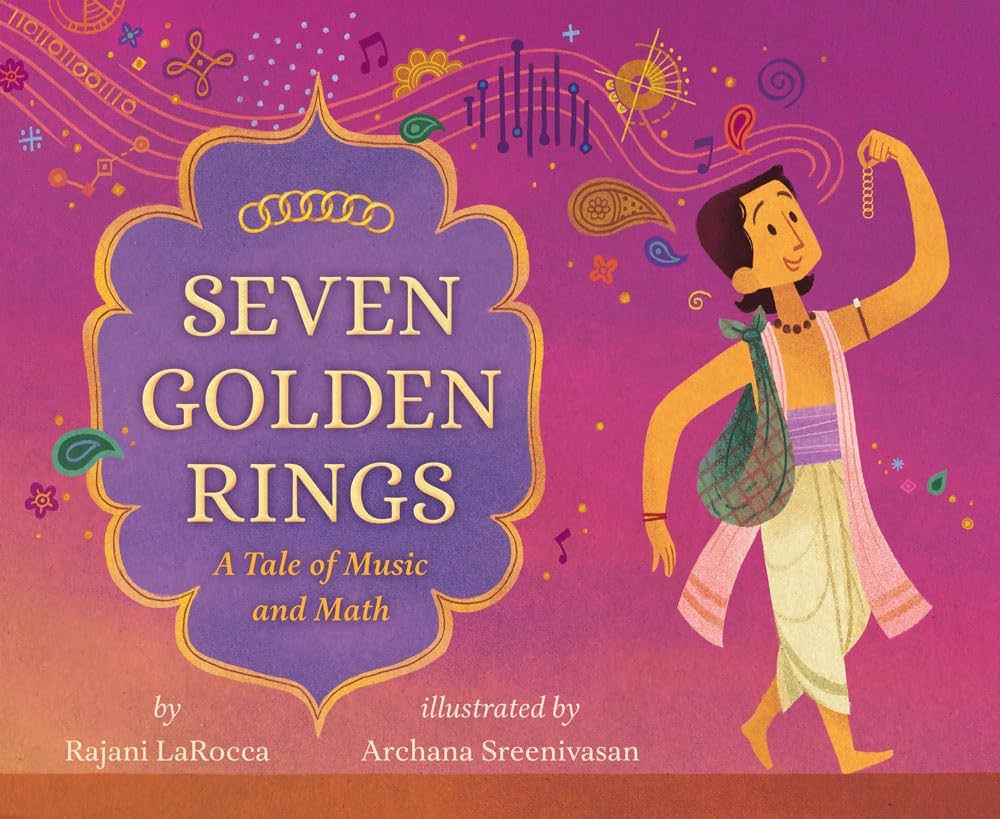
By Rajani LaRocca, Seven Golden Rings (Lee & Low, 2024), set in ancient India, is a tale of math and music as a young musician heads to the city with his family’s entire fortune – a single coin and a chain of seven golden rings. Ultimately it’s a clever lesson in binary numbers. (There’s a helpful Author’s Note at the end.) For ages 7-10.

In Edward Eager’s Half Magic (Houghton Mifflin Harcourt, 1999), Jane finds a magic talisman that grants just half of every wish. She and her siblings – Mark, Katherine, and Martha – find that this makes for some complications. A great read for ages 8-12.

In Norton Juster’s The Phantom Tollbooth (Bulleseye Books, 1988), Milo passes through the Phantom Tollbooth and ends up in a magical country where he sets out on a quest to find the sisters Rhyme and Reason, thus restoring peace to the warring kingdoms of Dictionopolis and Digitopolis. A wonderful cast of characters and a lot of brilliant play on words and numbers. A must-read for ages 8-12.

In The Number Devil by Hans Magnus Enzensberger (Metropolitan Books, 1997), Robert, twelve, loathes Mr. Bockel, his math teacher, who refuses to let him use his calculator and who afflicts him with word problems, such as: "If 2 pretzel makers can make 444 pretzels in 6 hours, how long does it take 5 pretzel makers to make 88 pretzels?” ("How dumb can you get?” said Robert.) Then one night Robert falls asleep and meets the Number Devil, a little bright red man the size of a grasshopper, dressed in knickers and carrying a silver-knobbed walking stick. The Devil, who has his own calculator (it’s slimy and green), introduces Robert - night by night - to the many fascinations of mathematics. Among these are the concept of infinity, "prima donna” numbers (those uppity primes that can only be divided by themselves and 1), repeating fractions, square roots, triangular numbers, Fibonacci numbers (and rabbits), factorials, topology, irrational numbers, and more. Humor, memory-sticking mathematical information, and a lot of terrific color illustrations for ages 10 and up.

Twelve-year-old Willow Chance of Holly Goldberg Sloan’s Counting by 7s (Dial, 2013) is a scientific genius who loves gardens, books, and the number 7, but doesn’t have much luck with her peers. Then her adoptive parents are killed in a car crash and she’s left completely on her own – except for new friends Mai and Quang-ha, who live with their mother, Pattie, who has a manicure business, in a garage; her disturbed school counselor Dell Duke, and Jairo Hernandez, a Mexican taxi driver. A great story, interspersed with counting by sevens, for ages 10 and up.

By the fictious Malba Tahan, The Man Who Counted (W.W. Norton & Company, 1993) is the Arabian-Nights-style tale of Beremiz Samir – a.k.a. the Man Who Counted – first encountered sitting on a rock by the side of the road, calling out mysterious and enormous numbers. The book, which purports to be Samir’s life story, is actually a series of puzzles: in one story, for example, Samir has to help three quarreling brothers settle their inheritance (35 camels, of which their father has left half to the oldest son, 1/3 to the middle son, and 1/9 to the youngest). In another, he has to determine the eye color of veiled concubines (the blue-eyed ones always lie and the brown-eyed ones always tell the truth). For ages 10 and up.
Read The Man Who Counted online here.

In Wendy Lichtman’s Do the Math: Secrets, Lies, and Algebra (Greenwillow Books, 2008), eighth-grader Tess sees the world in terms of math – in this case including tangles with friends, a school cheating scandal, and a mysterious death. Chapter titles are all math terms, such as “Inequalities,” “Graphs,” “Tangents,” and “The Quadratic Equation.” For ages 10-14.

Edwin Abbot’s classic Flatland (Dover Publications, 1992), originally written in 1884, is a clever satire set in a two-dimensional world, where the women are lines and the men, polygons. The narrator, a Square, then meets a Sphere and discovers the third dimension. Not only math, but a critique of rigid Victorian society. For teenagers and adults.
At Project Gutenberg, the complete text of Flatland is available online.

Flatland: The Movie (2007) is an excellent 34-minute animation, voiced by Martin Sheen, Kristen Bell, and Michael York.

For the bookish mathematician, Clifton Fadiman’s Fantasia Mathematica (Copernicus, 1997) is a collection of stories, poems, and excerpts all drawn from the “universe of mathematics.” Included, for example, are Robert Heinlein’s sci-fi short story “And He Built a Crooked House,” Martin Gardner’s “The Island of Five Colors,” George Gamow’s “An Infinity of Guests,” and poems by Vachel Lindsay, Edna St. Vincent Millay, and Carl Sandburg. For teenagers and adults.
Mathematical Fiction is a long (over a thousand entries) list of books and stories incorporating math and/or mathematicians. For each title, there’s a synopsis, examples of math features, and a list of similar titles.
Math and Art

Greg Tang’s Math-terpieces (Scholastic, 2003) combines art history and problem solving. Catchy rhymes propose mathematical puzzles based on paintings by 12 different artists, among them Degas, Monet, Renoir, Matisse, Picasso, Pollock, and Warhol. For ages 7-10.

Zachary Brewer’s Math Art (CreateSpace, 2010) isn’t art – it’s hands-on math; but it’s a plus for those who believe in learning by doing. For example, kids make paper clocks with moveable hands, money boards, addition collages, fraction flowers, and number charts. For ages 6-9.
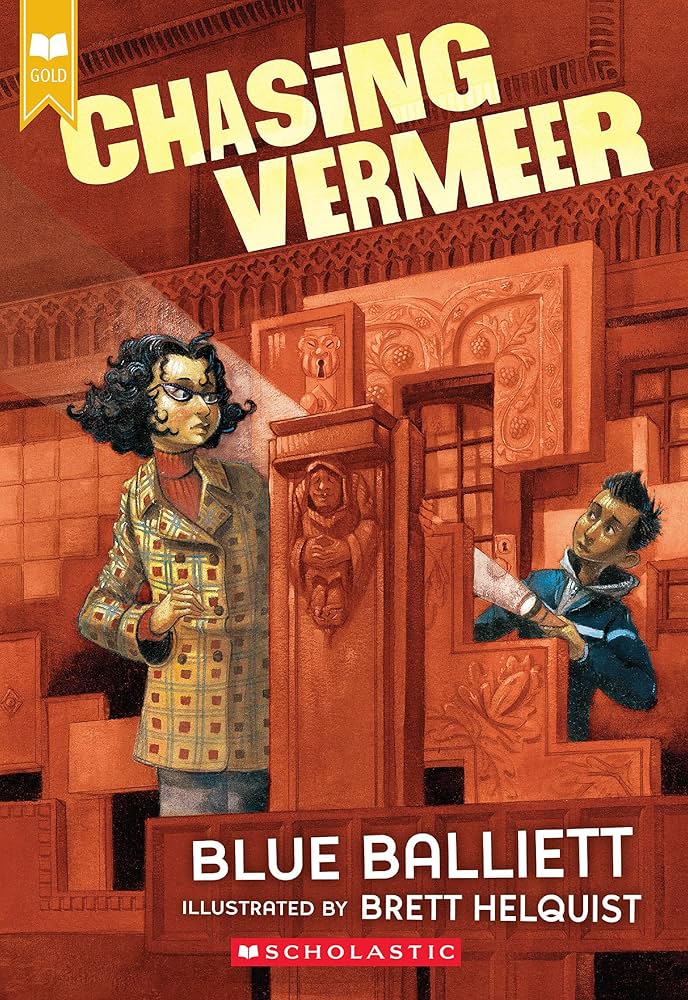
In Blue Balliett’s Chasing Vermeer (Scholastic, 2005), Petra and Calder find themselves embroiled in an international art scandal involving a missing Vermeer painting. An art history mystery involving clues in the form of a (mathematical) pentomino code. For ages 9-11.
Check out pentomino puzzle games online. See
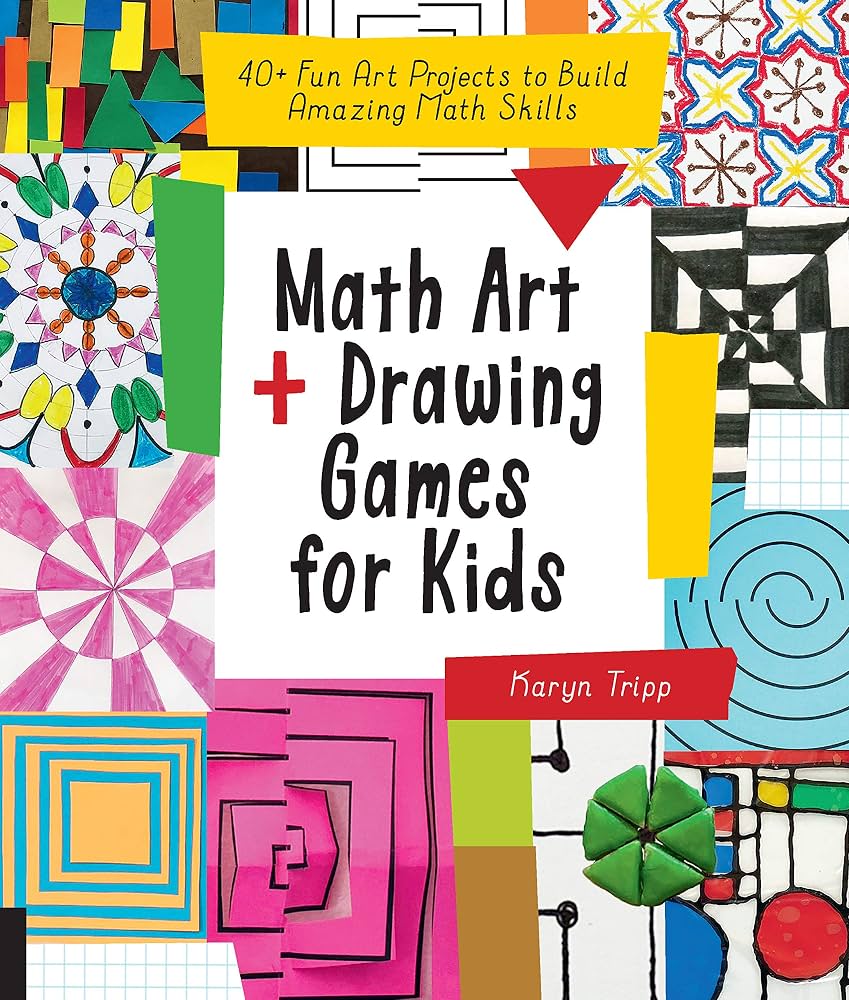
Karyn Tripp’s Math Art + Drawing Games for Kids (Quarry Books, 2019) has 40 great math-based projects based on everything from Calder mobiles to native American porcupine quill art to African Kente prints. For ages 7-12.

Play with online pattern blocks.
From Mathcats, at the Polygon Playground, visitors can make patterns, tessellations, symmetrical designs, and pictures with a range of colorful geometric shapes in various sizes.

Math and the Art of M.C. Escher at https://eschermath.org/ is an interactive online book on the mathematics of Escher’s work with associated student art projects. Topics covered include symmetry, frieze patterns, tessellations, polygons, fractals, and knot theory. For teenagers and up.
Learn about tessellations at https://www.mathsisfun.com/geometry/tessellation.html. Also see Take a Tour of Tessellations from My Modern Met at
https://mymodernmet.com/tessellation-art/.
From Mathematics in the Middle School, Masterpieces in Mathematics is an article on using art to teach fractions, decimals, and percents.

At Simon Beck's Snow and Sand Patterns, see how artist Simon Beck makes spectacular and enormous mathematical pictures.
MathArtFun sells books, puzzles, kits, and manipulatives related to math and art. A source for fractal and knot puzzles, polyhedral kits, Penrose tiles, and more.
Math and Cooking

In Amy Axelrod’s Pigs in the Pantry (Aladdin, 1999), Mrs. Pig is sick in bed, so Mr. Pig and kids decide to make her a tempting pot of Firehouse Chili. Unfortunately measuring mistakes lead to disasters, among these the arrival of real firefighters. Included is a recipe so you can see where Mr. Pig went so wrong. For ages 4-8.

Deborah Hopkinson’s picture book Fannie in the Kitchen (Aladdin, 2004) – subtitled “The Whole Story from Soup to Nuts of How Fannie Farmer Invented Recipes with Precise Measurements” – is told from the point of view of young Marcia Shaw, who is not exactly pleased when Fannie Farmer comes to cook for her family’s Victorian household. Soon, though, she’s hooked on Fannie’s delicious meals and even has a hand in writing the famous Boston Cooking-School Cook Book. For ages 5-9.

In Ann McCallum’s Eat Your Math Homework (Charlesbridge, 2011), kids learn math concepts while whipping up Fibonacci Snack Sticks, Fraction Chips, Tangram Cookies, Tessellation Brownies, Variable Pizza Pi, and Probability Trail Mix. For ages 7-10.

Joan D’Amico and Karen Eich Drummond’s The Math Chef (John Wiley & Sons, 1997) teaches math through applesauce, waffles, homemade animal crackers, and banana muffins. The book is divided into four main parts, each devoted to a different math concept: Measuring, Arithmetic, Fractions and Percents, and Geometry. For example, kids learn how to figure out how many grams are in a pound of potatoes, how to triple a sandwich recipe, and how to calculate the area of a brownie, the diameter of a cupcake, and the circumference of a pie. For ages 9-12.
From PBS, Math and Science Gumbo, hosted by the Kitchen Mathematician, uses food and cooking to teach math and science. Math concepts include unit pricing, fractions, estimation, units of measure, and so on. Episodes (among them “Grocery Shop,” “Bake Shop,” and “Pizza Shop”) are available online.
Math in the Movies and on TV

Donald in Mathmagic Land (1959) is a clever 27-minute animated film on math in real life – in music, in nature, in games like chess and baseball, and in architecture and art. Nominated for an Oscar.
Watch Donald in Mathmagic Land on YouTube.

Simon Singh’s The Simpsons and Their Mathematical Secrets (Bloomsbury USA, 2013) shows how the popular (and hilarious) animated series “The Simpsons” is simply loaded with math. Singh uses the episodes as jumping-off points to discuss everything from calculus to baseball statistics. A fun mathematical read for teenagers and adults.

The TV series, Numb3rs – which ran for six seasons, 2005-2010 – features a pair of crime-fighting brothers in Los Angeles, one an FBI agent, the other a mathematical genius. An exciting pitch for math.

Keith Devlin’s The Numbers Behind NUMB3RS (Plume, 2007) discusses the real math involved in criminal investigation, covering such topics as geographic profiling, data mining, codes, and networks. A catchy reader-friendly read for teenagers and adults.
From Wolfram Research, The Math Behind Numb3rs has episode-by-episode descriptions with links to descriptions and explanations of specific math features in each.

Dimensions is a gorgeous film in nine 13-minute “chapters,” beginning with Hipparchus, stereographic projections, and maps of the world and proceeding through M.C. Escher, four-dimensional polytopes, complex numbers, “fibration,” and mathematical proofs. Free download. For teenagers and adults.
Check out the 10 Best Math Movies for All Ages.
From MathBits, Math in the Movies has a long list of movies that in some way feature math, with summaries and printable worksheets to accompany each. Categorized by grade level (for the math, not the movie). Most worksheets are targeted at middle- and high-school-level students. Among the movies: Alice in Wonderland, Contact, October Sky, and Proof.
The Math in the Movies Page is an opinionated guide to movies (and plays) “with scenes of real mathematics,” with brief reviews and ratings both for math presentation and overall performance. A Beautiful Mind (2001), for example, starring Russell Crowe as brilliant mathematician John Nash, gets 3 stars for Math and five stars for Film; Good Will Hunting (1997), the story of a young math genius from South Boston (Matt Damon) and a helpful psychologist (Robin Williams), scores one star for Math and three for Film.
The Mathematical Movie Database is a long (long) alphabetized list of math-containing movies. Included is a separate much shorter list of “must-see” math movies.
Mathematics in the Movies has video clips of essential scenes from a long and interesting list of movies featuring math.
Mathematical Poetry

A must-read for the mathematically frustrated, Carl Sandburg’s poem Arithmetic begins “Arithmetic is where numbers fly like pigeons in and out of your head.”

Selected by Lee Bennett Hopkins, Marvelous Math (Simon & Schuster, 2001) is an illustrated collection of poems about math by a range of poets – among them “Counting Birds” by Felice Holman, “Pythagoras” by Madeleine Comora, and “Nature Knows Its Math” by Joan Bransfield Graham. For ages 5-8.

Theoni Pappas’s Math Talk (Wide World Publishing, 1993) is a collection of 25 mathematical poems for two voices, covering everything from circles, fractals, and zero to Mobius strips, tessellations, googols, and infinity. For ages 7 and up.

J. Patrick Lewis’s Edgar Allan Poe’s Pie (Harcourt Children’s Books, 2012) is a collection of math puzzles presented through parodies of classic poems by such poets as Edgar Allan Poe, Walt Whitman, Emily Dickinson, Robert Frost, A.A. Milne, Langston Hughes, and Ogden Nash. “Elephant with Hot Dog,” for example, was inspired by Edward Lear’s “There Was an Old Man with a Beard:” “When an elephant sat down to order/A half of a third of a quarter/Of an eighty-foot bun/And a frankfurter, son/Was it longer than three feet, or shorter?” For ages 7-11.
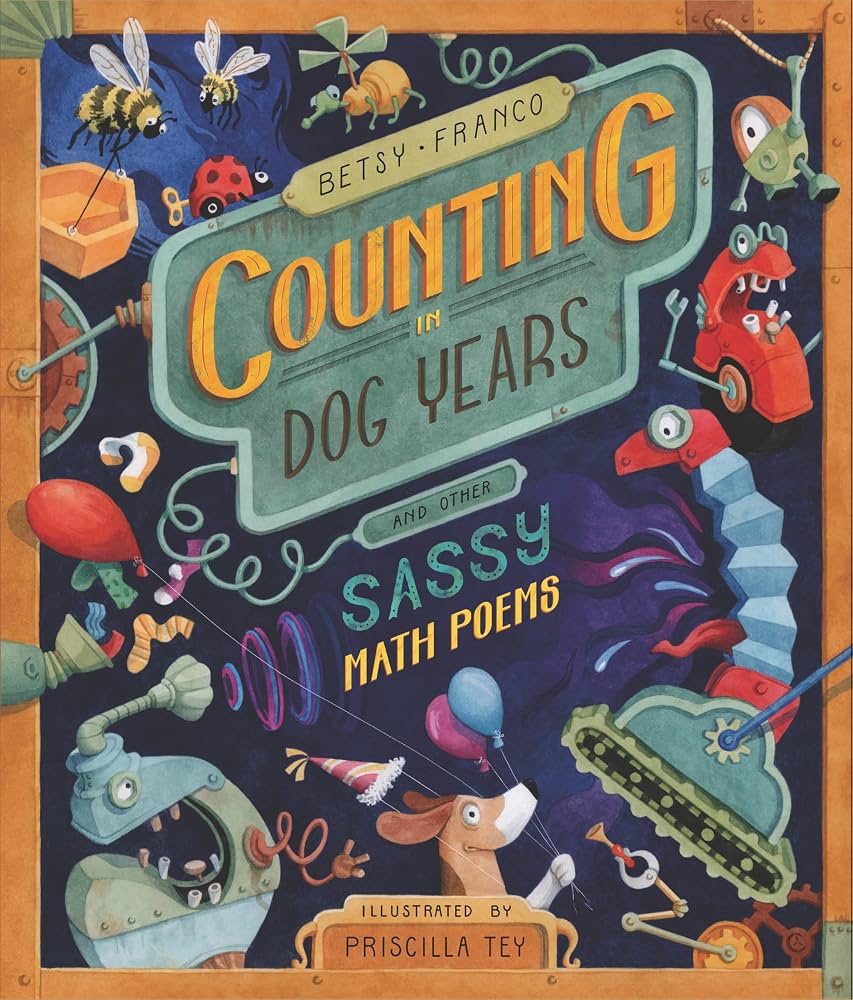
Betsy Franco’s Counting in Dog Years (Candlewick, 2022) is a collection of 29 clever poems that deal with everything from multiplying mice to fractions, geometry, and graphs. For ages 8-12.
Famous Mathematicians

Deborah Heiligman’s The Boy Who Loved Math (Roaring Brook Press, 2013) is a delightful picture-book biography of Hungarian mathematician Paul Erdos who loved numbers from the time he was a toddler. (Tell him your birthday and he could tell you how many seconds you’d been alive.) For ages 4-8.

Jennifer Berne’s On a Beam of Light (Chronicle Books, 2013) is a picture-book biography of Albert Einstein, charmingly illustrated in pen-and-ink and watercolor. Kids learn about Einstein's early fascination with a compass (“Suddenly he knew there were mysteries in the world…”) and how – one day while riding his bicycle – he wondered what it would be like to ride on a beam of light. Eventually he grew up to theorize about atoms, mass, and energy, and to devise his famous Theory of Relativity. For ages 6-9.

Joseph D’Agnese’s Blockhead (Henry Holt and Company, 2010) is a charmingly illustrated picture-book biography of Leonardo Fibonacci – the daydreaming medieval “blockhead” (and famous mathematician) whose astute observations of numbers in nature led to the discovery of the “Fibonacci series.” Pictures show Fibonacci happily counting pomegranate and sunflower seeds, flower petals, and seashell chambers; text includes a beautifully clear description of his signature number pattern. For ages 6-10.

For more on the Fibonacci sequence for the same age group, see Sarah Campbell’s Growing Patterns (Boyds Mill Press, 2010), illustrated with gorgeous (and countable) color photographs; and Emily Gravett's The Rabbit Problem (above).

Julie Glass’s A Fly on the Ceiling (Random House, 1998) is a Step-Into-Reading book about French mathematician Rene Descartes and his discovery of the Cartesian system of coordinates. For ages 7-9.
Play Cartesian Battleship!

By Julie Ellis, What’s Your Angle, Pythagoras? (Charlesbridge, 2004) is a fictionalized picture-book account of the famous Greek mathematician. Here Pythagoras, a curious young boy, travels to Egypt with his father, learns about right triangles, and comes up with the Pythagorean theorem. For ages 7-10

Also see the sequel, Pythagoras and the Ratios (Charlesbridge, 2010), in which Pythagoras and his cousins want to win a music contest, but their pipes and lyres sound awful. Pythagoras saves the day by elucidating the mathematical ratio that creates harmony. For ages 7-10.

By Luetta Reimer and Wilbert Reimer, Mathematicians Are People Too! (Dale Seymour Publications, 1994) is a collection of short friendly biographical stories about fifteen famous mathematicians, among them Thales (“Pyramids, Olives, and Donkeys”), Archimedes (“The Man Who Concentrated Too Hard”), Blaise Pascal (“Count on Pascal”), Sophie Germain (“Mathematics at Midnight”), and Srinivasa Ramanujan (“Numbers Were His Greatest Treasure”). For ages 7-12.
Also see Mathematicians Are People Too! Volume 2 (Dale Seymour
Publications, 1995) for another fifteen mathematicians, among them Euclid,
Fibonacci, Descartes, Benjamin Banneker, Ada Lovelace, and Albert Einstein.
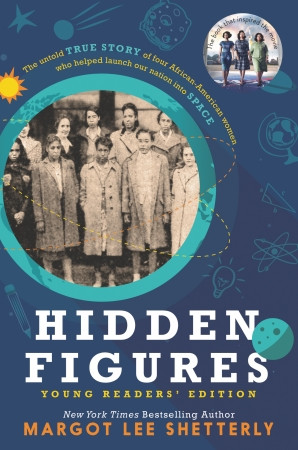
By Margot Lee Shetterly, Hidden Figures (HarperCollins, 2016), the Young Readers Edition, is the story of four brilliant female African-American mathematicians – the “human computers” who contributed to the success of NASA’s space programs. For ages 9-12.
Also see the picture-book version for ages 5-8.
Math and Sports

Titles in Ian F. Mahaney’s Sports Math series (PowerKids Press, 2011) include The Math of Baseball, The Math of Basketball, The Math of Soccer, The Math of Football, and The Math of Hockey. Each has an overview of the featured sport, measurements of the relevant playing field or court, and information on scoring or statistics. “Figure It Out” sidebars challenge readers to solve problems. Illustrated with photos, charts, and diagrams. For ages 7-12.

The Math & Movement program, developed by math educator Suzy Koontz, is tailor-made for non-sitters. Koontz describes the program as a “kinesthetic multisensory” approach to math that involves physical exercise (jumping, hopping, bending), dance, and yoga, plus an array of “visually pleasing floor mats” to teach and reinforce basic math concepts. Kids dance, wiggle, and leap their way through counting, skip counting, addition and subtraction facts, the multiplication tables, positive and negative numbers, and more. The Math & Movement Training Manual, which describes the program in detail, is available in paperback or eBook formats; the floor mats - clearly intended for schools – are pricey, but creative families can get around that. There’s always sidewalk chalk, paint, and duct tape.
Compete?

Take your math out for a spin. Tackle the Math Olympiad!
Or What About a Field Trip?

Check out New York City’s National Museum of Mathematics.