
Marvelous Moths, Beautiful Butterflies
In this collection
People in the know don’t call butterflies “butterflies” – they call them “leps,” which is short for Lepidoptera, the order of insects that includes not only butterflies, but moths and skippers. You can tell these apart by their antennae: true butterflies have straight skinny antennae with little bulbs at the tips; moths have antennae shaped like tiny feathers; and skippers have long straight antennae that curl backwards at the end, like question marks or fishhooks.
There are about 20,000 species of butterflies worldwide, 800 of which live in North America – and spotting as many of these as you can find is a terrific and addictive challenge for the spring and summer.

Visit the National Moth Week website for moth facts, moth activities, methods for attracting moths, instructions for making a moth feeder, a citizen science data-collecting project (everybody welcome to participate), and more.

Or celebrate National Learn About Butterflies Day on March 14.
Moth and Butterfly Stories

In Cambria Evans’s Martha Moth Makes Socks (Houghton Mifflin, 2006), the socks aren't just footwear - they're food, destined for a moth birthday dinner. Martha goes shopping and buys a polka-dot scarf, a shrunken sweater, and a pair of itchy socks, all intended for a fabulous feast. Unfortunately she tastes so much of her woolly dishes that, by the time the guests are due arrive, there’s practically nothing left to eat. Luckily her friends show up with just the right (edible) gift. For ages 4-7.
Actually it’s not moths that eat wool. It’s the larvae – caterpillars – of certain moths that chow down on sweaters, scarves, and socks. Find out just why.

Geoff Waring’s Oscar and the Moth (Candlewick, 2008) is an early science book in which Oscar, a goggle-eyed kitten, learns about light and dark from the very helpful and talkative Moth. Covered are common sources of light, what causes day and night, and how shadows are made. For ages 4-8.

In Kari and Brit Trogen’s Margaret and the Moth Tree (Kids Can Press, 2012), Margaret, an orphan, is trapped in a dreadful orphanage presided over by the evil Miss Switch. Margaret, condemned by Miss Switch to absolute silence, discovers that she can hear things that others can’t – notably the tiny voices of the moths who live in a nearby thorn tree. The moths eat Nimblers – the filmy stuff of dreams – and with their help, Margaret comes up with a plan to defeat Miss Switch and free the orphans from misery. For ages 8-12.

In Sara Pennypacker’s Summer of the Gypsy Moths (Balzer + Bray, 2012), 11-year-old Stella’s unstable mother is perpetually on the move – designing costumes in California, mining turquoise in Mexico – so Stella, along with Angel, an orphan in need of a foster home, has been sent to live with her great-aunt Louise on Cape Cod. When Aunt Louise suddenly dies, the two girls – fearful of what will happen to them – bury her secretly in the garden and embark on a series of elaborate deceptions to explain her absence. In the process, as they struggle to survive, they forge an unexpected friendship. The girls are polar opposites: Stella, a control freak, is painfully neat and addicted to “Hints from Heloise;” Angel is careless, messy, and rebellious. (They also battle gypsy moths.) Well-written, though the premise and the extremely tidy ending are somewhat unbelievable. For ages 10 and up.

In Gene Stratton-Porter’s now-classic A Girl of the Limberlost (Empire Books, 2011), originally published in 1909, Elnora Comstock, growing up on the banks of Indiana’s Limberlost Swamp, struggles to pay for her education – in the teeth of her obstructive mother – by selling moths from the nearby swamp to collectors. As well as print, the book is available online. For ages 12 and up.

In Margaret Willey’s A Summer of Silk Moths (Flux, 2009), seventeen-year-old Pete is passionately devoted to helping his mentor Abe maintain Riverside, a nature preserve dedicated to the memory of Abe’s brother Paul - and to sketching Paul’s beautifully preserved moth collection. Into this idyll comes the angry and disruptive runaway Nora, who claims to be Paul’s daughter. Collecting moths – and reading Paul’s moth journal – eventually bring Pete and Nora together as they solve mysteries of their pasts. For ages 13 and up.

Virginia Woolf’s 1942 essay "The Death of the Moth" is a recommended read for high-school students. Available online at https://gutenberg.net.au/ebooks12/1203811h.html.

And don’t forget Peaseblossom, Cobweb, Moth, and Mustardseed, Titania’s fairies in Shakespeare’s Midsummer Night’s Dream.
The play is available in many editions, among them Lois Burdett’s adaptation, A Midsummer Night’s Dream for Kids (Firefly Books, 1997), illustrated with terrific children’s drawings, in which the plot is summarized in catchy rhyming couplets. For ages 5-8.

In Eric Carle’s The Very Hungry Caterpillar (Philomel, 2010), illustrated with gorgeous paper collages, the caterpillar eats his way through a week (starting with an apple on Monday) – then forms a chrysalis and hatches out as a spectacularly beautiful butterfly. For ages 2-6. See a lovely animated film version of The Very Hungry Caterpillar.

Make an egg-carton caterpillar! You’ll need green paint, green pipe cleaners, and wiggle eyes.
Butterfly and caterpillar crafts! Make craft-stick caterpillars and a great fold-out caterpillar-to-butterfly project.
Pet caterpillars? Here’s how to make your own caterpillar habitat.

Grow these great grass caterpillars!

In Elly MacKay’s Butterfly Park (Running Press, 2015), a little girl moves to a new town and discovers Butterfly Park – where there are no butterflies. With the help of other neighborhood children, she finds a way to bring the butterflies back. The 3-D lightbox diorama illustrations are great. For ages 4-7.

Sometimes a butterfly makes you special. In Alan Madison’s Velma Gratch and the Way Cool Butterfly (Dragonfly Books, 2012), first-grader Velma Gratch is outshone by two older and practically perfect sisters – until, on a trip to the Butterfly Conservatory, she’s adopted by a monarch butterfly. For ages 4-8.

Rudyard Kipling’s “The Butterfly That Stamped” from the Just So Stories (available in many editions) is a wonderful read for all ages about the wise King Suleiman-bin-Daoud, Queen Balkis the Most Beautiful, nine hundred and ninety-nine quarrelsome wives, and a very boastful butterfly.

By Julia Alvarez, In the Time of the Butterflies (Algonquin, 2010), a historical fiction novel, is the story of the four beautiful Mirabal sisters - known as "the butterflies" - who opposed the rule of Trujillo in the Dominican Republic. Three of the sisters have been murdered by the regime, but one – DeDe – survives. A powerful work of literature for teens and adults.
Sci-fi Moths

Jack Vance’s science-fiction tale The Moon Moth, originally published in 1961, has recently been adapted as a graphic novel by Humayoun Ibrahim (First Second, 2012). The story is set on the planet Sirene, where the inhabitants wear elaborate masks to indicate their social status and communicate by singing, accompanying themselves – depending on the situation – with any one of a dozen musical instruments. Edwer Thissell, human consul to Sirene, is both socially clueless and tone deaf – challenging in a world where etiquette lapses are punishable by death – and has been condemned to wear the low-status Moon Moth mask. The plot is a clever murder mystery, in which Thissell tracks down an assassin. For ages 12 and up.

Check out real moon moths in John Himmelman’s beautifully illustrated A Luna Moth’s Life (Children’s Press, 1998). A simple text describes the moth’s life cycle for ages 4-7.

In Jean Paton Walsh’s The Green Book (Square Fish, 2012), Pattie and her family have fled the dying Earth to make a new life on a distant planet known as Shine. (In chapter one, they struggle to decide which single book each can take along – a great discussion premise.) Life on Shine, however, proves to be more difficult than expected: farm animals die eating the glassy native grasses and Earth crops refuse to grow. The colonists’ children, however, eventually discover how to live on the new world, and even learn to communicate with the native moth people, who hatch from the boulders – really cocoons – in “Boulder Valley.” For ages 8-12.
Science of Moths and Butterflies

Fran Howard’s Moths (Capstone Press, 2006), illustrated with full-page color photographs, is a simple and nicely informational introduction to moths for ages 3-7.

Jerry Pallotta’s The Butterfly Alphabet Book (Charlesbridge Publishing, 2016) is an A to Z tour of the varied world of butterfly species, from A (for Apollo) to Z (for Zephyr Metalmark).

Lois Ehlert’s Waiting for Wings (Harcourt, 2001) is a simple rhyming explanation of the butterfly life cycle for ages 3-6, illustrated with exquisite cut-paper pictures; it includes some background information at the end about butterfly anatomy, butterfly and flower identification, and growing a butterfly garden.

Dianna Hutts Aston’s A Butterfly Is Patient (Chronicle Books, 2015) is a celebration of many kinds of butterflies, from the creators of An Egg is Quiet and A Seed is Sleepy. For ages 4-8.

Deborah Heiligman’s From Caterpillar to Butterfly (HarperCollins, 2015) in the Let’s-Read-and-Find-Out Science series, covers the life cycle of a Painted Lady butterfly. For ages 4-8.

James Prosek’s Bird, Butterfly, Eel (Simon & Schuster, 2009) follows the activities of a barn swallow, a Monarch butterfly, and an American eel – who all spend summer on a farm off Cape Cod, but in the fall depart and go their very separate ways. Butterfly sets off on a 3000-mile-long trip to Mexico. For ages 4-8. Hear it read aloud here.

With Insect Lore’s Butterfly Garden, kids can watch their (included) caterpillars eat, grow, form chrysalides, and develop into Painted Lady butterflies. The entire process takes about three weeks. A wonderful project for all ages.

In Judy Allen’s Are You a Butterfly? (Kingfisher, 2003), written in talk-directly-to-the-reader second person, kids find out just what it takes to be a developing butterfly. (“Your wings are crumpled. They look terrible. But don’t worry…”) Other titles in the series include Are You a Ladybug? and Are You a Bee? For ages 4-8.

Ruth Heller’s How to Hide a Butterfly (Grosset & Dunlap, 1992) is a clever rhyming nature hunt on insect camouflage. (“The butterfly/that you see here/just folds its wings/to disappear.”) For ages 4-8.

In Pamela Duncan Edwards’s Clara Caterpillar (Harpercollins, 2004), Clara begins life as an egg, laid on the leaf of a cabbage plant by a cream-colored butterfly who advises her offspring to grow up to be “courageous and contented.” Clara, a blah-colored caterpillar, grows up to become a plain cream-colored butterfly; the bane of her existence is her flashy friend Catisha, who is crimson and conceited. When a hungry crow moves in, however, clever Clara, safely camouflaged among the camellias, courageously saves her friend’s life. The book is a masterpiece of alliteration; not only will kids learn life lessons from Clara, but they’ll never forget the sound of hard c. For ages 4-8.

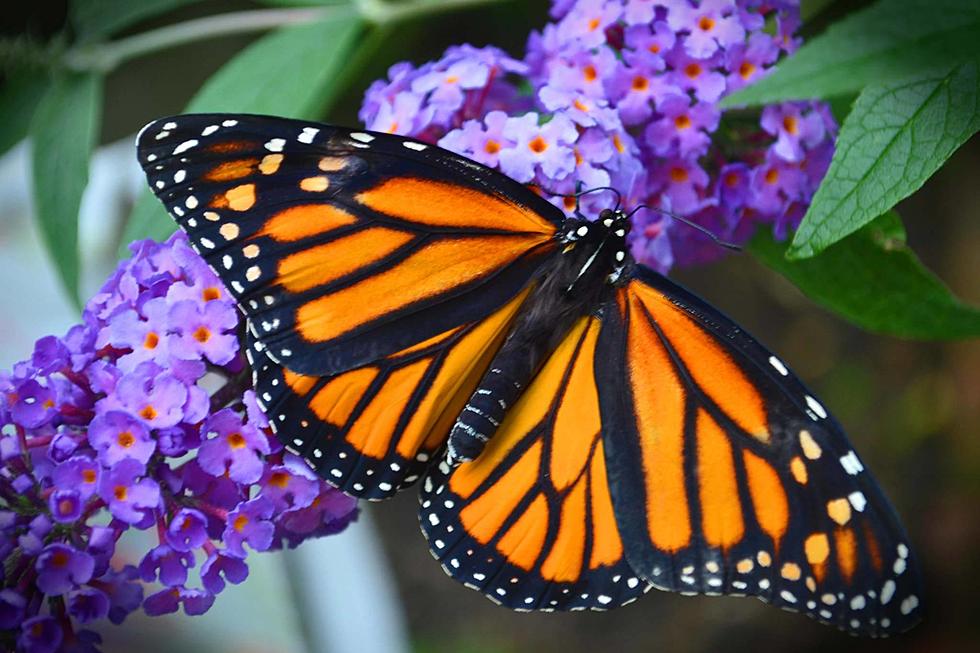
The most famous of North American butterflies is probably the black-and-orange Monarch, famed for its phenomenal annual migration in which it travels as much as 3000 miles to spend the winter in Mexico. For ages 4-7, Sam Swope’s Gotta Go! Gotta Go! (Farrar Straus & Giroux, 2000) is the story of one exuberant little Monarch’s journey (“I gotta go! I gotta go! I gotta go to Mexico!”).

In Antoine O Flatharta’s Hurry and the Monarch (Dragonfly, 2009), the story of the annual 2000-mile migration of the Monarch butterflies is told through the friendship of a traveling butterfly and Hurry, a tortoise, who lives in a garden in Wichita Falls, Kansas. For ages 4-8.

Track the butterflies! Journey North is a citizen science project in which participants track migrations and seasonal events – many, among them Monarch butterflies.

Monarch Watch is a citizen science program in which participants learn about Monarch butterflies, tag and track Monarchs, create Monarch waystations and butterfly gardens, collect and donate milkweed seeds, and more.

Loree Griffin Burns’s Handle with Care (Millbrook, 2014) is the story of a Blue Morpho butterfly farm in Costa Rico, illustrated with great color photos. For ages 4-9.

Katy Flint’s The Butterfly House (Frances Lincoln Books, 2019), gorgeously illustrated by Alice Pattullo, has beautifully presented information on a wide range of butterfly and moth families for ages 6-10.

Lynn Rosenblatt’s Monarch Magic! (MindStir Media, 2018) is a terrific collection of butterfly activities, projects, and nature discoveries for ages 8-12, illustrated with drawings and photographs.

Which moth? And which butterfly? Peterson First Guides are simplified and condensed versions of the renowned Peterson Field Guides, targeted at beginning naturalists. Paul A. Opier’s color-illustrated Peterson First Guide to Butterflies and Moths (Houghton Mifflin Harcourt, 1998) covers 182 different species in 128 pages.

In Butterfly & Moth (DK Publishing, 2012) in the DK Eyewitness series, each double-page spread is devoted to a different topic, such as “Butterfly or moth?,” “Caterpillars,” “Silk moths,” “Migration and hibernation,” and “Camouflage.” Like all the volumes in the series, it's beautifully designed, with captioned color photographs, drawings, diagrams, and fact boxes. Officially for ages 8 and up, but the great pictures will also appeal to younger kids.

Rick Mikula’s The Family Butterfly Book (Storey, 2000) is a 160+-page compendium of fascinating butterfly information (did you know that the best place to find butterfly fossils is Pike’s Peak, Colorado?), illustrated with gorgeous color photographs and paintings. The author covers the anatomy and behavior of caterpillars and butterflies and then goes on to show young enthusiasts how to attract, identify, and raise them. Included, for example, are detailed illustrated instructions for planting a butterfly garden, making a butterfly net, building a caterpillar-rearing container and a hanging butterfly cage, feeding butterflies, photographing butterflies, and much more.
All About Butterflies from Enchanted Learning is an illustrated hypertext book for kids of all ages. There are detailed pages on butterfly biology, behavior, classification, and life cycles, many printable worksheets, coloring and puzzle pages, instructions for planting a butterfly garden and raising caterpillars, an illustrated butterfly dictionary, activities and crafts, and information sheets on individual butterflies. For elementary-level kids.
What’s the difference between a butterfly and a moth? Find out at Everyday Mysteries at https://www.loc.gov/everyday-mysteries/ which also features photographs, fascinating facts, and a reference list.
The Butterfly Website has a wealth of information on butterflies, butterfly gardening (with a helpful plant list), butterfly science, and a photo gallery, plus crafts (many), printable coloring pages, and lesson plans.

Check out the fabulous South Asian Attacus atlas moth, the world’s biggest, a gaudy beauty with a wingspan of up to twelve inches.

Loree Burns’s You’re Invited to a Moth Ball (Charlesbridge, 2020) is all about creating a late-night party to lure moths, illustrated with great color photographs. Try it! For kids ages 5-8, but a great project for all ages.
Go mothing! From Science Friday, find out how to attract and study moths, along with some suggested experiments.
Butterflies...and Math

In Jerry Pallotta’s Butterfly Colors and Counting (Charlesbridge, 2013), kids learn to count to ten with ten different-colored butterflies. For ages 2-5.

Bill Martin, Jr.’s Ten Little Caterpillars (Beach Lane Books, 2011), beautifully illustrated by Lois Ehlert, is a rhyming counting book for ages 2-6. (“The first little caterpillar/crawled into a bower/The second little caterpillar/wriggled up a flower.”)

By Danica McKellar, Ten Magic Butterflies (Crown, 2018) uses flowers, butterflies, and fairies to teach simple arithmetic concepts. For ages 3-6.
Peppered Moths and Evolution
The peppered moth is often cited as a textbook example of Darwin’s theory of natural selection. Prior to the Industrial Revolution in England, most peppered moths were pale; with the spread of industrial pollution, however, the moths became predominately dark, the better to camouflage themselves on soot-blackened trees.

Wikipedia’s Peppered Moth Evolution has a good general summary and explanation of peppered moth studies.
From the journal Nature, The peppered moth’s dark genetic past revealed is a reader-friendly explanation of the genetic mutation that rendered pale peppered moths dark.
At the Peppered Moth Simulation, students play the part of moth-eating bluejays, recording the numbers of light- and dark-colored moths found respectively on light- and dark-colored tree trunks.
Silk Moths, Silkworms, and Silk

Lily Toy Hong’s The Empress and the Silkworm (Albert Whitman and Company, 1995) is a tale of the origin of silk, beginning when a cocoon falls into the Empress Si Ling-Chi’s teacup and begins to unwind. The empress envisions her husband, Huang-Ti, the Yellow Emperor, clothed in a shimmering robe woven from this “heavenly thread.” She weaves him just such a robe; silk-making comes to China; and Si Ling-Chi becomes known as the Lady of the Silkworm. For ages 5-9.

Charles Santore’s The Silk Princess is the fairy-tale like story of the little princess Hsi-Ling Chi who – when a silkworm cocoon falls into her mother’s tea and starts to unravel – decides to find out how long the thread is. Off she goes on a long and magical journey to the Holy Mountains that results in an encounter with a giant spider and a dragon – and ultimately a triumphant return, bringing with her the wonderful secret of silk-making. For ages 6-9.

In Deborah Noyes’s Red Butterfly: How a Princess Smuggled the Secret of Silk Out of China (Candlewick, 2007), a young Chinese princess is sent by her father to marry the faraway king of Khotan. Sad to leave her home, the princess lists the many things she will miss – pink peach petals, red-crowned cranes, sour plums – and the beautiful silk made by Chinese silkworms. Though it is forbidden to reveal the secret of silk-making outside China, the princess nonetheless smuggles out silkworm cocoons and mulberry seeds in her hair, so that she will always have with her a part of her beloved home. For ages 6-10.

In Linda Sue Park’s Project Mulberry (Yearling, 2007), Julia, a daughter of Korean immigrants, and her friend Patrick team up to do an animal husbandry project on silkworms for the state fair. Initially, Julia isn’t enthusiastic (it’s too Korean), but soon both kids become wrapped up in the project – and along the way learn a great deal, not only about environmentalism and silkworm biology, but about friendship and tolerance. For ages 9 and up.

Sylvia A. Johnson’s Silkworms (First Avenue Editions, 1989), illustrated with great color photographs, is a straightforward account of domesticated silkworms and silk production for ages 9 and up.

Carrie Gleason’s 32-page The Biography of Silk (Crabtree Publishing, 2006), illustrated with color photographs, covers all the basics, including silkworms and silk production, ancient China and the Silk Road, the silk industry in America, and the uses of silk. For ages 9-12.

John S. Major’s The Silk Route: 7000 Miles of History (HarperCollins, 1996), in 32 lushly illustrated pages, traces the early silk trade from the mulberry groves of China to Byzantium (now Constantinople) via a journey on the famous Silk Road in 700 AD. For ages 9 and up.

Kathryn Ceceri’s The Silk Road: 20 Projects to Explore the World’s Most Famous Trade Route (Nomad Press, 2011) covers the history and geography of the Silk Road, the peoples who lived along its path, the role it played in the spread of technology, and the Silk Road today in 128 nicely designed pages featuring “Words to Know” and “Fascinating Facts” boxes and capsule biographies of famous Silk Road travelers. Sample projects include making an abacus and a sand design bottle, and building a model yurt. For ages 9-12.
Make your own silk? Silkworms has general information, sources for eggs and equipment, instructions for raising silkworms at home or in a classroom, and much more.
For more information on silkworms or to order eggs or worms, see the Silkworm Shop.
Silk and…vaccines? Silk protein may help deliver vaccines and antibiotics to developing countries. See https://now.tufts.edu/2012/07/09/new-silk-technology-preserves-heat-sensitive-drugs-months-without-refrigeration.

Pheromones were first discovered in silk moths. The first, named bombykol, was isolated from the silk moth Bombyx mori. Learn all about it at 
Bombykol: Sex Pheromone of the Silk Moth.
Poetry

Carole Gerber’s Seeds, Bees, Butterflies, and More! (Henry Holt, 2018) is a collection of 18 chatty poems for two voices. For ages 4-8.

Douglas Florian’s Insectopedia (Sandpiper, 2002) is a great collection of insect poems, illustrated with colorful paintings. Among these, along with poems in honor of army ants, mosquitoes, termites, and praying mantises, is “The Io Moth.” For ages 5-9.

Among the fourteen bug-themed poems in Paul Fleischman’s Newbery-winning Joyful Noise: Poems for Two Voices (HarperCollins, 2004) is “The Moth’s Serenade,” a love poem from moth to porch light. For ages 5-10.

Joyce Sidman’s Butterfly Eyes and Other Secrets of the Meadow (HMH, 2006) is an illustrated collection of riddle poems about the creatures of the meadow environment. (What creature sees colors that humans can’t? What insect hides in a nest of bubbles?) For ages 7-10.
For Emily Dickinson’s “A moth the hue of this,” see here.
Li Po’s 
Arts, Crafts, Activities

Joyce Sidman’s award-winning The Girl Who Drew Butterflies (HMH, 2018) in the exquisitely illustrated story of 17th-century artist and naturalist Maria Merian, one of the first to observe and draw live insects and to record the process of metamorphosis. Chapters are titled for the stages of metamorphosis, from Egg to Hatching to First Instar and so on, and finally back to Egg again. A beautiful book for ages 9-12.

For younger readers, see Margarita Engle’s Summer Birds: The Butterflies of Maria Merian (Henry Holt, 2010) for ages 4-8.

Who hasn’t been frustrated by origami? In Cathryn Falwell’s Butterflies for Kiri (Lee & Low, 2008), Kiri has been given a gift of origami paper and instructions for her birthday – but she just can’t seem to make a butterfly. For ages 5-8.


See this Butterfly Painting Art Lesson from Deep Space Sparkle.

At Butterfly Alphabet, you can write your name in butterfly-wing letters and view an art print of letters and numbers photographed on actual butterfly wings.
Artist David Kracov’s Book of Life is a metal sculpture showing a flock of glorious butterflies bursting out of a book.
View examples of John Hampson’s “Bug Art” mosaics made with moths, beetles, and butterflies at the Fairbanks Museum at https://fairbanksmuseum.org/bug-art/ and at Roadside America at
https://www.roadsideamerica.com/story/10860. (Check out George Washington in moths.)

Ruth Soffer’s Exotic Butterflies and Moths (Dover Publications, 2002) has 20 black-line ready-to-color drawings of butterflies and moths. $3.99.
Sunset Moth is a craft project for making a gorgeous moth from colored cellophane.

By Nicola Tedman and Jean Power, Beaded Bugs (Andrews McMeel Publishing, 2012) includes instructions for making 30 different moths, butterflies, and beetles from colored seed beads and wire. Included are basic beading instructions for beginners. Too finicky for the very little, but fun for older kids.

By Lydia Tresselt, Lalylala’s Beetles, Bugs and Butterflies (SewandSo, 2017) is a butterfly life cycle story illustrated with tiny crocheted caterpillars and butterflies. Patterns included.
Cool Things to Do with Moth Balls

Mothballs in outer space! Naphthalene, the major chemical component of mothballs, has been found in interstellar clouds. Read about it here.
And the Butterfly Effect

In chaos theory, the butterfly effect is the idea that a small change in initial conditions can lead to large changes at a later time – as in a butterfly flapping its wings can lead to a typhoon in the China Sea. From the American Scientist, see Understanding the Butterfly Effect or read an overview
here.

Ray Bradbury’s classic short story A Sound of Thunder is a classic example of the butterfly effect via Time Safari, Inc. (Don’t step off the path!)