
Lewis Carroll and Alice
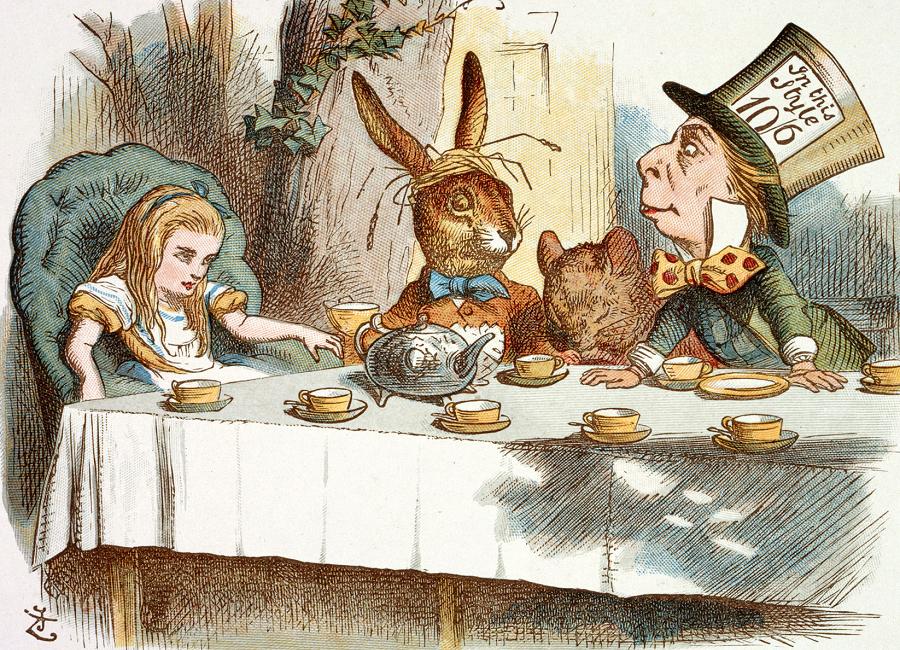
In this collection
Lewis Carroll is the pen name of British mathematician Charles Lutwidge Dodgson, author of the brilliantly creative Alice’s Adventures in Wonderland and Through the Looking-Glass.
See below for books, games, puzzles, poems, and an Alice-style House of Cards that you can build yourself.
Alice in Wonderland

Lewis Carroll’s Alice’s Adventures in Wonderland, originally published in 1865, and its sequel, Through the Looking-Glass, and What Alice Found There (1871) have been in print ever since, and are now available in many different editions. I’d recommend those with the original John Tenniel illustrations. For ages 7 and up.

Alice’s Adventures in Wonderland has been translated into literally dozens of foreign languages, from Afrikaans to Zulu. Available through Amazon are Alice in Latin (Alicia in Terra Mirabili), French (Alice au Pays des Merveilles), German (Alice’s Abenteuer im Wunderland), Spanish (Alicia en el Pais de las Maravillas), Italian (Le Avventure di Alice nel Paese delle Meraviglie), and Chinese.
Project Gutenberg at https://projectgutenberg.org offers tens of thousands of free online books, among these a long list of titles by Lewis Carroll, including Alice’s Adventures in Wonderland in English, German, and Italian.
At the British Library website, page through the original handwritten manuscript of Alice's Adventures in Wonderland. See https://www.britishlibrary.cn/en/works/alice-in-wonderland/.
MORE VERSIONS OF ALICE

Jennifer Adams’s Alice in Wonderland (Gibbs Smith, 2012) in the BabyLit series is a board book that uses images from Alice to teach colors, via a white rabbit, orange Cheshire Cat, blue Caterpillar, and Queen of (red) Hearts. For ages 1-3.

By Lewis Carroll and brilliant paper engineer Robert Sabuda, Alice’s Adventures in Wonderland: A Pop-Up Adaptation (Little Simon, 2003) is a work of art, with 3-D Tenniel-style images, inserted small booklets, a Victorian peep show (of Alice falling down the rabbit hole), and a fuzzy Cheshire cat. For ages 4-12.
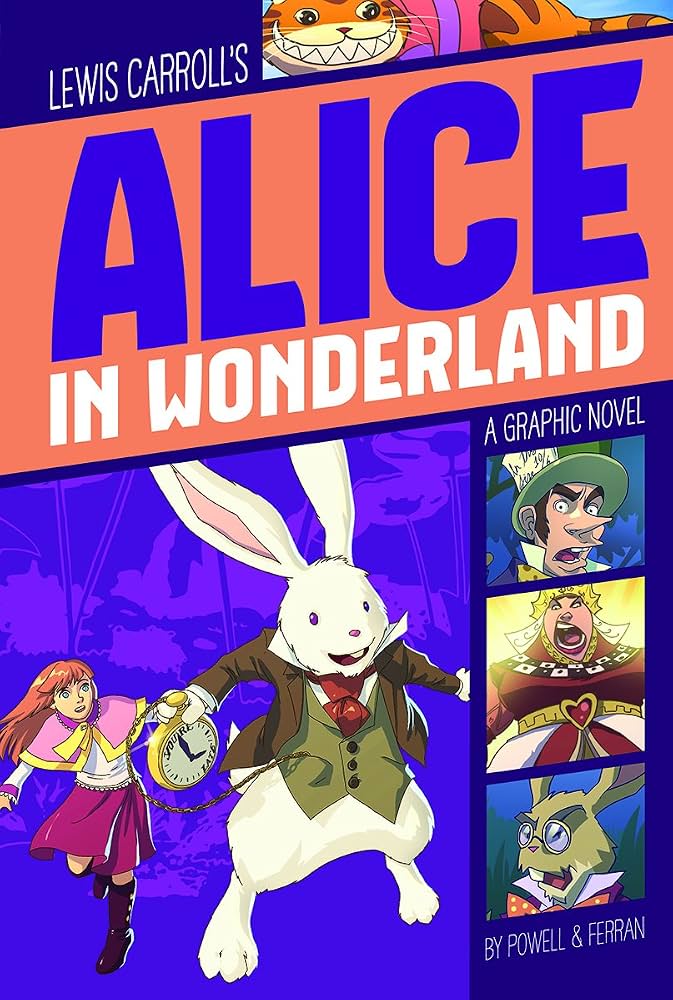
There are numerous graphic-novel adaptations of Alice. For example, see Lewis Carroll's Alice in Wonderland, illustrated by Daniel Perez (Capstone, 2014) - one of a series of graphic-novel classics.

By Lewis Carroll with extensive notes by Martin Gardner, The Annotated Alice (W.W. Norton, 1999) is a fascinating read, with full text and illustrations of both Alice books, and crammed with extra tidbits of information. Included, for example, are French and German versions of the poem “Jabberwocky,” a discussion of puns, and several possible answers to the Mad Hatter’s riddle “Why is a raven like a writing-desk?” The annotations are in the wide margins of the text, so readers don’t have to keep flipping pages back and forth.
Author A.S. Byatt’s There’s something about Alice is a fascinating essay on her relationship with Alice and other classic children’s books.
Lewis Carroll
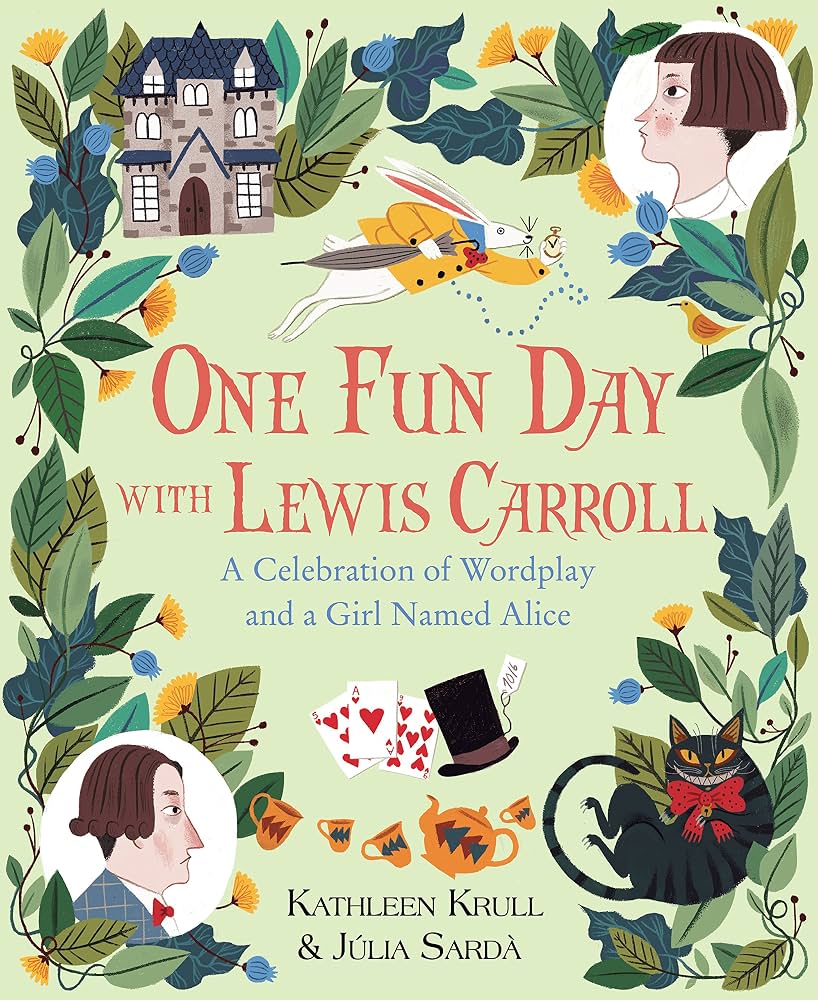
Kathleen Krull’s One Fun Day with Lewis Carroll (Clarion, 2018) is a beautifully illustrated picture-book account of Carroll’s life, word play, and the writing of the Alice books. For ages 6-9.

Christina Bjork’s The Other Alice (R&S Books, 1993) packs a lot of information into 100 illustrated pages: included is the story of the friendship between Carroll and Alice Liddell and how Alice’s Adventures in Wonderland came to be written, accounts of Victorian childhood, period photographs of Oxford, and more. For ages 10 and up.

In Simon Winchester’s The Alice Behind Wonderland (Oxford University Press, 2011), the author uses Lewis Carroll’s 1858 photograph of six-year-old Alice Liddell, costumed as “The Beggar Maid,” to tell the story of the real Alice for whom Carroll wrote Alice’s Adventures in Wonderland. For teenagers and adults.
From the Metropolitan Museum of Art, see Lewis Carroll’s photograph of Alice Liddle as the Beggar Maid. See https://www.metmuseum.org/art/collection/search/283092.

Morton Cohen’s Lewis Carroll (Vintage, 1996) is generally accepted as the definitive biography of Carroll. It’s over 600 pages long and intended for the dedicated older reader.

Also see Jenny Woolf’s chattier and shorter The Mystery of Lewis Carroll (St. Martin’s Press, 2010). For teenagers and adults.
Jenny Woolf’s Lewis Carroll’s Shifting Reputation is an article on Carroll’s life and work published in Smithsonian magazine, April 2010.
Lewis Carroll is a short biography from the Poetry Foundation.
The Lewis Carroll Society of North America website has links to Carroll’s online texts, a photography collection, Lewis Carroll puzzles and games, a list of Carroll-inspired fiction books, and an extensive list of educational resources.
The Victorian Web’s Lewis Carroll page has a wealth of information, including a gallery of Tenniel illustrations, a character map of Alice’s Adventures in Wonderland, literary essays, and social commentary.
Philosophy and Alice

Edited by William Irwin and Richard Brian Davis, Alice in Wonderland and Philosophy (Wiley, 2010) is a collection of essays by various authors on the deeper aspects of Wonderland and its characters. Titles include “Unruly Alice: A Feminist View of Some Adventures in Wonderland,” “Six Impossible Things Before Breakfast,” “Is There Such a Thing as Language?” “Serious Nonsense,” and “Memory and Muchness.” For teenagers and up.

From The Marginalian, The Philosophy of Alice in Wonderland is a detailed review of the book, with short excerpts.

Daniel Silberberg’s Wonderland: The Zen of Alice (Parallax Press, 2009) combines quotes and stories from Alice with personal anecdotes, Buddhist koans, and discourses on the nature of reality and the search for truth. A short (120 pages), interesting read for teenagers and up.
Poetry

Lewis Carroll in the Poetry for Young People series (Sterling, 2008) is an illustrated collection of 26 of Carroll’s best-known poems, among them “How Doth the Little Crocodile,” “You Are Old, Father William,” and “The Walrus and the Carpenter.” For ages 8 and up.
Poemhunter’s Lewis Carroll page has a selection of Carroll’s poems including, of course, “Jabberwocky.”
Listen to author Neil Gaiman recite Jabberwocky.
Math (and Puzzles)

One of Lewis Carroll’s puzzle masterpieces is a game/puzzle known as Doublets or Word Ladders, in which players are challenged to change one word into another by changing just one letter at a time. It’s much tricker than it sounds. See https://lewiscarrollresources.net/doublets/index.html.
See puzzles at https://www.psychologytoday.com/us/blog/brain-workout/200908/the-doublet-puzzle-a-masterpiece-from-the-pen-of-lewis-carroll.

Play on your phone! There are several Word Ladders apps available - for example, see Word Ladder Game from Ventura Educational Systems.

In Lewis Carroll’s famous Pillow Problem, a bag contains a counter, known to be either white or black. A white counter is put in, the bag is shaken, and a counter is pulled out, which proves to be white. What is now the chance of drawing a white counter? See Lewis Carroll’s Pillow Problem for a simulation.

Edited by Edward Wakeling, Lewis Carroll’s Games and Puzzles (Dover Publications, 1992) is a collection of 42 brainteasers, among them Looking-Glass Time, Arithmetical Croquet, and Cakes in a Row. For ages 9-12.

Martin Gardner’s The Universe in a Handkerchief (Copernicus, 1998) is a 150-page collection of Lewis Carroll’s “mathematical recreations, games, puzzles, and word plays.” For ages 12 and up.

Robin Wilson’s Lewis Carroll in Numberland (W.W. Norton, 2010) is a very readable mathematical biography of Carroll – a.k.a. mathematician Charles Dodgson. Included are a chronology of Carroll’s life and explanations of many of the mathematical concepts and puzzles incorporated into his books. For teenagers and adults.
Algebra in Wonderland is a short article explaining the math behind some of the events in Alice’s Adventures in Wonderland. Alice’s encounter with the hookah-smoking Caterpillar, for example, has a lot to do with algebra.
Lesson Plans
From Core Knowledge, Alice in Wonderland is a detailed third-grade level lesson plan to accompany the book. The 12-lesson sequence includes resource and vocabulary lists, activities, and discussion questions. The culminating activity is a mock trial (“Who DID steal the tarts?”).e https://www.coreknowledge.org/wp-content/uploads/2016/11/Alice-in-Wonderland.pdf.
From the University of Oxford, see a summary and discussion questions to accompany Alice's Adventures in Wonderland at https://media.podcasts.ox.ac.uk/engfac/fantasy_lit/Alice_in_Wonderland_Teaching_Pack.pdf.
Arts, Crafts, and Activities
Alice in Wonderland: An Interactive Adventure has a long list of Alice-based games and activities. Kids can solve mazes, read poems (including “Jabberwocky” in Latin), play chess with the Red Queen, put Humpty Dumpty together again, get a recipe for tarts, and more.

The Alice in Wonderland Coloring Book (Dover Publications) includes 36 of the original John Tenniel illustrations (enlarged to coloring-book size) along with an abridged version of the text.

By Hannah Read-Baldry and Christine Leech, Everything Alice (North Light Books, 2011) is a collection of craft projects and recipes for Alice lovers. For example, kids and adults can make a stuffed white rabbit, a Cheshire cat mask, lavender dormice, and Duchess macaroons.

By Dawn Hylton and Diane Sedo, Taking Tea With Alice (Benjamin Press, 2008) gives readers the scoop on Alice-style Victorian tea parties, complete with recipes, activities, table settings, decorations, and party games.
Alice at the Movies

See The Ten Best Alice in Wonderland movies, starting with an eight-minute silent film short made in 1903.

Walt Disney’s Alice in Wonderland (1951) is the familiar animated musical. Rated G.

Alice in Wonderland (1999) combines Alice’s Adventures in Wonderland and Through the Looking-Glass in a single film, with a cast of characters that includes Whoopi Goldberg as the Cheshire Cat, Ben Kingsley as the Caterpillar, Miranda Richardson as Queen of Hearts, and Peter Ustinov as the Walrus. Rated PG.

In Tim Burton’s 2010 version of Alice in Wonderland, a teenaged Alice falls down a rabbit hole and ends up in a surreal world where – with the help of friends – she has to battle the horrible Jabberwocky and help defeat the Red Queen and restore the White Queen to the throne. The impressive cast includes Johnny Depp as the Mad Hatter, Helena Bonham Carter as the Red Queen, and Anne Hathaway as the White Queen. Rated PG.