
Famous Potatoes
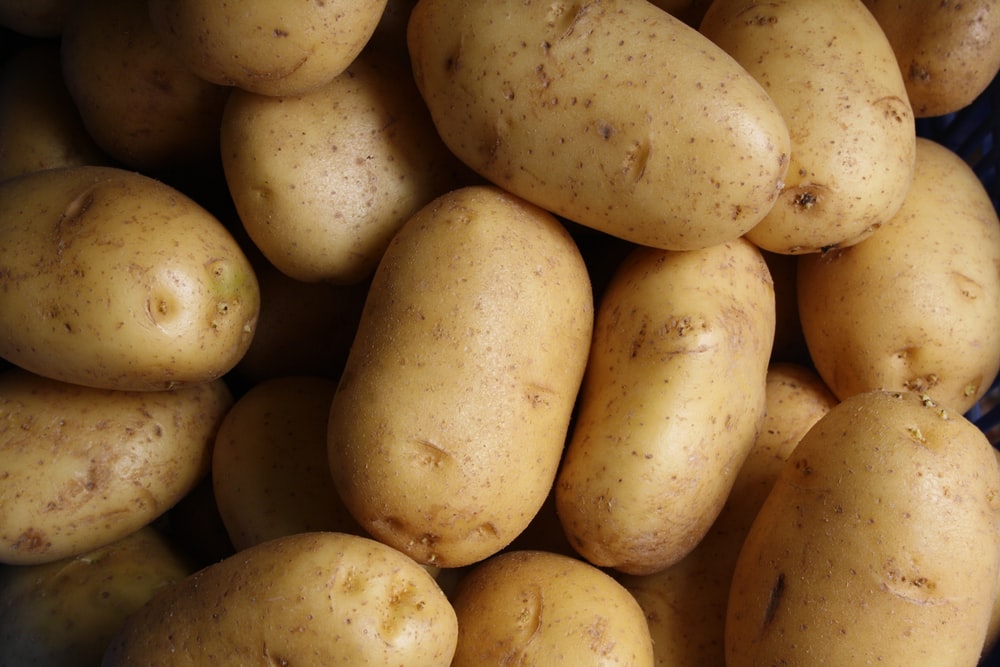
In this collection
We’ve got a National Potato Month (September) and a National Potato Day (August 19), but potatoes, frankly, are interesting (yes, and even fun) any time of the year.
Famous incidents in the life of the potato include Richard Dreyfuss’s mashed-potato sculpture in Close Encounters of the Third Kind; Dan Quayle’s career-crushing 1992 misspelling of POTATO(E); the debut (in 1952) of the perennially popular Mr. Potato Head; and the deciphering of the potato genome, which is when we discovered that potatoes have more genes than we do.
And, of course, there’s much more.

Rebecca Rupp’s How Carrots Won the Trojan War (Storey Publishing, 2011) – a reader-friendly overview of the history and science of garden vegetables from Asparagus to Turnip – includes a chapter on potatoes. Learn about Henry VIII’s favorite pie, Marie Antoinette’s potato-blossom hair-do, John Dillinger’s potato-based escape from jail, and the devastating 18th-century Potato War. Intended for adults, but there’s something interesting here for all.
Potato Tales

Aubrey Davis’s The Enormous Potato (Kids Can Press, 1999) is a re-telling of the familiar folktale in which a farmer grows the most enormous – say, potato – in the world, which requires the help of every person and creature in sight to unearth. Similar huge vegetable tales include Aleksei Tolstoy’s The Gigantic Turnip (Barefoot Books, 2009), Jan Peck’s The Giant Carrot (Dial, 1998), Cherie Stihler’s The Giant Cabbage (Sasquatch Books, 2003) and Dianne de las Casas’s The Gigantic Sweet Potato (Pelican Publishing, 2010). For ages 4-7.
For a lesson plan to accompany The Enormous Potato, see The Enormous Kinder Garden (subtitled “Books about planting enormous things”).
Check out books of world records of which there are many (famously, The Guinness Book of World Records, published annually) for the latest in record-breaking humongous vegetables.

In Tomie de Paola’s Jamie O’Rourke and the Big Potato (Puffin, 1997), Jamie – the laziest man in Ireland – is used to having his wife, Eileen, do all the work. Then Eileen wrenches her back and is laid up in bed, and it’s all over to Jamie – who captures a leprechaun and gets a seed for the biggest potato (pratie) ever. For ages 4-8.

In Michael Ian Black’s delightful picture book I’m Bored (Simon & Schuster, 2012), a bored little girl in pigtails is smacked down by an equally bored potato, who announces that kids are the ultimate in boring. Outraged, the girl sets out to show the potato how creative and fun kids can be, what with games, acrobatics, and imaginative pretend play, in which she becomes everything from a ballerina to a pirate. (“Boring,” the potato responds.) Reverse psychology with a twist for ages 3-8.
Illustrator Debbie Ohi’s website at https://debbieohi.com/resources/printready/printready-classroom-guides/ has activities to accompany I'm Bored. For example, kids write their own story pages, make potato prints, and learn to say "I'm bored" in a dozen different languages.

In John Coy’s Two Old Potatoes and Me (Dragonfly Books, 2009), with wonderful illustrations by Carolyn Fisher, a little girl is about to toss a pair of old sprouted potatoes into the trash, when her dad suggests that they plant them instead. They do, and raise a new crop of potatoes. The greater message has to do with conservation, intergenerational relationships, and the survival of family after divorce. For ages 5-8.

Kate Lied’s Potato: A Tale from the Great Depression (National Geographic Children’s Books, 2002) is a family story, originally written by an eight-year-old about her grandparents, Clarence and Agnes. When the Great Depression hit, Clarence lost his job – so they borrowed a car and drove to Idaho to work digging potatoes. A perk of the job was that they were allowed to dig leftovers to keep – and at the end of the harvest season, they headed home, loaded with potatoes to carry them through the winter. For ages 5-8.

In Anita Lobel’s Potatoes, Potatoes (Greenwillow Books, 2004), neighboring countries are at war and, rather than tending their crops and chickens, the people spend all their time making cannonballs, sharpening swords, and sewing buttons on soldiers’ uniforms. Except, that is, for one woman, who builds a wall around her little farm to protect her potatoes and her two sons. Eventually, however, the boys grow up and decide that they too want to become soldiers – and end up as commanders of opposing armies. When the war destroys their mother’s home, however, they realize the dreadful damage that they’ve done – and at last the war ends. A good discussion book for ages 5-8.

In Kathleen D. Lindsey’s Sweet Potato Pie (Lee & Low Books, 2008), set in the early 1900s, crops have failed due to drought and eight-year-old Sadie’s family is at risk of losing their farm. All that has survived are the sweet potatoes – so, in a bid to save their home, the whole family pitches in to make and sell sweet potato pies. A lovely family story for ages 5-9.
See this economics-based lesson plan to accompany the book, targeted at grades 1-3.
Try this recipe for sweet potato pie.

In Erin Berlin’s The Potato Chip Puzzles (Puffin, 2010), puzzle-lover Winston Breen and friends enter a puzzle competition sponsored by potato chip magnate Dmitri Simon in an attempt to win a huge cash prize for their school. The plot involves a zealous math teacher, a lot of brain-bending puzzles, and a dangerous saboteur. For ages 8-12.
Other puzzle-filled Winston Breen mysteries include The Puzzling World of Winston Breen (Puffin, 2009) and The Puzzler’s Mansion (Putnam Juvenile Books, 2012).

In Ellen Raskin’s The Tattooed Potato and Other Clues (Puffin, 2011), teenaged art student Dickory Dock takes a job as painter’s assistant at 12 Cobble Lane and ends up helping the painter and friends solve crimes. For ages 10 and up.

Bake a batch of Tattooed Potatoes.

Potatoes are about all there is to eat on the occupied island of Guernsey during World War II. Mary Ann Shaffer and Annie Barrows’s The Guernsey Literary and Potato Peel Pie Society (Dial Press, 2009) is a wonderful epistolary novel that begins when – just post-World-War-II – author Juliet Ashton gets a letter from Guernsey pig farmer Dawsey Adams, written because one of her books found its way into his hands. Juliet becomes increasingly involved with the islanders and their experiences under the Nazis – a story that is tragic, brave, and hopeful, with a lovely happy ending. For teenagers and adults.
Growing Potatoes

Ellen Weiss’s From Eye to Potato (Children’s Press, 2007) is an overview of the life cycle of the potato, with a simple text and terrific color photographs. For ages 4-7.

Rosalind Creasy’s Blue Potatoes, Orange Tomatoes (Sierra Club Books for Children, 2000) is a picture-book gardening guide to growing vegetables in out-of-the-ordinary colors – not only blue potatoes and orange tomatoes, but red popcorn, yellow watermelon, and purple string beans. For ages 6-9.

Ellen Rodger’s The Biography of Potatoes (Crabtree Publishing, 2007) is one of the How Did They Get Here? Series, each volume of which traces the history and global impact of such staples as chocolate, coffee, cotton, rice, rubber, sugar, tomatoes, wheat, wool – and, here, potatoes. The book, in 32 illustrated pages, covers the life and times of potatoes, from their origin in the Andes Mountains of Peru – the Incas grew them – through their impact on workers’ diets, the Irish potato famine, potato farming today, and modern potato products. For ages 7-11.

By Deborah Peterson and Millicent Selsam, Don’t Throw It, Grow It! (Storey Publishing, 2008) has instructions for growing 68 different windowsill plants from kitchen scraps – among them a potted potato. Fun for all.

In Michael Pollan’s The Botany of Desire (Random House, 2002), a fascinating discussion of the convoluted relationships between human beings and plants, the section on the potato covers the history of the potato and the way in which biotechnology – via genetic engineering – is changing the potato’s future. Highly recommended for teenagers and adults.
From Fordham University’s Modern History Sourcebook, Accounts of the Potato Revolution has a collection of primary sources on potatoes, dated 1695-1845.
From Smithsonian magazine, How the Potato Changed the World is a reader-friendly history of the potato and how it led to modern industrial agriculture. See https://www.smithsonianmag.com/history/how-the-potato-changed-the-world-108470605/.
The Potato Museum claims to have the world’s largest collection of all things potato.
Potato Chips

Gaylia Taylor’s George Crum and the Saratoga Chip (Lee & Low Books, 2011) is the picture-book story of the African-American/native American cook at Saratoga’s Moon’s Lake House who – frustrated by a customer who incessantly complained that his French fries weren’t cut thin enough – chopped potatoes paper-thin and invented the now-famous potato chip. For ages 7-11. See the accompanying Teacher's Guide.
Learn about hyperbolic paraboloids! Check out the Geometry of Pringles. See more
here.

Ship the Chip is an engineering challenge for ages 8-18 in which participants design a package that will protect a potato chip sent through the mail such that it arrives intact.
Mathematical Potatoes

Keith Baker’s Potato Joe (Harcourt Children’s Books, 2008) is a clever take on the traditional “One Potato, Two Potato” counting rhyme, featuring a lot of cheerful potatoes variously playing tic-tac-toe, in the snow, at a rodeo, and in the dirt underground, where potatoes grow. For ages 3-6.

Cynthia DeFelice’s One Potato, Two Potato (Farrar, Straus & Giroux, 2008) is a charming exercise in magic and math. Mr. and Mrs. O’Grady are so poor that they have just one of everything – until they find a mysterious pot that doubles whatever falls into it. For ages 5-8.

Though nothing to do with potatoes, a nice connection here is Edward Eager’s Half Magic (Sandpiper, 1999), originally published in 1954, in which four children find a coin that grants them wishes – but only half of every wish. A great impetus for learning how to multiply by two. For ages 8-12.

Greg Tang’s Math Potatoes (Scholastic Press, 2005) is one of a creative series of witty illustrated rhyming math picture books – beginning with The Grapes of Math (Scholastic, 2004) – that demonstrate quick tricks for solving arithmetic problems by grouping numbers. For ages 7 and up.
For interactive math puzzles and ebooks, and information on Tang's math program, visit Tang Math at https://tangmath.com/.
In Potato Olympics, a math lesson for grades K-8, kids measure potatoes, invent characters for their potatoes, decorate their potatoes, create literary pieces about their potatoes, and hold a math-based sports competition.
Science with Potatoes

Allen Kurzweil’s Potato Chip Science (Workman Publishing Company, 2010) is a book-and-kit combo that uses everything potato – including potatoes, potato chips, and potato chip containers – for 29 “incredible” experiments and projects, ranging from building a bird feeder to making potato-based fingerprint powder and a potato shrunken head. For ages 8-12.
From Science Buddies, How Greasy Are Your Potato Chips? is a science project on fats in chips, with a list of questions, background information, experimental procedure, and forms for collecting data and plotting graphs.

Steve Spangler’s Naked Eggs and Flying Potatoes (Greenleaf Book Group Press, 2010) is a collection of marvelous, messy, and irresistible science experiments, variously categorized under “The Power of Air,” “Kitchen Chemistry,” “Dry Ice,” “Gooey Wonders,” and “Don’t Try This at Home…Try It at a Friend’s Home!” The book is illustrated with color photographs and has complete instructions and explanations. The experiments are great, and at least two of them involve potatoes. For ages 8 and up.

Robert Gurstelle’s Backyard Ballistics (Chicago Review Press, 2001) has step-by-step instructions for building thirteen cheap, but thrilling, ballistic devices, from match rockets and tabletop catapults to fire kites and potato cannons. Included are explanations of the physics behind each device and profiles of such ballistic-savvy scientists as Robert Goddard and Sir Isaac Newton. With caution, for ages 9 and up.
For the science of spud guns (several kinds), see How Spud Guns Work.

Test for starch! And all you need is iodine. The Do It Yourself Starch Test has instructions, explanations, and some great pictures of starch-positive potatoes.

See Food Batteries, which adds some chemistry and lists questions to investigate. (Make a potato battery.)

The Potato Clock kit (Green Science) is powered by a pair of potatoes. See 
Scientists have sequenced the potato genome – and found that it has some 39,000 genes (about 10,000 more than you). Read about it here and
here.
From Penn State, Potato Mountain is a middle-grade lesson in reading and understanding topographic maps using a potato.
Potato Earth? A satellite-based image of how gravity varies over the surface of the Earth makes our planet look like a giant potato. Read about it here.

In Andy Weir's The Martian (Broadway Books, 2014) - an edge-of-your-seat read, packed with science - astronaut Mark Watney is stranded on Mars. And survives, in part, by growing - yes! - potatoes. For teens and adults.

The 2015 movie based on the book stars Matt Damon as Mark Watney. PG-13.
The Irish Potato Famine

Susan Campbell Bartoletti’s Black Potatoes: The Story of the Great Irish Famine, 1845-1850 (Sandpiper, 2005) is a compelling history of the horrific 19th-century Irish potato famine, a disaster with global implications. The book is 192 pages long, illustrated with period prints, maps, and a timeline, and including first-person anecdotes and accounts. For ages 12 and up.

Patricia Reilly Giff’s Nory Ryan’s Song (Yearling, 2002) is a fictionalized tale of the Irish potato famine, through the eyes of 12-year-old Nory Ryan, whose family has farmed and fished for generations on Ireland’s Maidin Bay. Then the famine strikes. Nory’s older sister leaves Ireland for New York; her father fails to return home from the sea; and Nory struggles to survive and ultimately to find her family a home in America. For ages 9 and up.
Nory’s story continues in Maggie’s Door (Yearling, 2005), in which Nory and her friend Sean Red Mallon, in alternating voices, tell the harrowing stories of their respective journeys to America; and Water Street (Yearling, 2008), set in 1875, and told in the alternating voices of Bird Mallon, Nory and Sean’s daughter, and her neighbor, young Thomas Neary.
Nory Ryan's Song at Carol Hurst’s Children’s Literature Site has discussion questions and activities to accompany Nory Ryan’s Song, along with a list of related books.

Cecil Woodham-Smith’s The Great Hunger (Penguin Books, 1991) is an excellent history of a terrible event. For older teenagers and adults.
At The History Place, Irish Potato Famine has a reader-friendly chronological history of the Famine with an extensive bibliography. For ages 12 and up.
Forced to Flee is a lesson plan on the Irish famine, targeted at grades 6-8.Also see
Hunger on Trial from the Zinn Education Project.
From the BBC, The Irish Famine covers the history and causes of the Irish potato famine.
Poetic Potatoes

Selected by Neil Phillip, Hot Potato: Mealtime Rhymes (Clarion, 2004) is a collection of 18 cheerful poems about food by such poets as Edward Lear, Mary Ann Hoberman, Douglas Florian, Lewis Carroll, and A.A. Milne.

Spud Songs: An Anthology of Potato Poems (Helicon Nine Editions, 1999), edited by Gloria Vando and Robert Stewart, is a nearly 200-page collection of potato poems by – among many others – X.J. Kennedy, Joyce Carol Oates, Seamus Heaney, and Denise Levertov. It’s currently out of print - check your local library. For teenagers and adults.
Kenn Nesbit’s Mashed Potatoes on the Ceiling is a must for vegetable avoiders.
See Pablo Neruda’s potato-loving 
Daniel Nyikos's Potato Soup begins “I set up my computer and webcam in the kitchen/So I can ask my mother’s and aunt’s advice/As I cook soup for the first time alone.”
Joseph Stroud’s The Potato is set in the Andes, original home of the potato.
Dancing potatoes. Read The Potato’s Dance by Vachel Lindsay.
Nobel laureate Seamus Heaney’s Digging makes a wonderful connection between potatoes and poetry.
A poem for gardeners: Amy King’s Digging Potatoes, Sebago, Maine.
See Leonard Nathan’s The Potato Eaters.
Art, Crafts, and Potatoes

The Potato Eaters, finished in 1885, is considered by many critics to be Vincent Van Gogh’s first great work of art. The Van Gogh Gallery has a brief history and analysis of the painting.
From the WAH Center in Brooklyn, NY, the Potato Revolution is an exhibition of contemporary potato art, of which there is a surprising amount.
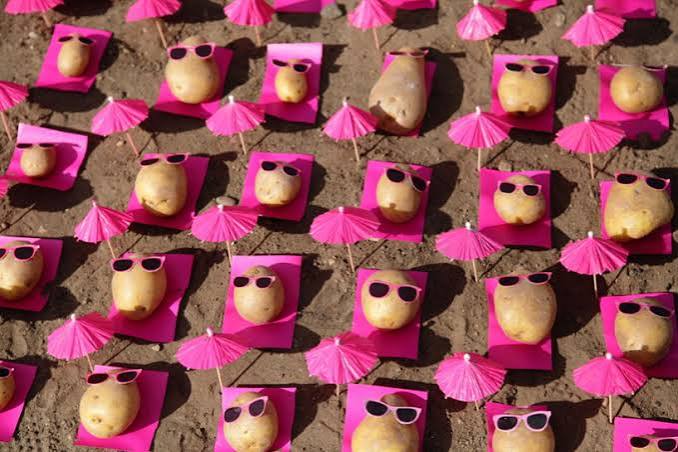
Self-described "nonsense maker" Peter Pink is known for installation displays of very cool potatoes in pink sunglasses.
See https://www.designboom.com/art/urban-food-art-installations-by-peter-pink/.

Make potato prints! See https://www.clumsycrafter.com/printing-with-potatoes/,

Try a dot art tiny-potato-print project suitable for preschoolers.
Mr. Potato Head
Mr. Potato Head, who first went on the market in 1952, is still going strong - and in many permutations, among them Darth Tater, complete with helmet and light saber. Back in the day, Mr. Potato Head was the first toy to be advertised on TV.

Funny Face! by Mark Rich and Jeff Potocsnak (Krause Publications, 2002) is a fascinating and heavily illustrated short history of potato heads and related toys. For teenagers and adults, but the pictures are great for all ages.
Owners of the original Mr. Potato Head had to supply their own (real) potatoes. Read all about it here.

Don Wulffson’s Toys! Amazing Stories Behind Some Great Inventions (Henry Holt and Company, 2000) is a catchy history of such classic toys as slinkies, seesaws, silly putty, bicycles, checkers, kites, and Trivial Pursuit – and, of course, Mr. Potato Head. With black-and-white cartoon illustrations, for ages 9 and up.

Templates and instructions for making a felt Mr. Potato Head Quiet Book can be found 

Make a steampunk Mr. Potato Head. You'll need, among other things, Sculpey clay, metal dohickeys, and copper-colored acrylic paint.
How Not to Spell Potato

Ouch. Dan Quayle's fatal potatoe spelling mistake can be viewed in this YouTube clip.