
Nutrition: Good Eats!
In this collection
A classic New Yorker cartoon of 1928 shows a sullen little girl and her mother sitting at the dinner table. “It’s broccoli, dear,” the mother says hopefully. The daughter retorts “I say it’s spinach and I say the hell with it.”
We’ve all been there with something. Peas. Whole-wheat pasta. Cheese. Inveigling kids into decent diets isn’t always a bowl of organic cherries.
Luckily there are a lot of delightful and encouraging books and resources on the topic of healthy eating – a subject that is garnering a lot of attention right now, what with the upsurge in childhood obesity and the growing interest in local and organic foods. Take a look at some of these:
How Carrots Won the Trojan War

My non-fiction book, How Carrots Won the Trojan War (Storey Publishing, 2011) is a catchy science and history of garden vegetables. It’s an adult book, but is packed with stories and information adaptable for a wide range of educational and just plain interesting purposes. Find out, for example, about the Burmese Cucumber King, Henry Ford’s carrot obsession, and the pirate who discovered bell peppers, and discover what corn had to do with Dracula and why pumpkins sometimes explode.
Picky and Not-so-picky Eaters

In Dr. Seuss’s Green Eggs and Ham (Random House, 2005), the narrator will not – absolutely WILL NOT – eat green eggs and ham. Until he finally tries them. A great book for picky eaters ages 3-7.

In Stan and Jan Berenstain’s The Berenstain Bears and Too Much Junk Food (Random House, 1985), Brother and Sister Bear are hooked on sweets and other unhealthy snacks – and they’re getting chubby. Mama Bear, with some back-up from Dr. Grizzly, helps them change their eating habits. For ages 3-7.

In Mitchell Sharmat’s Gregory the Terrible Eater (Scholastic, 2009), Gregory, a little goat, spurns normal goat foods – tin cans, shoes, rubber tires – in favor of healthful fruits and vegetables. His appalled parents take him to the doctor. For ages 4-8.

Frances, the endearing little badger of Russell Hoban’s Bread and Jam for Frances (HarperCollins, 2008) decides to eat nothing for breakfast, lunch, and dinner but her favorite bread and jam. Her parents go along with it – and Frances finally discovers that she’s awfully sick of jam. For ages 4-8.

In Lauren Child’s wonderful I Will Never Not Ever Eat a Tomato (Candlewick, 2003), big brother Charlie – who has a much more creative take on food than “It’s broccoli, dear” – convinces his picky little sister Lola to eat by reinventing carrots as orange twiglets from Jupiter, mashed potatoes as cloud fluff from the top of Mount Fuji, and fish sticks as Ocean Nibbles. (Mermaids eat them!) For ages 4-8.

In Alice Weaver Flaherty’s The Luck of the Loch Ness Monster (Houghton Mifflin Books for Children, 2007), young Katerina-Elizabeth, on a transatlantic trip to visit her grandmother in Scotland, tosses her healthy but hated breakfast oatmeal overboard every morning. Her oatmeal is promptly gobbled up by a small sea worm, who grows to monstrous size and ultimately follows Katerina-Elizabeth’s ship up the River Ness, where it makes itself at home in a Scottish lake. For ages 4-8.
For info on the bennies of oatmeal for breakfast, see NPR’s A Better Breakfast Can Boost a Child’s Brainpower.

In Marc Brown’s D.W. the Picky Eater (Little, Brown Books for Young Readers, 1997), Arthur’s little sister won’t eat anything with eyes, or pickles, tomatoes, mushrooms, eggplant, pineapple, parsnips, cauliflower, or liver (never), or - especially - spinach. (“Face it,” said Arthur. “You are a picky eater.”) D.W.’s eating habits cause all kinds of trouble until, at her grandmother’s birthday dinner, she orders Little Bo Peep Pie – and enjoys every bite before discovering that it’s made of…spinach. For ages 4-8.

The seven Peters children, of Mary Ann Hoberman’s rhyming picture-book The Seven Silly Eaters (Sandpiper, 2000) are all picky eaters: Peter insists on milk of the proper (just-warm) temperature; Lucy demands homemade lemonade; Jack eats nothing but applesauce; Mac wants his oatmeal strained. The harried Mrs. Peters struggles to cope – and then, for her birthday, the picky seven solve all their problems by making a very imaginative multi-ingredient birthday cake. For ages 5-9.

In Fat Men from Space by the incomparable Daniel Pinkwater (Yearling, 1980), overweight alien invaders in knit ties arrive and devour all the junk food on earth, planning to enslave the populace and force them to make more. William, forewarned of their intentions by picking up radio transmissions through a filling in his tooth, helps foil the plot – but once the invaders are gone, there’s nothing left to eat but vegetables, milk, and whole-grain bread. For ages 8-11.

James Solheim’s It’s Disgusting and We Ate It! (Aladdin, 2001) is a (true) account of off-putting foods from around the world and throughout history, from Australian witchetty grubs to Magellan’s rat stew. For ages 8-12.
Healthy Eating

Juana Medina’s 1 Big Salad (Viking, 2016) is a clever counting book of animated salad veggies, starting with one avocado deer and two radish mice. For ages 3-6.

Where does our food come from? Nikki McClure’s To Market, To Market (Harry N. Abrams, 2011) follows a boy and his mother as they shop at the local farmer’s market – learning from each farmer about the origins of each food (honey, cheese, kale). For ages 4-7.

Marjorie Priceman’s How to Make an Apple Pie and See the World (Dragonfly, 1996) is a whirlwind tour of the world in search of the ingredients for an apple pie. Recipe included. For ages 4-8. Also by Priceman, see How to Make a Cherry Pie and See the U.S.A. (2013).

Aliki’s Corn Is Maize: The Gift of the Indians (HarperCollins, 1986), one of the Let’s-Read-and-Find-Out Science series, explains how an unpromising wild grass became one of the worlds’s most important food crops. For ages 4-8.

By Chris Butterworth, How Did That Get in My Lunchbox? (Candlewick, 2011) answers questions kids have about where food comes from: Where did the bread in my sandwich come from? What about the cheese? The chocolate in my cookie? For ages 5-8.

Loreen Leedy’s The Edible Pyramid: Good Eating Every Day (Holiday House, 2007) is a re-issue of an old favorite, now featuring the updated (vertically striped) food pyramid from the U.S. Department of Agriculture. The Edible Pyramid is a restaurant where hungry animal customers (including a chocolate-fudge-craving hippo) are helped with their menu choices by a nutrition-savvy cat waiter. For ages 4-8.

Lizzy Rockwell’s Good Enough to Eat: A Kid’s Guide to Food and Nutrition (HarperCollins, 2009) is a cheerfully illustrated guide to healthy eating, variously covering essential nutrients, food groups, the digestive process, the definition of a calorie, and the importance of a good breakfast. There’s also an explanation of just why you can’t live on candy and a handful of healthy kid-friendly recipes. For ages 5-9.

Edward Miller’s humorously illustrated The Monster Health Book (Holiday House, 2008) features a fat chartreuse monster making healthy food and lifestyle choices. The book covers food groups, nutrition, calories, exercise, and other assorted health issues. Included are lots of fun food facts. For ages 7-10.

Eric Schlosser and Charles Wilson’s Chew on This: Everything You Don’t Want to Know About Fast Food (Sandpiper, 2007) is an adaptation of Schlosser’s best-selling Fast Food Nation for kids. Packed with information and fascinating facts, it’s an eyeopener. Be prepared to go off Chicken McNuggets forever. For ages 11-14.

Food, Inc., a film documentary based on the Schlosser’s book and on Michael Pollan’s The Omnivore’s Dilemma (Penguin, 2007) is available from Netflix and Amazon.com. Rated PG.

Michael Pollan’s The Omnivore’s Dilemma for Kids: The Secrets Behind What You Eat (Dial 2009) is a shortened version of the superb adult book, similarly divided into four sections covering “The Industrial Meal,” “The Industrial Organic Meal,” “Local Sustainable,” and “The Do-It-Yourself Meal,” which last involves hunting and gathering. For ages 12 and up.
Also by Pollan, see In Defense of Food: An Eater’s Manifesto (Penguin, 2009).

David A. Kessler’s Your Food is Fooling You (Roaring Brook, 2012) explains how our brain chemistry is altered by consuming foods high in sugar, fat, and salt – and how this leads to overeating. Targeted at teens.

Ruby Roth’s That’s Why We Don’t Eat Animals (North Atlantic Books, 2009) is a book about veganism and vegetarianism, factory farms, and the impact of meat-eating on the environment for ages 7-11. No matter what your lifestyle, the ethics of meat-eating is an issue worth discussing.

How to Teach Nutrition to Kids by nutritionist/educator Connie Evers (24 Carrot Press, 2006) is a 200+-page compendium of information and activities for ages 6-12, with nutritional connections to language arts, science, social studies, the performing arts, cooking, and physical education. Visit the How to Teach Nutrition to Kids website for additional information, games and activities for kids, and a newsletter.
Carol Hurst’s Children’s Literature Site has instructions and fill-in-the-blank forms for a library Nutrition Book Hunt, in which kids are challenged to track down picture books or novels featuring fruits, vegetables, grains, meats, beans, eggs, or nuts. (Suggested answers included.)
Hot Off the Vine

Anne Rockwell’s One Bean (Walker, 1999) covers the life cycle of a bean in child-friendly fashion. Get a bean and a paper cup and plant along. For ages 3-6.

Ruth Krauss’s The Carrot Seed (HarperCollins, 2004), originally published in 1945, is the story of a little boy who plants a carrot seed - after which everyone tells him that it will never come up. Still, his faith and dedication never falter, and eventually he harvests a truly spectacular carrot. For ages 3-8.

In Lois Ehlert’s brilliantly illustrated Growing Vegetable Soup (Sandpiper, 1991), a child and father plant and tend a garden, harvest the vegetables, and cook up a pot of vegetable soup. A soup recipe is included. For ages 3-8.

Janet Stevens’s Tops & Bottoms (Harcourt Children’s Books, 1995) is a trickster tale that shows the advantages of knowing one’s veggies. Hare and Bear make a deal: Hare will farm Bear’s land and they’ll split the crops. Bear just has to choose: does he want tops or bottoms? When hapless Bear picks tops, Hare plants carrots and radishes; when Bear picks bottoms, Hare plants celery and lettuce. Funny, clever, and a lesson learned at the end. For ages 4-8.

The Vegetables We Eat by Gail Gibbons (Holiday House, 2008) covers eight groups of vegetables, with lush illustrations and scenes of garden, farm, and supermarket. Text is straightforward and unexciting (“It is good for us to eat vegetables”), but the pictures compensate. For ages 4-8.

In Susan Grigsby’s First Peas to the Table (Albert Whitman & Company, 2012) , Maya and her classmates plant a school garden and race to see who can produce the first peas – just like Thomas Jefferson and neighbors did in Jefferson’s annual pea contest. For ages 5-8.

Rosalind Creasy’s Blue Potatoes, Orange Tomatoes (Sierra Club Books for Children, 2000) is a picture-book guide to planting a “rainbow garden” filled with unusually colored plants. Who wouldn’t want to grow purple beans? For ages 6-9.
Veggie Math and Science

Greg Tang’s Math Potatoes (Scholastic, 2005) is a collection of catchy rhyming arithmetic puzzles, variously involving onions, pickles, potatoes, peanuts, and more. For ages 7-10.
For printable fruit and vegetable counting and arithmetic worksheets, see the Enchanted Learning website.

Kathleen M. Reilly’s Food: 25 Amazing Projects (Nomad Press, 2010) is an information-packed activity guide covering food history, culture, and science, with “Words to Know” lists, fact boxes, and hands-on experiments. Study gravity with beans, snack on fried dandelions, and make your own marshmallows. For ages 9-12.
Veggie Power! has illustrated instructions for making batteries with vegetables and fruits.

From TOPS Learning Systems, Green Thumbs: Radishes for grades 3-8 and Green Thumbs: Corn and Beans for grades 4-12 are terrific hands-on life science units, with complete illustrated instructions, reproducible lab journal pages, extension activities, and far better-than-average experiments that require (really) very simple, but creative, equipment. Highly recommended.
Veggies and the Arts - Play with Your Food?
Food and Nutrition Songs has dozens of ditties on everything from beans to zucchini. Learn, listen, sing along.
The Vegetable Orchestra plays instruments made solely from fresh vegetables. See them in action on
You Tube.
See Vegetable Instruments for instructions for making many, including a carrot kazoo, watermelon drum, and radish clarinet.

What if the world were made of food? Photographer Carl Warner’s A World of Food: Discover Magical Lands Made of Things You Can Eat (Harry N. Abrams, 2012) is a marvelous collection of color-coded miniature landscapes made entirely of edibles. “Orange,” for example, is an intricate tiny world of pumpkin cottages and carrot trees. All ages.

Deborah Zemke’s Super Hero Food Doodles (Blue Apple Books, 2010) is a spiral-bound collection of step-by-step instructions for doodling such zany fruits and veggies as The Tomatonator, Colonel Kernels, and Alien Allium. Tear the pages out of the book and use them as place mats at a vegetable lunch. For ages 8 and up.
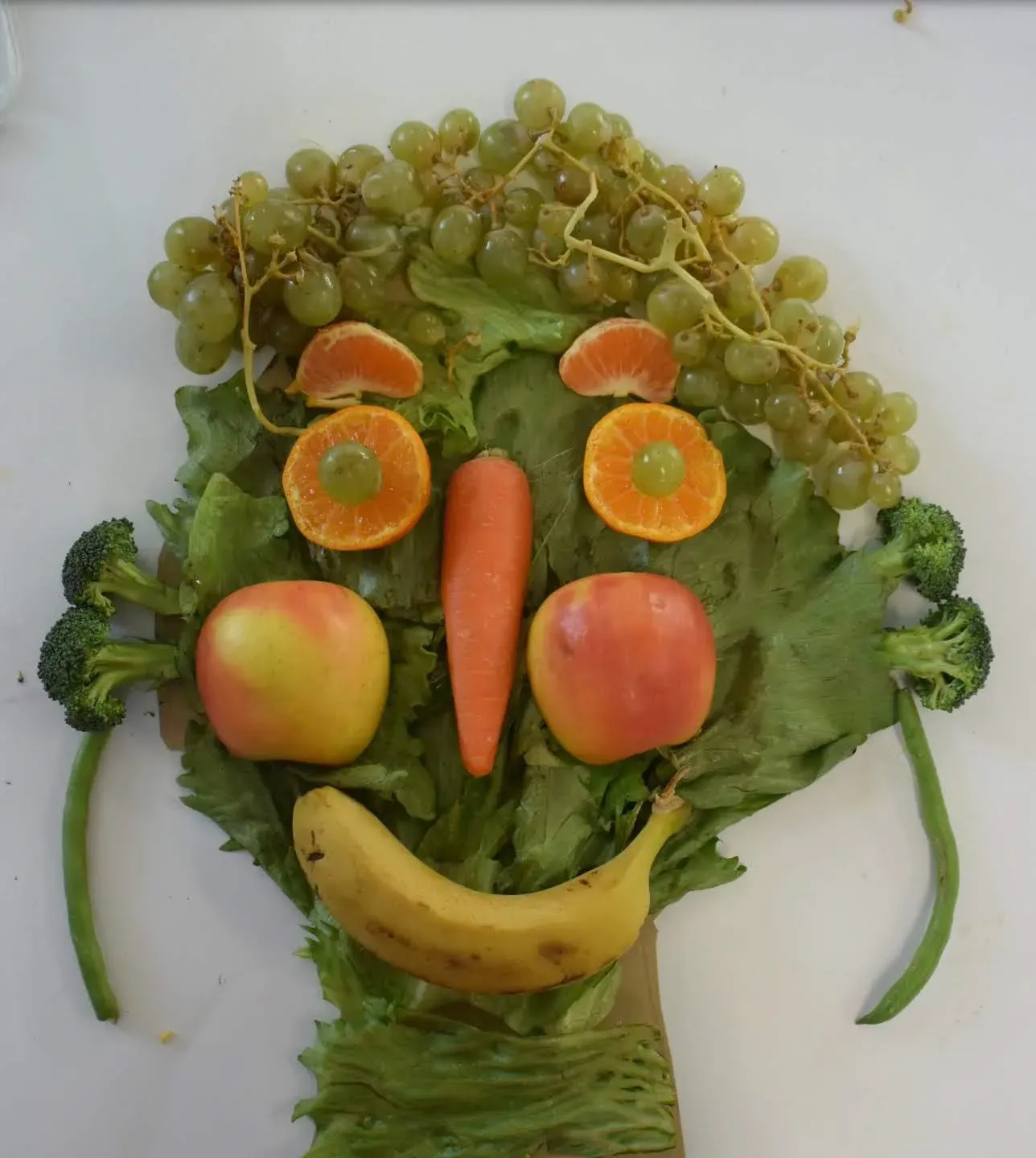
From Primary School Art, see Food Faces, a project based on the veggie-based portraits of 16th-century Italian artist Giuseppe Arcimboldo at https://primaryschoolart.com/2019/09/26/guiseppe-arcimboldo-food-portraits-year-3-4/.
From Creative Educator, also see the Arcimboldo-Style Self-Portraits project for grades 2-8 at https://creativeeducator.tech4learning.com/2020/lessons/arcimboldo-style-self-portraits.
From Smithsonian magazine, see Arcimboldo's Feast for the Eyes at https://www.smithsonianmag.com/arts-culture/arcimboldos-feast-for-the-eyes-74732989/ for more information on Giuseppe Arcimboldo and his portraits.
Make your own fruit and vegetable paints! See Nature Art for Kids or
Paint Made from Berries.
Next up: Gardening!