
Beautiful Soup
In this collection
January is NATIONAL SOUP MONTH. (Though of course anytime is just fine for soup.)
See below for soup stories, soup poems, mathematical soups, scientific soups, and artistic soups (well, soup cans); find out how to volunteer at a soup kitchen; and learn about life's (possible) origin in primordial soup. And much much more...
Soup Starters
Soupsong, a large and multifaceted website wholly devoted to soup, covers soup myths, folktales, and poems; soup in the movies and in art; soup history; soup in the news; soup etiquette; and many international and historical recipes for soups. There’s even a list of Deathbed Soups, and – under Soup Songs – the complete lyrics to “Who Threw the Overalls in Mrs. Murphy’s Chowder?”

Patricia Solley’s An Exaltation of Soups (Clarkson Potter, 2004) is a fascinating compendium of all things soup, packed with history, folklore, quotations, and a host of international recipes. For teenagers and adults.
Soup Stories

In Melissa Iwai’s Soup Day (Henry Holt and Co., 2010) – illustrated with bright collages - a snowy day is declared “soup day,” and a little girl and her mother go to the market for vegetables, prepare a pot of soup, spend a cozy afternoon reading and playing, and then share a soup supper when Daddy comes home. Included is a recipe for Snowy Day Vegetable Soup. A homey read for ages 3-6.

In Lois Ehlert’s brilliantly illustrated Growing Vegetable Soup (Sandpiper, 1991), a child and parent plant, water, weed, and harvest a garden full of gorgeous vegetables, and finally make a pot of vegetable soup. A recipe for soup is included. For ages 4-8.

In the story “Birthday Soup” in Else Holmelund Minarik’s Little Bear (Harper Trophy, 1978), Little Bear is convinced that his absent mother has forgotten his birthday. Since he has carrots, potatoes, peas, and tomatoes, he decides to make Birthday Soup for his friends – but just as he, Hen, Duck, and Cat gather around the table, Mother Bear arrives with a beautiful cake. For ages 3-7.

In Scott Gustafson’s lushly illustrated Alphabet Soup (Greenwich Workshop Press, 1994), Otter invites 26 alphabetical animal friends to a housewarming party, each to bring an ingredient for soup. All do, from Armadillo (asparagus) to Zebra (zucchini). A lot of wonderful language – Unicorn, for example, brings useful utensils, transported via unicycle in an upside-down umbrella. For ages 4-8.

In Susan Meddaugh’s Martha Speaks (Houghton Mifflin Harcourt, 1992), Martha, the family dog, eats a bowl of alphabet soup – and suddenly she can talk. The problem: sometimes Martha talks too much. Many funny sequels, for ages 4-8.

In Betsy Everitt’s Mean Soup (Sandpiper, 1995), Horace has had a horrible day. (Zelda sent him a love note. The show-and-tell cow stepped on his foot.) He arrives home in a mean mood, so his creative and sympathetic mother suggests they collaborate on a cathartic pot of Mean Soup. After yelling at the soup, making faces at the soup, and even (well, yes, unsafely) banging on the soup pot, Horace’s mean mood has been stirred away. For ages 3-8.

Mercer Mayer’s Snowball Soup (HarperCollins, 2007), an I Can Read Book, features the Little Critter characters making lunch for their snowman. Suggested activity to accompany this one: invent your own soup recipes to feed hungry snowmen. For ages 4-7.
Check out recipes for Snowman Soup - actually hot chocolate with marshmallows. For example, see Glorious Treats at https://www.glorioustreats.com/snowman-soup/.

In Arnold Lobel’s Mouse Soup (HarperCollins, 1983), a mouse has been nabbed by a hungry weasel, who plans to turn him into Mouse Soup – but the quick-thinking mouse, by means of four clever stories, convinces the weasel that he needs many additional ingredients for soup (among them bees, crickets, and a thorn bush). The gullible weasel heads off on a disastrous collecting expedition, while the mouse heads happily home to have supper and finish reading his book. For ages 4-8.

In DyAnne Disalvo-Ryan’s Uncle Willie and the Soup Kitchen (HarperCollins, 1997), a young boy helps at the soup kitchen where his Uncle Willie volunteers daily – because, Willie explains, sometimes “people need help.” A Reading Rainbow selection. For ages 4-8.
From the Smithsonian’s Food & Think blog, Count Rumford and the History of the Soup Kitchen is the story of the first real soup kitchen, established in the mid-18th century to feed the beggars of Munich.
For background information and guidelines for becoming a soup kitchen volunteer, see How to Volunteer at a Soup Kitchen from the How Stuff Works website.

In Helen Cooper’s Pumpkin Soup (Square Fish, 2005), buddies Cat, Duck, and Squirrel live happily together in a little white (pumpkin-shaped) cabin in the woods, where they collaborate on music (Cat plays the bagpipes) and cooking pumpkin soup. One day a squabble breaks out over who adds what to the soup, and angry Duck packs up his wheelbarrow and leaves in a huff. Soon Cat and Squirrel miss him – and when he finally returns, all have learned a lesson about the value of friendship (and the importance of taking turns). Included is a recipe for Pumpkin Soup. Further soup stories featuring Cat, Duck, and Squirrel are Delicious! (Farrar, Straus & Giroux, 2007) and A Pipkin of Pepper (2008). For ages 4-8.

In Jackie Urbanovic’s Duck Soup (HarperCollins, 2008), Maxwell Duck – a master chef of soups, creator of Red HOT Chili Soup, Cracker Barrel Cheese and Marshmallow Soup, and Way Way Too Many Beans Soup – has embarked on a soup masterpiece. Just as he goes to the garden for a missing herb, however, three friends stop by. Spotting a floating feather in the simmering soup, they fear the worst and embark on an hysterical search. For ages 4-8.

Charlotte Huck’s Princess Furball (Greenwillow Books, 1994) is a Cinderella tale, with soup. The motherless princess, whose greedy father plans to marry her off to a wealthy ogre, escapes, disguised in her coat (made from the fur of a thousand animals), and taking with her three dresses, three golden tokens belonging to her mother, and a packet of special soup seasoning. Hired to work in the palace kitchen of a neighboring kingdom, Furball manages to attend three balls, each time dropping a golden token in the prince’s soup. The prince discovers that the mysterious token-dropping guest is Furball, declares his love, and the two live happily ever after. For ages 4-8.

Katie Speck’s comical short chapter book Maybelle in the Soup (Henry Holt and Co., 2007) features Maybelle, a charming cockroach – she wears pearls and a pink bow – who lives, discretely, under the refrigerator in the home of Myrtle and Henry Peabody. Disaster strikes when the snooty Mr. and Mrs. Snodgrass come to dinner – and Maybelle, who simply can’t resist a taste, falls into the turtle soup. Sequels are Maybelle Goes to Tea (2008) and Maybelle and the Haunted Cupcake (2012). For ages 6-10.

By Kate DiCamillo, The Tale of Despereaux: Being the Story of a Mouse, a Princess, Some Soup and a Spool of Thread (Candlewick, 2006) features – along with the title character, a little mouse with too-big ears – the beautiful Princess Pea, whom Despereaux adores; Roscuro, a soup-loving rat, and Miggery Sow, a dimwitted orphan girl, who dreams of taking the place of the princess. Soup plays an essential part in the story, especially when Roscuro, dangling from the palace chandelier, falls into the queen’s bowl of soup, which causes the queen to die. A wonderful read for ages 7 and up.

In the computer-animated movie version of The Tale of Despereaux (2008), Despereaux is voiced by Matthew Broderick, Roscuro by Dustin Hoffman, Princess Pea by Emma Watson, and Miggery Sow by Tracy Ullman. Rated G.

Robert Newton Peck’s Soup (Yearling, 1998) is an autobiographical account of Peck’s childhood experiences in rural Vermont in the 1920s – along with his best friend Soup, a genius at getting the two of them into trouble. (Soup’s real name is Luther, to which he refuses to answer. But he always responds when his mother yells “Soup’s on!”) There are several sequels. For ages 8-11.

In Sharon Creech’s Granny Torrelli Makes Soup (HarperCollins, 2005), twelve-year-old Rosie and her best friend, Bailey (“that Bailey boy”) – who is legally blind – have had a rift, and just because Rosie has learned to read Braille. Through cooking, stories, and good advice, Granny Torrelli teaches the two some lessons about lasting friendship. For ages 9-13.
Stone Soup
There are many versions of “Stone Soup,” the traditional folktale about hungry strangers persuading stingy townspeople to feed them by making what looks like a wholly inedible pot of soup.

In Marcia Brown’s Caldecott-winning Stone Soup (Aladdin, 1997), originally published in 1947, three soldiers trudging home from the war come to a little French village, where the peasants rush to hide their food – until the clever soldiers begin to prepare a batch of Stone Soup. Soon everyone comes forward to offer ingredients, and in no time there’s a wonderful feast and a town party. For ages 4-8.

In Heather Forest’s Stone Soup (August House, 2005), two tattered travellers come to a mountain village where – denied food – they announce that they can make soup from a stone. But they’ll need a carrot – and perhaps, a potato. Soon there’s a delicious pot of bubbling soup – though Forest (over)drives the message home by emphasizing the “magic ingredient” of sharing. Included is a recipe for Stone Soup: you’ll need a large stone, a pot, a lot of friends, vegetables, and sharing. For ages 4-8. See a video version here.

In Jon Muth’s Stone Soup (Scholastic, 2003), the story is set in China and the hungry travellers are Buddhist monks. For ages 4-8.

Ying Chang Compestine’s The Real Story of Stone Soup (Dutton Juvenile Books, 2007) explains that stone soup was invented in China. The story is told in the first person by a fisherman, who complains of his helpers – the lazy and stupid Chang boys – who, as it turns out, are anything but. In fact, the clever trio manages to trick their employer as – claiming it’s all from stones – they produce a yummy pot of fish soup. The humor lies in the disparity between the text, told from the point of view of the lounging fisherman, and the pictures of the smart and busy boys. Included is a recipe for Egg Drop Stone Soup. For ages 5-9.

Eric A. Kimmel’s Cactus Soup (Amazon Children’s Publishing, 2011) is a Mexican version of the Stone Soup tale. When hungry Zapatistas ride into the little town of San Miguel, the inhabitants hurry to hide their stores of food – but the undaunted Capitan offers to make soup from a single cactus spine. This would, of course, be far tastier with onions, chiles, beans, and chicken – and soon there’s a wonderful collaborative meal and a fiesta. For ages 5-9.

In Eric Madden’s Nail Soup (Frances Lincoln Children’s Books, 2009), a poor Traveller begs a bed for the night at a curmudgeonly woman’s cottage – where he convinces her to feed him supper by starting a pot of soup made from a single rusty nail. The illustrations, by Paul Hess, are terrific. For ages 5-9.

In Aubrey Davis’s Bone Button Borscht (Kids Can Press, 1996) – a Stone Soup story with an Eastern European setting – a poor beggar arrives at the town synagogue and offers to make a pot of soup with the bone buttons from his coat. The conclusion: good soup and friendly neighbors. For ages 5-9.
From YouTube, “The Wonderful Soup Stone” is a rendition of Shel Silverstein’s song about his momma’s kitchen, back in the “hard time days.”

By Jane Yolen and Heidi E.Y. Stemple, Fairy Tale Feasts (Interlink Publishing Group, 2009) – a “literary cookbook” – is a collection of 20 familiar fairy tales, each paired with a recipe. Among these: a recipe for Stone Soup. For ages 5-11.
Chicken Soup

Maurice Sendak’s Chicken Soup with Rice: A Book of Months (HarperCollins, 1991), originally published in 1962, is as catchy now as ever. (“In January/it’s so nice/while slipping/on the sliding ice/to sip hot chicken soup/with rice.”) What better way to learn the months of the year? For ages 4-8.

In Esther Hershenhorn’s Chicken Soup by Heart (Simon and Schuster Books for Young Readers, 2010), Rudie’s elderly babysitter, Mrs. Gittel, is sick with the flu, so Rudie decides to make her a batch of Mrs.-Gittel-style chicken soup – flavored with Mrs. Gittel’s special ingredient, stories. As he and his mother cook, he tells (charming) stories about his friendship with Mrs. Gittel. The soup does the trick, and soon after, when Rudie has a tummy ache, Mrs. Gittel returns the favor, flavoring the soup with a story about “how such a nice boychik saved the Chicken Soup Queen.” For ages 4-8.
Chicken soup for colds? The most commonly cited study on the medical efficacy of chicken soup is that of Stephen Rennard of the University of Nebraska Medical Center, who tested his wife’s homemade soup on patients with colds. Chicken soup, he found, reduced cold symptoms, possibly by inhibiting the movement of white blood cells that defend against infection. Read about it at “The Science of Chicken Soup,” from the New York Times.

By Jack Canfield and Mark Victor Hansen, Chicken Soup for the Soul (Health Communications, Inc., 1993), a collection of 101 short inspirational and uplifting stories, has spawned dozens of sequels, including Chicken Soup for the Teenage Soul, Chicken Soup for the Child’s Soul, and chicken soup for practically everybody’s soul.
Making Soup

Mollie Katzen’s charmingly illustrated Pretend Soup and Other Real Recipes (Tricycle Press, 1994) is a delight for just-beginning cooks – safety tips, step-by-step illustrations, and, as promised, nineteen real recipes, among them Pretend Soup (a yummy mix of orange juice, yogurt, and fruit), Zucchini Moons, Green Spaghetti, Hide-and-Seek Muffins, and Bagel Faces. Sequels are Salad People and More Real Recipes (2005) and Honest Pretzels (2009). For ages 3-6 (plus adult).

Virginia Ellison’s Winnie-the-Pooh Cookbook (Dutton Juvenile Books, 2010) is filled with Eugene Shepard illustrations, Pooh quotations, and kid-friendly recipes, including several for soups. Try Pea-Bean Alphabet Soup (and add lots of Ps, for Pooh and Piglet). For ages 7 and up.

Fans of Brian Jacques’s Redwall series know that the animals of Redwall Abbey love to feast. Jacques’s The Redwall Cookbook (Philomel, 2005) has everyone’s favorite recipes from the book, categorized by season. Learn how to make the Abbot’s Special Abbey Trifle, Great Hall Gooseberry Fool, Summer Strawberry Fizz, and the otters’ favorite Shrimp ‘n’ Hotroot Soup. For ages 8 and up.

Straight from the Roald Dahl books, with witty illustrations by Quentin Black, comes Roald Dahl’s Revolting Recipes (Puffin, 1997). Included along with the Eatable Pillows, Stink Bugs’ Eggs, and Snozzcumbers is a recipe for Green Pea Soup from The Witches. For ages 8 and up.
From Cooking with Kids, Vegetable Soup Mix is a good project for beginning soup cooks: kids measure and combine dry ingredients to make a soup mix; then use their mix to cook vegetable soup.

Make Soup in a Jar.
Multicultural Soup

In Norah Dooley’s Everybody Serves Soup (First Avenue Editions, 2004), Carrie travels around her multicultural neighborhood shoveling snow, in hopes of earning enough money to buy her mother a Christmas present. Each house is cooking a different kind of soup – Puerto Rican chuleton, Italian lentil soup, Southern corn chowder, Japanese miso shiru. All seven soup recipes are included in an appendix. In the same format, see Dooley’s Everybody Bakes Bread, Everybody Cooks Rice, and Everybody Brings Noodles. For ages 6-9.

In Jama Kim Rattigan’s Dumpling Soup (Little, Brown Books for Young Readers, 1998), every New Year’s Eve, Marisa’s very mixed Hawaiian/Korean/Japanese family gathers at grandmother’s house to make a traditional pot of dumpling soup. Included is a helpful glossary of Hawaiian, Japanese, and Korean words. For ages 4-8.

In Tomie dePaola’s Watch Out for Chicken Feet in Your Soup (Aladdin, 1985), Joey is worried about introducing his friend Eugene to his old-fashioned Italian grandmother – but Eugene adores his visit, including his bowl of zuppa, with chicken feet. For ages 5-9.

The Silver Spoon for Children (Phaidon Press, 2009) is a delightfully illustrated collection of 40 kid-friendly Italian recipes. Learn how to make fresh pasta, focaccia, Fruits of the Forest ice cream, and some delicious Italian zuppas. For ages 8 and up.
Poetic Soup

Calef Brown’s Soup for Breakfast (Houghton Mifflin Books for Children, 2008) is an illustrated collection of eccentrically delightful poems, among them the soup-themed “Soup for Breakfast.” For more poems and pictures by Brown, see Flamingos on the Roof (2006). For ages 8-12.

Larry Fagin’s The List Poem (Teachers & Writers Collaborative, 2000) is a book of poetry exercises and projects for aspiring writers. Among these is an activity in which kids write “recipe poems” based on recipe-style lists of ingredients: samples included “Recipe for Martin Luther King, Jr.” (“7 gallons of love/10 cups of courage/10 cups of caring...”) and a recipe for “King Midas Touch” (“1 pound egg shells/2 pounds of mosquitoes (bones removed)/1 purple duck with polka dots...”). Projects can be used with kids of a wide range of ages. Try inventing some imaginative soups.
Read the cautionary tale of "Augustus Who Would Not Have Any Soup" by Heinrich Hoffman.
Poem Origins: Alice's Adventures in Wonderland shows how many of Lewis Carroll’s poems are parodies of once-familiar late 19th-century rhymes. Here the texts of Carroll poems are paired with their sources. “Soup of the Evening” turns out to be a twist on “Star of the Evening,” a considerably less funny poem by James Sayle. See which you like better.
Historical Soup
The Food Timeline: Soups and Stews has a history of soup in general, information on individual soups (among them alphabet, Mulligatawny, cock-a-leekie, Vichyssoise, and portable), quotations from historical cookbooks and culinary authorities, and resource recommendations. A terrific and informative website.

Janet Clarkson’s 150-page Soup: A Global History (Reaktion Books, 2010) traces the history of soup from prehistoric times to the present day. Informative and reader-friendly. One of a large series of food global histories; other volumes include Pie, Cake, Sandwich, Cheese, Ice Cream, and Tea. For teenagers and adults.

Victoria Rumble’s 280-page Soup Through the Ages (McFarland, 2009) is a culinary history with many period recipes from the Middle Ages through World War II. For teens and adults.

By Andrew F. Smith, an authority on all things tomato, Souper Tomatoes (Rutgers University Press, 1999) is a history of tomatoes, tomato soup, and the soup canning industry, with a large appended collection of historical recipes. For teenagers and adults.
Stone Age soup? Soup just might be at least 20,000 years old. Find out about it here.
From The Nibble, Soup Types has a brief history of soup and an annotated list of dozens of soup types from Aspic and Avgolemono to Winter Melon and Wonton. Many interesting informational tidbits.
Food History at https://toriavey.com/history-kitchen-food-history/ is a wonderful illustrated collection of recipes and background cooking histories. Visitors to the site learn, for example, how to make Charles Dickens’s Smoking Bishop (holiday punch), Abraham’s Lincoln’s Pumpkin Pudding, Civil War Beef Stew, the Salmon Mousseline served on the Titanic, Marilla’s Raspberry Cordial from Anne of Green Gables, and Thomas Jefferson’s White Bean Soup.
Science and Soup

One of the world’s most famous experiments was performed in 1953 at the University of Chicago when scientists Stanley Miller and Harold Urey mimicked a lightning storm in the environment of early Earth and produced a “primordial soup” of amino acids, the building blocks of proteins. From Stated Clearly, see https://www.youtube.com/watch?v=NNijmxsKGbc.
Read about new research pertaining to the Miller/Urey experiment at Primordial Soup’s On from Scientific American.

Learn the composition of blood with Plasma Soup. In this simple experiment, kids make candy soup to demonstrate the four major components of blood: plasma, red blood cells, white blood cells, and platelets.
From the Garden Science website (where “gardening meets science meets adventure”), Plant Soup is a project in which kids attempt to grow a plant from cooking leftovers in a soup can.

Make DNA from pea soup!
The Mathematics OF...Yes, Soup

Stuart V. Murphy’s Seaweed Soup (HarperCollins, 2001), a MathStart 1 book, introduces readers to the concept of one-to-one correspondence, as they match numbers of places, bowls, cups, and spoons to number of guests – all invited to sit down and share Turtle’s awful green seaweed soup. For ages 4-7.
From the Math Is Fun website, Soup Can is a multi-part geometry puzzle in which kids calculate the amount of metal in a soup can. Included are step-by-step instructions and spin-off permutations for kids to tackle on their own.
The mathematics of alphabet soup? From the New York Times, read a short article on the (impressive) geometry of pasta at Pasta Graduates from Alphabet Soup.
Artistic Soup

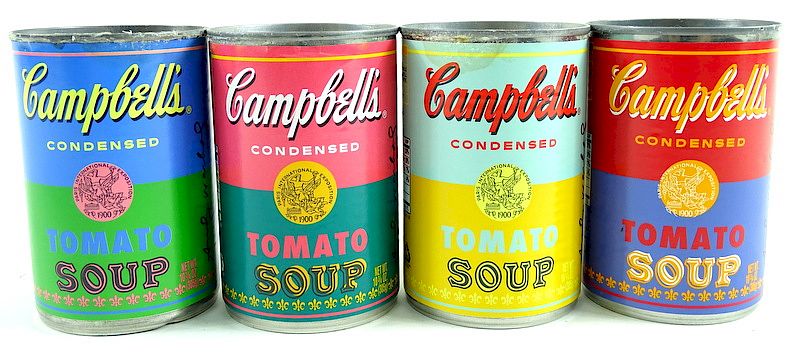
From the Museum of Modern Art, Campbell’s Soup Cans has an image of Andy Warhol’s iconic soup can paintings with brief background information.
From Neatorama, Everything You Wanted to Know About Andy Warhol’s Soup is a catchy list.

Mike Venezia’s Andy Warhol (Children’s Press, 1997) in the Getting to Know the World’s Greatest Artists Series covers Warhol’s life and art and provides information on the Pop Art movement. Illustrated with photos, color reproductions, and clever little cartoons. For ages 5-9.

James Warhola’s Uncle Andy’s (Putnam Juvenile Books, 2003) – written by Andy Warhol’s nephew – is the picture-book story of a childhood visit to eccentric Uncle Andy’s fabulous apartment in New York City, crammed with cats, paintings of soup cans, and a wealth of whacky stuff that Uncle Andy insisted was art. For ages 5-9.

Susan Goldman Rubin’s colorful picture-book biography Andy Warhol: Pop Art Painter (Harry N. Abrams, 2006) covers Warhol’s life and art with many quotations by and about Warhol, plus a timeline, resource list, and list of museums exhibiting Warhol’s work. For ages 9 and up.
From Dick Blick, Souper Art is a “whimsical introduction to nutrition and graphic design” in which kids invent and design a label for an imaginary soup. The site has instructions and some great examples of student work. Adaptable for a wide range of ages.
Soup at the Movies
See Soupsong’s Soup Goes to Movies for an amazingly long alphabetized list of movies that feature - in some way or another - soup. (Some not for the very young.)

In Pixar’s Ratatouille (2007), Remy, a Parisian rat, dreams of becoming a chef. He ends up in the restaurant once belonging to famous chef Anton Gusteau – now fallen on hard times – where he makes his mark by salvaging a ruined pot of soup. Rated G.

In the classic 1933 Marx Brothers’ movie Duck Soup, wealthy Mrs. Teasdale saves Freedonia from bankruptcy on the condition that Rufus T. Firefly – Groucho Marx – becomes the country’s president/dictator. Mayhem ensures, as Firefly and Ambassador Trentino of the neighboring country of Sylvania go to war over the hand of Mrs. Teasdale.
