
Banned Books
In this collection
Harriet the Spy? James and the Giant Peach? J.K. Rowling and Judy Blume? See below for banned books, burned books, forbidden books, a spirited defense of Huckleberry Finn, and a video contest.
And remember to celebrate Banned Books Week, which usually takes place the first week in October.
Just What Is It We Can’t Read? and Why Not?

The American Library Association’s Banned Books has general information about banned and challenged books and year-by-year lists of challenged books. Among the forbidden: Louise Fitzhugh’s Harriet the Spy (anti-authority), William Stieg’s Sylvester and the Magic Pebble (police portrayed as pigs), and Shel Silverstein’s A Light in the Attic (one of the poems advocates breaking dishes).

From BuzzFeed, 17 Banned Books You Read As a Child is an illustrated list that begins with the Harry Potter books (witchcraft) and proceeds through Bridge to Terabithia (profanity, disrespect of adults), Are You There, God? It’s Me, Margaret (religious doubt), James and the Giant Peach (Communist and racist overtones), and The Giver (belittles motherhood and family).

The Banned Books We Have Loved is a thoughtful essay on YA book banning, with a list of the most frequently banned books from the past twenty years. (Included: Catcher in the Rye, In the Night Kitchen, and The Chocolate War.)

Alan Levinowitz’s Ban This Book is an “uncensored” reflection on censorship in children’s books, both overt and covert, that provides a lot of fuel for discussion. Targeted at older teenagers and adults – topics include sexual abuse and homophobia.

Banned & Challenged Comic Books is a collection of case studies on banned and challenged graphic novels, among them Alan Moore's Watchmen, Art Spiegelman's Maus, and Alison Bechdel's Fun Home.
See Secrets Behind the Forbidden Books for an overview of the Vatican’s Index of Forbidden Books. (Among the condemned: Descartes, Hobbes, Voltaire, and Jean-Paul Sartre.)

Censored: Wielding the Red Pen is a great online exhibit on the history and practice of censorship from the University of Virginia Library. Various sections cover Margaret Sanger and birth control; Thomas Bowdler, who took it upon himself to expurgate Shakespeare; wartime censorship; science and censorship; web filtering and the Internet; Hollywood and censorship; and more.

Edited and introduced by Judy Blume, whose works appear on many banned books lists, Places I Never Meant to Be (Simon Pulse, 2001) is a collection of twelve short stories by well-known writers who have been censored, among them Katherine Paterson, Julius Lester, Paul Zindel, and Walter Dean Myers. Each story is followed by the author’s reflections on censorship. For ages 12 and up.
Judy Blume Talks About Censorship has informational articles (including Blume’s “Is Harry Potter Evil?” from the New York Times) and a resource guide for people combatting book bans in their communities.

By Nicholas J. Karolides, Margaret Bald, and Dawn B. Sova, 120 Banned Books (Checkmark Books, 2011) is a fascinating (and appalling) history of the censorship of world literature. Discussed works are variously categorized as books banned on political grounds (All Quiet on the Western Front, I Am the Cheese, Animal Farm), religious grounds (Oliver Twist, The Satanic Verses, On the Origin of Species), sexual grounds (Madame Bovary, Ulysses, Judy Blume’s Forever), and social grounds (The Adventures of Huckleberry Finn, To Kill a Mockingbird, Anne Frank’s Diary of a Young Girl). For teenagers and adults.

Marjorie Heins’s Not in Front of the Children (Rutgers University Press, 2007), subtitled “Indecency, Censorship, and the Innocence of Youth,” is a 400+-page history of attempts to protect children from “evil influences” (this dates back at least to the ancient Greeks; Plato worried about the corrupting effect of tragic poetry) and the modern rise of censorship. A scholarly approach to a complex problem. For older teenagers and adults.
The National Coalition Against Censorship is devoted to expanding public awareness of censorship and promoting free expression. The site includes resources for kids and info on the Kids’ Right to Read Project (KRRP).
Stories About Censorship
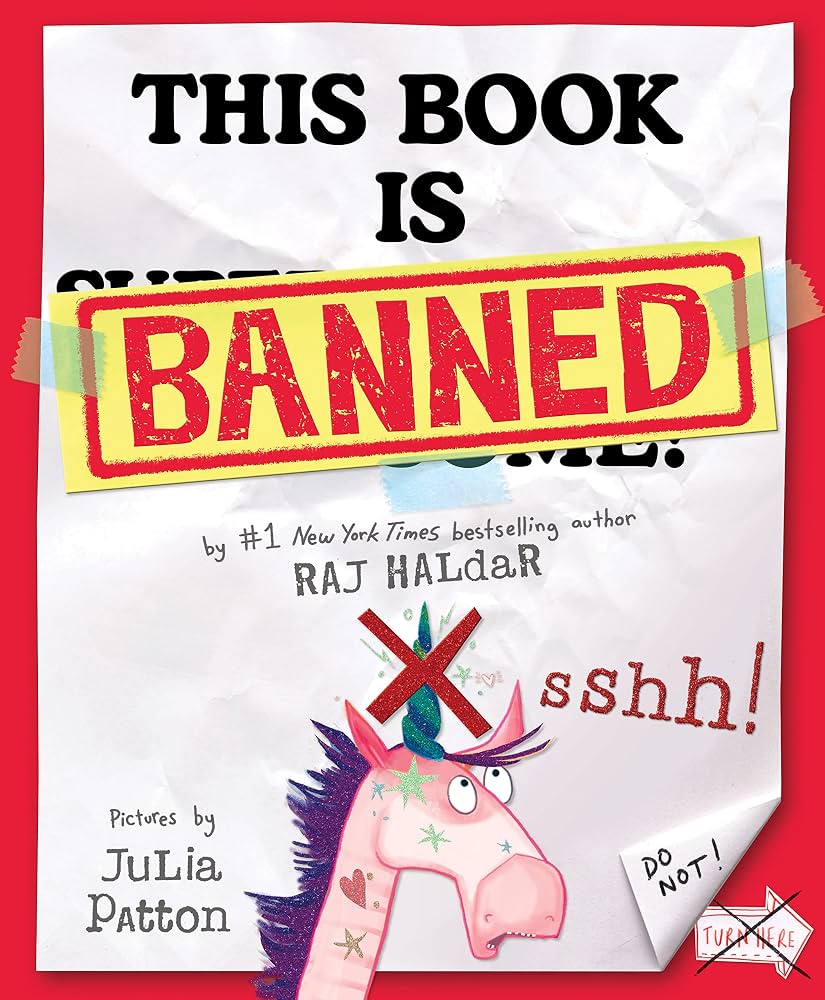
Raj Haldar’s This Book Is Banned (Sourcebooks Explore, 2023) is a funny and thought-provoking picture book on the practice of book banning. Among the banned are giraffes, dinosaurs, avocados, and even unicorns. For ages 5-8.

In Marc Brown’s Arthur and the Scare-Your-Pants-Off Club (Little, Brown Books for Young Readers, 1998), Arthur, everybody’s favorite aardvark, and pals have been eagerly waiting for the new Scare-Your-Pants-Off Club book to arrive at the library – only to find that the series has been banned by a concerned parents’ group as too frightening for young readers. Arthur and friends then embark on a campaign to get their books back. A short chapter book for ages 5-8.

In Andrew Clements’s The Landry News (Atheneum Books for Young Readers, 2000), fifth-grader Cara Landry begins to publish a newspaper, featuring – in the first edition – a critical editorial about her apathetic teacher Mr. Larson, who is so impressed by it that he stops ignoring the class and returns to his past creative teaching methods. When Cara publishes a poignant story about divorce written by a classmate, however, the school principal – long looking for a reason to fire Mr. Larson – is infuriated and declares the story inappropriate for young readers, setting off a conflict over freedom of the press and First Amendment rights. For ages 8-12.

Stephen Krensky’s The Printer’s Apprentice (Delacorte, 1995) is the story of the early 18th-century John Peter Zenger trial, a crucial event in the history of freedom of the press, as experienced by Gus and Zach, two young apprentices. It’s out of print, but is available from used-book dealers and public libraries. For ages 8-12.

In Alan Gratz’s Ban This Book (Starscape, 2018), fourth-grader Amy Anne is appalled when a parent has From the Mixed-Up Files of Mrs. Basil E. Frankweiler removed from the school library – and in retaliation starts a banned-books library in her locker. For ages 8-12.

In Rebecca Rupp’s Octavia Boone’s Big Questions About Life, the Universe, and Everything (Candlewick, 2010), Octavia’s life is disrupted when her mother, Ray, joins the fundamentalist Redeemers and her artist father insists he needs time alone to find himself. Octavia – unhappy with the Redeemers who reject science, forbid fantasy books, and insist on traditional gender roles – struggles for independence and freedom of belief, while eventually coming to understand her mother’s needs and motivations. “Funny, caustic, thought-provoking, and a bit of a damp hankie…” writes one reviewer. For ages 9-12.
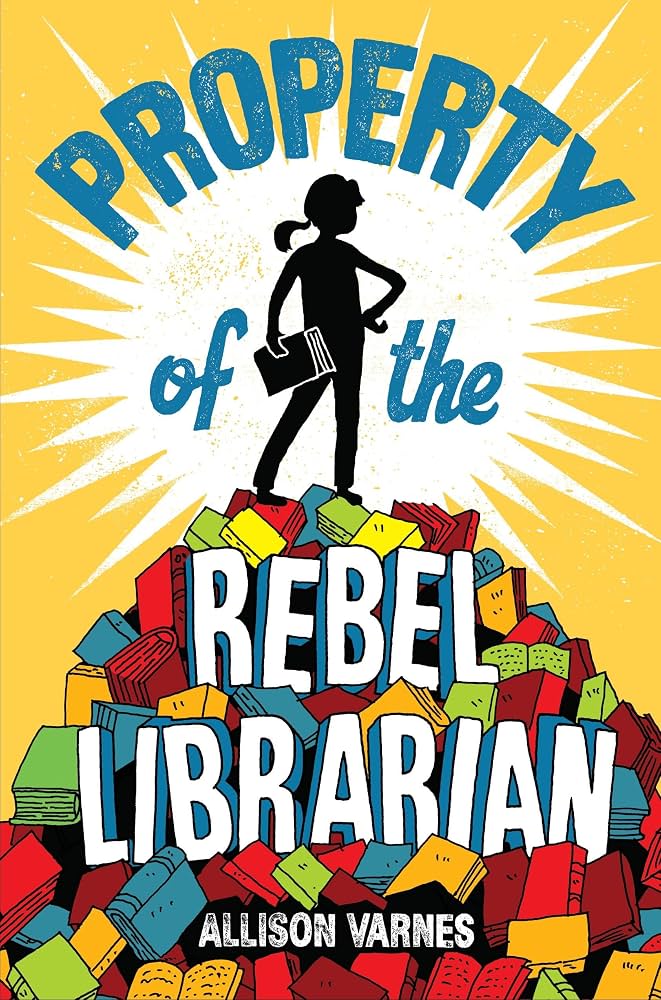
In Property of the Rebel Librarian by Allison Varnes (Yearling, 2019), seventh-grader June Harper’s parents object to an “inappropriate” book in the school library – and soon the school librarian has been fired, books have been removed from the library shelves for review, and June goes to bat for the freedom to read, rallying support and starting a secret library of forbidden books. For ages 9-12.
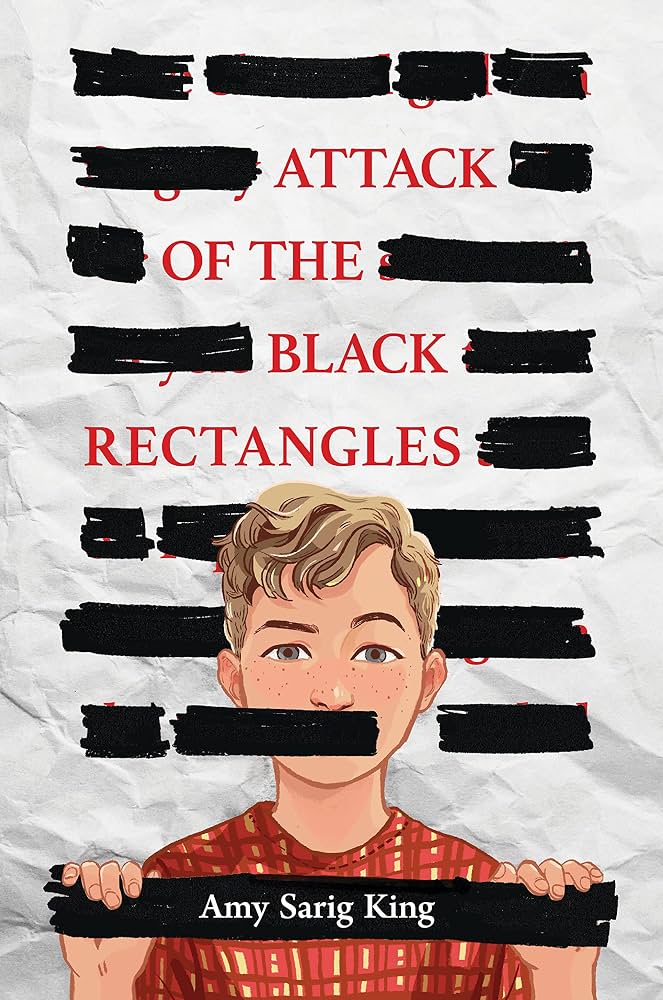
In A.S. King’s Attack of the Black Rectangles (Scholastic, 2024), Mac opens his copy of Jane Yolen’s The Devil’s Arithmetic to find that many passages have been blacked out. Mac and friends protest – but find that battling censorship can be a hard and uphill battle. For ages 10-12.

In M. K. Reed and Jonathan David Hill’s great graphic novel Americus (First Second, 2011), Christian activists are attempting to ban eighth-grader Neil’s favorite fantasy series, The Chronicles of Apathea Ravenchilde, from the library on grounds of immorality and heresy. Neil, with the help of Charlotte, the feisty youth librarian, sets out to save his beloved books. For ages 10 and up.

In Karen Cushman’s The Loud Silence of Francine Green (Clarion Books, 2006), Francine is an eighth-grade student at the restrictive Los Angeles All Saints School for Girls during the tense days of the McCarthy era. When fiery Sophie arrives at the school and begins protesting the lack of free speech, Francine begins rethinking her own views. Themes include friendship, growing up, and intellectual freedom. For ages 10-14.

2041: Twelve Short Stories About the Future by Top Science Fiction Writers (Laurel Leaf, 1994) includes Connie Willis’s “Much Ado About [Censored],” an hilarious tale of Shakespearean censorship in a future age of extreme political correctness. Portia wants her high-school English class to read Shakespeare, but protests are legion: the Angry Women’s Alliance argues that Romeo and Juliet promotes suicide and drug abuse; the Wildlife Club claims that As You Like It furthers destructive attitudes toward the environment (Orlando carves Rosalind’s name on a tree); the National Cutlery Council objects to the portrayal of swords as deadly weapons; and the Drapery Defense League objects to Hamlet, because Polonius was stabbed while behind a curtain, thus implying that curtains are dangerous. For ages 11 and up.
Willis’s story is also available online.

In Nat Hentoff’s The Day They Came to Arrest the Book (Laurel Leaf, 1983), Barney Roth, editor of the George Mason High School newspaper, comes up against a group of students and parents determined to ban The Adventures of Huckleberry Finn. A discussion promoter and a good pick for book clubs. For ages 12 and up.

In Kathryn Lasky’s Memoirs of a Bookbat (Harcourt, 1996), 14-year-old Harper Jessup is a passionate reader. Then her parents convert to Christian fundamentalism and Harper, willy-nilly, becomes a “migrant for God” as the family travels the country in a motor home advocating book censorship and protesting blasphemy, abortion, and the theory of evolution. Harper is forced to hide her beloved books (satanic); and struggles to cope with how different her parents’ beliefs now are from her own. Eventually, with the help of a friend, she manages to escape, and at the end of the book she’s living with her supportive grandmother. For ages 12 and up.

In Chris Crutcher’s The Sledding Hill (Harper Tempest, 2006), main character Eddie Proffit has just lost both his father and his best friend, Billy – though Billy, dead, is the narrator of the book. Eddie, traumatized by his dual loss, has stopped talking. His mother is pressuring him to join a local evangelical church, presided over by the Reverend Tarter, who also teaches English at the high school. When Eddie’s class starts reading the suspect novel Warren Peece by an obscure author named (heh) Chris Crutcher, Tarter – citing bad language and homosexuality – goes on a campaign to have the book removed from the school curriculum. For ages 12 and up.

In Richard Peck’s The Last Safe Place on Earth (Delacorte, 1995), 15-year-old Todd, his seven-year-old sister Marnie, cousin Diana, and parents have moved to the idyllic community of Walden Woods. Walden Woods, however, proves to have a dark side: Christian fundamentalists are attempting to ban Anne Frank’s Diary from the schools because it implies that all religious views are equally valid; and babysitter Laurel has been brainwashing Marnie, convincing her that Halloween is evil and anyone who celebrates it is going to hell. For ages 12 and up.

The protagonist of Gary Paulsen’s Nightjohn (Laurel Leaf, 1995) is twelve-year-old Sarny, a slave on a southern plantation in the 1850s. Slave are forbidden to learn to read, but even so Sarny does, under the tutelage of the indomitable Nightjohn, who had escaped north to freedom, but returned to teach reading in secret. A brutal, painful, and wonderful book. For ages 12 and up.

In Nancy Garden’s The Year They Burned the Books (Farrar, Straus & Giroux, 1999), main character Jamie Crawford, editor of the high-school newspaper, runs up against a fundamentalist school board member who, on moral grounds, is censoring articles in Jamie’s paper, removing sex education books from the school shelves, and even staging a book burning. The story is complicated by Jamie’s struggle to come to terms with her own homosexuality. For ages 12 and up.

In Carol Lynch Williams’s The Chosen One (St. Martin’s Griffin, 2010), 13-year-old Kyra lives in a walled compound with her family – her father, his three wives, and Kyra’s twenty siblings – and belongs to an ultra-religious polygamous sect, ruled over by the Prophet Childs and his God Squad. When the Prophet announces that Kyra is to become the seventh wife of her sixty-year-old Uncle Hyrum, Kyra – who has been reading forbidden books from the mobile library and secretly seeing a young sect member, Joshua – rebels. Tense and complex. For ages 13 and up.

In Dai Sijie’s Balzac and the Little Chinese Seamstress (Anchor Books, 2002), set during the Chinese Cultural Revolution of the 1960s and 70s, two young boys, respectively the sons of a doctor and a dentist, are sent to a mountain village for “re-education” through labor. There they fall for the village tailor’s beautiful daughter and find solace in a stash of forbidden Western books. As in Markus Zusak’s The Book Thief (see Up in Smoke, below), a prominent theme is the power of literature to comfort people in adversity. For teenagers and adults.

Azar Nafisi’s Reading Lolita in Tehran (Random House, 2008) is the compelling story of how Nafisi, a literature professor in repressive Iran, gathered a group of students at her home to read forbidden Western books by such authors as Vladimir Nabokov, Henry James, Jane Austen, and F. Scott Fitzgerald. For teens and adults.

Margaret Atwood’s The Handmaid’s Tale (Anchor Books, 1998) – itself an often-banned book – is a darkly fascinating story of a fanatical future society in which women are wholly repressed by the state. The main character is Offred, a handmaid assigned to the household of the Commander, a high official in the Republic of Gilead (the former United States), whose duty – as one of Gilead’s rare fertile women – is to bear children. Gilead is chilling: books are forbidden; women are not allowed to read, hold jobs, own property, or have money; and the handmaids, who wear wimple-like headdresses and long red robes, are not even allowed to make eye contact with other people. For older teenagers and adults.

A movie version of The Handmaid's Tale (1990), starring Natasha Richardson, Faye Dunaway, and Robert Duvall, is rated R; also see the excellent multi-episode
TV series (2017). For mature teens and adults.
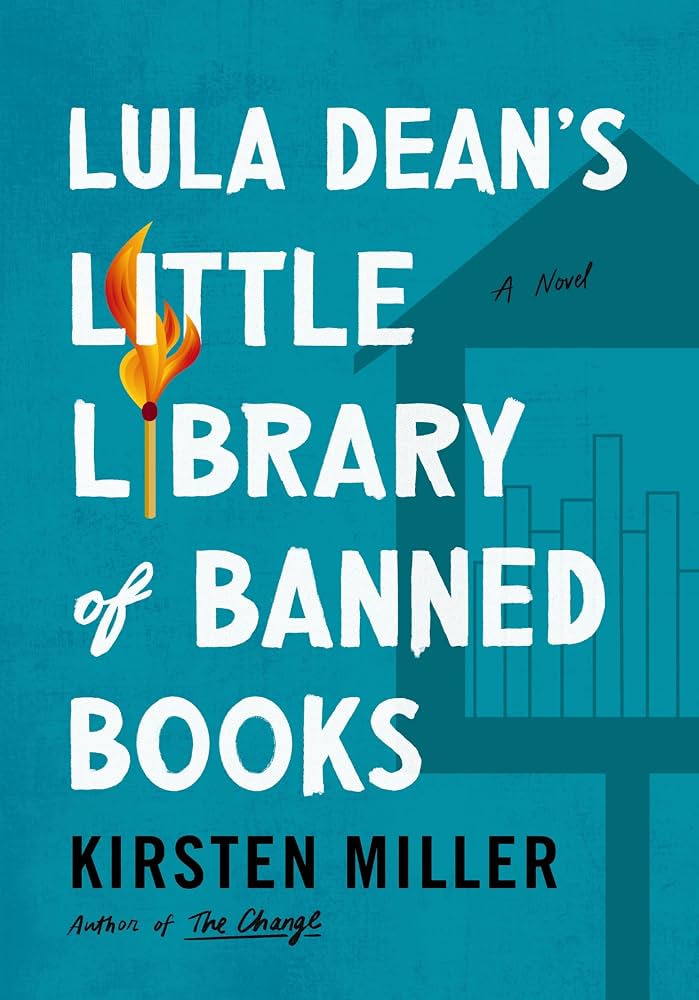
By Kirsten Miller, Lulu Dean's Little Library of Banned Books (William Morrow, 2024) is set in a small Southern town where a battle is raging over banned books. Lulu Dean, who spearheads the censorship campaign, has started her own lending library, stocked with the wholesome books she feels it would be beneficial for the townspeople to read. What she doesn't know is that Ronnie Childers and Lindsay Underwood have switched the books, putting dust covers from Lulu's approved volumes on literary classics, gay romances, Black history, fantasies - even Judy Blume novels. The books change the town forever. For teens and adults.

In the film The Male Animal (Warner Brothers, 1942), based on the play of the same name by James Thurber and Elliot Nugent, Tommy Turner, a college English professor, has come under fire for preparing to read a letter to his class by Bartolomeo Vanzetti, of the politically explosive Sacco and Vanzetti case. The free speech issue is paired with a subplot in which football hero Joe Ferguson, ex-boyfriend of Turner’s wife Ellen, has returned to campus and is renewing his interest in Ellen. With Henry Fonda and Olivia DeHavilland.
For information on the Sacco-Vanzetti case, including background information, a chronology, trial transcripts, and images, see The Trial of Sacco and Vanzetti.

In M.K. Wren's A Gift Upon the Shore (Ballantine, 1990), set in a not-far-distant future, young Mary Hope is taken in by Rachel, a painter, following the collapse of civilization. The two survive on their Oregon farm, struggling to preserve the world's remaining books - a legacy put at risk when they come in contact with the Arkites, a fundamentalist society that rejects everything but the teachings of the Bible. For older teens and adults.
Up in Smoke: Burning Books

Markus Zusak’s brilliantly creative The Book Thief (Alfred A. Knopf, 2007) is set in Germany in World War II and narrated by Death. Here Death tells the story of the book thief, Liesel Meminger, living with foster parents Hans and Rosa Hubermann near Munich, who steals books from the Nazi book burnings and reads them to neighbors during the bombing raids and to Max, the Jewish man the Hubermanns are hiding in their cellar. A must-read for ages 12 and up.

In Ray Bradbury’s Fahrenheit 451 (Simon & Schuster, 2012), originally published in 1953, Montag, the main character, is a fireman – that is, a bookburner – and the temperature of the title is that at which paper goes up in flames. Montag’s wife Mildred, like the rest of society, devotes herself to soap operas on wall-sized TV screens; and books are forbidden, being deemed disturbing, disruptive, and dangerous. Then Montag meets a neighbor, Clarisse, whose unconventional ideas cause him gradually to change his beliefs. Soon he has become a clandestine reader; and by the end of the book he has fled the city and joined an underground band of rebels, devoted to preserving literature. A classic for ages 12 and up.
Also see the excellent 1966 film version of Fahrenheit 451, directed by Francois Truffaut, starring Julie Christie and Oskar Werner.
See this Fahrenheit 451 Teacher's Guide with plot summary, discussion questions, and activities.

Matthew Fishburn’s Burning Books (Palgrave Macmillan, 2008) is a history of book-burning, with particular emphasis on the iconic Nazi book-burning of 1933. For older teenagers and adults.
From The Guardian, Book burning: fanning the flames of hatred is a brief essay on the history of book-burning.
“Reasonable people…do not burn books.” From the New Yorker, see the essay Heated Debates, Burning Books.