
Pi Day (and Albert Einstein)
In this collection
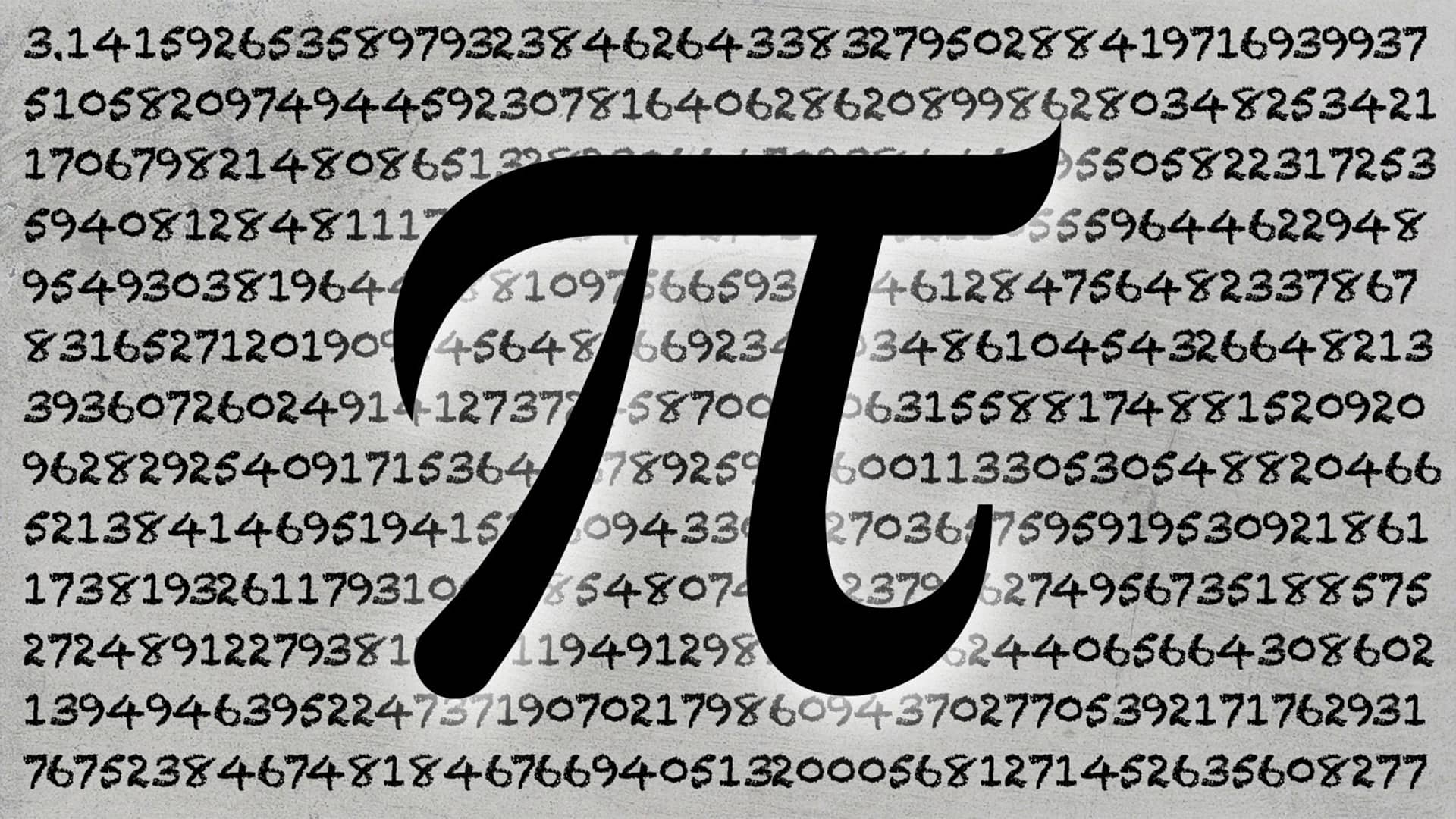
Pi. Almost everybody’s favorite irrational number – irrational meaning that it cannot be accurately expressed as a fraction since it never (ever) comes out even, but continues, without repeating, past its decimal point and on into infinity. Pi has been computed to over one trillion decimal places (and counting).
In 2009 the U.S. House of Representatives formally recognized March 14 as National Pi Day. It shares the date with Albert Einstein, who was born on it in 1879.
All About Pi

In Cindy Neuschwander’s picture book Sir Cumference and the Dragon of Pi (Charlesbridge Publishing, 1999), Sir Cumference (in an attempt to alleviate a stomach ache) gulps down a potion that promptly turns him into a fire-breathing dragon. His son Radius sets out to find a cure – which ultimately involves a magic circle-related number (you’ll never guess what). One of the Math Adventure series, all starring Sir Cumference, his wife Lady Di Ameter, and son Radius, for ages 7-11.
From Core Knowledge, see a comprehensive lesson plan on measuring circles at https://www.coreknowledge.org/free-resource/ckmath-unit-3-measuring-circles/.

Johnny Ball’s Why Pi? (Dorling Kindersley Children’s Books, 2009) is a terrific 96-page history of measurement from ancient times to the present. The book is beautifully designed, crammed with bright illustrations, clear diagrams, and a wealth of kicky facts and comparisons. Pi is in there, of course – but readers also discover how Egyptian built pyramids, how Romans built aqueducts, and how people figured out how to measure everything from the length of a month to the speed of light. Also included are puzzles and activities. For ages 7 and up.

David Blatner’s The Joy of Pi (Walker & Company, 1999) is a fun 144-page read for teenagers and adults, packed with illustrations, quotations, factoids, cartoons, and limericks. Included are a detailed history of pi, quirky anecdotes about the many people who have been obsessed with it - including the story of the Chudnovsky brothers, who calculated pi to two billion digits in their Manhattan apartment using a homemade supercomputer, and accounts of pi memory champions.
For more on pi, see the Joy of Pi website.

BrainPop’s Pi is a short animated movie for grade 3 and up (hosted by Tim, a human, and Moby, an orange robot) which defines pi, explains irrational numbers, and demonstrates the use of pi in calculating the circumference and area of a circle. Accompanying the movie are a hands-on activity (involving circles and string), a Q&A list, and a quiz. See https://www.brainpop.com/unit/numbers-and-operations/.
Also from BrainPop, see Circles at https://www.brainpop.com/unit/geometry-and-measurement/.
The BrainPop site has many similar short animations in the fields of math, science, social studies, English, arts and music, health, and engineering and technology. Annual subscriptions are available for homeschooling families (24-hour access, multiple users); there's also a short free trial option for those who would like a quick peek.

For those within reach of San Francisco, the San Francisco Exploratorium hosts an annual Pi Day celebration, complete with pi-based numerical parade. Visit the Exploratorium website for a brief history of pi, hands-on pi activities, and a list of helpful links.
From Live Science, see 10 Surprising Facts About Pi.
A History of Pi from the MacTutor History of Mathematics Archive traces the evolution of the number from the Egyptian Rhind Papyrus and the Bible to the present day. A more challenging mathematical approach for older kids.
For the first one million digits of pi, see Pi to a Million Digits.

The classic probability experiment known as Buffon’s Needle generates a statistical estimate of the value of pi. The idea for the experiment was first proposed in the 18th century by Georges Louis Leclerc, Comte de Buffon who initially tried to measure pi by tossing loaves of French bread over his shoulder onto a tile floor.
Try it! From Science Friday, see Pickup Sticks and Pi.
For the full scoop, calculus and all, see Buffon's Needle Problem at Wolfram MathWorld.
From the National Council of Teachers of Mathematics, Pi Day has lesson plans and activities for Pi Day.
Some people have a passion for memorizing pi. See the Pi World Ranking List for a list of champions (and instructions for how you too can get on it). (Warning: there’s stiff competition. The current champion is Chao Lu of China, who in 2005 rattled off pi to 67,890 digits.

Your very own Pi Day! Find your birthday in pi here.
Pi = 3? Did Alabama – or maybe Indiana – ever actually enact legislation redefining pi as just plain 3.0? No, according to Alabama’s Slice of Pi.
Pi Projects and Activities

Ed Emberley’s Picture Pie (LB Kids, 2006) is an art project book that shows kids – step by step – how to use paper-cut circles and fractions of circles to make animals, bugs, flowers, and patterns. For ages 4 and up.
Pi Activities has suggestions for making a pi paper chain, measuring pi on a basketball court, and estimating pi using bicycle wheels and hula hoops.


See Piku: A New Game of Poetry for Pi Day. Try it!

The obvious accompaniment to Pi Day dinner: pie. See this recipe for making a pi-shaped Drunken Irish Apple Pi(e).
Musical Pi

YouTube's “The Pi Song” is a vocal rendition of pi to many many places. It’s a little monotonous, but surpisingly addictive. Or listen to this
piano piece based on pi.
Steven Rochen’s violin piece, “A Piece of Pi” is a pi-based violin piece by Steven Rochen. Listen to it here. Or try it: “A Piece of Pie” sheet music for violin or viola is available from
Ovation Press.
Pi Is...wrong?
Well, no. There are some mathematicians, however, who argue that the better and more fundamental constant is tau – which represents the relationship of circumference to radius (rather than diameter) and is thus twice as big as pi. 2 x pi = 6.28….which means that Tau Day is celebrated on 6/28. (Mark your calendars.)

Happy Pi Day - Let's Kill It! explains -just why tau is the far better circle constant. See https://www.wired.com/story/pi-winning/.

The Tau Manifesto by physicist Michael Hartl is a spirited defense of tau, best appreciated by students with background in trigonometry.
At What Tau Sounds Like, visitors can listen to a musical interpretation of tau by pianist Michael Blake.
Albert Einstein: Born on Pi Day, March 14, 1879

Dan Brown’s Odd Boy Out: Young Albert Einstein (Sandpiper, 2008) is a picture-book biography for ages 6-10, charmingly illustrated with pen-and-ink and watercolor. What readers take away from this one – I hope – is that, though those with different learning styles sometimes don’t fit in, they still can find their own way. Einstein has problems: his mother thinks his head is too big; his family calls him dopey; his teachers find him frustrating. At the same time, he’s forging an education of his own - he’s fascinated by a compass; he spends hours building a 14-story house of cards; he teaches himself geometry with the help of a friendly medical student – and ultimately his oddness is spectacularly vindicated. For ages 4-8.

Jennifer Berne’s On a Beam of Light (Chronicle Books, 2013) is a charming picture-book biography of Albert Einstein for ages 5-8.

Mike Venezia’s Albert Einstein: Universal Genius (Children’s Press, 2009) in the extensive Getting to Know the World’s Greatest Scientists & Inventors series is an appealing 32-page picture-book biography, illustrated with photographs and Venezia’s trademark humorous cartoons. A short catchy introduction to Einstein for ages 7-10.
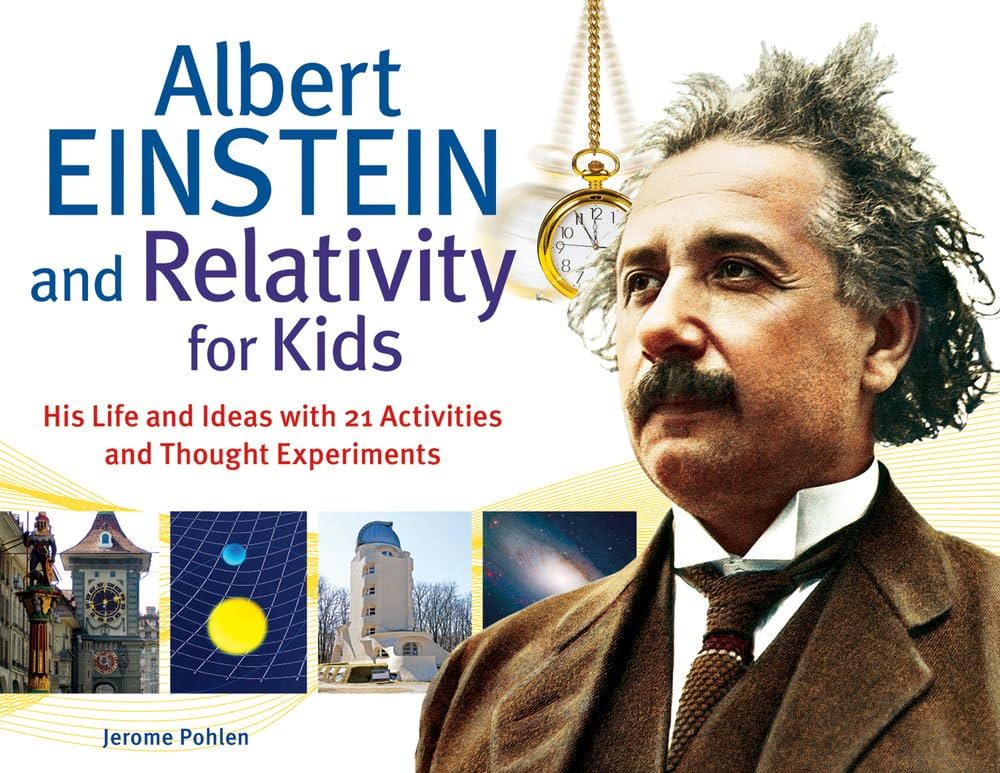
Jerome Pohlen’s Albert Einstein and Relativity for Kids (Chicago Review Press, 2012) covers Einstein’s life and work with 21 related hands-on activities. Included are a timeline, period photographs, and capsule biographies of other historical physicists. For ages 9-12.

Kathleen Krull’s Albert Einstein (Viking Juvenile, 2009) in the Giants of Science series is an interesting and wonderfully written 128-page account of Einstein’s life and work. The book is substantive and informative, but it’s Krull’s knack for human interest and lively phrasing that cause it to stand out from the often-dull biographical crowd. For ages 10 and up.

Frieda Wishinky’s Albert Einstein (Dorling Kindersley Children’s Books, 2005) is an attractively presented 128-page biography, illustrated with many modern and period photographs. For ages 10 and up.

Einstein for Beginners by Joseph Schwartz and Michael McGuinness (Pantheon, 2003) is a multifaceted, catchy, and clever graphic presentation – yes, cartoons, but sophisticated cartoons – of Einstein’s life, times, and scientific accomplishments. A good pick for ages 12 and up.

Gravity’s relationship to the curvature of space-time is hardly a simple concept, but Bruce Bassett’s Introducing Relativity: A Graphic Guide (Totem Books, 2005) – an illustrated historical approach to Einstein’s famous theorem – is a good bet for interested teenagers.

By David Bodanis, E = mc2: A Biography of the World’s Most Famous Equation (Berkley Books, 2000) is history and science for a popular audience. The book covers the components of the equation one by one (E, m, c, and squared), plus accounts of the many scientists whose research preceded Einstein. For teenagers and adults.

Why Does E=mc2? by theoretical physicists Brian Cox and Jeffrey Forshaw (Da Capo Press, 2010) is a fascinating and reader-friendly approach to Einstein’s special theory of relativity and modern physicists’ views of the universe. For teenagers and adults.

Einstein: His Life and Universe (Simon & Schuster, 2008) by Walter Isaacson – famed for his best-selling biographies of Benjamin Franklin and Steve Jobs – is a fascinating read for older teenagers and adults.
This collection of Einstein’s WWII-era letters to Franklin Roosevelt begins with his letter of 1939, generally believed to have instigated America’s race to build an atomic bomb. Einstein later referred to this as the greatest mistake of his life.

The PBS/NOVA program Einstein’s Big Idea is the story of E=mc2 – the “world’s most famous equation.” Included at the website are interactive activities, demonstrations, an Einsteinian timeline, a teacher’s guide, and a resource list.
What became of Albert Einstein’s brain? Find out at Neuroscience for Kids.

Michael Paterniti’s Driving Mr. Albert: A Trip Across America with Einstein’s Brain (Dial Press, 2001) is the story of an eccentric cross-country road trip in which Paterniti and elderly pathologist Thomas Harvey set off to return Einstein’s brain to his granddaughter in California. A great read for teenagers and adults – and it provides, incidentally, a lot of information about Einstein.
Inside Einstein’s Universe, a joint project of NASA and the Harvard-Smithsonian Center for Astrophysics, has a collection of learning resources on Einsteinian cosmology including detailed downloadable teacher’s guides and interactive web resources for grades 7-12.